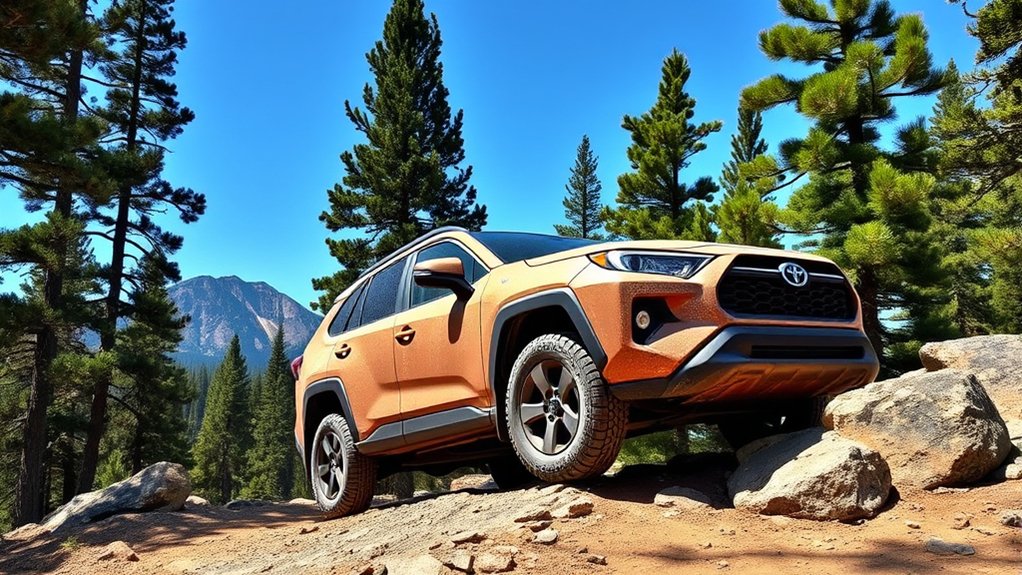
The 2024 Toyota RAV4 TRD Off-Road sits between a road-focused compact SUV and a dedicated four-wheel-drive vehicle. It can handle gravel, maintained forest roads, moderate ruts, snow-covered roads, and mild muddy or rocky trails. However, its clearance angles, crossover construction, and lack of low-range gearing limit it on technical terrain.
Quick Answer
Yes, the 2024 RAV4 TRD Off-Road is capable on gravel, dirt, snow, moderate mud, and mild rocky trails. Its 8.6-inch clearance, torque-vectoring AWD, Multi-Terrain Select, all-terrain tires, and tuned suspension help. However, it lacks low-range gearing and locking differentials, so it is not designed for rock crawling or large obstacles.
Key Takeaways
- The TRD Off-Road works best on maintained trails, gravel roads, moderate ruts, light mud, sand, and snowy roads.
- Toyota equipped it with Falken WILDPEAK all-terrain tires, not ordinary street tires.
- Its gasoline engine uses an eight-speed automatic transmission rather than a CVT.
- The AWD system disconnects and reconnects the rear driveline automatically. You do not manually switch the vehicle into front-wheel drive.
- The trim lacks low-range gearing and locking differentials, so technical rock crawling, deep water, and large ledges are outside its intended use.
- Toyota discontinued the gas-powered TRD Off-Road after the 2024 model year, making used-condition checks especially important.
Can the 2024 RAV4 TRD Off-Road Handle Tough Terrain?
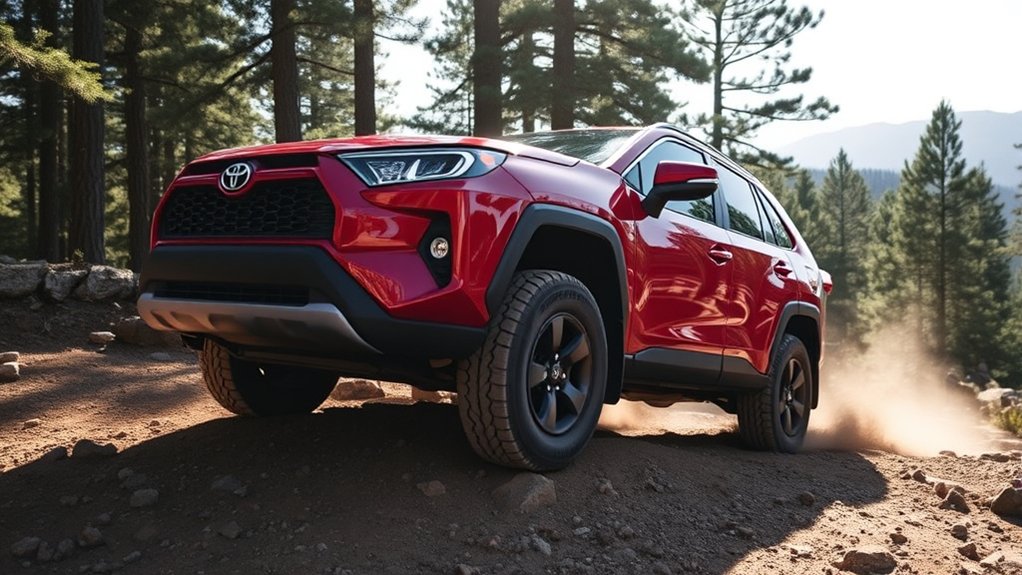
The RAV4 TRD Off-Road can travel beyond ordinary pavement, but “tough terrain” covers a wide range of conditions. It is well suited to unpaved access roads, washboard surfaces, shallow ruts, moderate inclines, and trailheads that do not require low-range four-wheel drive.
The vehicle has 8.6 inches of ground clearance, a 19-degree approach angle, and a 21-degree departure angle. Those figures provide useful clearance on uneven roads, but the front bumper and rear overhang can still contact steep transitions or large ledges.
Note: Toyota did not offer the gas-powered Adventure or TRD Off-Road grades for 2025. The information below focuses on the 2024 model, which was the final U.S. model year for this trim.
| Terrain | Suitability | What to Expect |
|---|---|---|
| Gravel and maintained dirt roads | Good | The suspension, all-terrain tires, and AWD suit these surfaces well. |
| Washboard roads and moderate ruts | Good with care | Reduce speed and choose a line that protects the bumpers and underbody. |
| Light or moderate mud | Conditional | Mud & Sand mode can limit wheelspin, but deep mud can overwhelm the tires and clearance. |
| Firm or shallow sand | Conditional | Maintain smooth momentum and follow local access and tire-pressure rules. |
| Snow-covered roads | Good with suitable tires | Snow mode and AWD help, but braking and cornering still depend heavily on the tires. |
| Mild rocky forest roads | Conditional | Proceed slowly and avoid rocks that could contact the bumpers, exhaust, or underbody. |
| Rock crawling, deep cross-axle holes, or large ledges | Not recommended | The vehicle lacks low-range gearing, locking differentials, and generous clearance angles. |
| Deep water | Avoid | Toyota does not publish a water-fording depth for the 2024 RAV4 TRD Off-Road. |
Warning: Turn around before attempting deep water, large rock steps, severe off-camber sections, or routes marked as requiring low-range four-wheel drive. AWD can improve traction, but it cannot create extra ground clearance or protect the entire underbody.
Key Off-Road Features of the RAV4 TRD Off-Road
Toyota gave the TRD Off-Road meaningful upgrades over a standard road-focused RAV4. These include a TRD-tuned suspension, Dynamic Torque Vectoring AWD, Multi-Terrain Select, Falken WILDPEAK all-terrain tires, and a TRD-stamped stainless steel front skid plate.
| Specification | 2024 RAV4 TRD Off-Road |
|---|---|
| Engine | 2.5-liter four-cylinder gasoline engine |
| Output | 203 horsepower and 184 lb-ft of torque |
| Transmission | Eight-speed Direct Shift automatic |
| Drivetrain | Dynamic Torque Vectoring AWD with automatic rear driveline disconnect |
| Terrain modes | Mud & Sand, Rock & Dirt, and Snow |
| Ground clearance | 8.6 inches |
| Approach/departure angles | 19 degrees / 21 degrees |
| Factory tires | Falken WILDPEAK all-terrain tires on 18-inch TRD wheels |
| Maximum towing capacity | 3,500 pounds when properly equipped |
| Payload | 1,025 pounds |
| EPA-estimated fuel economy | 25 city / 32 highway / 28 combined mpg |
The suspension uses trail-focused struts and shocks, red-painted coil springs, and revised bump stops. These parts improve body control and small-bump isolation, but they do not turn the RAV4 into a high-articulation crawler.
The front skid plate adds protection against loose debris and minor contact. It does not mean every vulnerable component under the vehicle has heavy-duty armor.
Engine Performance: What to Expect
The 2.5-liter four-cylinder engine produces 203 horsepower at 6,600 rpm and 184 lb-ft of torque at 5,000 rpm. It provides enough power for highway travel, graded climbs, and moderate trail driving, although it does not deliver the strong low-rpm pull of a turbocharged engine or a larger V6.
Engine Specifications Overview
The engine works with an eight-speed automatic transmission. This conventional stepped transmission can hold or select lower gears more predictably than a CVT when you climb or descend uneven roads.
- Normal mode balances everyday response and efficiency.
- Eco mode softens accelerator response for road driving.
- Sport mode sharpens accelerator and transmission response.
- Multi-Terrain Select changes control strategies for specific low-traction surfaces.
Toyota does not publish a special crawl ratio for this model because it has no low-range transfer case. On steep or loose climbs, smooth momentum often works better than sudden throttle inputs.
Power Delivery Challenges
Peak torque arrives relatively high in the rev range, so the engine may sound busy when climbing a steep grade or accelerating with a trailer. That behavior does not mean the transmission is a CVT. The eight-speed automatic is selecting lower gears to keep the engine within its useful power range.
On loose terrain, excessive throttle can create wheelspin and reduce steering control. Apply power gradually and let the AWD and traction systems work before adding more accelerator input.
How the RAV4 TRD Off-Road AWD System Works
The TRD Off-Road uses Dynamic Torque Vectoring All-Wheel Drive. The system can send up to 50% of engine torque to the rear axle and vary torque between the left and right rear wheels to support traction and handling.
Dynamic Torque Vectoring AWD
When the vehicle detects wheel slip, acceleration, cornering, or another need for rear-wheel assistance, it can engage the rear axle and distribute torque to the rear wheel with better grip. This is more capable than a basic system that only divides torque from front to rear.
The system remains electronically controlled. It does not provide a mechanically locked center coupling or locking rear differential, and it cannot guarantee forward motion when multiple wheels lose contact with the ground.
Multi-Terrain Select Modes
According to Toyota’s 2024 Quick Reference Guide, Multi-Terrain Select adjusts brake control, steering feel, and drive-force control to suit the selected surface.
- Mud & Sand: Intended for muddy, sandy, rough, or dirty conditions where controlled wheelspin may help maintain momentum.
- Rock & Dirt: Intended for bumpy surfaces such as unpaved forest roads. The name does not mean the vehicle is suitable for technical rock crawling.
- Snow: Intended for slippery snow-covered roads. It does not replace winter tires or increase braking grip on ice.
Downhill Assist Control can help manage speed on steep descents. You still need to choose a safe line, control steering, and stop if the surface exceeds the vehicle’s clearance or traction.
Automatic Rear Driveline Disconnect
The system can automatically disconnect the rear driveline during steady road driving when AWD is unnecessary. This reduces mechanical drag and can support fuel efficiency.
You do not manually choose a permanent front-wheel-drive setting. The vehicle’s computers reconnect the rear driveline when acceleration, cornering, wheel slip, or terrain conditions call for AWD assistance.
Comparing the RAV4 TRD Off-Road to Competitors
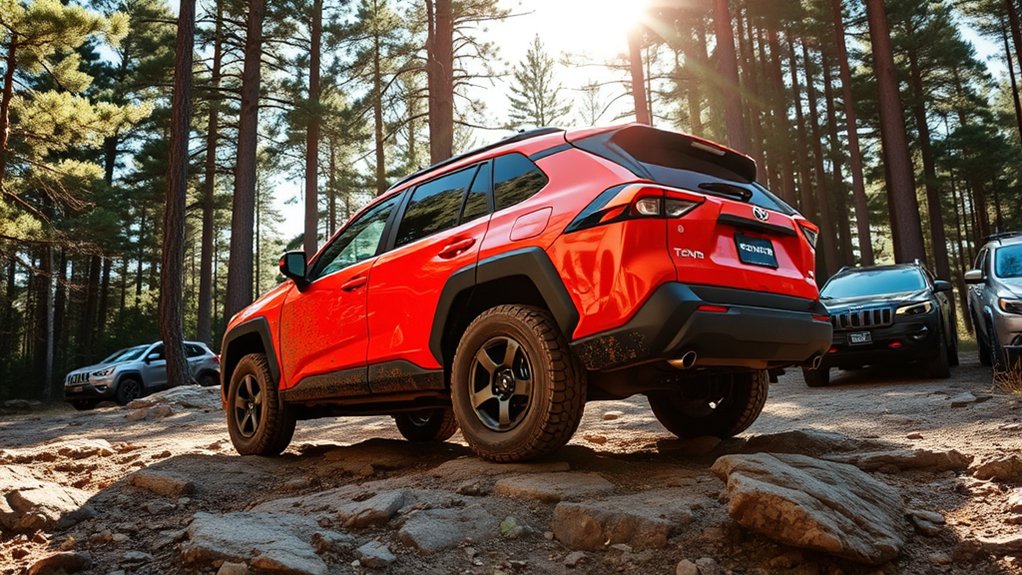
The RAV4 TRD Off-Road competes most directly with rugged crossover trims rather than dedicated body-on-frame four-wheel-drive vehicles. The comparison changes depending on whether you prioritize compact dimensions, engine power, towing, or trail clearance.
| 2024 Model | Power | Ground Clearance | Maximum Towing | Main Trade-off |
|---|---|---|---|---|
| Toyota RAV4 TRD Off-Road | 203 hp | 8.6 in. | 3,500 lb. | Compact and efficient, but no low range or locking differential. |
| Subaru Outback Wilderness | 260 hp | 9.5 in. | 3,500 lb. | More clearance and turbo power, but a longer body and CVT. |
| Honda Passport TrailSport | 280 hp | 8.1 in. | 5,000 lb. | More power and towing capacity, but it is larger, heavier, and has slightly less clearance. |
The RAV4 is a strong choice when you want compact dimensions, reasonable fuel economy, and enough capability for trailheads or camping roads. The Outback Wilderness has more clearance and power, while the Passport TrailSport provides substantially more towing capacity.
For repeated technical trails, large rock obstacles, or routes that require low-range four-wheel drive, a dedicated off-road SUV such as a suitably equipped Toyota 4Runner belongs in a more appropriate vehicle category.
The RAV4’s 8.6-inch clearance helps on rutted roads, but its 19-degree approach and 21-degree departure angles set clear limits on ledges and steep transitions.
What Off-Road Limitations Should You Know?
The TRD badge adds useful capability, but the RAV4 remains a unibody crossover. Its main limitations become noticeable when terrain requires slow-speed torque multiplication, high articulation, heavy underbody protection, or large clearance angles.
- No low-range transfer case: The transmission cannot multiply torque at crawling speed like a traditional two-speed four-wheel-drive system.
- No locking differentials: Brake-based traction control and torque vectoring help, but they do not create a mechanical axle lock.
- Limited bumper clearance: The 19-degree approach and 21-degree departure angles can cause contact on abrupt climbs or exits.
- Partial underbody protection: The front skid plate does not armor the entire underside.
- Temporary spare tire: Toyota supplies a temporary spare rather than a matching full-size all-terrain spare.
- No published water-fording depth: Deep water can damage the engine, electronics, drivetrain, or interior.
- Moderate factory tires: The Falken WILDPEAK tires are legitimate all-terrain tires, but they are less aggressive than heavy-duty mud-terrain or LT tires.
The 3,500-pound towing rating is useful for small recreational trailers when the vehicle is properly equipped. However, towing on rough roads adds stress and reduces your margin for braking, turning, departure clearance, and avoiding trailer sway.
Real-World Use Cases for RAV4 Owners
The RAV4 TRD Off-Road makes the most sense when the trail is part of a trip rather than the entire purpose of the vehicle. It can serve as a comfortable daily driver during the week and reach campsites, fishing access points, cabins, and remote trailheads on weekends.
Suitable use cases include:
- Maintained forest and logging roads
- Gravel roads with washboard sections
- Dispersed camping routes with moderate ruts
- Snow-covered roads with suitable tires
- Firm sand where vehicle access is legal
- Mild rocky tracks without large ledges
- Light towing on maintained access roads
Turn around when you encounter axle-deep mud, rapidly flowing water, large cross-axle holes, severe side slopes, or signs stating that high-clearance four-wheel drive with low range is required.
Pre-Trail Checklist
- Inspect tire tread and sidewalls for cuts, bulges, or exposed cords.
- Set tire pressure according to the door-jamb label unless an authorized route provides different guidance.
- Check the temporary spare, jack, wheel-lock key, and tire tools.
- Carry a tire gauge, portable compressor, traction boards, flashlight, water, first-aid supplies, and offline maps.
- Check weather, fire restrictions, road closures, and legal vehicle-access rules.
- Tell someone where you are going and when you expect to return.
- Keep cargo secured and remain within the vehicle’s payload limit.
Pro Tip: Stop before a difficult obstacle and inspect it on foot. A slow walk can reveal hidden holes, sharp rocks, unstable edges, and an easier line that you cannot see from the driver’s seat.
After-Trail Inspection
Wash mud and packed debris from the wheel wells and underbody. Inspect the tires, front skid plate, exhaust, suspension, and lower bumper edges for damage. Driving regularly on dirt or dusty roads can also justify additional maintenance inspections under Toyota’s severe-use schedule.
Evaluating the Value of the RAV4 TRD Off-Road for Off-Road Enthusiasts
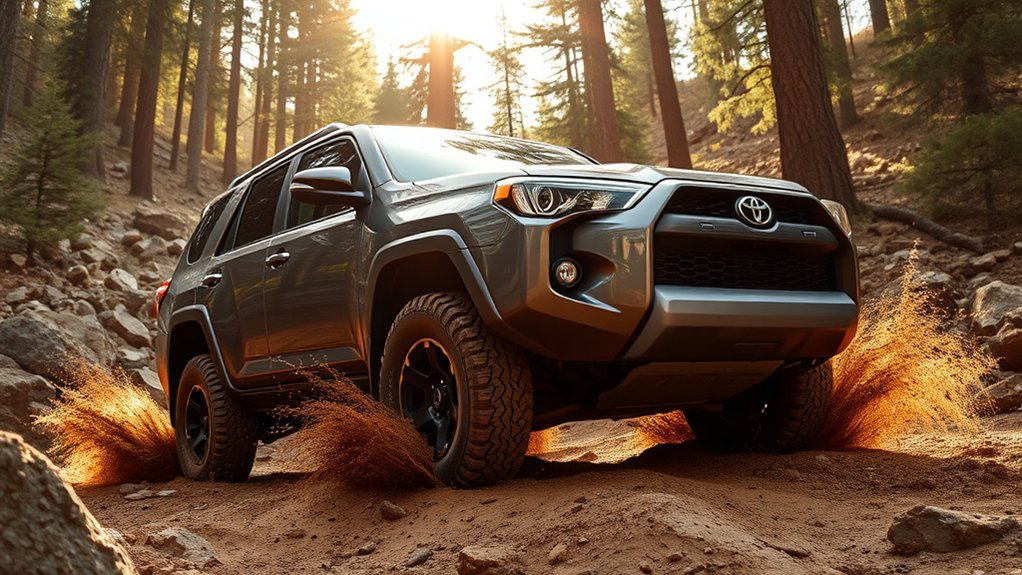
Toyota discontinued the TRD Off-Road after 2024, so value now depends heavily on mileage, condition, maintenance history, modifications, and evidence of trail use. A clean example can suit a buyer who needs one compact SUV for commuting, road trips, camping, and moderate unpaved travel.
Before buying a used example, inspect:
- Front skid plate and underbody: Look for deep impacts, bent mounting points, scrapes, leaks, or damaged plastic panels.
- Wheels and tires: Confirm that all four tires match in model, size, tread depth, and general condition.
- Alignment and steering: Watch for an off-center steering wheel, vibration, pulling, or uneven tire wear.
- Suspension: Listen for clunks and check the shocks or struts for leakage.
- AWD system: Confirm that no drivetrain, ABS, or traction-control warnings remain illuminated.
- Towing equipment: Inspect the hitch, wiring, rear structure, and service records if the vehicle has towed.
- Modifications: Check whether lifts, oversized tires, spacers, or nonfactory skid plates affect alignment, clearance, safety systems, or warranty coverage.
The RAV4 TRD Off-Road offers the most value to drivers who spend most of their time on pavement but regularly travel on mild or moderate trails. Buyers focused mainly on technical off-roading should choose a vehicle with low-range gearing, stronger recovery provisions, better clearance angles, and heavier underbody protection.
Related Guides
Frequently Asked Questions
What tires come standard on the RAV4 TRD Off-Road?
The 2024 RAV4 TRD Off-Road comes with Falken WILDPEAK all-terrain tires on 18-inch TRD flow-formed alloy wheels. They provide more trail traction and sidewall protection than ordinary road tires, but they are not as aggressive as dedicated mud-terrain tires.
Is the RAV4 TRD Off-Road suitable for rock crawling?
No. It can cross mild rocky forest roads, but it is not designed for technical rock crawling. Its 8.6-inch clearance, 19-degree approach angle, 21-degree departure angle, and lack of low-range gearing or locking differentials limit it on large rocks and ledges.
How does the RAV4 TRD Off-Road perform in snow?
Its torque-vectoring AWD, Snow mode, and factory all-terrain tires can provide useful traction on snowy roads. However, winter tires offer better braking and cornering grip in severe winter conditions. AWD does not shorten stopping distance on ice.
Can the RAV4 TRD Off-Road tow an off-road trailer?
It can tow up to 3,500 pounds when properly equipped, but the trailer, cargo, passengers, hitch equipment, and tongue weight must remain within every applicable limit. Rough terrain also reduces clearance and stability, so a trailer within the road-towing limit may still be unsuitable for a difficult trail.
What is the ground clearance of the RAV4 TRD Off-Road?
The 2024 RAV4 TRD Off-Road has 8.6 inches of ground clearance. Clearance under the center of the vehicle does not prevent bumper or underbody contact on abrupt ledges, so you must also consider its approach and departure angles.
Can the driver switch the RAV4 TRD Off-Road into front-wheel drive?
No manual front-wheel-drive selection is provided. The AWD system automatically disconnects the rear driveline when rear-wheel assistance is unnecessary and reconnects it when driving conditions require additional traction or handling support.
Is the RAV4 TRD Off-Road still available new?
Toyota did not offer the gas-powered TRD Off-Road grade for the 2025 model year, and the redesigned 2026 RAV4 lineup does not include that grade. Most shoppers will therefore be comparing used 2020–2024 vehicles or any remaining unsold 2024 inventory.
Conclusion
The 2024 Toyota RAV4 TRD Off-Road is a capable adventure crossover rather than a dedicated rock crawler. Its all-terrain tires, TRD-tuned suspension, torque-vectoring AWD, terrain modes, and 8.6-inch clearance make it well suited to gravel, maintained forest roads, moderate ruts, snow, and mild muddy or rocky trails.
Its limits become clear on large ledges, deep mud, severe cross-axle terrain, and routes that require low-range four-wheel drive. Choose it when you need everyday comfort with useful weekend-trail capability. Choose a more specialized four-wheel-drive vehicle when technical off-roading is your main goal.
Sources
- Toyota 2024 RAV4 Brochure — engine, transmission, tires, clearance, angles, towing, payload, suspension, and fuel-economy specifications.
- Toyota 2024 RAV4 Quick Reference Guide — Multi-Terrain Select and Snow mode operation.
- Toyota 2025 RAV4 Announcement — confirms that the TRD Off-Road grade was not offered for 2025.
- Toyota 2026 RAV4 Lineup — current RAV4 grades and powertrain lineup.
- Subaru 2024 Outback Comparison — Outback Wilderness power, clearance, towing, AWD, and X-MODE specifications.
- Honda 2024 Passport Specifications — Passport TrailSport engine, clearance, and towing specifications.
