Yes, Toyota RAV4 Hybrid and Plug-in Hybrid models use an electronically controlled continuously variable transmission, or eCVT. Unlike a conventional belt-and-pulley CVT, Toyota’s hybrid eCVT uses motor-generators and a planetary power-split mechanism. U.S. gas-only RAV4 models from 2019 through 2025 instead use an 8-speed automatic, and the 2026 U.S. lineup is Hybrid and Plug-in Hybrid only.
Quick Answer
Yes. RAV4 Hybrid and Plug-in Hybrid models use an eCVT-style hybrid transaxle that blends engine and electric-motor power without a conventional CVT belt. U.S. gas-only RAV4s from 2019–2025 use an 8-speed automatic. For 2026, every U.S. RAV4 is a Hybrid or Plug-in Hybrid, so the gas-only 8-speed model is gone.
Key Takeaways
- The RAV4 Hybrid’s eCVT uses motor-generators and a planetary power-split device, not a conventional CVT belt and pulley system.
- The 2026 U.S. RAV4 is available as a Hybrid or Plug-in Hybrid, with no gas-only 8-speed version.
- The RAV4 Hybrid first arrived in the U.S. for 2016 with a hybrid CVT/eCVT transaxle; gas-only 2019–2025 models use an 8-speed automatic instead.
- Toyota does not prescribe one universal eCVT-fluid replacement interval for every owner and operating condition.
- Towing capacity depends on the model year, trim, drivetrain, equipment, and total vehicle load, not just the transmission.
Last updated: September 19, 2026
Which Toyota RAV4 Models Use an eCVT?
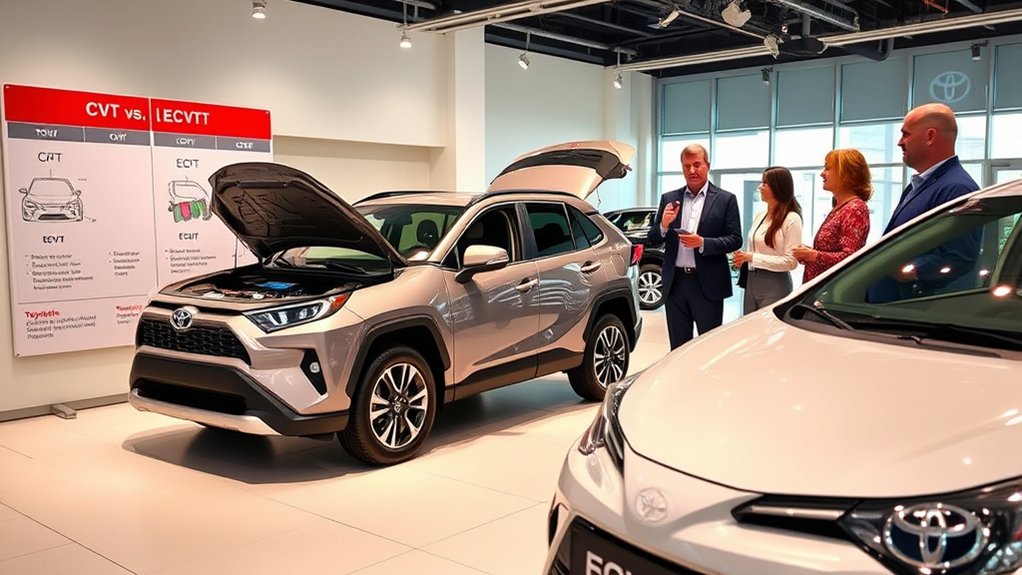
Yes, the Toyota RAV4 Hybrid uses an eCVT. Toyota describes the 2026 Hybrid system as a 2.5-liter engine working with two motor-generators through a planetary-type continuously variable transmission.
The plug-in model uses the same basic transmission concept. Toyota sold it as the RAV4 Prime for 2021–2024, renamed it the RAV4 Plug-in Hybrid for 2025, and lists the current plug-in model with an electronically controlled continuously variable transmission. The key point is that this is a hybrid motor-generator transaxle, not a conventional eight-speed automatic.
A Toyota hybrid eCVT is a planetary power-split system, not the belt-and-pulley CVT found in many gasoline vehicles.
The answer changes for older gas-only RAV4s. Toyota equipped U.S. gasoline models from the 2019–2025 generation with a Direct Shift 8-speed electronically controlled automatic transmission. For the broader gas-model timeline, see our non-hybrid RAV4 transmission guide.
Note: Toyota specifications vary by country and model year. Check the VIN-specific owner information before ordering fluid, parts, or a replacement transmission.
What Types of Transmissions Are in the RAV4?
For U.S.-spec RAV4s, the transmission type follows the powertrain and model year. The RAV4 Hybrid first appeared for 2016; the plug-in version arrived later, while fifth-generation gas models used fixed-gear automatics.
| U.S. model | Powertrain | Transmission |
|---|---|---|
| 2026 RAV4 Hybrid | Hybrid | Planetary-type ECVT/eCVT with motor-generators |
| 2026 RAV4 Plug-in Hybrid | Plug-in hybrid | Electronically controlled continuously variable hybrid transaxle (ECVT) |
| 2019–2025 RAV4 Hybrid | Hybrid | Hybrid eCVT |
| 2021–2024 RAV4 Prime; 2025 RAV4 Plug-in Hybrid | Plug-in hybrid | Plug-in-hybrid eCVT/transaxle |
| 2016–2018 RAV4 Hybrid | Hybrid | Hybrid CVT/eCVT transaxle |
| 2019–2025 gas-only RAV4 | 2.5-liter gasoline engine | Direct Shift 8-speed ECT-i automatic |
Toyota documented the first U.S. RAV4 Hybrid for 2016, confirmed the fifth-generation gas model’s 8-speed automatic in its 2025 RAV4 specifications, and changed the 2026 U.S. lineup to Hybrid and Plug-in Hybrid models only.
How Does a Toyota eCVT Work?
A conventional CVT usually changes ratios with a metal belt or chain running between two variable-width pulleys. Toyota’s hybrid eCVT takes a different approach.
| Feature | RAV4 hybrid eCVT | Conventional belt-type CVT | 2019–2025 gas RAV4 8-speed |
|---|---|---|---|
| Ratio mechanism | Planetary power-split device plus motor-generators | Variable-width pulleys with a belt or chain | Fixed gearsets with electronically controlled shifts |
| Physical stepped gears | No eight-gear shift sequence | No normal fixed-ratio shift sequence | Eight forward ratios |
| Typical acceleration feel | Engine speed can stay steady while road speed rises | Engine speed can stay steady while road speed rises | Noticeable upshifts and downshifts |
| U.S. RAV4 application | Hybrid and plug-in-hybrid models | Not used in the recent U.S. gas-only RAV4 | Gas-only 2019–2025 models |
The Toyota system combines three main elements:
- A gasoline engine that supplies power and can help charge the battery.
- Motor-generator 1, or MG1, which starts the engine, generates electricity, and helps control engine speed.
- Motor-generator 2, or MG2, which drives the wheels and recovers energy during regenerative braking.
A planetary gearset connects these components. Electronic controls continuously balance engine speed, motor speed, battery charge, road speed, and accelerator demand. This creates a continuously changing effective ratio without moving a belt between pulleys.
The system does not shift through eight physical forward gears. Under light loads, the RAV4 may move on electric power or use a low engine speed. Under hard acceleration, the engine may hold a higher, steadier speed while vehicle speed continues to rise.
Pro Tip: A steady engine note during strong acceleration is usually a normal eCVT characteristic. Warning lights, shuddering, grinding, fluid leaks, or a sudden loss of propulsion require professional diagnosis.
Is the Toyota RAV4 eCVT Reliable?
Toyota’s hybrid power-split design has a long production history. The Prius entered the U.S. market in 2000, giving Toyota more than two decades of experience with motor-generator hybrid transaxles.
The design avoids several wear components found in other transmissions. It does not use a conventional CVT belt and pulley set, and it does not rely on repeated clutch-pack shifts through multiple fixed gears.
That design can reduce some mechanical wear points, but it does not prove a universal failure rate or guaranteed mileage. Reliability still depends on the model year, maintenance, operating conditions, accident history, fluid condition, cooling, electrical systems, and previous repairs.
When evaluating a used RAV4 Hybrid, check for:
- Hybrid-system or transmission warning messages
- Fluid leaks around the transaxle
- Unusual grinding, whining, or shuddering
- Delayed engagement or unexpected loss of drive
- Incomplete maintenance or collision-repair records
- Signs of flood or high-voltage system damage
What Should You Check on a Used RAV4 Hybrid Test Drive?
Start by confirming that no hybrid-system or transmission warning is active. Check Drive and Reverse engagement, then use light and moderate acceleration. A smooth rise in road speed with a steady engine note can be normal; repeated shuddering, grinding, harsh impacts, fluid leakage, or loss of drive is not. Review service and collision records before purchase, and have a hybrid-qualified technician inspect the vehicle if its history is incomplete or any warning symptom appears.
Warning: Toyota hybrids contain high-voltage wiring and components. Do not touch orange cables, connectors, the service plug, or damaged hybrid components. Use a technician trained to service Toyota hybrid systems.
How Often Should RAV4 eCVT Fluid Be Changed?
A fixed “change the fluid every 30,000 to 60,000 miles” rule does not accurately represent Toyota’s published schedule for every RAV4.
For example, the 2025 RAV4 Hybrid Warranty and Maintenance Guide shows an automatic-transmission-fluid inspection at 30,000 miles. At 60,000 miles, it calls for replacement only under the listed special operating condition of primarily driving while towing a trailer, using a car-top carrier, or carrying heavy vehicle loads.
Your required service can differ based on:
- Model year and powertrain
- Country or sales market
- Towing and heavy-load use
- Whether Toyota lists your use as a special operating condition
- Previous fluid leaks or repairs
- The instructions in your vehicle’s maintenance guide
Use the fluid specification listed for your exact vehicle. An incorrect fluid or improper filling procedure can affect lubrication and operation.
Note: An inspection does not automatically mean replacement. Follow the maintenance guide for your VIN and discuss severe-use service with a qualified Toyota technician.
Benefits of the RAV4’s eCVT for Performance and Efficiency
The RAV4 Hybrid’s eCVT helps the engine and electric motors work together without conventional gear changes. Its main benefits come from smooth power blending and efficient energy management.
- Smooth acceleration: The system changes its effective ratio continuously, so you do not feel ordinary first-to-second or second-to-third shifts.
- Immediate electric assistance: The traction motor can provide torque as you move away from a stop or request more power.
- Efficient engine operation: The controls can run the gasoline engine at a speed that suits the requested power and battery conditions.
- Regenerative braking: The motor-generators recover some energy during deceleration and return it to the traction battery.
- Fewer conventional shift components: The power-split design does not need a belt-driven CVT mechanism or a full set of stepped automatic gear changes.
Possible eCVT Trade-Offs
An eCVT feels different from a geared automatic. During strong acceleration, engine speed may rise quickly and remain steady. Some drivers interpret this as slipping, although it can be normal operation.
You also do not get the distinct gear changes some drivers prefer. Simulated shift behavior, drive modes, and paddle controls on selected models can change the feel, but they do not turn the power-split transaxle into a conventional stepped automatic.
An eCVT can reduce certain mechanical wear points, but no transmission is maintenance-free or failure-proof. A major hybrid transaxle, inverter, motor, wiring, or control-system repair can still be expensive outside applicable warranty coverage.
How Does the RAV4’s Transmission Affect Towing and Off-Road Driving?
The eCVT can deliver smooth torque, but the transmission does not determine towing capacity by itself. Toyota calculates the rating using the complete vehicle, including the powertrain, drivetrain, brakes, cooling, suspension, hitch equipment, tires, and allowable load.
For the 2026 U.S. RAV4, Toyota lists 1,750 pounds for all FWD models and the LE AWD. Other eligible AWD Hybrid and Plug-in Hybrid grades are rated up to 3,500 pounds. Always confirm the rating for your exact trim, drivetrain, equipment, payload, and trailer before towing.
Warning: Do not apply the highest advertised RAV4 tow rating to every trim. Include passengers, cargo, accessories, hitch weight, and trailer load when checking vehicle limits.
For off-pavement driving, an eCVT can provide controlled power without abrupt shifts. However, useful trail capability depends more on AWD programming, tires, traction control, ground clearance, suspension, and driver judgment.
A RAV4 with suitable tires and equipment can be used on maintained dirt roads, snow, loose surfaces, and light off-pavement routes. It is not a substitute for a low-range four-wheel-drive system on severe rock, deep mud, or highly technical terrain.
Is the RAV4 eCVT the Same as a Regular Toyota CVT?
No. Toyota uses both hybrid eCVTs and conventional pulley-type CVTs, and the hardware is different. The RAV4 Hybrid’s power-split transaxle is more closely related in concept to Toyota hybrid systems such as the Camry Hybrid and Prius than to the gas Corolla’s Dynamic-Shift CVT.
| Toyota example | Transmission type | Key hardware |
|---|---|---|
| RAV4 Hybrid / Plug-in Hybrid | Hybrid ECVT/eCVT | Motor-generators plus planetary power-split mechanism |
| 2026 Camry / 2026 Prius | Hybrid ECVT/eCVT | Hybrid motor-generators and power-split transmission |
| 2026 Corolla gas model | Dynamic-Shift CVT | Physical launch gear plus variable pulley system |
That hardware distinction matters when comparing reliability, service procedures, and driving feel. Do not apply belt-CVT maintenance advice to a RAV4 Hybrid simply because both systems are described as continuously variable.
Frequently Asked Questions
What is the difference between a Toyota eCVT and a regular CVT?
A regular CVT commonly uses variable pulleys connected by a belt or chain. Toyota’s hybrid eCVT uses motor-generators and a planetary power-split device. Both provide continuously changing effective ratios, but their internal designs and service requirements are different.
Which Toyota RAV4 years use an eCVT?
U.S. RAV4 Hybrid models have used a hybrid CVT/eCVT transaxle since the first RAV4 Hybrid arrived for 2016. RAV4 Prime models from 2021–2024 and the renamed RAV4 Plug-in Hybrid from 2025 onward also use an electronically controlled hybrid transaxle. The 2026 U.S. lineup is Hybrid and Plug-in Hybrid only.
Does the 2026 Toyota RAV4 have an 8-speed automatic?
No gas-only 8-speed RAV4 is offered in the 2026 U.S. lineup. Toyota offers the 2026 RAV4 as a Hybrid or Plug-in Hybrid. The 8-speed automatic applies to gasoline-only U.S. RAV4 models from the 2019–2025 generation.
How often should RAV4 eCVT fluid be changed?
Use the maintenance schedule for your exact model year and operating conditions. Toyota’s 2025 RAV4 Hybrid guide shows a fluid inspection at 30,000 miles and replacement at 60,000 miles when the vehicle is primarily used for towing, a car-top carrier, or heavy vehicle loading.
Does the RAV4 eCVT contain a belt?
The Toyota hybrid eCVT does not use the variable pulleys and drive belt found in a conventional belt-type CVT. It uses motor-generators and a planetary power-split mechanism to control the effective ratio.
Is the Toyota RAV4 eCVT reliable?
Toyota’s hybrid power-split design removes the belt-and-pulley mechanism used by conventional CVTs and avoids normal stepped gear changes. That reduces some wear points, but there is no universal failure-rate or lifespan guarantee. Condition, maintenance, leaks, accident history, electrical faults, and prior repairs still matter.
How does the RAV4’s transmission affect towing capacity?
The transmission contributes to the powertrain, but it does not determine towing capacity alone. For the 2026 U.S. RAV4, Toyota lists 1,750 pounds for all FWD models and the LE AWD, while eligible other AWD grades are rated up to 3,500 pounds. Confirm the exact vehicle before towing.
Why does the RAV4 Hybrid engine sound loud during acceleration?
The eCVT may hold the gasoline engine at an efficient or powerful operating speed while road speed continues to increase. A steady engine note can therefore be normal. Warning lights, grinding, shuddering, leaks, or loss of power are not normal and require inspection.
Conclusion
The Toyota RAV4 uses an eCVT when equipped with a hybrid or plug-in-hybrid powertrain. The system blends engine and electric-motor power through a planetary power-split design rather than the belt-and-pulley mechanism used by a conventional CVT.
If you are identifying or servicing a RAV4, start with the model year and powertrain. U.S. gas-only 2019–2025 models use an 8-speed automatic, while the 2026 U.S. lineup is Hybrid and Plug-in Hybrid only. Then use the VIN-specific owner and maintenance information for fluid service, towing limits, and repair decisions.
Sources
- Toyota: The Next Adventure Begins, 2026 RAV4 — current powertrains, planetary hybrid transmission, towing ratings, and model-year changes.
- Toyota: 2025 RAV4 Product Information — 2025 gas-model 8-speed automatic and hybrid transmission details.
- Toyota: 2025 RAV4 Hybrid Warranty and Maintenance Guide — transmission-fluid inspection, special-condition replacement, and hybrid safety guidance.
- Toyota: 2026 Camry Product Information — current hybrid-only Camry lineup and eCVT.
- Toyota: 2026 Corolla Product Information — Dynamic-Shift CVT launch gear and pulley-system design.
- Toyota: 2026 Prius Product Information — Toyota’s hybrid history and planetary-type continuously variable transmission.
- Toyota: Refreshed 2016 RAV4 Line Offers Toyota’s Eighth Hybrid — first U.S. RAV4 Hybrid and hybrid-transaxle history.
- Toyota: 2025 RAV4 Plug-in Hybrid — Prime-to-Plug-in-Hybrid naming change and current plug-in-hybrid context.
