
Toyota RAV4 regenerative braking uses the electric drive motor-generators in Hybrid and Plug-in Hybrid models to slow the vehicle while sending some recovered energy back to the traction battery. The system automatically blends regenerative braking with hydraulic friction braking, so the driver uses the brake pedal normally. Regeneration can improve efficiency and reduce routine pad and rotor use, but friction brakes remain essential for strong stops, low-speed stopping, traction-limited conditions, and holding the vehicle stationary.
Last updated: September 19, 2026 — model naming, 2026 RAV4 brake-system information, maintenance guidance, and cited Toyota/DOE sources were rechecked.
Quick Answer
Toyota RAV4 Hybrid and RAV4 Prime/Plug-in Hybrid models use their electric motor-generators to slow the vehicle and return energy to the traction battery. The braking computer automatically blends regeneration with conventional friction braking. Smooth, early deceleration generally gives the system more opportunity to recover energy, while hard stops, low traction, battery limits, and the final part of a stop require more friction braking.
Key Takeaways
- Regenerative braking applies to electrified RAV4 models, not every gasoline-only RAV4 from earlier model years.
- The system recovers some energy during deceleration, but the hydraulic friction brakes remain responsible for complete, dependable stopping.
- Gentle, early braking generally captures more energy than waiting and braking hard.
- Brake pads may last longer, but Toyota’s scheduled brake inspections are still required.
- Changes in pedal feel, regeneration level, or energy-flow displays can be normal, but warning lights or reduced braking performance require prompt attention.
Which Toyota RAV4 Models Have Regenerative Braking?
Regenerative braking is found in RAV4 models with an electric traction motor:
- RAV4 Hybrid: Introduced in the United States for the 2016 model year.
- RAV4 Prime/RAV4 Plug-in Hybrid: The plug-in model debuted for 2021. Toyota changed the U.S. name from RAV4 Prime to RAV4 Plug-in Hybrid for 2025.
- 2026 RAV4: The redesigned U.S. lineup is offered with Hybrid Electric Vehicle or Plug-in Hybrid Electric Vehicle powertrains rather than a gasoline-only powertrain.
- 2012–2014 RAV4 EV: This discontinued battery-electric model also used regenerative braking, but its controls and operation differ from current hybrids.
Note: Gasoline-only RAV4 models do not use the hybrid regenerative-braking system. For the U.S. market, the 2026 RAV4 lineup is fully electrified with Hybrid and Plug-in Hybrid powertrains. Check the badge, power meter, owner’s manual, or vehicle specifications when you are unsure which powertrain you have. For related powertrain context, see how the Toyota RAV4 Hybrid engine and electric system work together and whether a RAV4 Hybrid needs external charging.
How Regenerative Braking Works in the Toyota RAV4
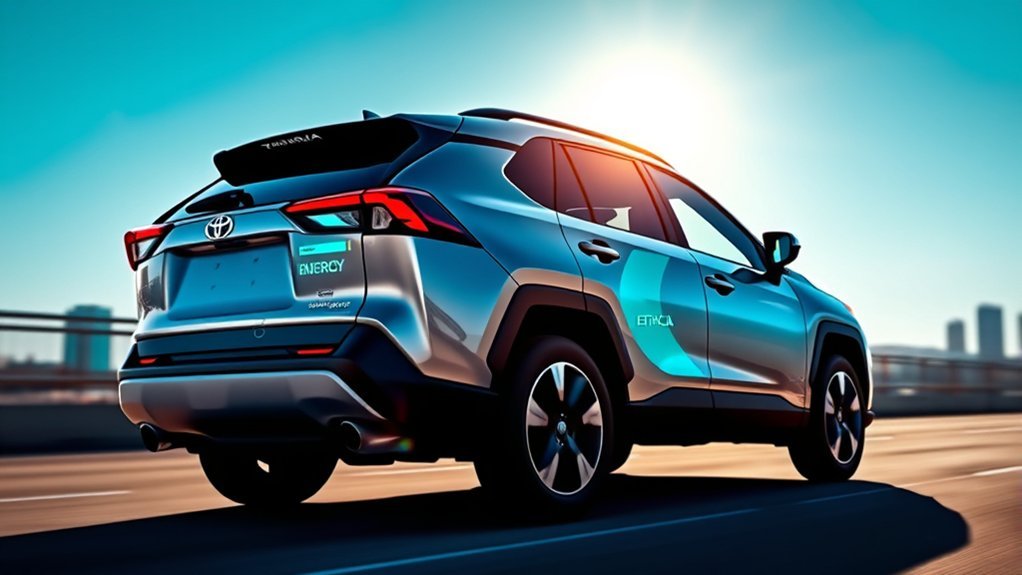
During ordinary acceleration, an electric motor can help drive the RAV4’s wheels. During deceleration, that motor can operate as a generator. The wheels turn the motor-generator, creating resistance that slows the vehicle while sending recovered electrical energy to the traction battery.
Toyota’s 2025 RAV4 Hybrid Owner’s Manual states that regenerative deceleration can occur when the accelerator is released or the brake pedal is pressed while driving in D or S. The RAV4 Plug-in Hybrid Owner’s Manual describes the same basic process.
Regeneration When You Lift Off the Accelerator
Releasing the accelerator produces a modest amount of deceleration. The exact strength depends on the model, selected shift range, vehicle speed, road conditions, traction-battery condition, and the vehicle’s control strategy.
This is not necessarily one-pedal driving. In normal D operation, a RAV4 generally continues to coast more freely than many battery-electric vehicles with aggressive one-pedal modes. You will normally need the brake pedal to come to a complete stop.
Regeneration When You Press the Brake Pedal
Pressing the brake pedal tells the braking computer how much deceleration you want. During light or moderate braking, the system can obtain a useful share of that deceleration through the motor-generator. It adds hydraulic friction braking whenever more stopping force is needed.
This automatic coordination is called brake blending. The driver does not need to choose between the two systems. The vehicle continuously decides how much regenerative and friction braking to use.
Why the Friction Brakes Are Still Essential
Regeneration alone cannot meet every braking demand. The disc brakes are needed to complete the stop, provide stronger deceleration, hold the vehicle stationary, and stop safely when regeneration is limited or unavailable. Anti-lock braking, stability control, emergency braking, and low-traction conditions can also change the blend. If you are trying to separate regeneration from the feature that holds the vehicle after it has stopped, see how Toyota RAV4 Brake Hold works.
Warning: Never delay braking, coast in Neutral, or follow another vehicle more closely in an attempt to capture more energy. Safe stopping distance and vehicle control always take priority over regeneration.
The Benefits of Regenerative Braking for Drivers
Regenerative braking offers several practical advantages when it operates within its normal range.
- Energy recovery: Some energy that would otherwise become heat at the brake discs is returned to the traction battery.
- Improved efficiency: The recovered energy can later help power the electric motor, reducing the amount of fuel or externally supplied electricity needed for a given trip.
- Reduced friction-brake use: Light and moderate stops can place less demand on pads and rotors.
- Less brake dust: Reduced pad-to-rotor contact can help keep the wheels cleaner, although friction braking still produces wear and dust.
- Lower brake heat during routine driving: Sharing deceleration with the electric motor reduces the heat that ordinary friction braking must absorb.
The U.S. Department of Energy confirms that regenerative braking significantly reduces brake wear in electrified vehicles. However, neither Toyota nor the Department of Energy promises a specific brake-pad lifespan.
Regenerative braking can extend friction-brake life, but longer component life is a benefit—not a replacement interval or a reason to skip inspections.
What Regenerative Braking Feels Like in a RAV4

A properly operating RAV4 normally makes the transition between regenerative and friction braking with little driver input. Even so, its pedal response may feel different from a gasoline-only vehicle.
Smooth Deceleration During Ordinary Stops
Light accelerator release may create gentle resistance, while pressing the brake pedal increases deceleration. During a well-judged stop, the power or hybrid-system display may move into a charge area while the traction battery receives recovered energy.
The amount shown on the display can change from one stop to another. A lower reading does not automatically indicate a fault because the system responds to changing battery, traction, temperature, and braking conditions.
What Does the CHG or Charge Display Mean?
When the Hybrid System Indicator or energy-flow display moves into a charge area during deceleration, it shows that the vehicle is recovering energy into the traction battery. It is not a direct brake-pad-wear gauge and does not prove that the friction brakes are completely inactive. The braking computer can blend regenerative and hydraulic braking at the same time, so use the display as an efficiency cue rather than a target you must hold.
Pedal and Transition Sensations
The brake pedal may feel more electronically managed than a conventional hydraulic system. Some drivers notice a small change in response as friction braking contributes more strongly near the end of a stop or when braking demand increases.
You may also hear a soft electric-motor or generator sound while slowing. Toyota identifies sounds from regenerative braking as a normal characteristic of the hybrid system.
What Changed for the 2026 RAV4 Brake System?
Toyota says the redesigned 2026 RAV4 uses a new Electronically Controlled Brake System with a new master-cylinder configuration and on-demand pressurization. The system coordinates regenerative force from the electric motors with hydraulic braking force to provide the requested stopping power while recovering energy when conditions allow. This is a meaningful model-year change, so pedal feel on a 2026 RAV4 should not be assumed to match an older Hybrid or Prime exactly. See Toyota’s 2026 RAV4 technical overview for the current U.S.-market description.
What Can Change the Pedal Feel
The braking blend may change when the vehicle passes over a bump, encounters a slippery surface, activates ABS, or requests stronger deceleration. The goal is to maintain tire grip and stable stopping, even when that means recovering less energy.
A brief change in sensation is not necessarily a malfunction. Persistent pulling, grinding, severe vibration, a sinking pedal, an unusually hard pedal, or reduced stopping ability is not normal and should be inspected.
How to Maximize Regenerative Braking Safely
- Look well ahead. Anticipating traffic lights, curves, and slowing vehicles gives you more time to decelerate gradually.
- Release the accelerator early. Allow the vehicle to begin slowing before greater brake pressure is needed.
- Use smooth brake pressure. Light-to-moderate braking usually gives the system more opportunity to recover energy than a late, hard stop.
- Stay in D for normal driving. The traction battery is not charged while the transmission is in N, so coasting in Neutral does not improve regeneration.
- Use lower shift ranges only when appropriate. S mode or a lower selectable range can increase deceleration or engine braking on hills, but the exact operation varies by model year.
- Do not chase the charge display. Brake according to traffic and road conditions rather than trying to keep the gauge in a particular zone.
Pro Tip: The most effective technique is also the simplest: leave adequate following distance, lift early, and apply steady pressure. Toyota’s quick-reference guidance recommends avoiding sudden stops when possible to maximize recovered braking energy.
D, S Mode, and Paddle Shifters
Normal D mode allows automatic regenerative braking when you release the accelerator or use the brake pedal. S mode and selectable shift ranges can provide stronger deceleration or engine braking, especially on long descents.
Some RAV4 Prime or Plug-in Hybrid versions include paddle shifters that increase regenerative deceleration in steps. Availability and behavior differ by trim and model year, so follow the instructions for your specific vehicle. These controls are not a universal regenerative-braking off switch.
On a long downhill grade, choose a suitable lower range early and keep vehicle speed controlled. Do not ride the brake pedal continuously. If the vehicle cannot maintain a safe speed, slow down and select a lower range when the owner’s manual permits it.
Regenerative Braking vs. Traditional Friction Brakes

| Feature | Regenerative Braking | Friction Braking |
| How it slows the RAV4 | Uses a motor-generator to resist wheel motion. | Presses brake pads against rotating discs. |
| Where the energy goes | Returns part of the energy to the traction battery. | Converts motion mainly into heat. |
| Best suited for | Coasting and light-to-moderate deceleration. | Final stopping, strong braking, holding, and conditions that limit regeneration. |
| Component wear | Does not directly wear pads and rotors. | Gradually wears pads and discs and produces brake dust. |
| Can it stop the vehicle alone? | Not under every condition and generally not for the complete stop. | Yes; it remains the essential physical stopping system. |
Energy-Efficiency Difference
Traditional brakes discard most braking energy as heat. Regeneration captures only a portion of it because energy is lost through the tires, drivetrain, motor-generator, inverter, wiring, and battery. Recovery also ends when the vehicle no longer has enough motion to convert or when the control system limits charging.
There is no single RAV4 recovery percentage that applies to every stop. City driving commonly presents more opportunities for regeneration than steady highway cruising because it includes more frequent deceleration.
Brake-Wear Difference
Because the motor-generator can perform part of the deceleration, the pads and rotors may wear more slowly than they would in a similar vehicle that relies entirely on friction braking. Pad life still varies widely.
Low friction-brake use can create a different maintenance concern: rotors and caliper components still need inspection for rust, scoring, sticking, uneven wear, and fluid leakage. A vehicle driven in wet, snowy, salty, or coastal conditions may require attention even when the pads remain thick.
Driving-Experience Difference
The RAV4’s computer-controlled blend can feel smooth and predictable once you become familiar with it. Friction brakes provide the consistent stopping reserve needed when energy recovery is not possible. Neither system should be viewed as a replacement for the other.
When Regenerative Braking May Be Reduced
The amount of regeneration can change automatically. Common reasons include:
- Hard or emergency braking: The friction brakes supply additional stopping force.
- Very low speed or the final stop: The hydraulic brakes complete and hold the stop.
- Low traction: ABS, traction control, and stability control may alter braking to preserve tire grip.
- Neutral: The traction battery is not charged while the transmission is in N.
- High or low traction-battery temperature: Charging power may be restricted to protect the battery.
- A nearly full plug-in hybrid battery: Less storage headroom is available until some energy has been used.
- Hybrid or brake-system faults: The vehicle may limit regeneration and illuminate a warning.
The system manages these transitions automatically. Reduced regeneration does not mean the vehicle is designed to lose its conventional braking ability; the hydraulic system remains available to provide stopping force. Any actual reduction in overall braking effectiveness, however, requires immediate attention.
Maintenance Considerations for Regenerative Braking
Regeneration may reduce replacement frequency, but the complete brake system still includes pads, rotors, calipers, brake fluid, hoses, electronic controls, sensors, and a hydraulic actuator.
For the 2025 U.S. RAV4 Hybrid, Toyota’s Warranty & Maintenance Guide calls for scheduled maintenance every 5,000 miles or six months. Its chart specifies visual inspection of the brake pads and discs every 5,000 miles and inspection of pad thickness and disc runout every 30,000 miles.
Schedules can differ by model year, market, use, and operating conditions. Follow the maintenance guide supplied with your specific RAV4 rather than treating 150,000 miles as an inspection or replacement interval.
What a Brake Inspection Should Cover
- Remaining pad thickness and evenness of wear
- Rotor scoring, rust, thickness, and runout
- Caliper movement and slide-pin condition
- Brake-fluid level and condition
- Brake lines and hoses for damage or leakage
- Parking-brake operation
- Warning lights, stored diagnostic codes, and electronically controlled brake operation
When a shop recommends replacement, ask for the measured pad thickness, rotor measurements, visible damage, or applicable service limit. A long-lasting pad can still accompany a damaged rotor, seized caliper, or fluid problem.
The Environmental Impact of Regenerative Braking
Regenerative braking improves efficiency by returning some deceleration energy to the traction battery instead of turning all of it into heat. It can also reduce brake dust and the frequency with which pads must be manufactured, transported, and discarded.
The overall environmental benefit depends on the complete vehicle and trip, including fuel use, electricity source, traffic, temperature, speed, cargo, and driving style. Regenerative braking is one useful part of an electrified powertrain rather than a stand-alone guarantee of low emissions.
The Department of Energy’s hybrid-vehicle overview explains that the electric generator produces electricity from the rotating wheels during braking and transfers it to the traction battery.
How to Interpret Owner-Reported Brake Life
Online owner reports can show very long pad life on one RAV4 and much earlier brake service on another. That variation is expected because hills, towing, road salt, corrosion, frequent hard stops, and sticking components can change wear even when regenerative braking is working normally.
Use owner-reported mileage as anecdotal context, not as a maintenance specification. A high odometer does not prove the brakes are healthy, and an early replacement recommendation should be supported by measured pad thickness, rotor condition, caliper operation, or another documented fault.
The best evidence of brake condition is a proper inspection and measurement—not the odometer alone.
Troubleshooting Regenerative Braking Concerns
Normal Characteristics
- A soft motor or generator sound during deceleration
- Different charge-gauge readings from one stop to another
- A mild transition in pedal response near the end of a stop
- Less regeneration on slippery roads or during strong braking
- Reduced energy recovery when the traction battery is hot, cold, or nearly full
Warning Signs That Need Inspection
- A yellow brake-system warning light or a message referring to regenerative or electronically controlled braking
- A persistent change in brake-pedal response
- Grinding, scraping, repeated clunking, or severe vibration
- The vehicle pulling strongly to one side while braking
- Brake-fluid leakage
- A burning smell or an unusually hot wheel
- Noticeably longer stopping distance or reduced braking effectiveness
Warning: A red brake-system warning, a pedal that approaches the floor, fluid loss, or reduced stopping ability can indicate a serious fault. Stop in a safe place as soon as conditions permit and obtain professional assistance. Do not continue driving solely because regenerative braking still appears on the display.
Frequently Asked Questions
Does the Toyota RAV4 Hybrid have regenerative braking?
Yes. Toyota RAV4 Hybrid models use regenerative braking as part of normal hybrid operation. During deceleration, the electric drive system can act as a generator, slowing the vehicle and sending some recovered energy to the traction battery. Hydraulic friction brakes remain available and are blended in automatically whenever the vehicle needs additional stopping force.
How does regenerative braking affect RAV4 Hybrid fuel economy or Plug-in Hybrid range?
It returns part of the vehicle’s deceleration energy to the traction battery. That stored energy can later help power the electric motor, reducing fuel use in a hybrid or supporting additional electric operation in a plug-in hybrid. The benefit varies with traffic, terrain, temperature, speed, and driving style.
Can regenerative braking be disabled in a Toyota RAV4?
Generally, there is no ordinary setting that completely disables regenerative braking on a RAV4 Hybrid. Some RAV4 Prime or Plug-in Hybrid models have paddle shifters or selectable ranges that change deceleration strength, but availability varies by model year. Neutral also prevents traction-battery charging and should not be used as an efficiency technique.
What happens to regenerative braking when the plug-in hybrid battery is fully charged?
A fully or nearly fully charged battery has less room to accept recovered energy. The vehicle manages this automatically and can use engine braking or the hydraulic friction brakes as needed. Brake normally and do not expect the energy-flow display to show the same recovery as it would with more battery headroom.
Does regenerative braking require a special driving technique?
No special technique is required. Leaving adequate following distance, lifting off the accelerator early, and applying smooth brake pressure can increase energy recovery. Always brake as firmly as safety requires, even when that reduces regeneration.
Do RAV4 Hybrid brake pads really last 150,000 miles?
They can last longer than pads on a comparable conventional vehicle, but 150,000 miles is not a guaranteed service life. Climate, corrosion, hills, towing, braking style, and component condition all affect wear. Follow Toyota’s inspection schedule and replace parts according to measured condition.
Why does the braking feel different on a bump or slippery road?
The vehicle may reduce or alter regeneration while ABS, traction control, or stability control manages wheel grip. The friction brakes can take a greater role, creating a brief change in pedal response. Persistent or severe changes should be inspected.
What are the warning signs of a regenerative braking problem?
Watch for a brake-system warning light, a message about regenerative or electronically controlled braking, reduced stopping ability, a major pedal change, pulling, grinding, fluid leakage, or severe vibration. A red brake warning or reduced braking effectiveness requires immediate action.
Conclusion
Toyota RAV4 regenerative braking recovers part of the energy produced while an electrified RAV4 slows, helping recharge the traction battery and reducing routine use of the pads and rotors. The system works automatically with the hydraulic brakes, so smooth early deceleration can improve efficiency without requiring a special driving method.
Regeneration can change with battery condition, traction, speed, selected range, and braking demand. Those normal limits are why friction brakes remain essential. Follow the maintenance schedule for your model year, treat warning lights seriously, and have any reduction in braking performance inspected immediately.
Sources
- Toyota 2025 RAV4 Hybrid Owner’s Manual — regenerative braking operation, shift positions, normal sounds, and brake warnings.
- Toyota RAV4 Plug-in Hybrid Owner’s Manual — plug-in hybrid regeneration, traction-battery operation, and driving controls.
- Toyota 2025 RAV4 Hybrid Warranty & Maintenance Guide — scheduled maintenance and brake-inspection intervals.
- U.S. Department of Energy: How Hybrid Electric Cars Work — motor-generator energy recovery and traction-battery charging.
- U.S. Department of Energy: Maintenance and Safety of Electric Vehicles — reduced friction-brake wear from regenerative braking.
- Toyota USA Newsroom: 2026 RAV4 Debut — current HEV and PHEV powertrain lineup.
- Toyota USA Newsroom: The Next Adventure Begins — 2026 RAV4 — 2026 Electronically Controlled Brake System and regenerative/hydraulic brake coordination.
