
Toyota RAV4 AWD works automatically, but the hardware depends on the model year and powertrain. On 2019–2025 U.S. gas AWD models, a mechanical driveline can send engine torque to the rear axle, and selected trims add left-to-right rear torque vectoring. RAV4 Hybrid and Plug-in Hybrid models use Electronic On-Demand AWD with a dedicated rear electric motor. The redesigned 2026 U.S. lineup is hybrid-only, so every 2026 AWD RAV4 uses the electronic rear-motor layout rather than the older gas-model mechanical systems.
Last updated: September 11, 2026 | Scope: U.S.-market Toyota RAV4 models. AWD equipment and drive modes vary by model year, trim, and market.
Quick Answer
Toyota RAV4 AWD automatically adds rear-wheel drive force when traction, acceleration, or stability can benefit. Most 2019–2025 gas AWD models use a mechanical rear driveline, selected gas trims add rear-wheel torque vectoring, and hybrid or plug-in hybrid AWD models use a dedicated rear electric motor. For 2026, U.S. AWD RAV4 models use Electronic On-Demand AWD.
Key Takeaways
- The RAV4 has used three main AWD designs: Dynamic Torque Control AWD, Dynamic Torque Vectoring AWD, and Electronic On-Demand AWD.
- Dynamic Torque Vectoring AWD was offered on selected 2019–2025 gas models and can distribute rear-axle torque between the left and right wheels.
- Hybrid and plug-in hybrid models use an independent rear electric motor rather than a mechanical front-to-rear driveshaft.
- Snow mode, Multi-Terrain Select, and Trail mode change vehicle-control strategies; they do not turn the RAV4 into a low-range 4WD vehicle.
- AWD can improve acceleration and directional control, but tires, speed, and road grip still determine cornering and braking performance.
Which RAV4 AWD System Do You Have?
Start with the model year and powertrain before using any AWD instructions. An “AWD” badge does not identify the internal system by itself, and trim availability changed during the fifth generation.
| RAV4 configuration | Likely AWD design | Best way to confirm |
|---|---|---|
| 2019–2025 gas AWD, non-torque-vectoring trims | Dynamic Torque Control AWD | Check the model-year specification sheet or original window sticker. |
| Selected 2019–2025 gas AWD trims | Dynamic Torque Vectoring AWD with Rear Driveline Disconnect | Verify the exact year and trim; availability changed by year. |
| 2019–2025 RAV4 Hybrid or Plug-in Hybrid AWD | Electronic On-Demand AWD | Check Toyota’s model-year documentation and the owner’s manual. |
| 2026 RAV4 AWD Hybrid or Plug-in Hybrid | Electronic On-Demand AWD with a dedicated rear electric motor | Use the 2026 Toyota specification sheet for your grade. |
Fast check: If you are unsure which system is installed, use the original window sticker, Toyota vehicle specifications, or the VIN with a Toyota dealer before following system-specific maintenance or drive-mode advice.
How Does the Toyota RAV4 AWD System Work?
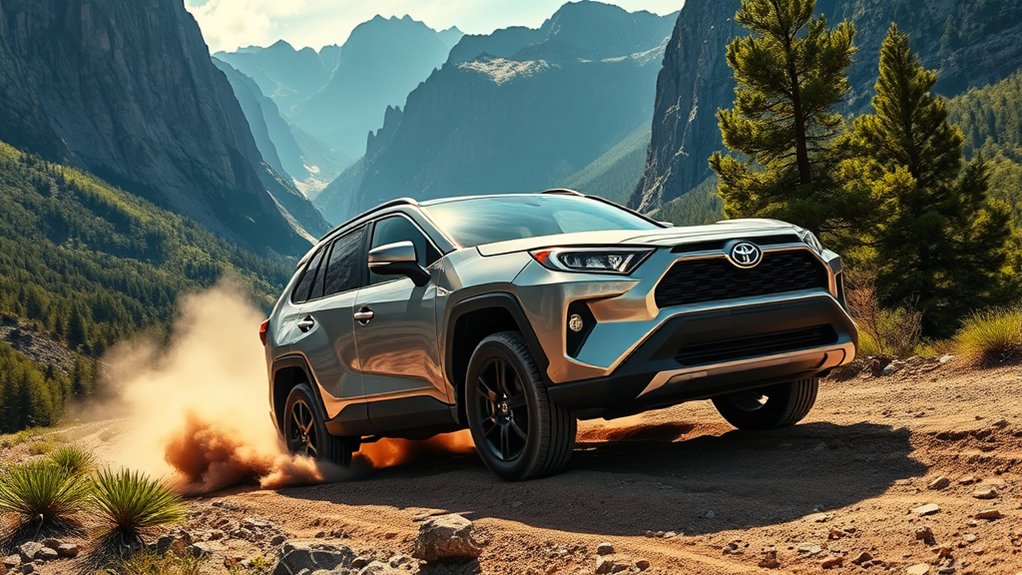
A RAV4 AWD system can add drive force at the rear wheels during acceleration, wheel slip, cornering, or other conditions in which the control computer determines that rear-wheel assistance will help. The transition normally happens without requiring you to select AWD manually.
That automatic operation is useful on rain-soaked pavement, packed snow, loose gravel, and uneven roads. It can also reduce front-wheel spin when you accelerate from a stop. However, the way the RAV4 creates rear-wheel drive force depends on which system is installed.
| AWD system | Typical application | How it drives the rear wheels | Main advantage |
|---|---|---|---|
| Dynamic Torque Control AWD | Selected 2019–2025 gas AWD models | A mechanical coupling varies torque between the front and rear axles. | Automatic all-weather traction without permanent four-wheel engagement. |
| Dynamic Torque Vectoring AWD | Selected 2019–2025 gas trims, depending on year | A mechanical rear driveline can direct torque rearward and vary it between the two rear wheels. | More precise traction and handling on uneven or low-grip surfaces. |
| Electronic On-Demand AWD | RAV4 Hybrid and RAV4 Plug-in Hybrid AWD models | An independent electric motor drives the rear axle. | Fast electronic response without a mechanical front-to-rear driveshaft. |
Dynamic Torque Control AWD
Dynamic Torque Control AWD was used on selected gas-powered fifth-generation RAV4 models that did not receive the more advanced torque-vectoring rear differential. The system normally favors the front wheels for efficiency but can use a controlled mechanical coupling to send drive force rearward.
The computer considers inputs such as accelerator position, vehicle speed, steering angle, wheel speed, and vehicle movement. It can add rear torque before obvious wheelspin occurs or react after a difference in wheel speed is detected.
Key Features of Dynamic Torque Vectoring AWD
Dynamic Torque Vectoring AWD with Rear Driveline Disconnect was fitted to selected 2019–2025 gas RAV4 trims. The exact trim availability changed by year, so check the original window sticker, owner’s manual, or vehicle specifications rather than assuming every AWD RAV4 has torque vectoring.
According to Toyota’s 2025 RAV4 specifications, this system can direct up to 50% of engine torque to the rear axle. Rear clutch control can then vary torque between the left and right rear wheels to support traction and handling.
On eligible 2019–2025 gas models, Toyota’s torque-vectoring AWD can send up to 50% of engine torque to the rear axle and vary that torque between the rear wheels.
The Rear Driveline Disconnect feature reduces unnecessary mechanical rotation when AWD is not required. During steady cruising on a dry road, the vehicle can disengage parts of the rear driveline and operate primarily through the front wheels. When conditions change, the system reconnects the rear driveline automatically.
Torque vectoring is particularly useful when one rear tire has more grip than the other or when the vehicle is turning on a loose surface. It is still a traction aid rather than a locking rear differential, and it does not provide low-range gearing.
Pro Tip: Use the AWD or torque-distribution display in the instrument cluster, if equipped, to see when the system is requesting rear-wheel drive force. The display is informative; you do not need to manage the torque split yourself.
What You Need to Know About the RAV4’s Electronic On-Demand AWD
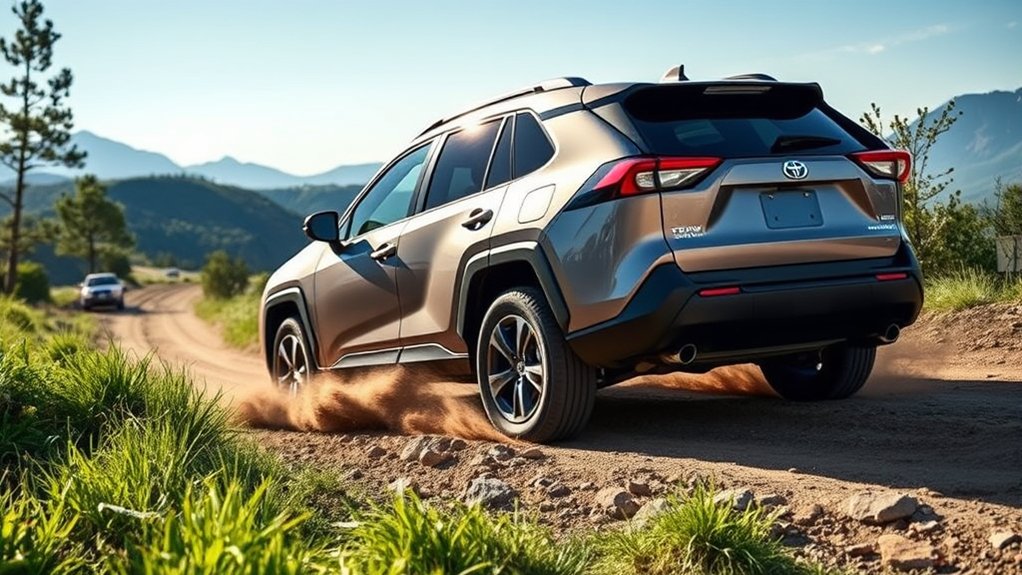
Electronic On-Demand AWD is used on AWD-equipped RAV4 Hybrid and RAV4 Plug-in Hybrid models. A separate rear-mounted electric motor powers the rear wheels, so these vehicles do not need a mechanical driveshaft connecting the front transaxle to the rear axle.
The hybrid control system can request rear-motor torque during initial acceleration, on slippery surfaces, while cornering, or whenever additional rear drive force would support the driver’s intended path. Toyota states that the 2025 RAV4 Hybrid Electronic On-Demand AWD system operates at all vehicle speeds, so rear assistance is not restricted by a universal 43-mph threshold.
When rear-wheel assistance is unnecessary, the vehicle can reduce or stop rear-motor output. This on-demand design supports efficiency while keeping rear-wheel assistance available when conditions change.
What Changed for the 2026 RAV4?
The redesigned 2026 U.S. RAV4 is hybrid-only. The standard hybrid powertrain is available with front-wheel drive or Electronic On-Demand AWD depending on grade, while the 2026 RAV4 Plug-in Hybrid uses AWD. Toyota states that AWD-equipped 2026 hybrid models use a dedicated rear electric motor; for the standard 2026 AWD hybrid, Toyota lists 89 lb.-ft. of rear-motor torque.
That means descriptions of gas-engine Dynamic Torque Control AWD or Dynamic Torque Vectoring AWD apply to earlier fifth-generation gas models, not to the current 2026 hybrid-only lineup. Current specifications are available on Toyota’s RAV4 model page.
Note: AWD badges alone do not identify which system is installed. Confirm the model year, powertrain, trim, and original equipment before following instructions for a drive mode or maintenance item.
Key Differences Between RAV4 AWD and Traditional 4WD Systems
RAV4 AWD is designed primarily for paved roads, changing weather, and light off-pavement use. A traditional off-road-oriented 4WD system is generally built for deeper mud, rocks, steep grades, and other conditions that place heavier loads on the drivetrain.
Automatic vs. Manual Engagement
RAV4 AWD manages the front-rear torque request automatically. You may be able to select Snow mode, Multi-Terrain Select, or Trail mode, but those controls change how the vehicle manages throttle, braking, steering feel, and drive force. They do not manually connect a low-range transfer case.
Traditional 4WD systems vary. Some require the driver to select 4H or 4L, while others offer automatic or full-time operation. The important hardware difference is that a purpose-built 4WD vehicle may include low-range gearing, stronger driveline components, and one or more locking differentials.
Traction on Various Surfaces
On wet pavement or packed snow, automatic AWD can reduce front-wheel spin and help the vehicle accelerate more smoothly. Torque-vectoring systems may also support cornering by varying rear-wheel torque.
However, every accelerating, braking, and cornering force still passes through the tires. AWD cannot create grip where the tires have little traction, and it cannot prevent hydroplaning or eliminate the longer stopping distances caused by snow and ice.
Off-Roading Capabilities Comparison
A RAV4 AWD can handle maintained dirt roads, gravel, moderate snow, campsites, and some uneven trails when ground clearance and tire grip are sufficient. Multi-Terrain Select or Trail mode can also limit wheelspin and use selective braking to help maintain progress.
The RAV4 does not have a low-range transfer case. Deep mud, large rocks, severe cross-axle terrain, deep water, or prolonged wheelspin can exceed its tires, clearance, cooling capacity, or driveline capability. A truck-based 4WD vehicle is usually a better choice for repeated severe off-road use.
Warning: AWD improves the ability to apply power, but it does not guarantee shorter braking distances. Slow down before a slippery turn, leave extra following distance, and never use AWD capability as a reason to exceed the available tire grip.
Which RAV4 AWD Mode Should You Use?
The available drive controls differ by model year and powertrain. Use a special mode only when the surface matches its intended purpose, and always follow the owner’s manual for your exact vehicle.
| Driving condition | Mode to consider | Important limit |
|---|---|---|
| Slippery or snow-covered paved road | Snow mode on eligible gas AWD models | It changes control strategy; it does not add tire grip. |
| Loose mud or sand | Mud & Sand on eligible gas AWD models | Ground clearance and tire choice still set the limit. |
| Rough rock-and-dirt surface | Rock & Dirt on eligible gas AWD models | The RAV4 has no low-range transfer case. |
| Bumpy or low-traction trail in an applicable hybrid or plug-in hybrid | Trail mode | Use for rough-road traction support, not as a substitute for cautious speed. |
Snow Mode
On eligible 2019–2025 gas AWD models, Snow mode adjusts accelerator response and drivetrain control to support smoother operation on slippery roads. It does not install more tire grip or permanently lock the front and rear axles together.
Multi-Terrain Select
Eligible prior-generation gas AWD models may provide Mud & Sand and Rock & Dirt settings through Multi-Terrain Select. Toyota’s RAV4 Quick Reference Guide explains that the system can optimize brake control, steering feel, and drive-force control for the selected terrain.
- Mud & Sand: Allows a control strategy suited to loose, muddy, sandy, rough, or dirty surfaces.
- Rock & Dirt: Uses a strategy intended for very uneven surfaces such as unpaved forest roads.
Select the mode that most closely matches the surface and return to the normal setting when the difficult section ends. These modes are not intended to compensate for excessive speed, insufficient ground clearance, or unsuitable tires.
Trail Mode
Applicable RAV4 Hybrid models use Trail mode to coordinate AWD, brake control, and drive-force control on bumpy or low-traction surfaces. Selective braking can limit the speed of a spinning wheel so that useful drive force can reach a wheel with more grip.
Note: Some older RAV4 generations used an AWD Lock switch that automatically canceled above a specified speed. Do not assume a 2019-or-newer RAV4 has that feature; fifth-generation models generally use Snow mode, Multi-Terrain Select, or Trail mode instead.
Real-World Benefits of RAV4 AWD in Various Conditions
Enhanced Traction in Snow
RAV4 AWD can improve initial acceleration and help the vehicle maintain forward progress when one axle encounters packed snow or a slick patch. Automatic rear-wheel assistance is useful when pulling away from an intersection, climbing a moderate grade, or crossing an unplowed parking area.
Winter tires usually make a larger difference to braking and cornering than AWD alone. The National Highway Traffic Safety Administration states that winter tires are more effective than all-season tires in deep snow and recommends regular checks of tire pressure, tread, and damage.
Confident Handling on Wet Roads
On wet pavement, the system can reduce excessive front-wheel spin and support smooth acceleration. Torque-vectoring hardware may also help the vehicle follow the driver’s intended line when rear-wheel torque is useful.
AWD cannot prevent hydroplaning. Slow down in standing water, avoid sudden steering or braking inputs, and replace tires that have inadequate tread depth.
Light Off-Road and Gravel Performance
On gravel or maintained dirt roads, rear-wheel drive force can reduce the amount of work demanded from the front tires. Terrain modes can further manage wheelspin. Drive slowly enough to avoid underbody impacts, tire damage, and loss of control on loose corners.
| Condition | What AWD can help with | What AWD cannot fix |
|---|---|---|
| Packed snow | Starting, climbing, and maintaining propulsion | Poor braking grip or excessive speed |
| Wet pavement | Reducing wheelspin during acceleration | Hydroplaning caused by speed, water depth, or worn tires |
| Gravel or dirt | Sharing drive force and controlling wheelspin | Insufficient clearance, deep ruts, or tire punctures |
| Deep mud or rocks | Limited assistance if tires retain grip | The absence of low range, locking differentials, or heavy-duty protection |
How to Optimize RAV4 AWD for Winter Driving
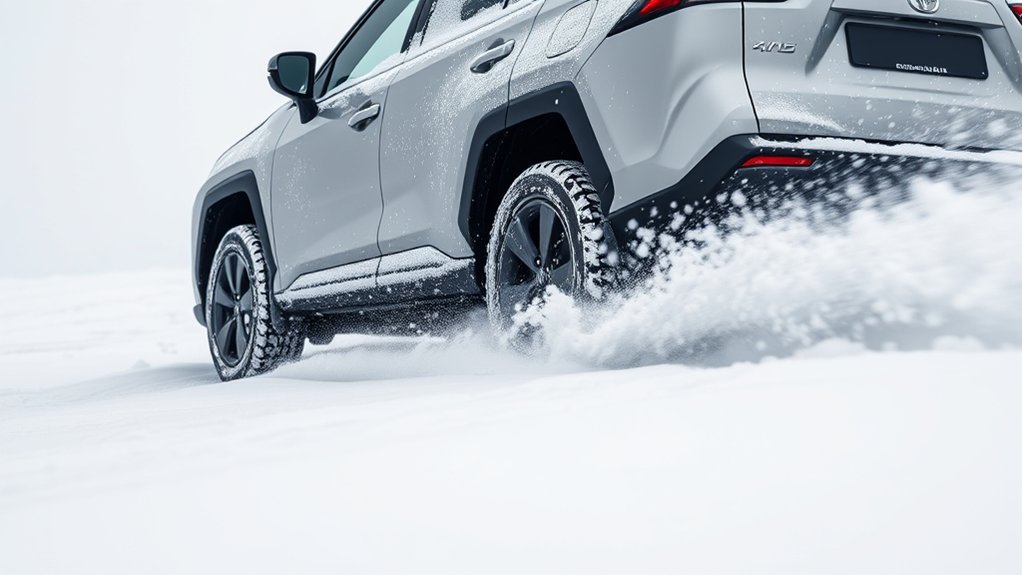
The AWD system works through the tires, so winter preparation should begin with tire condition rather than drive-mode selection.
- Use suitable tires: Install four matching winter tires when your climate regularly includes snow, ice, or prolonged freezing temperatures.
- Check cold pressure: Inflate the tires to the pressure on the driver-door placard, not the maximum pressure molded into the tire sidewall.
- Match all four tires: Use the specified size and avoid large differences in tread depth or overall circumference.
- Select the correct mode: Use Snow mode, Multi-Terrain Select, or Trail mode only when your model has the feature and the surface matches its intended use.
- Reduce speed: Accelerate, steer, and brake gradually, especially on bridges, shaded roads, and packed snow.
- Increase following distance: AWD does not remove the extra stopping distance required on low-grip roads.
- Clear the vehicle: Remove snow and ice from the windows, lights, roof, sensors, and wheel openings before driving.
Pro Tip: Practice gentle acceleration and braking in a safe, open area after the first snowfall. Learning how the tires and stability-control system respond is more useful than waiting until an emergency to discover the vehicle’s limits.
Tires, Loading, Towing, and AWD Maintenance
Why Matching Tires Matter
AWD control depends on accurate wheel-speed information and reasonably consistent tire circumference. Use the tire size specified for the vehicle and keep all four tires properly inflated, rotated, and in similar condition.
If one tire is damaged, ask a qualified tire professional whether a single replacement will remain within Toyota’s permitted tread and circumference differences. A substantially mismatched tire can cause incorrect wheel-speed interpretation or unnecessary driveline activity.
How Weight Affects AWD Performance
Passengers, cargo, roof loads, and trailer tongue weight consume the vehicle’s payload capacity and change the load carried by each axle. Additional weight can increase stopping distance, reduce acceleration, increase tire heat, and make the vehicle react more slowly to steering inputs.
Keep the loaded vehicle within its Gross Vehicle Weight Rating and front and rear Gross Axle Weight Ratings. Distribute cargo securely and avoid placing excessive weight behind the rear axle.
Is RAV4 AWD Suitable for Towing?
Yes, when the exact RAV4 configuration is rated for the trailer and all other weight limits are observed. AWD can help launch a trailer on a wet ramp or loose surface, but it does not increase the rating beyond Toyota’s published limit.
Ratings vary significantly by year and trim. For 2026, Toyota lists 1,750 pounds for all FWD models and the LE AWD, while specified AWD hybrid and plug-in hybrid grades are rated for up to 3,500 pounds. Earlier fifth-generation RAV4 ratings may be 1,500, 1,750, 2,500, or 3,500 pounds depending on the configuration.
Before towing, confirm all of the following:
- The exact towing capacity for the model year, powertrain, drivetrain, and trim
- Payload remaining after passengers, cargo, accessories, and tongue weight are included
- Trailer tongue weight and Gross Trailer Weight
- Vehicle and trailer Gross Combined Weight limits where specified
- Required hitch, wiring, brakes, and other towing equipment
- The maintenance schedule for towing or heavy-load operation
What Maintenance Does RAV4 AWD Require?
There is no single universal “AWD fluid” service for every RAV4. The required components and intervals depend on whether the vehicle has a mechanical gas-model AWD system or an electrically driven hybrid rear axle.
Toyota’s 2025 RAV4 Hybrid maintenance guide, for example, identifies rear differential oil as a separate inspection item. Under the guide’s special operating conditions for towing, car-top carrier use, or heavy loading, rear differential oil replacement is specified at 60,000 miles and again at later listed intervals. Use the guide for your exact model year rather than applying that interval to every RAV4.
Follow the maintenance guide supplied for your model year and inspect the vehicle promptly if you notice:
- An AWD, hybrid-system, traction-control, or master warning message
- Fluid leakage beneath a differential, transfer assembly, or transaxle
- Binding, shuddering, vibration, or unusual noise while turning or accelerating
- A strong difference in tire size, pressure, or tread depth
- Repeated overheating or a warning after sand, mud, snow, or prolonged wheelspin
Why Choose the RAV4 for Your All-Wheel Drive Needs?
The RAV4’s AWD options are best suited to drivers who want automatic assistance in rain, snow, gravel, and everyday mixed conditions without operating a conventional low-range 4WD system.
Prior-generation gas models offer either straightforward front-rear torque control or more advanced rear-wheel torque vectoring, depending on trim. Hybrid and plug-in hybrid models provide quick rear-motor response without a mechanical front-to-rear driveshaft. The current 2026 lineup extends that electronic approach across its AWD-equipped hybrid models.
The tradeoff is that the RAV4 remains a compact crossover rather than a dedicated rock-crawling vehicle. Drivers who understand that limit—and equip the vehicle with suitable tires—can benefit from added traction without sacrificing the comfort and efficiency expected from a daily-use SUV.
Frequently Asked Questions
How do I know which AWD system my RAV4 has?
Check the model year, powertrain, and original specifications. Most 2019–2025 gas AWD models use a mechanical AWD system, selected gas trims use Dynamic Torque Vectoring AWD, and hybrid or plug-in hybrid AWD models use a rear electric motor. For a specific vehicle, confirm the original window sticker, Toyota specification sheet, owner’s manual, or VIN with a Toyota dealer.
Can I switch between AWD and 2WD in the RAV4?
You generally cannot use a dashboard control to convert an AWD-equipped RAV4 into a true 2WD vehicle. The control system automatically reduces or disengages rear-wheel drive force when it is unnecessary. FWD and AWD are separate vehicle configurations selected when the vehicle is built.
Does the RAV4 AWD system stay engaged all the time?
Not necessarily. The system remains available, but rear-wheel torque changes continuously. Mechanical systems may favor front-wheel drive or disconnect part of the rear driveline, while Electronic On-Demand AWD can reduce rear-motor output when assistance is not needed.
Does a Toyota RAV4 have an AWD Lock button?
Some older RAV4 generations used an AWD Lock switch, but 2019–2025 fifth-generation models generally use Snow mode, Multi-Terrain Select, or Trail mode instead. Check the control labels and owner’s manual for your model year rather than relying on instructions for another generation.
How does weight affect the RAV4’s AWD performance?
Passengers, cargo, roof loads, and trailer tongue weight increase the work required from the tires, brakes, suspension, and drivetrain. Stay within the payload, axle, and vehicle weight ratings, secure the load, and expect longer stopping distances when the RAV4 is heavily loaded.
Is RAV4 AWD suitable for towing?
It can be, but AWD alone does not determine the towing capacity. Ratings vary by year, powertrain, and trim. Confirm the exact rating in Toyota’s documentation and include passengers, cargo, accessories, and trailer tongue weight when checking payload and axle limits.
What maintenance is required for the RAV4’s AWD system?
Follow the maintenance guide for the exact model year and powertrain. Depending on the system, service may include inspections of rear differential oil, transfer or driveline components, drive-shaft boots, seals, and tire condition. Severe use such as towing or heavy loading may require additional fluid service.
Does the RAV4’s AWD affect fuel efficiency?
AWD can slightly reduce fuel economy compared with an otherwise similar FWD configuration because it adds hardware, weight, and rear-wheel drive capability. On-demand operation and rear-driveline disconnect features reduce unnecessary losses, but the exact difference depends on the model year and trim.
Does AWD help the RAV4 stop faster in snow?
No. AWD can help the vehicle accelerate by using more driven wheels, but braking depends mainly on tire grip, road conditions, brake condition, and speed. Four suitable winter tires and increased following distance are more important for winter stopping performance.
Conclusion
The Toyota RAV4 AWD system can improve traction and stability, but its operation depends on the vehicle’s model year and powertrain. Selected 2019–2025 gas models use mechanical front-to-rear torque control, some add rear-wheel torque vectoring, and hybrid or plug-in hybrid AWD models use an independent rear electric motor. The 2026 U.S. lineup moves entirely to hybrid powertrains.
Use the drive mode intended for the surface, keep four suitable tires in similar condition, and remember that AWD does not replace cautious braking or responsible speed. Your next step is to confirm the model year, powertrain, and AWD system on the original specifications, then use that exact Toyota manual for towing, maintenance, tire replacement, and terrain-mode instructions.
Sources
- Toyota: 2025 RAV4 overview and specifications — Dynamic Torque Vectoring AWD, rear torque distribution, driveline disconnect, and prior-generation trim availability.
- Toyota: 2026 RAV4 launch information — Current hybrid lineup, AWD configuration, rear electric motor, output, and grade information.
- Toyota: 2026 RAV4 debut and towing capacities — 1,750-pound and 3,500-pound towing ratings by drivetrain and grade.
- Toyota RAV4 Quick Reference Guide — Snow mode, Multi-Terrain Select, Trail mode, and control limitations for the fifth-generation RAV4.
- Toyota 2025 RAV4 Hybrid Warranty and Maintenance Guide — Rear differential oil, tire rotation, special operating conditions, and scheduled inspections.
- National Highway Traffic Safety Administration: Winter Driving Tips — Tire pressure, tread inspections, winter tires, and safe winter-driving practices.
