The Toyota RAV4 has used several different all-wheel-drive systems, so the way it distributes power depends on the model year, powertrain, and trim. Older gas models may have an AWD Lock button, selected 2019–2025 gas trims use Dynamic Torque Vectoring AWD, and hybrid or plug-in-hybrid versions power the rear wheels with a separate electric motor.
Quick Answer
The Toyota RAV4 does not use one universal AWD system. Older gas models use a mechanical coupling, select 2019–2025 gas trims add rear-wheel torque vectoring, and hybrid or plug-in models use a separate rear electric motor. Lock, Multi-Terrain Select, and Trail mode availability depends on the year and trim.
Key Takeaways
- Most RAV4 AWD operation is automatic; the driver cannot continuously select an exact torque percentage.
- The 50:50 AWD Lock description applies to certain older RAV4 models, not every generation.
- Dynamic Torque Vectoring can send up to 50% of engine torque to the rear axle and vary drive force between the rear wheels.
- Hybrid, plug-in-hybrid, and 2026 AWD models use a rear electric motor instead of a mechanical prop shaft from the engine.
- AWD improves acceleration traction, but tires, braking distance, ground clearance, and vehicle weight limits still determine what the RAV4 can safely handle.
Which Toyota RAV4 AWD System Do You Have?
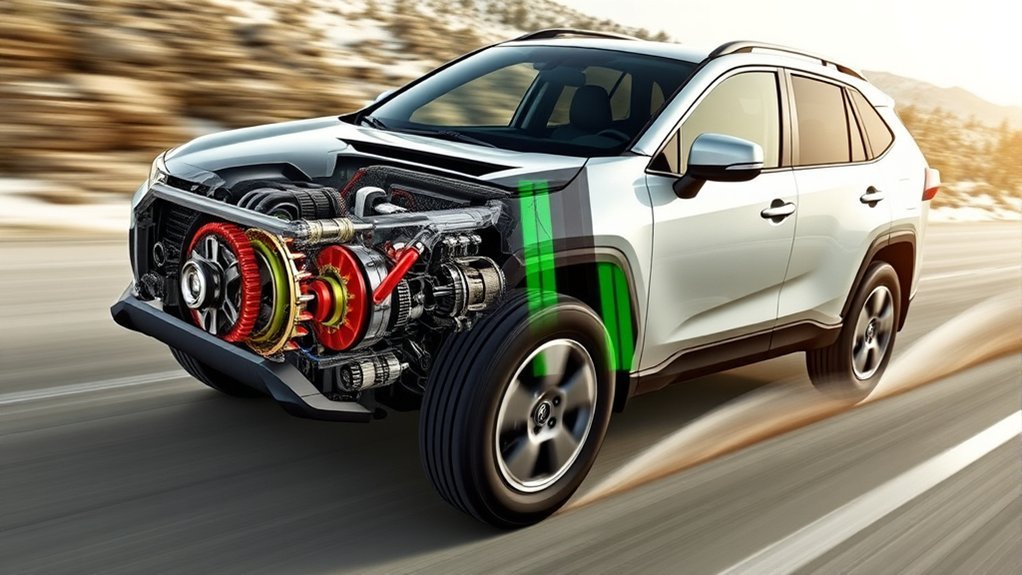
Before interpreting a torque display or looking for an AWD button, identify your RAV4’s model year, powertrain, and trim. Toyota has used mechanical and electric AWD designs, and their controls are not interchangeable.
| Model and powertrain | Basic AWD design | Driver control |
| 2013–2018 gas AWD | Dynamic Torque Control with an electronically controlled coupling that connects the rear axle when needed | AWD Lock on applicable models; automatic AWD during normal driving |
| 2016–2018 Hybrid AWD | Independent rear electric motor | Automatic electronic AWD |
| 2019–2025 gas AWD | Standard Dynamic Torque Control or, on selected trims, Dynamic Torque Vectoring AWD | Multi-Terrain Select on AWD-equipped gas models; exact modes vary by trim |
| 2019–2025 Hybrid and Plug-in Hybrid AWD | Electronic On-Demand AWD with a separate rear electric motor | Automatic AWD; Trail mode on applicable models |
| 2026 and newer U.S. models | HEV or PHEV powertrain; AWD versions use a rear electric motor with electronic drive-force control | Automatic AWD with model-specific drive or terrain modes |
Note: Trim equipment changes from year to year and by market. Check the controls in your vehicle and the corresponding Toyota owner’s manual rather than assuming that another RAV4 uses the same system.
For the U.S. market, Toyota’s sixth-generation 2026 RAV4 moved to hybrid and plug-in-hybrid powertrains. Some hybrid grades are front-wheel drive, while AWD versions use an electric motor to drive the rear wheels.
The correct explanation of RAV4 AWD always begins with the model year, powertrain, and trim—not with one universal torque split.
How Does the RAV4 AWD System Distribute Torque?
RAV4 AWD normally changes drive force automatically. The vehicle computer responds to acceleration, steering, wheel speed, and available tire grip instead of waiting for the driver to select a fixed front-to-rear ratio.
Older Dynamic Torque Control AWD
On applicable 2013–2018 gas models, the vehicle can operate with the engine driving the front wheels during steady cruising. An electronically controlled coupling engages the rear axle during acceleration or when additional traction is needed.
Toyota documented this system as varying between 100:0 and 50:50 front-to-rear distribution. That means the rear axle may receive no engine torque during suitable cruising conditions and up to half during conditions that call for AWD. A universal 10% minimum should not be assumed.
Standard Gas AWD on 2019–2025 Models
Standard AWD on applicable fifth-generation gas models also sends power rearward as driving conditions require. Toyota states that the system can direct up to 50% of engine torque to the rear wheels, but the actual amount changes continuously rather than remaining at one fixed split.
Dynamic Torque Vectoring AWD
Selected 2019–2025 gas trims use Dynamic Torque Vectoring AWD. This system can send up to 50% of engine torque to the rear axle and then vary drive force between the left and right rear wheels.
Sending more drive force toward the rear wheel that can use it can improve the vehicle’s response during cornering or on uneven surfaces. The system also includes a rear driveline disconnect that can stop unnecessary rear-driveline rotation when AWD is not required, reducing mechanical drag.
Electronic AWD on Hybrid and Plug-in-Hybrid Models
RAV4 Hybrid and Plug-in Hybrid models use a separate rear electric motor. There is no mechanical prop shaft carrying engine torque from the front powertrain to the rear axle.
The computer commands rear-motor torque during initial acceleration, when front-wheel slip is detected, and when rear drive force can support cornering or stability. Toyota does not publish one fixed front-to-rear percentage that applies in every electric-AWD situation.
What Role Do Sensors Play in the RAV4 AWD System?
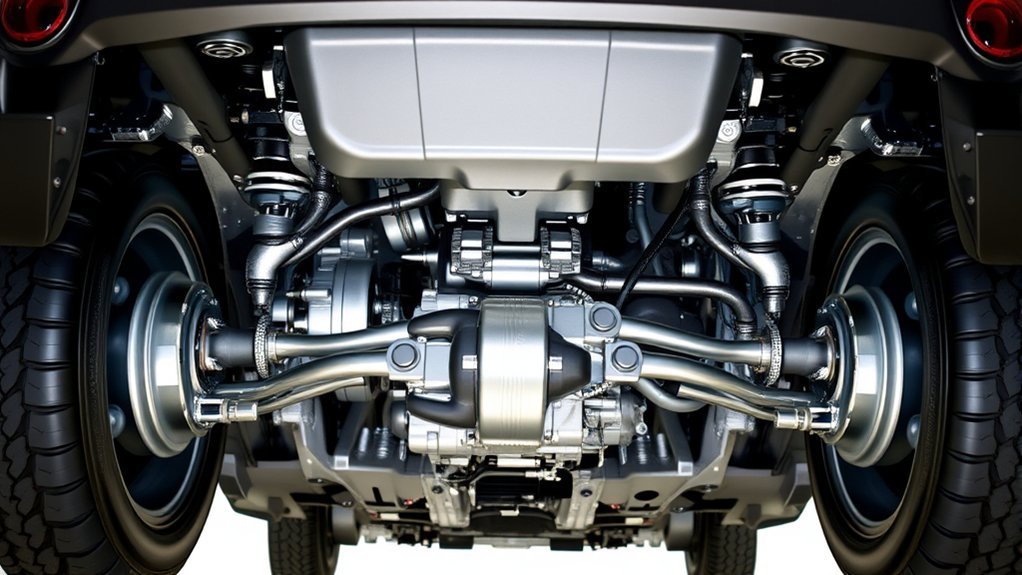
Sensors allow the AWD controller to respond before or as traction changes. Inputs differ slightly by system, but commonly include:
- Wheel speed: Differences in wheel rotation can indicate that a tire is beginning to slip.
- Vehicle speed: The system changes its response according to how fast the RAV4 is traveling.
- Steering angle: Steering input helps the controller predict the driver’s intended path.
- Throttle position: Accelerator demand indicates when additional rear drive force may support a launch or climb.
- Yaw rate: This measures how quickly the vehicle rotates around its vertical axis and helps the control systems compare actual movement with the intended path.
- Brake and stability-control activity: AWD can work with traction and stability control rather than operating as an isolated system.
The controller processes these inputs repeatedly and adjusts the mechanical coupling or rear electric motor. The driver may see changing front-to-rear graphics on the multi-information display, but those graphics are status indicators rather than a manually adjustable torque setting.
How Do AWD Lock, Multi-Terrain Select, and Trail Mode Differ?
These controls are often confused, but they belong to different RAV4 systems and do not perform the same job.
AWD Lock on Applicable 2013–2018 Models
On certain fourth-generation gas RAV4s, pressing the AWD Lock button requests a 50:50 front-to-rear torque split for low-speed use on loose, slippery, or unpaved surfaces. Toyota states that the system returns to automatic operation above approximately 25 mph.
AWD Lock is intended to help the vehicle start moving or continue at low speed when the surface permits tire slip. It is not a permanent four-wheel-drive lock, and it should not be treated as a control for dry, high-grip pavement.
Multi-Terrain Select on 2019–2025 Gas AWD Models
Multi-Terrain Select changes the coordinated response of the AWD, throttle, brakes, and traction-control systems. Available modes can include Mud & Sand, Rock & Dirt, Snow, and Normal, depending on the model year and trim.
Unlike the older AWD Lock button, Multi-Terrain Select does not promise a permanently fixed 50:50 split. It changes control strategies to suit the selected surface while the vehicle continues to adjust drive force automatically.
Trail Mode on Hybrid and Plug-in-Hybrid Models
Trail mode coordinates electric AWD, braking, and drive-force control on rough or slippery surfaces. If one wheel spins, the system may brake that wheel so more usable drive force reaches a wheel with better grip.
Warning: Do not use wheelspin as a substitute for traction. Prolonged spinning can overheat tires or drivetrain components, dig the vehicle deeper into sand or snow, and cause the AWD system to enter a temporary protection mode.
What Are the Benefits of Dynamic Torque Vectoring?
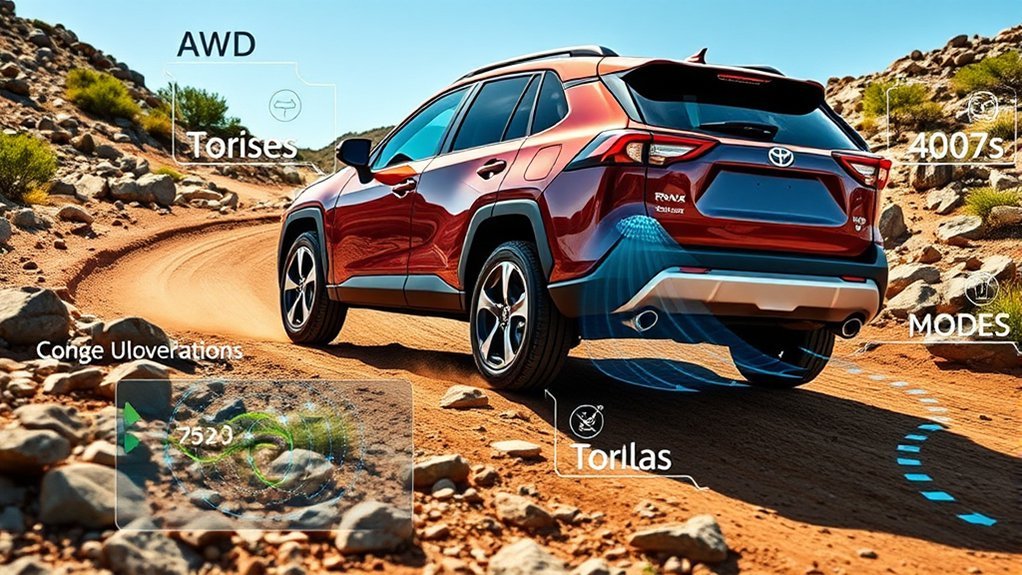
Dynamic Torque Vectoring was offered on selected fifth-generation gas RAV4 trims. It combines front-to-rear torque control with variable left-to-right rear-wheel drive force.
More Targeted Traction Control
When the rear axle is engaged, the system can direct more drive force toward the rear wheel that is better positioned to use it. This can reduce the need to rely only on brake-based traction control when the rear wheels have different amounts of grip.
Improved Cornering Response
During a turn, varying rear-wheel drive force can help the RAV4 follow the driver’s intended path and reduce the workload on the front tires. The effect is supportive rather than unlimited: the vehicle must still remain within the available tire grip.
Reduced Driveline Drag When AWD Is Not Needed
The Rear Driveline Disconnect system can disengage parts of the rear driveline during suitable cruising conditions. Toyota uses dog clutches to stop unnecessary prop-shaft rotation, which reduces mechanical energy loss compared with continuously spinning the disconnected rear driveline.
Dynamic Torque Vectoring can also help on gravel, dirt, or uneven trails, but it does not turn the RAV4 into a low-range 4WD vehicle. Ground clearance, tires, approach angles, wheel travel, and cooling limits still apply.
How Does the Hybrid AWD System Work in the RAV4?
The RAV4 Hybrid’s Electronic On-Demand AWD system uses the gasoline-electric front powertrain for the front wheels and an independent electric motor for the rear wheels.
Because rear torque is produced electrically, the system does not need a mechanical transfer case or prop shaft connecting the engine to the rear axle. The computer can request rear-motor assistance during:
- Acceleration from a stop
- Front-wheel slip
- Climbing or driving on a loose surface
- Cornering situations in which rear drive force can reduce understeer
- Trail-mode intervention on equipped models
The plug-in-hybrid version uses the same basic rear-motor AWD concept, although motor output, battery capacity, and control calibration differ from the standard hybrid.
The redesigned 2026 RAV4 continues with motor-driven AWD on equipped hybrid and plug-in-hybrid models. Toyota says wheel-speed data and driver inputs such as steering and throttle are processed electronically to determine rear-wheel drive force.
Electronic AWD adds rear-wheel drive force without a mechanical connection between the front powertrain and rear axle.
How Does RAV4 AWD Perform in Snow, Rain, and on Trails?
Snow and Ice
AWD can help a RAV4 accelerate from a stop and continue moving when one axle has less grip. It does not shorten braking distance by itself, and it cannot overcome the limits of worn, unsuitable, or incorrectly inflated tires.
The National Highway Traffic Safety Administration’s winter-driving guidance recommends checking tire pressure, tread, age, and damage and considering snow tires when conditions justify them.
Pro Tip: Four matching winter tires usually provide a larger safety benefit in persistent snow and ice than relying on AWD with unsuitable tires. Accelerate, steer, and brake smoothly even when the vehicle pulls away without obvious wheelspin.
Rain and Wet Roads
Automatic AWD can support acceleration and stability on wet pavement, but hydroplaning depends heavily on speed, water depth, tread condition, and tire pressure. Slow down before standing water and avoid abrupt steering or braking.
Mud, Sand, and Light Trails
Select the mode named for the surface when your RAV4 is equipped with Multi-Terrain Select. On a hybrid or plug-in-hybrid model with Trail mode, activate it before attempting a rough or slippery section.
The RAV4 is a unibody crossover without a conventional low-range transfer case. Avoid deep water, large rocks, severe cross-axle obstacles, or terrain that may exceed the vehicle’s clearance and cooling capacity.
How to Use the RAV4 AWD Controls Correctly
- Confirm your equipment. Look for an AWD Lock button, a Multi-Terrain Select dial or buttons, or a Trail mode button. Do not assume that instructions for another year apply.
- Select a mode before the difficult section. Choose Snow, Mud & Sand, Rock & Dirt, or Trail only when the surface matches the mode’s purpose.
- Use gentle accelerator input. Smooth power gives the control system more opportunity to manage grip than repeated full-throttle wheelspin.
- Keep the steering as straight as practical when starting. A tire has less grip available for acceleration when it is also being asked to make a sharp turn.
- Allow automatic disengagement. Older AWD Lock systems return to automatic operation at higher speed. Newer terrain modes may also change or cancel according to operating conditions.
- Return to Normal mode on ordinary pavement. Terrain modes are designed for specific low-grip situations, not as permanent performance settings.
RAV4 AWD Maintenance and Troubleshooting
There is no single maintenance item called “AWD fluid” that applies to every RAV4. Service requirements depend on whether the vehicle has a mechanical rear driveline, an electric rear axle, or both model-specific differential and e-transaxle components.
Follow the maintenance guide for your exact model year. As one current example, Toyota’s 2026 RAV4 Warranty & Maintenance Guide lists tire rotation at each 5,000-mile interval and inspection of rear differential oil at specified intervals when applicable.
Important AWD-related maintenance includes:
- Keeping all four tires at the pressure shown on the driver-door placard
- Using matching tire sizes and compatible tread depths
- Rotating tires at the specified interval when the tire configuration permits it
- Inspecting drive-shaft boots and mechanical driveline components where fitted
- Inspecting the rear differential or electric rear-drive components according to Toyota’s schedule
- Investigating leaks, vibration, binding, warning messages, or unusual driveline noise promptly
If an AWD warning appears, reduce speed and avoid continued wheelspin. The message may indicate temporary heat protection or a system fault, depending on the model. Stop in a safe place, follow the instructions shown in the owner’s manual, and arrange an inspection if the warning remains after the vehicle has cooled or restarted.
RAV4 AWD Versus Traditional 4WD
RAV4 AWD is designed mainly for automatic all-weather traction and light off-pavement use. It can vary drive force without requiring the driver to engage a transfer case.
A traditional truck-based 4WD system may include a rigidly engaged four-wheel-drive mode, low-range gearing, greater underbody clearance, and hardware designed for more severe off-road loads. The RAV4 does not provide those capabilities simply because all four wheels can receive power.
For most paved-road driving, AWD is easier to use because it responds automatically. For deep mud, rock crawling, steep low-speed descents, or repeated high-load off-road use, a vehicle designed with low-range 4WD may be more appropriate.
Related Guides
Frequently Asked Questions
Can I manually control the RAV4’s AWD system?
You cannot continuously choose an exact front-to-rear torque percentage. AWD operation remains automatic. Certain older models provide AWD Lock, while newer models may offer Multi-Terrain Select or Trail mode to change how AWD, throttle, and brake controls respond.
Which RAV4 models have an AWD Lock button?
The low-speed AWD Lock function is associated with applicable older models, including fourth-generation gas RAV4s. The fifth-generation RAV4 introduced Multi-Terrain Select on AWD gas models, while hybrid and plug-in-hybrid versions use electronic AWD and may provide Trail mode.
How does the RAV4 AWD perform in snow or ice?
AWD can improve acceleration traction by using both axles, but it does not shorten braking distance or create grip on ice. Correct tire pressure, adequate tread, suitable winter tires, lower speed, and smooth steering and braking remain essential.
What maintenance does the RAV4 AWD system require?
Follow the Toyota maintenance guide for the exact model year and powertrain. Typical items can include tire rotation, tire-pressure checks, drive-shaft-boot inspection, differential-oil inspection, or inspection of electric rear-drive components. Hybrid models do not use the same mechanical layout as gas models.
Is the RAV4 AWD system fuel-efficient?
Toyota’s on-demand systems reduce unnecessary rear drive force during suitable conditions, and selected gas systems can disconnect the rear driveline. Even so, an AWD version may use more fuel than an otherwise comparable front-wheel-drive model because it carries additional hardware and may have different tires or gearing.
How does towing affect the RAV4’s AWD capabilities?
AWD can help the vehicle start on a slippery surface, but it does not increase the published towing, payload, axle, or tongue-weight limits unless Toyota assigns a different rating to that specific configuration. Trailer weight also increases braking distance and drivetrain heat, so follow the rating and equipment requirements for the exact model and trim.
What should I do if the AWD warning light or message appears?
Reduce speed, stop aggressive wheelspin, and follow the message in the owner’s manual. Depending on the model, the warning may result from temporary overheating or a fault. If it remains after the vehicle cools or restarts, have the system inspected.
Is RAV4 AWD the same as four-wheel drive?
No. RAV4 AWD automatically adds rear-wheel drive force for road traction and light trail use. It does not provide the low-range transfer case or other heavy-duty off-road hardware found in many traditional 4WD vehicles.
Conclusion
The Toyota RAV4 AWD system can improve acceleration traction, cornering response, and control on loose or slippery surfaces, but its operation depends on the vehicle’s generation and powertrain. Older gas models may use low-speed AWD Lock, selected 2019–2025 gas trims add Dynamic Torque Vectoring, and hybrid, plug-in-hybrid, and 2026 AWD models use a separate rear electric motor.
Most torque distribution remains automatic. Use only the terrain controls provided in your vehicle, maintain four compatible tires, follow the model-specific service schedule, and remember that AWD cannot overcome braking, ground-clearance, towing, or tire-grip limits.
Sources
- Toyota USA Newsroom: 2026 RAV4 — current hybrid and plug-in-hybrid lineup, rear electric-motor AWD, sensor inputs, and drivetrain availability
- Toyota USA Newsroom: 2025 RAV4 — standard gas AWD, Dynamic Torque Vectoring, Rear Driveline Disconnect, Multi-Terrain Select, and Hybrid AWD
- Toyota USA Newsroom: 2015 RAV4 — Dynamic Torque Control, documented torque range, sensor inputs, and low-speed AWD Lock operation
- Toyota 2026 RAV4 Warranty & Maintenance Guide — tire rotation, differential-oil inspection, e-transaxle, and scheduled maintenance requirements
- NHTSA Winter Driving Tips — winter tire, tread, pressure, inspection, and safe-driving guidance
