Toyota RAV4 Eco Mode makes accelerator response gentler and, on many model years, reduces climate-control demand to support fuel economy. It is most useful in stop-and-go driving, but it does not guarantee a fixed MPG increase. Results depend on your RAV4’s model year, powertrain, driving style, route, weather, and climate-control use.
Last updated: September 19, 2026
Quick Answer
Toyota RAV4 Eco Mode softens accelerator response and may reduce heating and cooling demand. It can make smooth, efficient acceleration easier, especially in city traffic, but Toyota does not promise a specific MPG gain. Eco Mode does not block full acceleration; press the pedal farther when traffic conditions require it, or select Normal or Sport for a more immediate response.
Key Takeaways
- Eco Mode changes how the RAV4 responds to a given accelerator input; it does not create a guaranteed MPG increase.
- The greatest benefit is usually in traffic that requires repeated acceleration and slowing.
- Eco climate settings may reduce fan speed or heating and cooling output, so the cabin can take longer to reach the selected temperature.
- You can select Normal or Sport whenever you prefer a more immediate response; controls vary by model year.
- Eco Mode is a factory driving mode; follow the regular maintenance schedule for your exact model year and powertrain.
What Toyota RAV4 Eco Mode Actually Changes
Toyota describes Eco Mode as a drive setting that helps lower fuel consumption during trips involving frequent acceleration. On recent RAV4 models, it changes the relationship between the accelerator pedal and the powertrain so that a small pedal movement produces a gentler response than it does in Normal or Sport Mode.
The result is smoother torque delivery and less chance of using more power than intended when leaving a stoplight or following slow traffic. Toyota’s 2026 RAV4 documentation specifically recommends Eco Mode for trips that involve repeated acceleration and braking.
Depending on the model and powertrain, Eco Mode may also adjust heating and air-conditioning operation. It can restrain fan speed or other climate-control demands so the gas engine or hybrid battery supplies less energy to the cabin.
Eco Mode should not be treated as a fixed gear map or as a reduction in the vehicle’s rated horsepower. Toyota’s published descriptions focus on gentler torque response and lower climate demand, while other calibration details vary by model year and powertrain.
Note: Toyota redesigned the U.S. RAV4 for 2026 and moved the lineup to hybrid and plug-in hybrid powertrains. Toyota lists Normal, Eco, Sport, and Custom as selectable modes on the 2026 RAV4, while earlier gas, hybrid, and RAV4 Prime or Plug-in Hybrid models use different controls and mode sets. Consult the manual for your exact model year.
How Eco Mode Changes Throttle Response
In Eco Mode, you may need to press the accelerator farther to obtain the same initial response you feel in Normal Mode. This does not mean the pedal is malfunctioning. It is the intended calibration.
The gentler response can be useful when:
- Driving through stop-and-go city traffic
- Following vehicles at low or moderate speeds
- Leaving traffic lights smoothly
- Trying to reduce unnecessary bursts of acceleration
- Driving on a route with frequent slowing and restarting
The mode is less likely to produce a noticeable advantage during steady-speed highway cruising because there are fewer accelerator changes for the calibration to smooth out. Vehicle speed, aerodynamic drag, tire pressure, wind, and traffic can have a greater effect on highway economy.
Eco Mode does not prevent you from requesting more acceleration. Press the pedal farther when traffic conditions require it. You can also select Normal or Sport before a highway entrance, pass, or steep climb if you prefer a more immediate response.
Pro Tip: On a busy entrance ramp, select your preferred drive mode before you need to merge. Predictable acceleration and a safe gap are more important than saving a small amount of fuel.
Eco Mode vs. the Eco Driving Indicator
On some RAV4s, Eco drive mode and the Eco Driving Indicator are separate things. The Eco drive mode indicator confirms that you selected the efficiency-focused drive mode. The Eco Driving Indicator is a feedback light or display that can appear when your acceleration is within Toyota’s defined efficiency zone.
Toyota owner’s manuals list these as distinct indicators. That is why a RAV4 can show an ECO-related light while Normal Mode is selected, or show more than one ECO-related symbol when Eco Mode is active. The exact icons and display behavior vary by model year. See the Toyota RAV4 owner’s manual for an example that lists both the Eco Driving Indicator Light and the Eco drive mode indicator separately.
How Eco Mode Changes Air Conditioning and Heating

Cabin heating and cooling require energy. A gasoline RAV4 may place an additional load on the engine when the air conditioner is operating, while a hybrid or plug-in hybrid may use electrical energy from the traction battery.
On the 2025 RAV4 Plug-in Hybrid, Toyota says Eco Mode supports efficiency by smoothing torque response and restraining the heating and cooling system, including fan-speed control. Other RAV4 versions use model-specific strategies, so the exact behavior should be checked in the owner’s manual.
You may notice:
- Lower fan speed during automatic climate operation
- More gradual cabin cooling or heating
- Less aggressive response after selecting a much colder or warmer temperature
- More noticeable restraint during very hot or cold weather
This is a tradeoff rather than free fuel savings. The cabin may take longer to become comfortable. According to the U.S. Department of Energy, air-conditioning use can reduce a conventional vehicle’s fuel economy by more than 25% under very hot conditions, particularly on short trips. The percentage effect can be even larger for hybrids, plug-in hybrids, and EVs.
Warning: Do not let an efficiency setting interfere with windshield visibility. Use the windshield defogger, outside-air setting, or stronger climate output whenever needed to clear fog, frost, or condensation.
[Amazon Products Picked for You]

Compatible with most gasoline ODBII equipped vehicles from 1996 to present
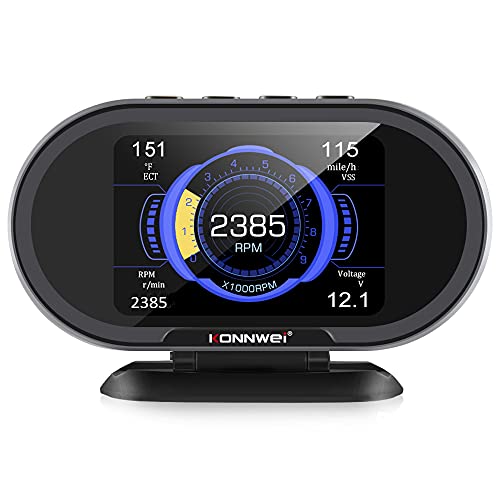
ALL IN ONE OBD2 GAUGES ➤ KW206 Car OBD2 HUD display is the combination of automotive trip computer gauge and diagnostic scan gauge. Not only it can display up to hundreds of real-time engine parameters in its digital 3.5’’ color screen like speedometer, RPM, water coolant temperature, fuel consumption, total mile ... but also can read engine fault codes and turn off the check engine light. Perfect household tool and present for daily use! NEW REPLACEMENT AVAILABLE FOR ANY QUALITY ISSUE.
How Much Fuel Can RAV4 Eco Mode Save?
There is no reliable universal answer such as “3 MPG” or “4 MPG.” Toyota does not publish a guaranteed RAV4 Eco-versus-Normal MPG improvement because the result depends heavily on how and where the vehicle is driven.
What Toyota measured: In a 2023 Toyota Connected internal study covering more than 2,000 company-owned model-year 2020–2023 Toyota and Lexus vehicles, Eco mode was associated with about 4% lower tailpipe CO2 output for hybrids and up to 26% lower tailpipe CO2 for full internal-combustion vehicles versus each vehicle’s baseline. The study was not RAV4-specific, and Toyota notes that route, weather, idling, driving habits, and other factors affect the result. Treat it as context, not a promised RAV4 MPG gain. Read Toyota’s study summary.
Eco Mode is most helpful when it changes driver behavior. A driver who normally accelerates sharply may see a meaningful improvement because the softer response makes smooth inputs easier. A driver who already accelerates gently may see little difference between Eco and Normal.
DOE context: Aggressive driving can lower fuel economy by roughly 10% to 40% in stop-and-go traffic and about 15% to 30% at highway speeds, according to FuelEconomy.gov.
Other factors that can outweigh the selected drive mode include:
- Short trips with a cold engine or cold hybrid system
- High highway speeds
- Long periods of idling
- Heavy heating or air-conditioning use
- Low tire pressure
- Roof boxes, racks, or heavy cargo
- Headwinds, rain, snow, and low temperatures
- Traffic congestion and route elevation
[Amazon Products Picked for You]

【Compatible】 fit for Chevrolet Corvette C8 Stingray 2020-2023, Special car use, original car customization, Enjoy the super cool and exquisite appearance of your car after installing.

Vehicle Compatibility: Precisely designed for Porsche 911 (2019–2024, 992), Taycan (2020–2025, 9J1), Panamera (2021–2025, 971.2/976), Macan (2022–2024, 95B.2), and Cayenne (2024–2025, 9Y0.2). Not compatible with previous generation mode selectors or Boxster models. Please compare your knob with the listing photos to confirm fitment

Fitment Check – Please Read Before Ordering: Designed for Lincoln Aviator (2020-2024), Corsair (2020-2024), and Navigator/Navigator L (2018-2024). NOT for Continental, MKZ, or other models. Please check your knob shape matches the listing photos before ordering
How to Test Eco Mode on Your Own RAV4
- Reset a trip meter at the beginning of the comparison.
- Drive at least two or three full tanks in Normal Mode.
- Record gallons added and miles driven at each fill-up.
- Repeat for two or three comparable tanks in Eco Mode.
- Use similar routes, speeds, tire pressures, climate settings, loads, and weather when possible.
- Calculate actual MPG by dividing miles driven by gallons added instead of relying only on a short dashboard average.
A one-way commute or a single short trip is not enough to isolate the effect of the mode. Temperature, wind, traffic, and refueling variation can easily distort a small sample.
Eco Mode vs. Normal Mode vs. Sport Mode
| Mode | Driving Feel | Best Uses | Main Tradeoff |
|---|---|---|---|
| Eco | Gentler initial accelerator response; climate output may be restrained. | City traffic, routine commuting, and repeated acceleration. | May feel less responsive and may cool or heat the cabin more slowly. |
| Normal | Balanced accelerator, climate, and handling response. | Most everyday driving and drivers who want predictable response. | Provides less assistance with smoothing an aggressive accelerator input. |
| Sport | Quicker response; some models also change steering feel and transmission behavior. | Curving roads, merging, passing, or situations where sharper response is preferred. | Can encourage greater fuel use if the added response leads to harder acceleration. |
No single mode is automatically best for every trip. Eco Mode can assist with efficiency, Normal Mode provides balanced operation, and Sport Mode makes the RAV4 feel more responsive. Your acceleration habits still matter in all three modes.
2026 model note: Toyota also lists a Custom mode on every 2026 RAV4. Other modes such as EV, Trail, Snow, or terrain settings depend on powertrain and grade, so do not assume every RAV4 has the same selector.
How to Turn RAV4 Eco Mode On or Off
The control depends on the RAV4’s year, trim, drivetrain, and powertrain:
- Many 2013–2018 RAV4s use a dedicated ECO MODE button; pressing it again cancels Eco Mode.
- Many 2019–2025 RAV4s use separate drive-mode buttons or a rotary selector, depending on gas, hybrid, or plug-in-hybrid configuration.
- The redesigned 2026 RAV4 uses updated controls and offers Normal, Eco, Sport, and Custom modes across the U.S. lineup.
Select Eco with the appropriate button, switch, or dial and confirm the drive-mode indicator on the instrument display. To leave Eco Mode, use the control described in your owner’s manual—on some older models that means pressing the ECO MODE button again, while many newer models let you select Normal, Sport, or another available mode.
The illustrated controls for earlier models are shown in Toyota’s 2024 RAV4 Quick Reference Guide. Because controls can change, use the owner’s manual associated with your vehicle identification number for the final instructions.
[Amazon Products Picked for You]

Specific Model: Variable Speed Knob Compatible with Lexus RX RX300 RX350 2020 2019 2018 2017 2016 2015 2016, NX NX200 NX300 2020 2019 2018 2017 2016 2015. Please confirm your car model and size before purchase for a seamless match

SmartVLT lenses come with an Anti-scratch protective coating for added durability

Compatible models : Fit for LEXUS ES(2014-2018), GS (2014-2020).
When Should You Use Eco Mode?
Eco Mode is a practical choice for:
- Daily commuting
- Urban and suburban traffic
- Routes with many lights or stop signs
- Low-speed driving where abrupt response is unnecessary
- Drivers who want help maintaining gradual accelerator inputs
You do not have to disable it simply because the road climbs. On a hill, the RAV4 may feel less eager at the same pedal position, but you can press farther for more output. Switch to Normal or Sport when a sharper response feels more comfortable.
Consider selecting another mode when:
- Entering fast traffic or making a time-sensitive pass
- Climbing a steep grade with passengers or cargo
- You want maximum heating, cooling, or defogging response
- A dedicated Snow, Trail, or terrain mode is more appropriate for the road surface
- The softer accelerator response is distracting or uncomfortable
Eco Mode is not a traction-control mode. It does not replace Snow Mode, Trail Mode, all-wheel drive, stability control, suitable tires, or safe driving for the conditions.
Why Eco Mode May Not Improve Your MPG
If your displayed fuel economy stays the same—or becomes worse—the mode may not be the cause. Check the following:
- Trip length: Repeated short trips can keep the engine and hybrid system below their most efficient operating temperatures.
- Speed: High cruising speeds increase aerodynamic drag regardless of drive mode.
- Climate use: Strong heating, cooling, and defogging demands can offset small powertrain savings.
- Tire pressure: Inflate cold tires to the specification on the driver-door placard, not to the maximum pressure printed on the tire sidewall.
- Driving behavior: Pressing the accelerator farther to compensate for the softer response can erase the intended benefit.
- Route and weather: Hills, wind, rain, snow, and heavy traffic make short comparisons unreliable.
- Dashboard averaging: A recently reset display can fluctuate sharply. Confirm results over multiple fill-ups.
The Department of Energy’s efficient-driving guidance emphasizes smooth acceleration, moderate speed, limited idling, and reduced unnecessary cargo. Those habits generally have a greater effect than relying on a drive-mode label alone.
Related Guides
Frequently Asked Questions
Can Eco Mode be used in all driving conditions?
Eco Mode can be used for ordinary road driving, but it is not always the most suitable setting. Select Normal or Sport when you want quicker accelerator response, and use Snow, Trail, or another dedicated traction mode when your RAV4 and the conditions call for it.
Does Eco Mode affect RAV4 performance in hilly areas?
It can make the initial response feel gentler at the same pedal position. Press the accelerator farther when more power is needed, or select Normal or Sport if you prefer a more immediate response on a steep climb.
Can I manually turn off or override Eco Mode?
Yes. Use the drive-mode control described in your owner’s manual. Some older RAV4s cancel Eco Mode by pressing the ECO MODE button again, while many newer models let you select Normal, Sport, or another available mode.
How does Eco Mode affect acceleration while merging?
The first part of the accelerator’s travel may feel less sensitive than it does in Normal or Sport. Press farther when necessary or select a more responsive mode before entering the ramp. Always prioritize a safe speed and gap over fuel economy.
Are there long-term negative effects from using Eco Mode?
Toyota presents Eco Mode as a normal factory driving mode. Follow the oil, coolant, tire, filter, and scheduled-maintenance requirements for your exact model year and powertrain.
Does Eco Mode guarantee better MPG?
No. It can encourage smoother acceleration and reduce climate demand, but the result depends on how you drive. Drivers who already use gentle inputs may see little difference from Normal Mode.
Why did my MPG decrease after selecting Eco Mode?
Weather, short trips, tire pressure, speed, hills, traffic, climate use, and refueling variation can outweigh the effect of the mode. Compare several full tanks under similar conditions before drawing a conclusion.
Why does my RAV4 show ECO even when Eco Mode is not selected?
Some RAV4s have a separate Eco Driving Indicator that lights when your acceleration is within an efficiency zone. It is different from the Eco drive mode indicator, so an ECO-related light can appear in Normal Mode. The exact icons vary by model year.
Conclusion
Toyota RAV4 Eco Mode is best understood as a driver aid rather than a fuel-saving guarantee. It moderates accelerator response and can reduce climate-control demand, making smooth driving easier during commutes and stop-and-go traffic. Use Normal or Sport when you prefer quicker response, remember that the Eco Driving Indicator can be separate from Eco Mode, and judge fuel economy over several comparable tanks instead of one dashboard reading.
Sources
- Toyota USA Newsroom: 2026 RAV4 — current powertrains, selectable drive modes, mode behavior, and fuel-economy estimates.
- Toyota USA Newsroom: 2025 RAV4 Plug-in Hybrid — Eco Mode torque response and heating and cooling control.
- Toyota 2024 RAV4 Quick Reference Guide — drive-mode controls, indicators, and intended uses.
- Toyota Connected: Eco Mode Study — 2023 connected-vehicle study, methodology, limits, and measured CO2 reductions.
- Toyota RAV4 Owner’s Manual — distinction between the Eco Driving Indicator and Eco drive mode indicator.
- U.S. Department of Energy: Driving More Efficiently — effects of acceleration, braking, speed, idling, cargo, and driver behavior.
- U.S. Department of Energy: Fuel Economy in Hot Weather — air-conditioning demand and hot-weather efficiency.
