
For recent U.S. Toyota RAV4 models, the synthetic oil change interval is generally 10,000 miles or 12 months, whichever comes first, under normal driving. Use 5,000 miles or six months, whichever comes first, when the majority of your driving falls under Toyota’s listed special operating conditions. Your exact model year, powertrain, market, and maintenance guide always take priority.
Last updated: September 11, 2026. Reviewed against Toyota’s 2025 and 2026 U.S. maintenance guidance.
Quick Answer
For recent U.S. Toyota RAV4 models, replace the engine oil and filter every 10,000 miles or 12 months, whichever comes first, under normal driving. Use a 5,000-mile or six-month interval when you primarily drive on dusty roads, tow or carry heavy loads, idle extensively, or make repeated short trips below freezing.
Key Takeaways
- Toyota’s 2025 and 2026 U.S. RAV4 maintenance charts place routine oil and filter replacement at 10,000-mile points under normal use.
- Use a 5,000-mile or six-month interval when the majority of your driving meets Toyota’s listed special operating conditions.
- Full synthetic oil does not override the maintenance interval in your model-specific guide.
- Use the exact oil viscosity and performance specification listed in your Owner’s Manual or on the oil-filler cap.
- Check the oil level about once a month and investigate leaks, low oil pressure, smoke, or rapid oil loss immediately.
What Is the Toyota RAV4 Synthetic Oil Change Interval?

For current guidance, start with the maintenance guide for your exact model year. The official 2026 Toyota RAV4 Warranty and Maintenance Guide places routine engine-oil and filter replacement at 10,000-mile points under normal use. The 2025 RAV4 guide follows the same basic pattern.
Toyota schedules a maintenance visit every 5,000 miles or six months. However, that does not mean every normal-use visit requires an oil change. Under the regular schedule, oil and filter replacement appears at every second 5,000-mile service.
2026 update: Toyota moved the U.S. 2026 RAV4 lineup to Hybrid Electric Vehicle and Plug-in Hybrid Electric Vehicle powertrains. The 2026 maintenance chart still places routine oil-and-filter replacement at 10,000-mile points under normal use and 5,000-mile points when the vehicle is primarily driven under Toyota’s listed special operating conditions.
| Driving Pattern | Typical Recent U.S. RAV4 Interval | What to Know |
| Normal driving | 10,000 miles or 12 months, whichever comes first | Oil and filter are replaced at every second 5,000-mile or six-month maintenance point. |
| Primarily special operating conditions | 5,000 miles or six months, whichever comes first | The shorter interval applies regardless of the oil brand or whether the oil is synthetic. |
| Older model or non-U.S. RAV4 | Follow the model-specific guide | Oil grades, engines, service schedules, and market requirements can differ. |
Note: A 5,000-mile maintenance visit can include tire rotation, fluid checks, brake inspection, and other services without requiring an oil change under the normal-use schedule.
The correct interval comes from Toyota’s maintenance chart, not from a universal rule about synthetic oil.
Should You Use a 5,000- or 10,000-Mile Oil-Change Interval?
Use the 10,000-mile or 12-month oil-and-filter interval when your exact maintenance guide allows it and the majority of your driving is normal use. Move to 5,000 miles or six months when most of your driving matches Toyota’s listed special operating conditions. If you only occasionally encounter one of those conditions, Toyota’s 2026 guide says the additional services are not automatically required.
- Choose the 10,000-mile schedule: Your model-specific guide allows it and most of your driving does not meet a listed special condition.
- Choose the 5,000-mile schedule: Most of your driving involves dirt or dusty roads, towing or heavy loading, extensive idling or prolonged low-speed use, or repeated sub-five-mile trips below freezing.
- Do not guess for an older or non-U.S. RAV4: Check the exact maintenance guide because engines, oil specifications, and service intervals can differ.
What Signs Mean Your RAV4 Needs Oil Service Before the Interval?
Your maintenance schedule should determine routine oil changes. However, certain symptoms require attention before the next scheduled service.
- Low oil level: If the dipstick shows oil below the low mark, add only the specified oil and inspect the vehicle for leakage or excessive consumption.
- Low-oil-pressure warning: A red oil-can symbol while the engine is running can indicate inadequate oil pressure. This is more urgent than a routine service reminder.
- Visible leakage: Fresh oil beneath the vehicle, wet areas around the engine, or oil on underbody panels should be inspected.
- Burning-oil odor or smoke: Oil may be leaking onto a hot surface or entering the combustion chamber.
- Metal particles, grit, or a strong burnt odor: These signs deserve professional inspection. Dark color by itself does not prove the oil is overdue.
- Unexplained engine noise: Ticking or knocking can have several causes. Check the oil level, but do not assume an oil change alone will solve the problem.
Warning: If the low-oil-pressure warning remains on while driving, pull over safely and shut off the engine. Do not continue driving until you have checked the Owner’s Manual and the cause has been identified. Running an engine without adequate oil pressure can cause severe damage.
A maintenance-required reminder is different. It tells you that a scheduled service point is approaching or has arrived. Check the mileage, date, and maintenance guide rather than treating the reminder as an oil-quality test. After completing the required service, use the model-year instructions in our Toyota RAV4 maintenance-light reset guide if you need help clearing the reminder.
Key Factors Affecting Your RAV4’s Oil Change Frequency
Several factors determine the correct interval. Oil viscosity is only one specification and should not be used by itself to choose a service schedule.
- Model year: Older and newer RAV4 generations may use different engines, oil grades, and service schedules.
- Powertrain: Gasoline, hybrid, and plug-in hybrid versions can have different maintenance documents even when their basic oil intervals are similar.
- Country or market: U.S., Canadian, European, Australian, and other manuals may list different oils or schedules.
- Driving pattern: Toyota shortens the interval when the vehicle is primarily used under its defined special operating conditions.
- Time: Low-mileage vehicles still need scheduled maintenance. Do not wait indefinitely simply because you have not reached the mileage limit.
- Oil loss or contamination: Leakage, consumption, fuel dilution, coolant contamination, or abnormal engine operation can require inspection before the scheduled interval.
You can find the correct documents through Toyota’s manual and warranty lookup. Use your vehicle identification number when available to reduce the risk of following guidance for the wrong engine or trim.
Choosing the Right Synthetic Oil for Your RAV4
Use the viscosity printed on the oil-filler cap and listed in the Owner’s Manual. Do not substitute 0W-20, 5W-20, 5W-30, or another grade simply because it is common in a different RAV4 year. For a separate model-year overview, see our Toyota RAV4 synthetic-oil requirement guide.
Oil viscosity and oil performance standards are separate requirements. Depending on the model year, your manual may specify an API, ILSAC, JASO, or other applicable performance standard in addition to the SAE viscosity. The American Petroleum Institute’s current Motor Oil Guide lists API SQ and ILSAC GF-7A/GF-7B as current categories for applications that call for those standards. The correct bottle must still match the viscosity and performance requirement specified by Toyota for your exact RAV4.
Full synthetic oil can provide strong cold-temperature flow, oxidation resistance, and deposit control when it meets the required specification. However, using synthetic oil does not permit you to ignore Toyota’s mileage, time, or special-use schedule.
How Driving Conditions Affect Oil Changes
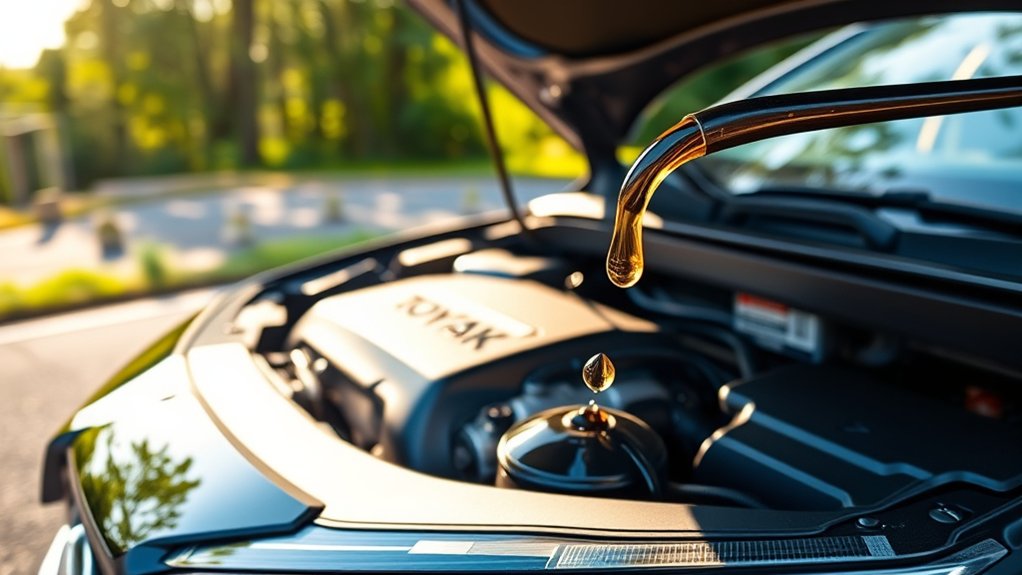
Toyota’s recent U.S. maintenance guides use the 5,000-mile or six-month oil interval when most of your driving involves one or more of these conditions:
- Dirt or dusty roads: Dust can increase contamination and also affects other filters and components.
- Towing, roof-carrier use, or heavy loading: Extra load increases operating stress. Follow the towing limits in your Owner’s Manual.
- Extensive idling or prolonged low-speed driving: Examples include taxi, police, delivery, or similar use where the engine runs for long periods while covering limited mileage.
- Repeated short trips below freezing: Toyota identifies repeated trips shorter than five miles when temperatures are below 32°F or 0°C.
An occasional dusty road or one short winter trip does not automatically place the vehicle on the shorter schedule. Toyota states that the additional services apply when the majority of your driving occurs under the listed conditions.
Ordinary stop-and-go commuting is not automatically identical to Toyota’s extensive-idling or long-distance low-speed category. Consider how long the engine idles, how often the pattern occurs, and whether most of your vehicle use fits the official description.
How to Check Your RAV4’s Oil Level
Toyota’s current RAV4 maintenance guide recommends checking the engine-oil level about once a month. Check it more often before long trips, after noticing a leak, or when the engine appears to be consuming oil.
- Park the RAV4 on a level surface.
- Bring the engine to normal operating temperature unless your Owner’s Manual instructs otherwise.
- Turn off the engine and wait several minutes so the oil can drain into the oil pan.
- Remove the dipstick and wipe it with a clean, lint-free cloth.
- Insert the dipstick fully, then remove it again.
- Confirm that the oil is between the low and full marks.
- If oil is low, add the specified oil gradually and recheck the level. Do not overfill.
- Reinstall the dipstick and oil-filler cap securely.
Contact a qualified technician if the level drops repeatedly, you see metal particles or creamy contamination, or the oil smells strongly of fuel or burning.
Best Practices for Maintaining Your RAV4’s Engine Health
Consistent maintenance matters more than choosing an arbitrary shorter or longer interval. Use these practices to reduce preventable lubrication problems:
- Follow the maintenance guide for the exact model year and powertrain.
- Use the required viscosity and oil performance specification.
- Replace the oil filter whenever the scheduled oil change is performed.
- Check the oil level monthly and before long journeys.
- Track both mileage and elapsed time.
- Inspect for leakage after service and periodically between services.
- Keep receipts showing the date, mileage, oil specification, filter, and service provider.
- Do not rely on oil color, a generic sticker, or the oil brand alone to determine the interval.
Pro Tip: Record the mileage and date immediately after each oil change. A photo of the receipt, oil container, filter box, and odometer can provide useful maintenance documentation.
In the United States, you do not have to use a Toyota dealership for routine maintenance to keep the warranty in effect. The Federal Trade Commission advises owners to retain maintenance records. A manufacturer may still deny coverage for damage caused by improper maintenance, incorrect fluids, defective parts, or faulty installation.
Related Guides
Frequently Asked Questions
What type of synthetic oil is best for my RAV4?
Use a reputable oil that matches both the viscosity and performance specification listed in the Owner’s Manual for your exact model year, engine, and market. The correct specification matters more than choosing a particular brand.
Can I switch back to conventional oil after using synthetic?
Only use an oil that meets Toyota’s required viscosity and performance specification. Many low-viscosity oils required by modern RAV4 engines are sold as synthetic products. Do not switch to conventional oil unless it fully meets the requirements in your manual.
Does synthetic oil improve fuel efficiency?
Using the correct low-viscosity oil helps the engine operate as Toyota designed it. However, you should not expect a guaranteed or easily noticeable fuel-economy increase simply from changing brands or switching base-oil types.
How do I check my RAV4’s oil level?
Park on level ground, shut off the engine, wait several minutes, remove and wipe the dipstick, insert it fully, and remove it again. The oil should sit between the low and full marks. Add the specified oil gradually if needed and avoid overfilling.
Can missed oil changes affect my warranty?
A warranty claim may be denied when a failure was caused by neglected or improper maintenance. You may use an independent shop or perform routine maintenance yourself, but keep receipts and records showing the date, mileage, oil specification, filter, and work performed.
Does a RAV4 Hybrid have the same oil change interval?
Recent U.S. RAV4 Hybrid maintenance charts generally use the same 10,000-mile normal-use and 5,000-mile special-use pattern. The 2026 U.S. RAV4 lineup is electrified with Hybrid and Plug-in Hybrid powertrains, and Toyota’s 2026 maintenance chart follows that same basic interval pattern. Still, check the guide for your exact model year and powertrain.
Is 5,000 or 10,000 miles the right RAV4 oil-change interval?
For verified recent U.S. schedules, use 10,000 miles or 12 months under normal use. Use 5,000 miles or six months when the majority of your driving meets Toyota’s listed special operating conditions. Your exact model-year maintenance guide takes priority.
Does the maintenance-required light measure oil quality?
Treat it as a scheduled-service reminder, not as proof that the vehicle has chemically tested the oil. Check the mileage, elapsed time, and maintenance guide. A low-oil-pressure warning is a separate and more urgent condition.
Conclusion
Your Toyota RAV4’s synthetic oil change interval should come from its model-specific maintenance guide. For verified recent U.S. models, the schedule is generally 10,000 miles or 12 months under normal use and 5,000 miles or six months when the majority of driving meets Toyota’s special operating conditions. Use the required oil specification, check the level monthly, keep service records, and address pressure warnings, leaks, smoke, or rapid oil loss without waiting for the next scheduled change. Your next step is simple: open Toyota’s manual lookup, select your exact model year and powertrain, then record the mileage and date of your next required oil service.
Sources
- 2026 Toyota RAV4 Warranty and Maintenance Guide — current U.S. maintenance intervals, monthly oil-level checks, and special operating conditions.
- 2025 Toyota RAV4 Warranty and Maintenance Guide — 2025 oil and filter schedule and maintenance requirements.
- Toyota USA Newsroom: 2026 RAV4 — 2026 U.S. RAV4 Hybrid and Plug-in Hybrid powertrain lineup.
- Toyota Manuals and Warranties — model-specific Owner’s Manuals and maintenance guides.
- American Petroleum Institute Motor Oil Guide — current API and ILSAC engine-oil performance categories.
- Federal Trade Commission: Auto Warranties and Service Contracts — independent maintenance, aftermarket parts, and recordkeeping guidance.


2 thoughts on “Toyota RAV4 Synthetic Oil Change Interval: How Often Should You Change It?”