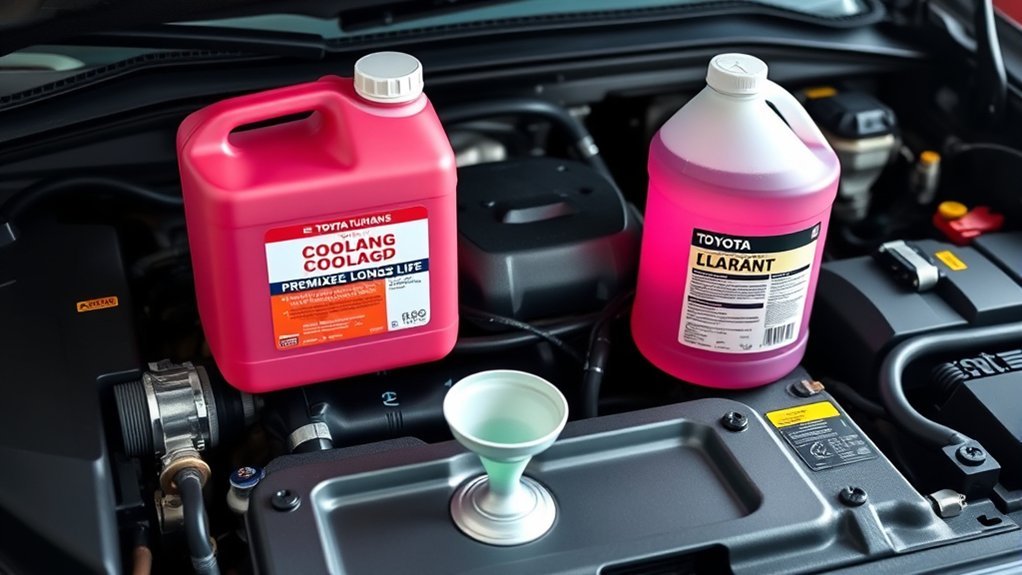
Your 2023–2026 Toyota Tundra needs coolant that matches Toyota’s specified chemistry, not simply a fluid with the right color. Toyota Genuine Super Long-Life Coolant is the safest straightforward choice, although Toyota also permits a similar high-quality coolant that meets the requirements for your exact model year. You also need to identify the correct cooling circuit before checking or adding fluid.
Quick Answer
For a 2023–2026 Toyota Tundra, use Toyota Genuine Super Long-Life Coolant or a high-quality equivalent that matches Toyota’s model-year chemistry requirements. Toyota schedules the first engine and intercooler coolant replacement, when applicable, at 100,000 miles or 120 months, then every 50,000 miles or 60 months. Never choose coolant by color alone.
Key Takeaways
- Toyota Genuine Super Long-Life Coolant is recommended, but a properly specified equivalent may also be used.
- The first scheduled engine and intercooler coolant replacement is at 100,000 miles or 120 months, not 30,000 miles.
- After the initial service, replace the applicable coolant every 50,000 miles or 60 months.
- Some Tundras have separate engine, intercooler, and inverter coolant reservoirs.
- Check levels only when the truck is cool, and investigate repeated coolant loss instead of continually topping it off.
- Coolant color is only a visual clue. The product’s chemistry and compatibility statement are what matter.
At a Glance
| Time Required | About 5–10 minutes for a cold-engine level check; coolant replacement takes longer and varies by powertrain and service method. |
| Difficulty | Easy for a visual level check; advanced for draining, refilling, and bleeding the cooling system. |
| Tools Needed | Gloves, a flashlight, a clean funnel, and the correct coolant for your model year and cooling circuit. |
| Cost | A visual check costs nothing. Top-off and replacement costs vary with coolant quantity, powertrain, local labor, and whether repairs are needed. |
Warning: Never remove a radiator or pressurized coolant cap while the engine is hot. Hot coolant and steam can escape under pressure and cause severe burns. Let the truck cool completely before inspecting or adding coolant.
Recommended Coolant for 2023–2026 Toyota Tundra
Toyota equips the Tundra with Toyota Genuine Super Long-Life Coolant. You may also use a similar high-quality coolant, but its label must explicitly match the chemistry required for your truck’s model year.
| Model Year | Toyota Coolant Guidance |
|---|---|
| 2023–2024 | Toyota Genuine Super Long-Life Coolant or a similar high-quality, non-silicate, non-amine, non-borate ethylene-glycol coolant using long-life hybrid organic acid technology. |
| 2025–2026 | Toyota Genuine Super Long-Life Coolant or a similar high-quality, non-silicate, non-amine, non-nitrate, non-borate ethylene-glycol coolant using long-life hybrid organic acid technology. |
You can verify these requirements in Toyota’s official 2023 guide, 2024 guide, 2025 guide, and 2026 guide.
Note: Factory coolant is typically pink, but color is not a technical standard. Different products can share a color while using different additive packages. Confirm compatibility from the product label and your exact owner’s manual.
Do not automatically add distilled water to the reservoir. If your coolant is sold as a premixed product, adding more water weakens its intended concentration. If you are using a concentrate, follow its label and Toyota’s instructions precisely.
[Amazon Products Picked for You]

Compatible with Toyota 4Runner 1989-2002, Avalon 1995-2004, Camry 1989-2006, Celica 1989-2005, Corolla 1988-2008, Cressida 1989-1992, Highlander 2001-2010, Land Cruiser 1989-2003, Matrix 2003-2008, MR2 1989-1995, MR2 Spyder 2000-2005, Paseo 1992-1997, Pickup 1989-1995, Previa 1991-1997, Prius 2001-2003, RAV4 1996-2003, Sienna 1998-2006, Solara 1999-2008, Supra 1989-1998, T100 1993-1998, Tacoma 1995-2004, Tercel 1990-1997, Tundra 2000-2004

FEL-PRO 35941 Engine Coolant Outlet Gasket for Toyota Tundra

Antifreeze Coolant
Identify the Correct Coolant Reservoir
A 2023–2026 Tundra may have more than one cooling circuit. Depending on its powertrain and equipment, you may see separate see-through reservoirs for:
- Engine coolant: Controls temperature in the engine’s main cooling system.
- Intercooler coolant: Supports the liquid-cooled charge-air system on applicable turbocharged configurations.
- Inverter coolant: Helps manage hybrid-system electronics on applicable i-FORCE MAX models.
Do not assume that every translucent tank serves the engine radiator. Read the cap and reservoir labels before adding fluid. Never transfer fluid between circuits unless Toyota’s documentation for your exact truck confirms the same product and procedure.
Pro Tip: Photograph the reservoir label and coolant-container label before topping off. The photos create a useful record if you later need to confirm what fluid was added.
When Should You Change Your Tundra’s Coolant?
Toyota’s scheduled interval is much longer than 30,000 miles. For 2023–2026 Tundras, Toyota specifies the following engine and intercooler coolant schedule when the circuit is applicable:
Replace the applicable engine and intercooler coolant for the first time at 100,000 miles or 120 months. Replace it every 50,000 miles or 60 months after that.
| Time or Mileage | Recommended Action | Important Details |
|---|---|---|
| At scheduled maintenance visits | Inspect coolant levels and condition | Check all applicable cooling circuits and inspect for leaks, damage, or contamination. |
| 100,000 miles or 120 months | First scheduled replacement | Applies to engine and intercooler coolant when equipped. Use the correct Toyota-specified coolant. |
| Every 50,000 miles or 60 months afterward | Subsequent replacement | Count from the previous coolant replacement. |
| Any time a leak, contamination, or incompatible fluid is found | Diagnose and service the system | Repair the cause before simply topping off or replacing the coolant. |
Time and mileage are both limits, so use whichever comes first. Consult your VIN-specific maintenance guide for inverter-coolant requirements and any regional differences.
[Amazon Products Picked for You]

Formulated to replace the OEM fluid in Asian make vehicles such as Toyota , Lexus , Scion and others requiring a red, silicate free HOAT antifreeze/coolant

Single Quantity

Specifically designed to match the needs of your car, OEM fluids keep your vehicle performing at its best. Drive with confidence. Drive with OEM.
Signs That Indicate Your Tundra Needs Coolant-System Service
Cooling-system symptoms do not automatically mean your Tundra needs a flush. They mean the system needs inspection so you can identify the leak, restriction, electrical fault, damaged component, or contaminated fluid causing the problem.
- Temperature warning or overheating: Stop driving as soon as it is safe. Continuing to operate an overheating engine can cause major damage.
- Repeatedly low coolant: A sealed cooling system should not need frequent top-offs. Look for leaks at hoses, reservoirs, connections, the radiator, or other components.
- Coolant under the truck: Note the location and color, but do not touch or taste the fluid.
- Sweet or chemical odor: This may indicate escaping coolant, especially if you also see dampness, residue, or steam.
- Rust, oil, particles, or heavy discoloration: Contamination requires professional evaluation before more coolant is added.
- Poor cabin heat with temperature changes: This can occur with low coolant, trapped air, or a circulation problem.
- Steam from the engine bay: Shut off the truck safely and do not open a hot cap.
A check-engine light can appear for many unrelated reasons. Read the diagnostic codes and inspect the truck rather than assuming coolant replacement will resolve it.
How to Check Your Tundra’s Coolant Level
You can perform a basic visual check at home, but the engine must be completely cool and the truck should be parked on level ground.
1. Locate and Identify Each Coolant Reservoir
Open the hood and locate the see-through coolant reservoirs. Read each cap or nearby label to determine whether it serves the engine, intercooler, or inverter circuit. Your truck may not have every circuit listed.
2. Inspect the Fluid Level
Look through the side of each applicable reservoir. The coolant should fall between its lower and upper level marks, which may be labeled “LOW” and “FULL” or “MIN” and “MAX.” Do not rely on the apparent level while the truck is parked on a steep slope.
3. Check the Coolant’s Condition
Healthy coolant should look uniform and free from oil, rust, sludge, or floating particles. A color difference alone does not confirm contamination because coolant dyes vary by manufacturer.
4. Top Off Only With a Verified Compatible Product
If the cold level is slightly low and no active leak is visible, add the correct coolant to the appropriate reservoir without exceeding the upper mark. Use a clean funnel and prevent dirt, oil, or another fluid from entering the tank.
Do not dilute a premixed product. If the container holds concentrate, follow its mixing instructions and your owner’s manual. Never use plain water as the routine replacement for properly formulated coolant.
5. Monitor for Recurring Coolant Loss
Recheck the level after normal driving and a complete cool-down. If the coolant drops again, arrange a pressure test and cooling-system inspection. Repeated topping off can hide a leak while the underlying problem becomes worse.
Why the Right Coolant Type Matters
Coolant carries heat away from the engine while its additive package helps protect metals, seals, hoses, and internal passages. A compatible product also supports freeze protection, boiling resistance, and corrosion control over the intended service interval.
Prevent Corrosion and Cooling-System Damage
Toyota’s specified long-life hybrid organic acid technology uses a controlled additive package designed for the materials in the cooling system. An incompatible product may shorten service life, reduce corrosion protection, or leave deposits that interfere with circulation.
The correct coolant also helps protect the turbocharged engine and applicable intercooler circuit during heavy loads, hot weather, cold starts, towing, and stop-and-go driving. It cannot compensate for a leak, failed pump, blocked radiator, damaged hose, or other mechanical fault.
Preserve Compatibility and the Intended Service Interval
Toyota bases its published replacement interval on Toyota Genuine Super Long-Life Coolant or a similar product meeting the stated chemistry. Toyota warns that a different ethylene-glycol coolant may require a different replacement interval.
For that reason, record the coolant brand, product name, specification, date, and mileage whenever fluid is added or replaced. This information makes future maintenance and troubleshooting more reliable.
Consequences of Mixing Different Types of Coolant
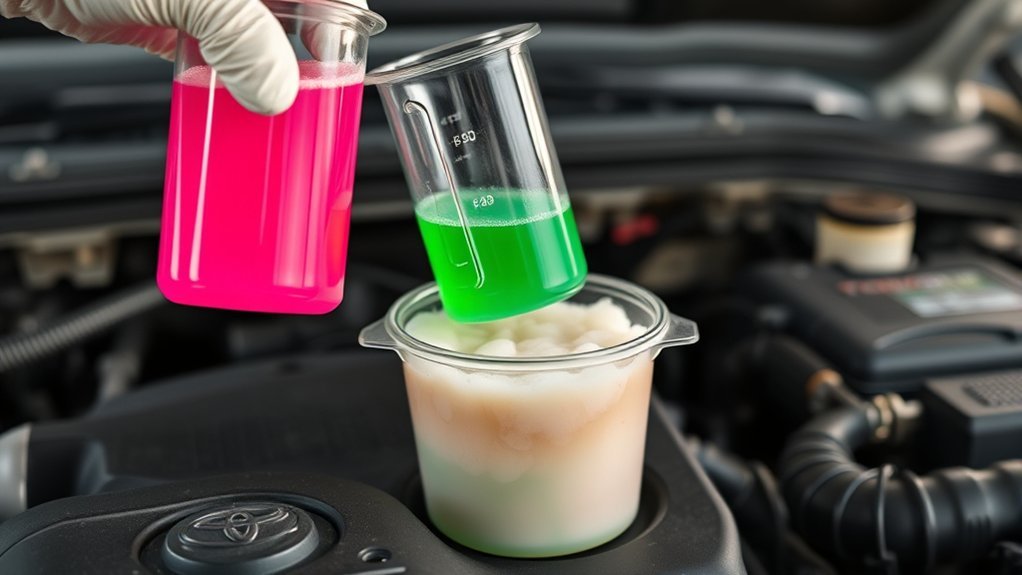
Mixing unknown or incompatible coolant formulations can alter the additive balance that protects your Tundra’s cooling system. Possible results include reduced corrosion protection, a shortened service interval, deposits, or uncertain freeze and boil protection.
A small addition of a verified compatible coolant is different from combining products based only on their color. Before topping off, compare the product’s chemistry statement with the requirements for your exact model year.
What to Do if the Wrong Coolant Was Added
- Do not add another product in an attempt to balance the mixture.
- Record the product name and estimate how much entered the system.
- Avoid driving if the truck is overheating, leaking, or displaying a temperature warning.
- Have a qualified technician determine whether the system needs testing, draining, refilling, or additional cleaning.
- Repair any leak or failed component before completing the coolant service.
If the fluid type is unknown, the safest approach is to have the system evaluated instead of assuming that similar colors mean compatibility.
Coolant Replacement vs. a Coolant Flush
For scheduled maintenance, Toyota describes draining the cooling system and refilling it with the specified coolant. This is commonly called a coolant replacement or drain-and-refill.
A more extensive flush may be considered when the system contains contamination, an incompatible product, heavy deposits, or debris from a failed component. Flushing should not replace proper diagnosis, and aggressive chemicals should not be introduced without confirming that they are suitable for the system.
Coolant replacement on a modern Tundra can involve multiple circuits, precise capacities, and procedures for removing trapped air. Air left in the system can cause unstable temperatures, poor circulation, or misleading reservoir levels. Toyota recommends having a qualified technician perform the drain-and-refill operation.
[Amazon Products Picked for You]

[Package Includes] The radiator funnel kit includes 4pcs filler caps, 5pcs adapters, 2pcs 45 ° elbows, a 5-inch extension tube, and a high-quality transparent antifreeze funnel. The radiator vent funnel kit is suitable for the radiator or reservoir of most vehicles, such as domestic and imported cars and light trucks.

Include two clamps, multiple tees, a garden hose adapter, an elbow and a cap

Clear Out Cooling System Buildup: Orion Motor Tech's coolant system flush gun combines compressed air and water flow to help remove rust, scale, sludge, and debris from radiators, heater cores, and cooling passages, helping coolant move more freely
Frequently Asked Questions
What kind of coolant does a 2023–2026 Toyota Tundra take?
Use Toyota Genuine Super Long-Life Coolant or a similar high-quality ethylene-glycol coolant that explicitly meets Toyota’s chemistry requirements for your model year. The 2025–2026 guidance includes non-silicate, non-amine, non-nitrate, non-borate long-life HOAT chemistry.
Do Toyotas require special coolant?
They require coolant with specific chemistry. Toyota Genuine Super Long-Life Coolant is the simplest choice, but Toyota also allows a similar high-quality product that meets the stated requirements. Do not select a coolant solely because its label says “universal.”
What color is the coolant in a Toyota Tundra?
Toyota Genuine Super Long-Life Coolant is typically pink. However, color does not prove compatibility because manufacturers can use similar dyes with different formulas. Verify the product specification and model-year requirements.
Does it matter what type of coolant I use?
Yes. An incompatible coolant can reduce corrosion protection, change the expected service interval, or create uncertainty about freeze and boil protection. Use a product that clearly matches Toyota’s specification for your exact truck.
How often should coolant be replaced in a 2023–2026 Tundra?
Toyota schedules the first engine and intercooler coolant replacement, when applicable, at 100,000 miles or 120 months. Replace it every 50,000 miles or 60 months after that. Use whichever time or mileage limit comes first.
Should you add distilled water to Toyota Super Long-Life Coolant?
Do not add water to a product that is already premixed. If you purchase a concentrate, mix it only as directed by its label and your owner’s manual. Adding an unmeasured amount of water can weaken the intended concentration.
Why does my Tundra have more than one coolant reservoir?
Depending on its configuration, your Tundra may have separate engine, intercooler, and inverter cooling circuits. Identify the label on each reservoir before adding fluid, and follow the instructions for that specific circuit.
Conclusion
For a 2023–2026 Toyota Tundra, choose coolant by Toyota’s chemistry requirements rather than color alone. Toyota Genuine Super Long-Life Coolant is the most direct option, while a properly specified equivalent may also be suitable. Inspect every applicable reservoir with the truck cool, investigate repeated fluid loss, and follow the official 100,000-mile or 120-month initial replacement interval.
After the first replacement, service the engine and applicable intercooler coolant every 50,000 miles or 60 months. Because Tundras can have multiple cooling circuits and require proper air bleeding, have a qualified technician handle replacement whenever you are uncertain about the fluid, procedure, or reservoir.
Sources
- 2023 Toyota Tundra Warranty & Maintenance Guide — coolant chemistry, inspection guidance, and replacement intervals.
- 2024 Toyota Tundra Warranty & Maintenance Guide — engine and intercooler coolant service requirements.
- 2025 Toyota Tundra Warranty & Maintenance Guide — engine, inverter, and intercooler reservoir guidance and updated coolant chemistry.
- 2026 Toyota Tundra Warranty & Maintenance Guide — current coolant inspection, chemistry, and scheduled maintenance requirements.
- Toyota Manuals and Warranties Portal — model- and year-specific owner documentation.
