Last updated: September 19, 2026
The 2024 Toyota Tacoma’s rear differential lock is a low-speed traction aid for situations where one rear wheel is spinning on a ditch, slippery surface, or rugged terrain. Toyota instructs drivers to stop the wheelspin before locking the differential, keep vehicle speed at or below 5 mph (8 km/h) while it is locked, and unlock it as soon as the truck moves free of the condition that required it.
Quick Answer
Use the 2024 Tacoma rear differential lock only when extra rear-axle traction is needed because one rear wheel is spinning on a slippery, rugged, or uneven surface. Release the throttle and let the wheels stop spinning, press the factory lock switch, wait until the indicators stop flashing and remain on, then move gently at no more than 5 mph (8 km/h). Unlock the differential as soon as the truck is free.
Key Takeaways
- The locker makes both rear wheels rotate at the same speed; it does not create tire grip or ground clearance.
- Toyota made the electronic rear locker standard on the 2024 TRD PreRunner, TRD Off-Road, TRD Pro, and Trailhunter.
- Do not press the lock switch while the rear wheels are spinning; let the wheelspin stop first.
- Do not exceed 5 mph (8 km/h) while the rear differential is locked.
- ABS, brake assist, VSC, TRAC, and Downhill Assist Control (if equipped) do not operate while the rear differential is locked, so unlock it as soon as the truck is free.
At a Glance
| Time Required | A few seconds for the system to complete locking or unlocking after the switch is pressed; recovery time depends on terrain |
| Difficulty | Easy to operate; safety-critical judgment is required on difficult terrain |
| Tools Needed | None for normal operation |
| Maximum Locked Speed | 5 mph (8 km/h) |
Which 2024 Tacoma Trims Have a Rear Locker?
Toyota lists the electronic locking rear differential as standard on four 2024 Tacoma grades: TRD PreRunner, TRD Off-Road, TRD Pro, and Trailhunter. The TRD PreRunner is the exception to the usual 4WD association because it is a two-wheel-drive XtraCab model with the rear locker standard.
| 2024 Tacoma Grade | Rear Locker | Drivetrain Note |
|---|---|---|
| TRD PreRunner | Standard | 2WD XtraCab |
| TRD Off-Road | Standard | 4WD grade |
| TRD Pro | Standard | 4WD grade |
| Trailhunter | Standard | 4WD grade |
Do not confuse the rear locker with a center differential lock. Toyota’s 2024 Tacoma Limited with the i-FORCE MAX powertrain uses a full-time 4WD system with a center locking differential, which is a different driveline function from the rear locker covered here.
What the 2024 Tacoma Rear Differential Lock Does

An unlocked differential lets the left and right rear wheels rotate at different speeds. That difference is necessary during normal turns because the outside wheel travels farther than the inside wheel.
When you activate the rear locker, the system couples the two rear axle shafts. Both rear wheels then rotate together, so a wheel on firmer ground can continue contributing when the opposite rear wheel has much less traction. Toyota describes the system as helping distribute power evenly between the rear wheels in low-traction conditions.
The lock does not create grip or increase ground clearance. Both tires can still spin, the truck can still slide, and the chassis can still become high-centered if the terrain supports the frame instead of the tires.
According to Toyota’s fourth-generation Tacoma information, the electronic locking rear differential is standard on the 2024 TRD PreRunner, TRD Off-Road, TRD Pro, and Trailhunter. The TRD PreRunner matters because it confirms that the factory rear locker is not limited to four-wheel-drive configurations.
A rear locker can help when one rear tire has much less traction than the other, but it cannot create grip, add ground clearance, or make an unsafe line safe.
When to Use the 2024 Tacoma Rear Diff Lock
Toyota’s 2024 owner documentation says the rear differential lock is for situations where wheelspin occurs in a ditch or on a slippery or rugged surface, especially when one rear wheel is spinning. If the wheels are already spinning, release the throttle and wait for them to stop before pressing the lock switch.
Typical low-speed examples include a rock step that unloads one rear tire, a deep rut, a diagonal washout, or a slippery climb where the two rear tires have sharply different grip. The locker is not a routine “just in case” setting for every off-road obstacle.
When both rear tires have similar traction, or when the truck can clear the terrain with its normal traction systems, leave the rear differential unlocked. An open differential lets the rear wheels rotate at different speeds in a turn, which reduces tire scrub and steering resistance.
Warning: Do not engage the rear locker while the wheels are spinning, do not drive faster than 5 mph (8 km/h) while it is locked, and do not keep driving with the lock engaged after the truck is free. ABS, brake assist, VSC, TRAC, and Downhill Assist Control (if equipped) do not operate while the rear differential is locked.
How to Activate the Rear Diff Lock (Step-by-Step)
Use the 2024 Tacoma owner’s manual and the instrument display for your exact configuration. The TRD PreRunner is 2WD, while locker-equipped TRD Off-Road, TRD Pro, and Trailhunter grades use 4WD systems, so transfer-case instructions are not identical across every locker-equipped 2024 Tacoma.
- Confirm that your Tacoma has the factory rear locker. Look for the rear differential lock switch and the matching indicator in the instrument display.
- Position the truck safely and stop wheelspin. Release the throttle and make sure the rear wheels have stopped spinning before you request the lock.
- Use the drive setting required by your configuration. Follow the instrument display and owner’s manual. On 4WD models, the 2024 manual notes that moving the front-wheel-drive control to 2H or 4H automatically unlocks the rear differential.
- Press the rear differential lock switch once. The rear differential lock indicator and the differential lock/unlock display indicator should flash while the system changes state.
- Wait for confirmed engagement. Do not rely on the locker until the indicators stop flashing and remain on.
- Move with gentle throttle. Keep speed at or below 5 mph (8 km/h) while the rear differential is locked.
- Unlock as soon as the truck moves free. Press the switch again and confirm that the indicators turn off before returning to normal driving.
Pro Tip: If the indicators keep flashing after you press the switch, stop the vehicle completely and operate the switch again. If they still continue to flash, Toyota advises having the truck inspected. If the indicator keeps flashing after an unlock request, check that the area is safe and slightly turn the steering wheel in either direction while moving slowly to help the mechanism release.
Rear Diff Lock Indicator and Engagement Problems
The dashboard indicators confirm whether the requested lock or unlock action has finished. Flashing is normal while the mechanism is changing state; a steady lock indication confirms engagement.
| What You Notice | Likely Meaning | What to Do |
|---|---|---|
| Indicators flash immediately after pressing the switch | The system is changing between locked and unlocked states | Wait a few seconds and do not rely on the locker until the indicators stop flashing |
| Indicators continue flashing after a lock request | The requested state has not been confirmed | Stop the vehicle completely and operate the switch again; if flashing persists, arrange Toyota inspection |
| Indicator still flashes after an unlock request | The locking mechanism may not have completed disengagement | When the area is safe, move slowly and slightly turn the steering wheel in either direction, then confirm the indicators go off |
| Warning message remains or returns | A four-wheel-drive or rear differential lock system problem may be present | Leave the locker disengaged and arrange inspection by a Toyota dealer or qualified technician |
Note: Exact display wording can vary by configuration. The 2024 owner’s manual and the messages shown by your truck take priority over generic off-road advice.
5 Tacoma Trail Scenarios Where the Rear Diff Lock Helps

The rear locker is most valuable when one rear tire is likely to lose contact or encounter a much slipperier surface. These five examples show where locking the axle may provide a meaningful advantage.
Deep Mud Ruts
In offset mud ruts, one rear tire may carry more weight while the other spins in soft material. If wheelspin shows that the locker is needed, release the throttle, let the wheels stop spinning, engage the lock, and then resume at low speed.
Use steady throttle and avoid rapidly digging holes beneath both tires. If the truck stops moving, reduce throttle instead of continuing to spin the tires.
Rocky Ascents
A rocky step can unload one rear tire as the suspension articulates. With the rear axle locked, the grounded tire can continue contributing even if the opposite tire has little contact.
- Choose your line before starting the climb.
- Keep the wheels as straight as practical.
- Use low, controlled engine torque.
- Pause if the chassis contacts the obstacle.
Loose Sand Traverses
Soft sand can let one rear wheel spin faster and dig beneath the surface. If one rear wheel begins spinning and the truck needs more rear-axle traction, stop the wheelspin before engaging the locker and then continue gently.
Avoid abrupt steering because the locked axle resists the wheel-speed difference required by a turn. Momentum can help, but speed should remain low enough for you to stop within the visible trail.
Cross-Axle Washouts and Diagonal Ditches
A diagonal ditch can place the front wheel on one side and the rear wheel on the opposite side under the greatest load. The other rear tire may become lightly loaded or lift from the ground.
The rear locker is particularly useful here because it prevents the lightly loaded tire from spinning independently. Crawl through while watching clearance under the frame, differential housing, and steps.
Deep Snow and Uneven Loose Climbs
On a slow climb covered by loose snow, gravel, or mixed surfaces, the rear tires may repeatedly encounter different levels of grip. Locking can reduce one-wheel flare and help you apply power more consistently.
Both tires can still slide sideways on a slope. Stop if the truck begins moving laterally or if the tires cannot hold your intended line.
| Scenario | Driver Input | Desired Result |
|---|---|---|
| Deep rut | Stop wheelspin, then engage | Keep both rear wheels contributing |
| Rock step | Use slow, smooth throttle | Reduce one-wheel spin |
| Soft sand | Hold a steady pace | Limit digging and speed variation |
| Diagonal washout | Crawl with nearly straight steering | Keep propulsion when one tire unloads |
| Slippery climb | Apply progressive throttle | Maintain controlled forward movement |
How to Keep Momentum With the Rear Diff Locked
With the rear differential locked, “momentum” means maintaining controlled movement, not adding speed. Toyota limits locked operation to 5 mph (8 km/h), so the goal is a smooth line and steady throttle rather than charging the obstacle.
- Look beyond the front bumper. Identify the exit, large rocks, holes, and possible chassis contact before moving.
- Stay at or below 5 mph (8 km/h). Keep enough control to stop immediately if the truck slides or the line becomes unsafe.
- Apply throttle progressively. Sudden torque can make both rear tires spin at once.
- Limit sharp steering. A locked rear axle resists the normal wheel-speed difference required in a turn.
- Pause when progress stops. Reassess rather than continuing to dig, bounce, or shock-load the drivetrain.
If the frame, differential, or skid plates are supporting the truck, more throttle may not help. Use a safer line or an appropriate recovery method instead of relying on the locker alone.
Rear Locker vs. Tacoma Traction Systems
The rear locker is only one part of the 2024 Tacoma’s off-road toolkit. Toyota says 4WD models use a two-speed transfer case with Active Traction Control (A-TRAC) and Auto LSD, while Multi-Terrain Select and Crawl Control are available on applicable grades. These systems do different jobs and are not interchangeable.
| System | What It Does | Best Use |
|---|---|---|
| Rear differential lock | Mechanically couples the rear axle so the rear wheels rotate together | Severe side-to-side rear-wheel traction differences at very low speed |
| A-TRAC | Uses vehicle controls to help limit wheelspin on 4WD models | Variable off-road traction without mechanically locking the rear axle |
| Auto LSD | Uses brake intervention and vehicle control to reduce drive-wheel slip | Moderate wheelspin when a mechanical rear lock is not required |
| Multi-Terrain Select | Adjusts vehicle control for supported terrain modes | Mud, dirt, sand, and other supported terrain settings |
| Crawl Control | Manages very low-speed throttle and braking | Technical terrain where the driver needs to concentrate on steering |
Important: While the rear differential is locked, Toyota states that ABS, brake assist, VSC, TRAC, and Downhill Assist Control (if equipped) do not operate. Follow the owner’s manual and instrument display rather than assuming every traction or braking aid remains available.
Risks and When Not to Use the Rear Diff Lock
A locked rear axle reduces maneuverability because both rear wheels must rotate together. On a firm turn, the inside and outside rear tires normally need different rotational speeds. With the axle locked, one tire must scrub or slip to compensate, increasing steering effort and driveline load.
The safety tradeoff is more important on the 2024 Tacoma because several electronic braking and stability aids are unavailable while the locker is engaged. Toyota therefore limits use to low-speed situations where wheelspin or sharply uneven traction makes the rear lock necessary.
| Condition | Recommended Action |
|---|---|
| Dry pavement or ordinary driving | Keep the rear differential unlocked |
| Rear wheels are currently spinning | Release the throttle and wait for wheelspin to stop before pressing the lock switch |
| Vehicle speed would exceed 5 mph (8 km/h) | Do not keep the rear differential locked |
| Truck has cleared the slippery or uneven section | Unlock the rear differential as soon as possible |
| Truck is high-centered | Stop spinning the tires and use an appropriate recovery method |
| Indicators keep flashing after a second attempt | Stop using the locker and arrange inspection |
Do not continue applying throttle if the truck is sliding toward an edge, digging both tires, hopping, or striking the underbody. A locker changes how the rear axle shares motion; it cannot make an unsafe line safe.
Maintenance and Troubleshooting for the Rear Diff Lock
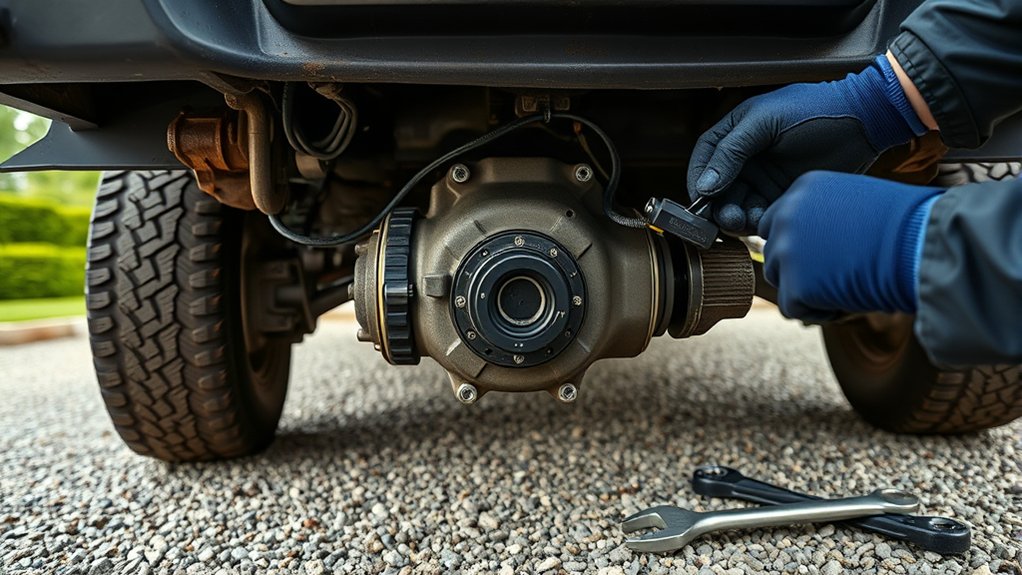
The factory locker does not need a special service routine each time it is used. It does depend on a healthy rear differential, correct lubricant condition, intact wiring, functioning sensors, and an actuator that can complete the lock and unlock movement.
- Inspect for leaks. Check the differential housing, axle seals, fill and drain plug areas, and the actuator area.
- Follow Toyota’s maintenance guide. Use the schedule and severe-use guidance that applies to your exact truck and operating conditions.
- Watch for delayed engagement. Repeated flashing or warning messages after the manual’s retry procedure should be diagnosed before another difficult trip.
- Listen for abnormal sounds. Stop using the locker if engagement is followed by persistent grinding, heavy banging, or a new driveline vibration.
- Inspect after deep water or heavy mud. Check for damaged wiring, packed debris, and signs of contamination around the axle and breather components.
- Confirm disengagement. Do not return to normal road driving while the display still shows the rear differential locked.
If a warning remains after the truck has been restarted under safe conditions, arrange inspection by a Toyota dealer or qualified technician. Do not strike the actuator, bypass control wiring, or repeatedly cycle the switch while the drivetrain is loaded.
Related Guides
Frequently Asked Questions
When should you use the rear locker on a Tacoma?
Toyota says to use the rear differential lock when wheelspin occurs in a ditch or on a slippery or rugged surface, especially when one rear wheel is spinning. Stop the wheelspin before pressing the lock switch, then unlock the differential as soon as the truck moves free.
Should you engage the locker before or after a wheel starts spinning?
On the 2024 Tacoma, wheelspin can indicate that the locker is needed, but Toyota also says not to lock the differential while the wheels are still spinning. Release the throttle, let the wheels stop, then press the rear differential lock switch.
How does the Toyota rear differential lock work?
The electronic control activates a mechanical locking mechanism in the rear axle. Once locked, the left and right rear axle shafts rotate together instead of allowing one rear wheel to turn faster than the other.
How do you use the rear differential lock on a 2024 Tacoma?
Stop the wheelspin, use the drive setting required by your configuration, press the rear-lock switch, and wait until the indicators stop flashing and remain on. Move gently at no more than 5 mph (8 km/h), then unlock the differential as soon as the truck is free.
Can a 2024 Tacoma rear locker work on a 2WD truck?
Yes. The 2024 TRD PreRunner is a two-wheel-drive XtraCab grade with an electronic locking rear differential as standard equipment, so 4WD is not a universal requirement across every locker-equipped 2024 Tacoma.
Why is the rear differential lock indicator blinking?
Blinking is normal while the system is locking or unlocking. If the indicators continue flashing after you operate the switch, stop the vehicle completely and operate the switch again. If they still keep flashing, Toyota advises having the truck inspected.
How fast can you drive with the 2024 Tacoma rear differential locked?
Toyota says not to drive faster than 5 mph (8 km/h) while the rear differential is locked. The locker is for very low-speed traction situations, not routine road driving.
What systems are disabled when the 2024 Tacoma rear differential is locked?
Toyota states that ABS, brake assist, Vehicle Stability Control (VSC), Traction Control (TRAC), and Downhill Assist Control when equipped do not operate while the rear differential is locked.
Conclusion
The 2024 Tacoma rear differential lock is a focused traction tool for very low-speed situations where one rear wheel is spinning and normal traction is not enough. It can help by making both rear wheels rotate together, but it cannot create tire grip, prevent high-centering, or replace careful line selection.
Stop wheelspin before locking, wait for solid indicator confirmation, stay at or below 5 mph (8 km/h), and remember that ABS, brake assist, VSC, TRAC, and Downhill Assist Control where equipped are unavailable while the rear differential is locked. Unlock as soon as the truck moves free, and investigate persistent warnings or repeated failure to engage or disengage.
Sources
- Toyota USA Newsroom: 2024 Toyota Tacoma Is the Ultimate Adventure Machine — confirms rear-locker availability by grade and Toyota’s description of the system.
- Toyota Owners: 2024 Tacoma Manuals and Warranties — provides the model-specific operating instructions, indicator behavior, speed limit, and warnings.
- Toyota 2024 Tacoma Quick Reference Guide — confirms that ABS, brake assist, VSC, TRAC, and Downhill Assist Control where equipped do not operate while the rear differential is locked.
