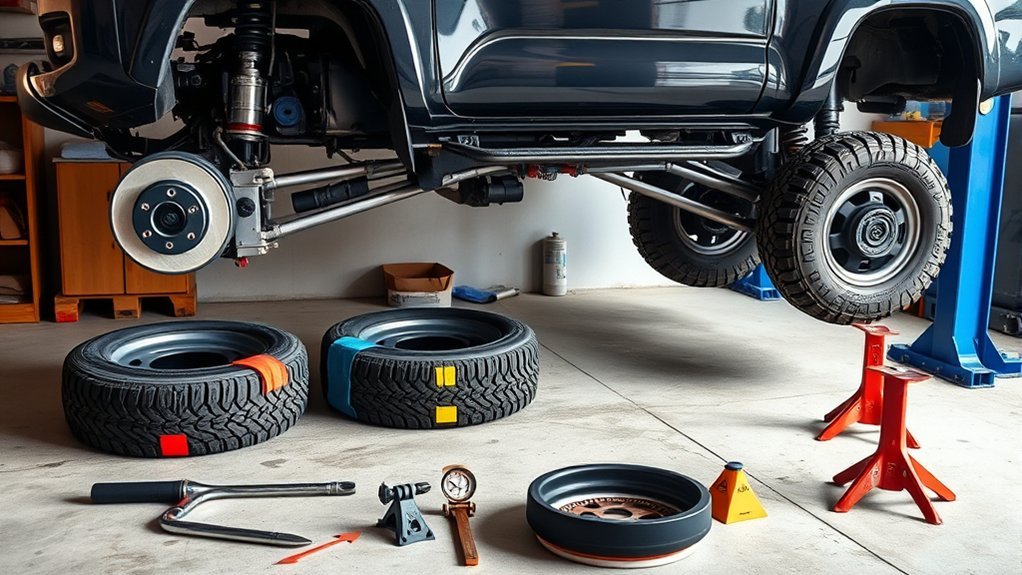
To rotate Toyota Tacoma tires correctly, start with the rotation diagram in the owner’s manual for your exact model year rather than a generic 2WD or 4WD chart. For the 2024 U.S. Tacoma, Toyota shows a front-to-rear, same-side rotation and schedules tire rotation at 5,000 miles or 6 months. Tire directionality, tire size, spare compatibility, and aftermarket equipment can still change what is possible, so confirm those details before lifting the truck.
Last updated: September 19, 2026. Source basis: Toyota model-year documentation, NHTSA TireWise, Michelin, and Bridgestone. This guide does not claim hands-on testing that was not performed.
Quick Answer
Follow the rotation pattern in your Tacoma’s exact model-year Toyota manual. The 2024 U.S. Tacoma manual shows a front-to-rear, same-side pattern, and its maintenance guide schedules tire rotation every 5,000 miles or 6 months. Directional tires also stay on the same side. Use a generic rearward-cross or X-pattern only when Toyota’s instructions and the tire manufacturer permit it. Use approved lift points and jack stands, torque the wheels to the exact specification for your truck, and set cold pressure from the vehicle placard.
Key Takeaways
- Toyota’s model-year rotation diagram takes priority over a generic drivetrain-based rotation chart.
- The 2024 U.S. Tacoma schedule calls for tire rotation every 5,000 miles or 6 months; verify the schedule for other model years.
- Directional tires stay on the same side unless a tire professional demounts and remounts them correctly.
- Use the exact lug-nut torque in your model-year Toyota information and the cold pressure on the driver-door placard.
- Do not rotate a tire with a bulge, exposed cords, severe cracking, or tread worn to 2/32 inch.
At a Glance
| Time Required | Varies by lifting method, wheel condition, spare-tire involvement, and the model-year TPMS procedure |
| Difficulty | Moderate; you must lift and support a heavy pickup correctly |
| Tools Needed | Rated floor jack, rated jack stands, wheel chocks, lug wrench or breaker bar, correct socket, torque wrench, tire-pressure gauge, tread gauge or ruler, and locking-lug key if fitted |
| Cost | No replacement parts are normally required if you already own the necessary tools; professional service pricing varies |
Warning: Never place any part of your body under a Tacoma supported only by a hydraulic jack or the factory emergency jack. Use rated stands at approved support points shown in your model-year manual. If you cannot identify safe lift and stand locations, have a qualified shop perform the rotation.
Choose the Right Tacoma Tire Rotation Pattern

The first rule is simple: use the Toyota rotation diagram for your exact model year before applying a generic tire-industry pattern. Toyota states that rotation frequency and pattern are vehicle-specific. The 2024 U.S. Tacoma owner’s manual shows the same-side front-to-rear pattern illustrated above. Check the current Toyota owner’s manual or Warranty and Maintenance Guide for your truck before moving any wheel.
Generic tire-industry charts are still useful for understanding special tire configurations. Michelin and Bridgestone describe rearward-cross, X-pattern, directional, staggered, and spare-inclusive rotations, but vehicle-manufacturer instructions take priority.
- Toyota manual specifies front-to-rear, same side: Swap left front with left rear and right front with right rear. The 2024 U.S. Tacoma is one confirmed example.
- Directional tires: Move each tire between the front and rear positions on the same side so its rotation arrow continues pointing in the correct direction.
- Equal-size, non-directional tires when Toyota permits a cross pattern: Tire-industry guidance commonly uses rearward-cross for rear-drive vehicles and X-patterns for many 4WD/AWD applications. Do not use those patterns merely because the Tacoma is 2WD or 4WD.
- Asymmetric but non-directional tires: They can generally be crossed when the vehicle and tire instructions allow it because the side marked
OUTSIDEremains facing outward. Confirm that no directional arrow is present. - Different front and rear tire sizes: Do not move tires between axles. Side-to-side rotation may be possible only when the same-size partners are non-directional and the vehicle and tire instructions permit it.
- Matching full-size spare: Include a spare only when it is a compatible full-size tire and the approved rotation procedure allows it. Confirm size, construction, load rating, usable tread, wheel compatibility, directionality, and TPMS requirements.
Important: Four-wheel drive does not automatically mean you should use an X-pattern on a Tacoma. If a generic rotation chart conflicts with Toyota’s model-year instructions, follow Toyota’s vehicle-specific pattern.
[Amazon Products Picked for You]

STEEL-IRON TIRE SPOONS: Each tire lever is constructed of hardened steel-iron with curved tips that provides strong toughness and reliable durability.

Excellent Plastic Material - This bead clamp is made high grade nylon and plastic composite material, durable and will not scratch or damage wheels. Its a huge time saver and can prevent tire bead and wheel damage from over stress.

Personal organizer for tire inspection tools
How Often Should You Rotate Tacoma Tires?
For the 2024 U.S. Tacoma, Toyota schedules tire rotation every 5,000 miles or 6 months, whichever comes first. Use the Warranty & Maintenance Guide for your exact model year because schedules can change. If you want a deeper schedule-focused explanation, see our Toyota Tacoma tire rotation interval guide.
Tire-company warranties may also contain rotation requirements. Follow the applicable Toyota schedule and any tire-warranty requirement that is more restrictive. After towing, heavy loading, rough-road use, or off-road driving, inspect the tires for pressure loss, cuts, bulges, and irregular wear rather than assuming the normal service interval is enough.
Do not wait for the TPMS warning light before checking your tires. The National Highway Traffic Safety Administration recommends checking pressure and tread at least monthly. Measure pressure when the tires are cold and use the value on the driver-door Tire and Loading Information label, not the maximum pressure molded into the tire sidewall.
Inspect the tread across the inner edge, center, and outer edge. Rotate as scheduled and investigate sooner if you notice:
- A measurable tread-depth difference between tire positions
- Feathering or a sawtooth feel across the tread blocks
- Cupped or scalloped depressions
- Faster wear on one shoulder
- New road noise or steering-wheel vibration
- Pulling on a straight, level road
- Repeated pressure loss
Rotation can redistribute ordinary wear, but it cannot repair a damaged tire or correct a mechanical problem. NHTSA advises replacing tires when tread reaches 2/32 inch or when damage makes continued use unsafe.
Pro Tip: Record the date, odometer reading, cold pressures, tread measurements, and rotation pattern. That record helps you repeat the approved pattern and spot a tire that is wearing faster than the others.
Checks Before Lifting the Tacoma
Complete these checks before loosening a lug nut:
- Open the model-year manual. Find the approved jack points, support locations, lug-nut torque, rotation pattern, and TPMS instructions.
- Read every tire sidewall. Look for a rotation arrow, an
OUTSIDEmarking, tire size, load index, and signs of damage. - Compare front and rear sizes. A staggered setup cannot use a normal front-to-rear rotation.
- Evaluate the spare. Exclude a temporary, differently sized, differently rated, excessively worn, or incompatible spare.
- Inspect the lifting equipment. Confirm that the jack and stands are rated for the truck and are undamaged.
- Find the locking-lug key. Confirm that the correct socket fits every lug nut before the truck is raised.
- Check the work surface. Use a hard, flat, level surface with enough room to work around the truck.
Do not rotate a tire that has exposed cords, a sidewall bulge, severe cracking, a deep cut, a leaking puncture, or tread at the wear bars. Have the tire professionally inspected or replaced.
[Amazon Products Picked for You]

Lightweight jack stands are used to support your vehicle after lifting with a jack; Wide pyramid foot base provides added strength and stable support

Pair of 3 Ton (2.7 metric Ton) jack stands with 6,000-pound capacity

【3 Ton Double Locking Jack Stands】:This Heavy Duty Vehicle Support has a 3-ton (6,600 lb) capacity per stand, with a lifting range of 11.22" (min) to 16.77" (max) and a net weight of 14.3 lbs. It fits most 3-ton automobiles but is not for large pick-ups, trucks, or oversized SUVs with a chassis height over 16".
How to Rotate Tires on a Toyota Tacoma: Step-by-Step
-
Confirm the exact rotation map.
Write down the starting and finishing position of each tire. Mark the tires with chalk as LF, RF, LR, and RR if that helps you avoid mistakes.
-
Secure the truck.
Park on a hard, flat, level surface. Place an automatic transmission in Park. For a manual transmission, use the parking procedure specified by the owner’s manual. Set the parking brake, switch off the engine, and chock the wheels that will remain on the ground during the initial lift.
-
Loosen the lug nuts slightly.
With the tires still on the ground, loosen each lug nut about one-quarter turn. Do not remove the nuts yet.
-
Raise and support the required wheels.
Lift only at the approved points shown in the model-year manual and place rated jack stands at approved support locations. Plan the support sequence around the approved rotation pattern. A cross-pattern may require multiple lift-and-support cycles, all four corners securely supported, or a compatible spare. Never improvise a support point or leave a corner unsupported.
-
Remove and inspect each wheel.
Remove the lug nuts and wheel. Check the tread, inner sidewall, outer sidewall, bead area, valve stem, rim, studs, and lug nuts. Clean loose dirt or rust from the wheel-to-hub mating surfaces. Keep studs and mating surfaces clean and dry unless Toyota service information specifically instructs otherwise.
-
Move the wheels to their assigned positions.
Follow the Toyota model-year rotation map you confirmed before lifting. Recheck directional arrows and sidewall markings before mounting each wheel.
-
Hand-start every lug nut.
Thread the nuts by hand to prevent cross-threading. Snug them gradually in a crisscross or star pattern. Do not use an impact wrench for final torque.
-
Apply the specified torque.
Lower the truck enough to prevent the wheel from turning, then tighten the lug nuts in a star pattern using a calibrated torque wrench set to the exact specification for your Tacoma’s model year, wheel, and fastener setup. Do not substitute a guessed universal Tacoma torque value.
-
Set cold tire pressure.
Adjust all road tires to the cold pressures on the driver-door placard. Front and rear recommendations may differ. Check the spare separately because its specified pressure may differ from the road tires.
-
Complete the model-year TPMS procedure and road-test the truck.
Tacoma TPMS procedures vary by generation and equipment. Depending on the system, the manual may call for initialization, wheel-position registration, or a drive period that lets the system identify tire positions. Follow the exact model-year procedure if the display identifies the wrong wheel or a warning remains after pressure is corrected. Drive at low speed first and check for warning lights, pulling, vibration, clunking, or unusual noise.
Warning: Stop driving and recheck the installation immediately if you hear clunking, feel severe vibration, or suspect a loose wheel. Do not assume a strong new vibration is a normal result of rotation.
[Amazon Products Picked for You]
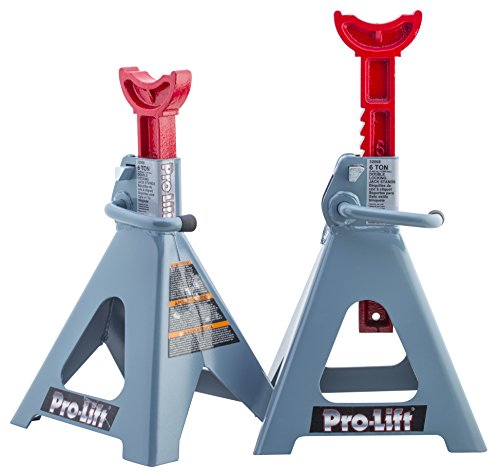
Sturdy Construction: Stamped steel construction with 6 ton capacity provides reliable support for heavy-duty lifting applications

3-TON LOAD CAPACITY: Supports up to 6,000 lb per pair with a 13.39-21.06 in adjustable height for compatible vehicle lifting applications
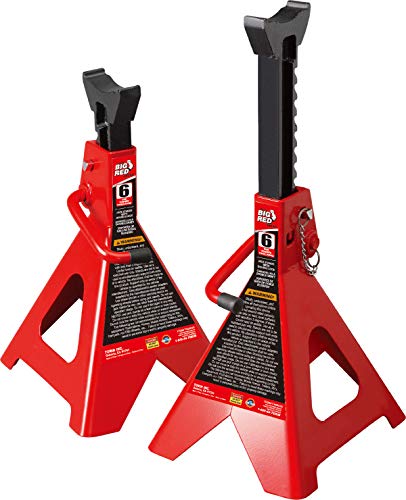
Double locking jack stands help support vehicles after lifting with a jack; Handles a wide range of vehicles including small cars, ATV's, UTV's, and more
Cross-Rotation vs Same-Side Rules
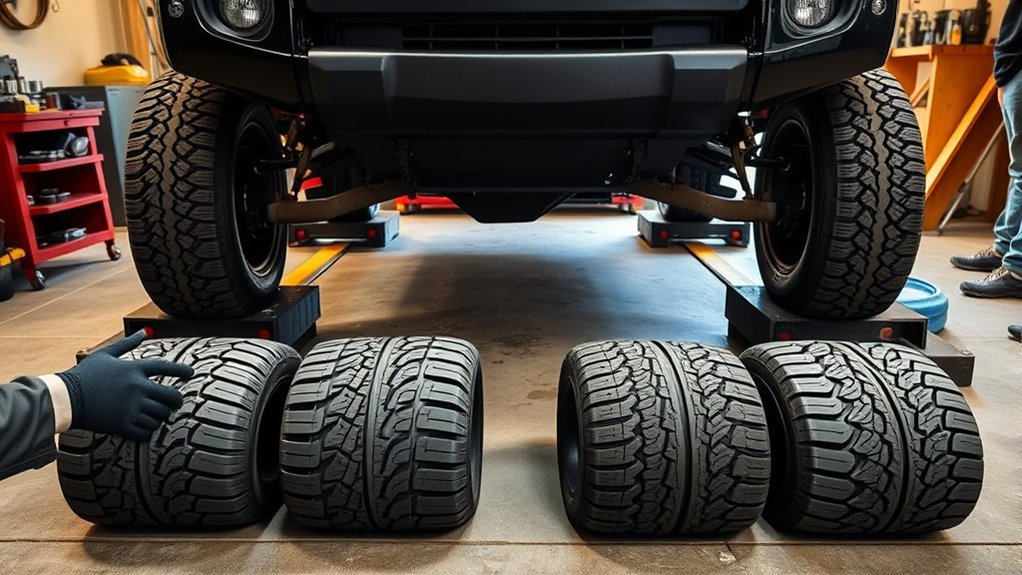
| Tacoma or Tire Setup | Rotation Rule | Important Limit |
|---|---|---|
| 2024 U.S. Tacoma factory guidance | Front to rear on the same side | Use the Toyota owner’s-manual diagram rather than substituting a generic 4WD pattern. |
| Other Tacoma model years | Use the exact Toyota model-year diagram | Do not assume a pattern from drivetrain alone. |
| Directional tires | Front to rear on the same side | The sidewall rotation arrow must point in the correct forward direction. |
| Equal-size, non-directional tires when Toyota permits crossing | Manual-approved cross pattern | Rearward-cross and X-patterns are tire-industry options, not automatic Tacoma rules. |
| Asymmetric, non-directional tires | Toyota-approved pattern | The side marked OUTSIDE must remain outward. Check for a directional arrow too. |
| Different front and rear sizes | Side to side only, when permitted | Do not exchange front and rear tires of different sizes. |
| Matching full-size spare | Approved five-tire pattern, when specified | The spare must be fully compatible and the approved procedure may include TPMS requirements. |
A directional arrow controls the tire’s rolling direction. An asymmetric OUTSIDE marking controls which sidewall faces away from the vehicle. A tire can have both markings, so inspect the complete sidewall rather than relying on tread appearance alone.
If crossing a directional tire is necessary for a specific approved setup, a tire professional must demount it from the wheel, remount it in the correct direction, balance it, and verify that the resulting position is permitted.
Post-Rotation Checks and Troubleshooting
Complete a final walk-around before normal driving:
- Confirm that every lug nut was tightened with a torque wrench in a star pattern.
- Verify cold pressure against the driver-door placard.
- Make sure each directional arrow points forward at the top of the tire.
- Check that asymmetric tires show
OUTSIDEon the visible sidewall. - Confirm that no valve cap, wheel center cap, or locking-lug key was left loose.
- Look for a TPMS warning or incorrect individual-position display.
- Drive slowly at first and listen for new sounds.
When Wheel Alignment Is Needed
A tire rotation does not change wheel alignment. Have the alignment measured if the truck pulls on a straight, level road, the steering wheel sits off-center, one shoulder wears faster, the tread feels feathered, or the truck recently struck a curb, pothole, or trail obstacle. Rotation alone will not correct these conditions.
When Wheel Balancing Is Needed
Balancing is not automatically required after every rotation. Request a balance inspection when vibration appears at a certain speed, a wheel weight is missing, a tire was removed from its wheel, or the tire shows cupping that may involve a balance or suspension problem.
What Common Wear Patterns Can Mean
- Both shoulders worn: Can be associated with repeated underinflation or overloading.
- Center worn: Can be associated with excessive inflation for the operating conditions or another setup problem.
- One edge worn: Often points to an alignment, suspension, or tire problem that needs diagnosis.
- Feathering: Frequently associated with an incorrect toe setting.
- Cupping or scalloping: May involve balance, worn shocks, loose suspension parts, alignment, or tire damage.
- Isolated flat spot: May follow hard braking, prolonged storage, or tire damage.
Wear patterns provide clues rather than a complete diagnosis. Have a qualified technician inspect the truck when wear is severe, rapidly progressing, or accompanied by noise, looseness, pulling, or vibration.
TPMS After Tire Rotation
The pressure sensor moves with its wheel, but the required post-rotation procedure varies by Tacoma generation and equipment. Some systems require tire-pressure initialization or wheel-position registration, while systems with tire-position identification may update positions after the required procedure and driving period. Set the tires to the correct cold pressure first, then follow the TPMS instructions in the exact model-year owner’s manual. Do not assume that one reset sequence applies to every Tacoma.
Related Guides
Frequently Asked Questions
How should I rotate my Tacoma tires?
Use the rotation diagram in your exact model-year Toyota manual. For the 2024 U.S. Tacoma, Toyota shows a front-to-rear, same-side pattern. Directional tires also remain on the same side. Do not choose a rearward-cross or X-pattern solely from the truck’s drivetrain.
How often should I rotate Toyota Tacoma tires?
The 2024 U.S. Tacoma Warranty & Maintenance Guide schedules tire rotation every 5,000 miles or 6 months, whichever comes first. Check the guide for your exact model year and also follow any applicable tire-warranty requirements.
What is the best tire rotation pattern for a 4WD Tacoma?
Do not select an X-pattern only because the Tacoma has 4WD. Use Toyota’s model-year diagram first. The 2024 U.S. Tacoma manual shows front-to-rear rotation on the same side. Generic X-pattern guidance applies only when the vehicle and tire instructions permit it.
What does Toyota recommend for Tacoma tire rotation?
Toyota recommends following the rotation pattern and maintenance interval specified for the exact vehicle. Check the Tacoma owner’s manual for the pattern and the Warranty & Maintenance Guide for the service interval rather than relying on a universal drivetrain chart.
Can I rotate Tacoma tires one corner at a time?
The lifting sequence depends on the approved rotation pattern. A same-side front-to-rear exchange can be planned differently from a cross-pattern. Use only approved lift and support points, keep every raised portion securely supported, and never rely on a hydraulic jack alone.
Should I include the full-size spare in the rotation?
Include a spare only when it is a matching full-size tire and the approved rotation procedure permits it. Confirm size, construction, load rating, tread condition, wheel compatibility, directionality, and any TPMS requirements. Do not include a temporary or incompatible spare.
What is the lug-nut torque for a Toyota Tacoma?
Use the exact lug-nut torque specification for your Tacoma’s model year, wheel, and fastener setup in Toyota owner or service information. Hand-start the lug nuts, tighten them in a star pattern, and use a calibrated torque wrench for final tightening rather than guessing a universal value.
Does the Tacoma TPMS need to be reset after rotation?
It depends on the model year and TPMS design. Toyota procedures can involve initialization, wheel-position registration, or position identification during a drive cycle. Set the correct cold pressure first and follow the exact TPMS procedure in your model-year manual.
Conclusion
For a Toyota Tacoma, the correct tire rotation pattern comes from the model-year Toyota manual first, not from a generic 2WD or 4WD chart. The 2024 U.S. Tacoma manual shows a front-to-rear, same-side pattern, and its maintenance guide schedules rotation every 5,000 miles or 6 months. Owners of other years should confirm both the pattern and interval in their exact Toyota documentation.
Support the truck only at approved points with rated equipment. Hand-start the lug nuts, use a star pattern and the exact Toyota torque specification, set cold pressure from the driver-door placard, complete the model-year TPMS procedure, and begin the road test slowly. Investigate strong vibration, pulling, pressure loss, damage, or abnormal wear rather than expecting rotation to correct the underlying problem.
Sources
- Toyota Manuals and Warranties — model-year owner’s manuals, Warranty & Maintenance Guides, specifications, rotation diagrams, and TPMS procedures
- Toyota Maintenance Schedule — factory-recommended scheduled-maintenance guidance
- Toyota Tire Rotation Guide — explains why vehicle-specific rotation schedules and patterns take priority
- NHTSA TireWise — tire pressure, tread depth, inspections, rotation, alignment, and balancing guidance
- Michelin Tire Rotation Guide — general rotation patterns for drivetrain, directional tires, and staggered setups
- Bridgestone Tire Rotation Guide — rearward-cross, X-pattern, directional, spare-inclusive, and specialty rotation guidance
