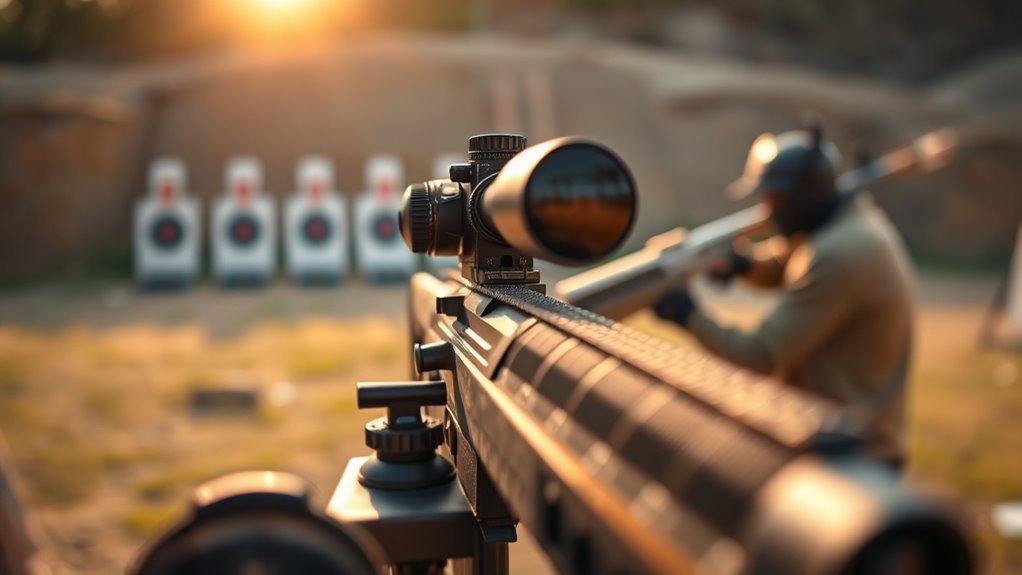
Does moving a rifle scope farther away reduce scope parallax? Eye relief and parallax are often confused because both affect what you see through an optic. However, they describe different optical properties, and changing one does not automatically correct the other.
Quick Answer
No. Moving a magnified scope farther from your eye changes eye relief, not the relationship between the reticle and target image inside the optic. Parallax occurs when the reticle appears to drift as your viewing angle changes. A scope’s parallax control, where fitted, addresses that optical mismatch.
Key Takeaways
- A magnified scope has a designed eye-relief range. Moving beyond it can produce dark edges and a restricted sight picture.
- Parallax occurs when the target image and reticle occupy different optical planes.
- Higher magnification can make apparent reticle movement easier to notice.
- Fixed-parallax scopes are designed around a particular distance, which varies by model.
- Red dot sights and magnified rifle scopes have different optical designs and eye-relief requirements.
What Parallax Does to Your Shot
)
Scope parallax is the apparent movement of the reticle against the target when your viewing angle changes. It occurs because the scope’s target image and reticle are not positioned on the same optical plane.
The reticle is the crosshair or other aiming reference inside the scope. When the two image planes do not match, changing your eye position can make the reticle appear to float over the target.
ZEISS explains this relationship in its parallax compensation guide. The effect comes from the internal optical alignment rather than the physical distance between your face and the scope.
Why apparent reticle movement matters
Parallax can create a difference between the apparent aiming point and the actual optical alignment. It may also make a properly zeroed scope appear inconsistent when the viewing angle changes.
However, parallax does not physically move the reticle or change the rifle’s mechanical zero. It changes the apparent relationship between the reticle and target image.
The amount of error depends on several factors:
- The distance at which the optic is designed or adjusted to be parallax-free.
- The actual distance to the viewed object.
- The viewer’s position relative to the optical axis.
- The scope’s internal optical design.
- The amount of magnification used.
There is no universal number of inches of parallax error for every scope at a particular distance. Two optics can behave differently even when used at the same magnification.
Does Moving the Scope Farther Away Reduce Parallax?
No. Moving a magnified scope farther from your eye does not directly correct its internal parallax. It changes the viewing distance and may alter how comfortable or complete the sight picture appears.
The distinction matters because eye relief and parallax are independent optical properties.
What changes when the scope moves farther away?
Eye relief is the distance between your eye and the scope’s eyepiece at which you can see the intended field of view.
Every conventional magnified rifle scope has a designed eye-relief range. Moving beyond that range can cause the image to appear smaller or develop dark edges.
Leupold’s riflescope support guidance explains that an incorrect viewing distance can produce a black ring around the image.
That ring is called vignetting or scope shadow. It indicates that the viewer is not receiving the full intended sight picture.
Moving the scope farther away can therefore make the optic less forgiving rather than more forgiving.
Why moving the scope cannot eliminate parallax
Parallax results from the relationship between the target image and the reticle inside the scope.
Changing the scope’s external position does not bring those internal image planes together. A different viewing position may change how noticeable the effect appears, but it does not eliminate its optical cause.
This also explains why an optic can show a clear, complete image while still exhibiting parallax.
Likewise, an optic can have little apparent parallax while the viewer experiences poor eye relief.
How Eye Position Affects Parallax
Eye position determines the viewing angle through the scope. When parallax is present, changes in that angle can make the reticle appear to move against a stationary target.
A consistent head position can reduce variation in the apparent sight picture. However, head-position consistency does not repair the underlying optical mismatch.
Burris explains the distinction in its guide to understanding parallax.
| Condition | Effect | Explanation |
|---|---|---|
| Consistent eye position | More repeatable appearance | The viewing angle remains similar |
| Off-center eye position | Apparent reticle movement | Parallax becomes visible when image planes differ |
| Full, clear sight picture | Better visual access | The eye is within the usable eye-relief range |
| Dark ring around the image | Restricted field of view | Viewing distance or alignment may be incorrect |
| Higher magnification | Apparent movement becomes easier to notice | The image is enlarged and the usable eye box may become less forgiving |
What is the difference between eye relief and eye box?
Eye relief describes the viewing distance behind the eyepiece. The eye box describes the area within which your eye can move while maintaining a usable image.
An optic with a generous eye box allows some variation in viewing position without losing the sight picture.
A narrow eye box requires more precise alignment to maintain a complete image. This is especially noticeable in some high-magnification scopes.
Does cheek weld affect the sight picture?
Yes. Cheek weld refers to the contact between your cheek and the rifle stock. A repeatable position helps maintain a similar viewing angle through the optic.
Scope height also affects how naturally the eye aligns with the eyepiece. Vortex discusses this relationship in its rifle-fit guidance.
Neither cheek weld nor mounting height changes the optical definition of parallax.
When Does Parallax Adjustment Matter Most?
Parallax adjustment becomes particularly relevant when the viewing distance differs from the optic’s parallax-free setting. Higher magnification can also make the resulting visual movement easier to recognize.
There is no universal distance beyond which every scope develops significant parallax. The effect depends on the optic and its optical settings.
Parallax is an optical alignment issue, not simply a problem caused by placing the scope too close to or too far from the eye.
Fixed-parallax scopes
A fixed-parallax scope is designed to have minimal parallax at a specified distance. It does not have a user-adjustable parallax control.
Many conventional rifle scopes use a factory setting around 100 or 150 yards, although the actual specification depends on the model.
At other distances, some parallax may remain. This does not automatically indicate a defect.
Scopes with adjustable parallax
Some magnified scopes include an adjustable optical system that changes the distance at which the reticle and target image share the same plane.
Two common designs are:
- Side-focus control: An adjustment dial on the side of the scope.
- Adjustable objective: An adjustment ring near the front objective lens.
These systems address the optical relationship between the reticle and target image.
The markings on a parallax dial are reference values rather than universal guarantees of perfect alignment.
Does magnification create parallax?
No. Magnification does not create the underlying optical mismatch. It can make an existing effect more noticeable by enlarging the viewed image.
A scope can exhibit parallax at low magnification, high magnification, or both.
There is also no universal 10x threshold at which parallax suddenly becomes a problem. The scope’s design and viewing distance determine its actual behavior.
How Parallax Controls Work
A parallax control changes the scope’s internal optical relationship between the target image and reticle. Its purpose is different from the adjustment that focuses the reticle for your eyesight.
Understanding these controls helps explain why simply changing the distance between the scope and your eye cannot provide the same correction.
Parallax control versus eyepiece focus
The eyepiece focus, often called the diopter adjustment, changes how clearly the reticle appears to your eye.
The parallax control changes the optical relationship between the reticle and the target image.
Bushnell explains this distinction in its parallax adjustment guidance.
These controls can affect different aspects of the visible image, but they are not interchangeable.
What does the head-bob test reveal?
The head-bob test is an optical observation used to identify apparent reticle movement. The reticle may seem to change position against a stationary object when the viewer’s eye changes position.
This apparent movement indicates that the reticle and target image do not occupy the same optical plane.
The effect is different from movement of the entire scope or object being viewed.
Does the infinity marking eliminate parallax?
No. The infinity marking represents an optical setting intended for distant objects. It is not a universal correction for every distance beyond a particular yardage.
A setting that works for one optic or viewing distance may not produce the same result with another.
The scope manufacturer’s documentation remains the appropriate reference for interpreting its adjustment scale.
What if the image looks clear but parallax remains?
A sharp image does not necessarily mean the target image and reticle occupy the same optical plane.
Image clarity and parallax are related optical characteristics, but they describe different things.
This is why a scope can display a crisp target while still showing apparent reticle movement when the viewing angle changes.
Note: If a scope shows persistent optical problems, damaged components, or unexplained image distortion, consult the manufacturer or a qualified optics technician. Internal optical repairs should not be attempted without the appropriate equipment and expertise.
Frequently Asked Questions
Does Optic Eye Relief Affect Recoil Safety?
Yes. Adequate eye relief helps maintain space between your face and the eyepiece during recoil. Too little clearance increases the risk of contact with the scope. The correct distance depends on the optic and firearm, so the manufacturer’s specifications and safe mounting practices matter.
Can Parallax Errors Happen at All Magnifications?
Yes. Parallax can occur at any magnification when the reticle and target image occupy different optical planes. Higher magnification can make the apparent movement easier to notice, but it does not create the underlying mismatch. The actual effect depends on the scope’s optical design and viewing distance.
Are Red Dot Sights Affected by Parallax Differently?
Yes. Red dot sights use a different optical design from conventional magnified scopes. Some manufacturers describe their models as operationally parallax-free. For example, the Aimpoint Micro H-1 lists unlimited eye relief and operationally parallax-free performance. However, those specifications should not be assumed for every red dot sight.
Does Head Position Consistency Improve Long-Range Accuracy?
Consistent head position can reduce variation in the apparent sight picture. It keeps the viewing angle more repeatable, which can limit the visible effects of existing parallax. However, consistency does not eliminate a mismatch between the scope’s reticle and target image planes.
Can Scope Height Over Bore Influence Perceived Parallax?
Scope height can influence the viewing position, but it does not directly change internal optical parallax. Height over bore describes the vertical distance between the scope’s optical axis and the barrel’s bore axis. It is a separate geometric relationship from the alignment of the reticle and target image inside the scope.
Conclusion
Moving a scope farther away does not eliminate parallax. It changes eye relief and may affect the visible field of view, while parallax comes from the relationship between the reticle and target image inside the optic.
The key is understanding which optical property causes the problem. Refer to your scope’s specifications for its eye-relief range, parallax-free distance, and available optical controls.
Sources
- ZEISS – Parallax Compensation: Explains the relationship between target image planes, reticle position, and parallax.
- Leupold – Riflescope Support: Explains eye relief, field-of-view restrictions, and scope positioning.
- Burris Optics – Understanding Parallax: Covers parallax behavior, eye position, and optical alignment.
- Vortex Optics – Make Your Rifle Fit You: Explains scope height, eye relief, and viewing comfort.
- Bushnell – Adjusting Parallax: Explains the purpose and function of adjustable parallax systems.
- Aimpoint – Micro H-1 Specifications: Documents the model’s eye relief and operational parallax characteristics.
