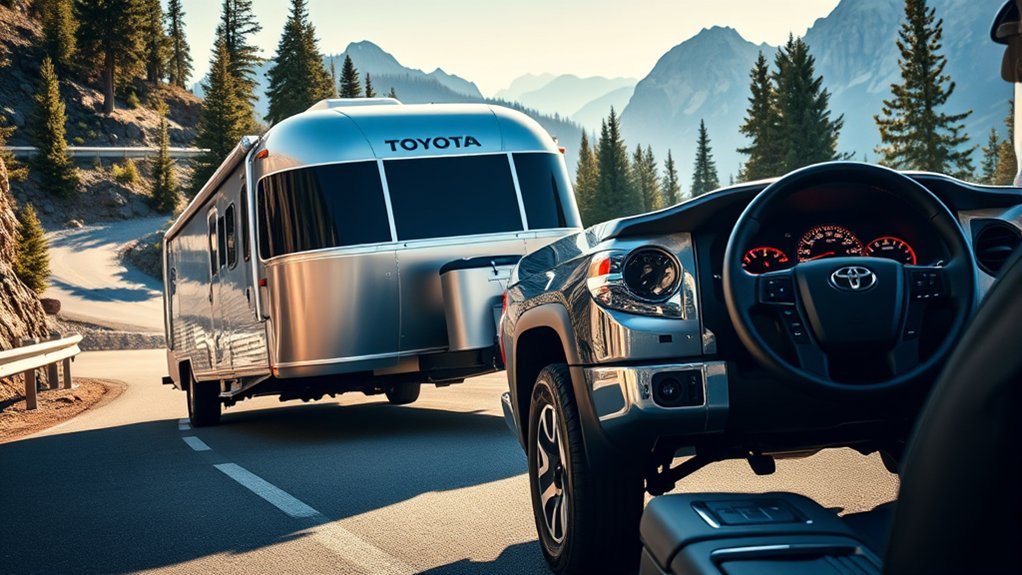
Mountain towing asks more from your Toyota Tundra, trailer, brakes, tires, and cooling system than level-road driving. The safest approach is to confirm your exact weight limits, prepare the trailer, slow down before each grade, use Tow/Haul mode if your model has it, and select a lower gear before speed builds on a descent.
Last updated: July 11, 2026
Quick Answer
For safer Toyota Tundra mountain towing, stay within the ratings for your exact truck and hitch, engage Tow/Haul mode if equipped, slow before steep grades, select a lower gear early, use engine braking, and avoid riding the brakes. Watch factory temperature warnings and stop safely if performance, braking, or cooling changes.
Key Takeaways
- Check your model-year owner’s manual because Tundra controls, gear ranges, warning displays, and towing limits vary by generation and configuration.
- Choose a safe speed before the downgrade and select a lower gear before the trailer pushes the truck faster.
- Use engine braking as the main speed-control aid, then use controlled brake applications instead of constant light pressure.
- Do not rely on a universal RPM or transmission-temperature number. Follow the factory gauge, warning message, and manual for your truck.
- Inspect loading, hitch hardware, trailer brakes, tires, lights, safety chains, mirrors, weather, and the route before entering mountain terrain.
At a Glance
| Time Required | About 30–45 minutes for pre-trip checks, plus ongoing monitoring while driving |
| Difficulty | Moderate; advanced planning and disciplined speed control are required |
| Tools Needed | Model-year owner’s manual, tire-pressure gauge, wheel chocks, trailer-brake controls if equipped, and verified weight information |
| Cost | Usually no added cost for the driving technique; maintenance, scale tickets, brake service, or optional monitoring equipment vary |
Warning: Never exceed the lowest-rated part of the towing system. That includes the truck, hitch, ball mount, coupler, trailer, tires, axles, and any weight-distribution equipment. If the brakes fade, a warning appears, or the truck cannot hold a controlled speed, leave the travel lane safely and stop.
Prepare Your Tundra and Trailer Before the Mountains
Mountain-driving technique cannot correct an overloaded truck, weak trailer brakes, damaged tires, or an unstable load. Complete these checks before the route becomes steep or remote.
[Amazon Products Picked for You]
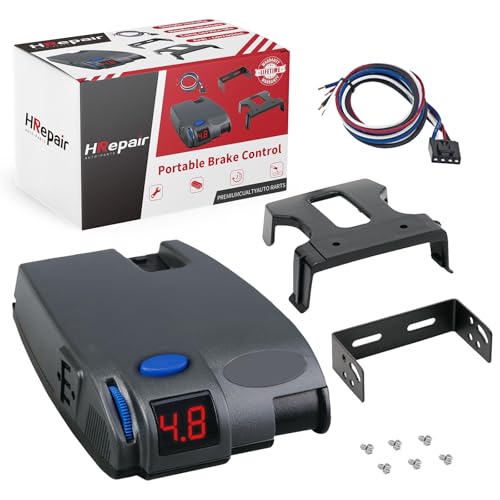
✨ Proportional Braking System: Ensures smooth, consistent stops by applying trailer brakes in proportion to your vehicle's braking intensity. Ideal for all trailer types, from light utility to heavy-duty.
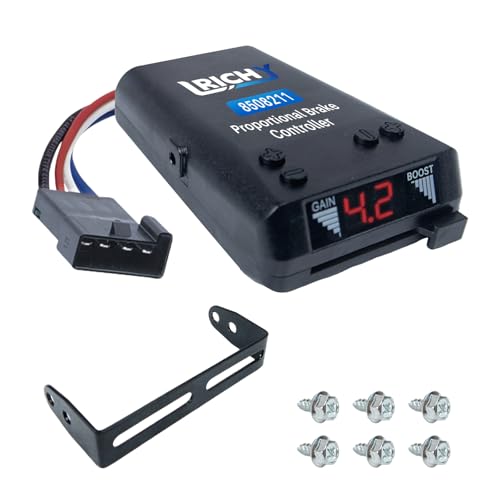
🏆【PROPORTIONAL ELECTRIC BRAKE CONTROLLER】Lrichy brake controller uses internal sensors to automatically apply trailer brakes based on your tow vehicle's braking intensity and speed. It intelligently sets the correct braking level and adjusts for hills, delivering reliable stopping power in any situation
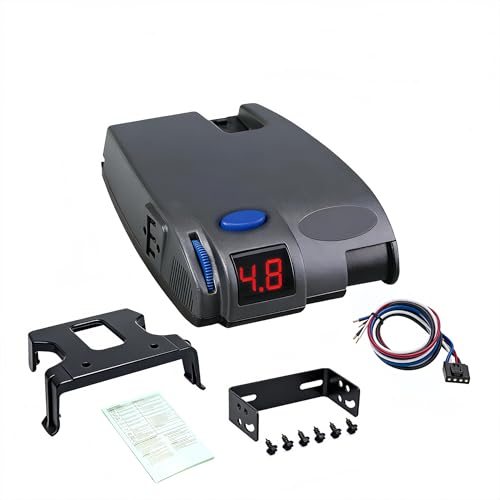
【WIDE COMPATIBILITY】Proportional Brake Controller Designed as a direct replacement for Tekonsha 90160 Primus IQ | Compatible with Ford, Chevy, Dodge, RAM, Toyota, Jeep, GM,etc supporting 2, 4, or 6 brake electric brake trailers. (NOTE: Vehicle-specific plug-and-play harness is not included)
Confirm Weight and Equipment Ratings
- Use the towing, payload, axle, and combined-weight limits for your exact Tundra model year, cab, bed, drivetrain, engine, and equipment package.
- Include passengers, cargo, accessories, hitch equipment, and trailer tongue weight when calculating the load on the truck.
- Confirm that the receiver, ball mount, hitch ball, coupler, safety chains, and weight-distribution system are rated for the actual trailer.
- Weigh the loaded combination when practical. A brochure’s maximum tow rating does not show whether your specific truck is within payload or axle limits.
Use Toyota’s manual and warranty portal to find the instructions and limits for your exact Tundra.
Inspect Trailer Brakes, Tires, and Connections
- Test the trailer brakes and brake controller at low speed before joining traffic. Set gain according to the controller and trailer instructions.
- Connect the breakaway cable independently of the safety chains, cross the chains if required by your equipment instructions, and leave enough slack for turns without allowing them to drag.
- Check truck and trailer tire pressure when cold. Use the vehicle placard, trailer label, and tire load requirements rather than the maximum pressure molded on a tire as a universal target.
- Inspect tread, sidewalls, valve stems, lug hardware, lights, mirrors, coupler engagement, cargo securement, and wheel-bearing condition.
The National Highway Traffic Safety Administration recommends using the manufacturer’s cold inflation pressure and checking tire condition regularly.
Plan the Route and Weather
Review grade length, steepness, curves, construction, fuel stops, pullouts, chain requirements, wind, rain, snow, and escape-ramp locations. Leave extra following distance and avoid a schedule that pressures you to maintain passenger-car speeds.
How to Choose the Best Towing Mode for Mountain Driving
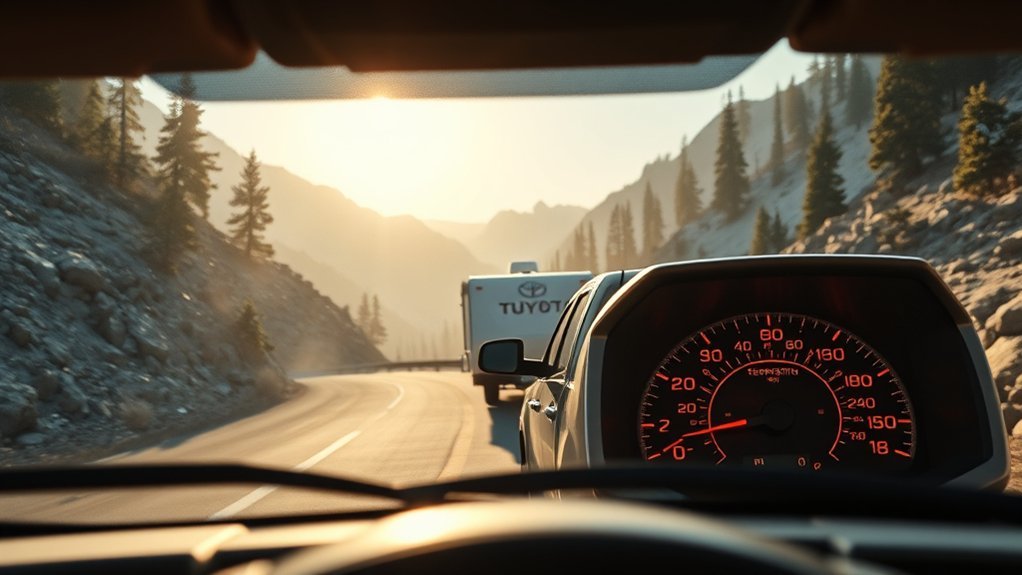
Engage Tow/Haul mode before the climb or descent if your Tundra is equipped with it and your owner’s manual recommends it for the load. The mode generally changes shift behavior to better manage a trailer, but its operation varies by generation. It does not increase any weight rating or replace proper gear selection, trailer brakes, and speed control.
Older and newer Tundras do not all use the same selector labels. Some offer a sequential or lower-range selection, while others manage more of the shift strategy automatically. Do not treat S3, S4, or any other gear label as a universal setting. Choose a range that holds a steady speed without exceeding the engine limits shown in your manual.
Pro Tip: Select Tow/Haul mode and the likely gear range before the steep section begins. Early setup is smoother and safer than reacting after the transmission starts hunting or the trailer begins pushing the truck downhill.
[Amazon Products Picked for You]

2.4Ghz Remote Control tow Truck - Our remote control tow truck toys are designed to move forward, backward, turn left, turn right and so on. We have also added sound and light control to the garbage truck to create a real garbage truck for kids. There are 4 buttons on the top of the front of the car, you can press different buttons to switch between music and sound effects
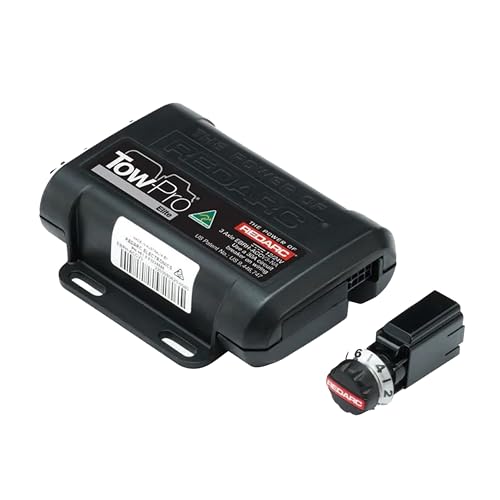
Dual Mode Brake for Any Terrain: The Tow-Pro Elite delivers Proportional Mode braking for smooth on-road control, and User-Controlled Mode for precise off-road braking. Switch between modes with a simple dash dial for ultimate towing confidence

This amazing set features an rc tow truck and a mini alloy car. Made of sturdy alloy, it's in a 64 - scale micro size. Ideal for urban rescue play, it lights up beautifully at night.
Selecting the Right Gear for Towing With Your Tundra in the Mountains
Use a lower gear when the transmission repeatedly shifts between ratios, the truck cannot hold speed comfortably, or you need more engine braking. A suitable gear lets the engine work steadily without lugging at very low RPM or exceeding the model-specific limit.
[Amazon Products Picked for You]

GlowShift Tinted 7 Color Series Transmission Temperature Gauge is Designed to Monitor & Display the Fluid Temperature Running Through Your Truck's Transmission & Help Prevent Overheating

Traditional incandescent lighting illuminates around the perimeter of the dial

MaxTow Transmission Temperature Gauge is Designed to Monitor & Display the Fluid Temperature Running Through Your Truck's Transmission & Help Prevent Overheating
Climbing Steep Grades
- Build a safe approach: Enter the climb at a legal, controlled speed with enough space ahead.
- Use Tow/Haul if equipped: Let the truck hold useful gears longer instead of chasing the highest gear.
- Reduce speed before heat builds: A slower climb lowers the power and cooling demand. Do not force the truck to maintain traffic speed.
- Use a steady throttle: Avoid repeated full-throttle surges unless needed for immediate safety.
- Watch the factory display: Respond to temperature warnings, reduced-power messages, unusual odors, or changing shift quality.
Higher engine speed during a climb is not automatically harmful. The correct RPM range depends on the engine, transmission, load, grade, and model year. The original advice to hold every Tundra between 3,000 and 4,500 RPM is too broad to use as a rule.
Descending Steep Grades
- Slow before the crest: Choose your safe speed while the truck and trailer are still under control.
- Select a lower gear early: Do this before downhill speed builds, not after the combination is already accelerating.
- Let engine braking carry most of the load: Use the service brakes to trim speed, not as the only way to hold it.
- Stay in your lane through curves: Complete most braking before the curve, then steer smoothly.
- Reassess after each steep section: Check for hot-brake odor, soft pedal feel, warning lights, smoke, or trailer-brake changes.
How to Brake Effectively on Steep Hills
Constant light pressure can keep adding heat to the brakes. After selecting a low gear, use controlled brake applications to reduce speed, then release enough pressure to let the system recover while engine braking maintains control. The exact technique must fit your Tundra, trailer brakes, road surface, traffic, and owner’s manual.
The California Commercial Driver Handbook explains the core mountain-driving principle: select a safe speed and low gear before the descent, use engine braking as the main control, and save the service brakes for additional slowing. Although that handbook is written for commercial vehicles, the heat-management principle is useful for pickup-and-trailer drivers.
The safe downhill speed is not a fixed number. It depends on total weight, grade length, steepness, curves, road condition, visibility, weather, and the ability of the truck and trailer to remain controlled.
Avoid These Braking Mistakes
- Do not coast in Neutral. You would lose useful engine braking and reduce control.
- Do not wait until speed is high before forcing a downshift.
- Do not ride the brakes continuously for miles.
- Do not use the trailer-brake manual control as the normal way to hold a long descent.
- Do not continue after brake fade, smoke, a burning smell, or a major change in pedal feel.
Manage Engine Temperatures for Safe Towing
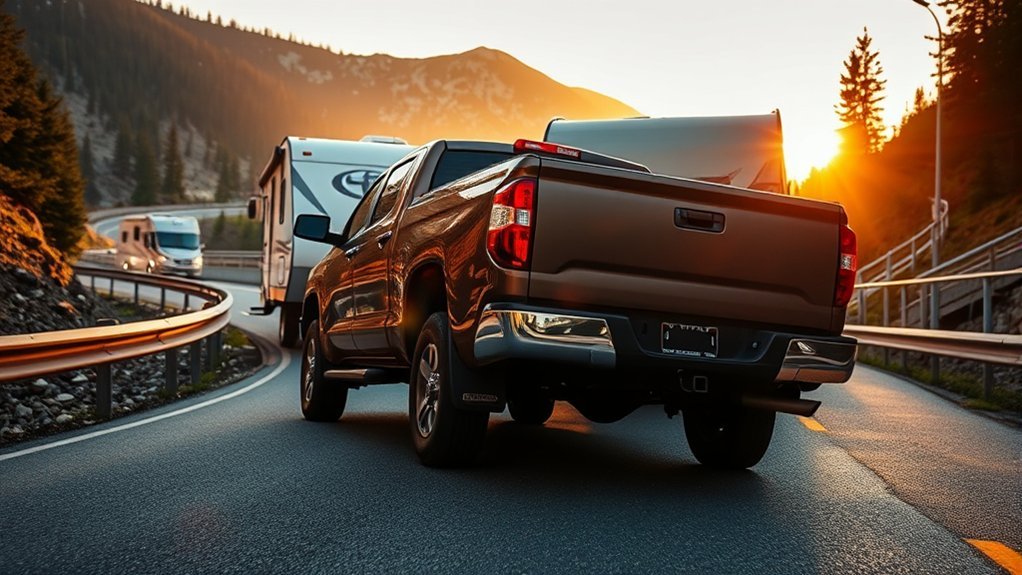
Long climbs, high ambient temperatures, heavy loads, low road speed, and repeated acceleration can increase cooling demand. Watch the factory coolant gauge, warning lights, and multi-information display. If a warning appears, reduce the load on the powertrain and follow the model-year manual.
Monitor Engine Oil Temperature
An engine-oil reading near 195°F by itself is not proof of overheating. Normal oil temperature varies with the engine, sensor location, weather, speed, and workload. Use trends and factory warnings rather than a single internet threshold.
- Note whether temperature rises continuously after you reduce speed and select a more suitable gear.
- Watch for coolant warnings, loss of power, unusual noise, steam, or a hot-fluid smell.
- If the truck warns of overheating, move to a safe location and follow Toyota’s shutdown or idle instructions for your model.
- Never remove a radiator or coolant-system cap while the system is hot.
Utilize OBD2 Connectors
An OBD2 monitor can provide useful trend data when it supports the correct parameters for your Tundra. It may show coolant, oil, or transmission data that the standard display does not show numerically. However, a third-party reading is not a universal safety limit, and unsupported or incorrectly interpreted data can mislead you.
Mount any display where it does not block your view, configure it before moving, and do not interact with it while driving. Treat factory warning messages and the owner’s manual as the primary instructions.
Note: A temperature that is acceptable for one Tundra powertrain may not be the correct limit for another. The article therefore avoids a universal 230°F transmission cutoff and uses the truck’s own warnings and model-specific manual.
Monitor Your Transmission Performance While Towing
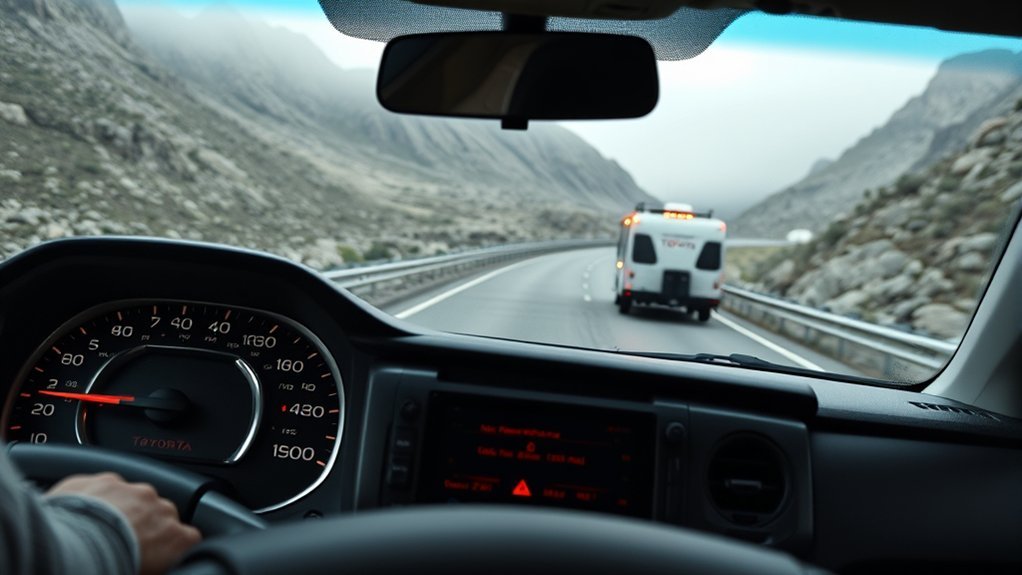
Transmission behavior often gives you an early sign that the combination needs a lower speed or a different gear range. Watch for repeated gear hunting, delayed engagement, harsh shifting, a warning message, reduced power, or a temperature trend that keeps climbing.
- Reduce speed: This lowers the power needed to climb and the energy the brakes must absorb downhill.
- Select a stable gear range: Avoid repeated upshifts and downshifts when a lower range holds speed more consistently.
- Keep airflow available: Do not block cooling openings, and make sure the cooling system is maintained.
- Stop when warned: Continuing through a temperature or transmission warning can turn a manageable condition into damage.
Torque-converter lockup and shift strategy are controlled differently across Tundra generations. A driver should not attempt to force a specific lockup state based on generic advice. Use Tow/Haul mode, the available gear selector, and the instructions for the exact truck.
Control Speed in Curves, Wind, Rain, and Snow
A loaded trailer changes stopping distance, steering response, and stability. Slow before curves, make small steering inputs, and increase following distance. The Federal Motor Carrier Safety Administration emphasizes matching speed to weather, visibility, road surface, curves, and load.
Respond to Trailer Sway
If sway begins, stay calm, hold the steering wheel straight, ease off the accelerator, and avoid abrupt steering or hard braking. Use the trailer-brake manual control only if the brake-controller manufacturer and trailer instructions recommend that response. Pull over safely and correct the cause, which may include speed, wind, poor loading, low tongue weight, tire problems, or unsuitable hitch setup.
Use Extra Caution on Low-Traction Roads
Engine braking and aggressive downshifts can affect drive-wheel traction on wet, icy, or snowy pavement. Reduce speed early, use smooth inputs, and follow the Tundra manual for four-wheel-drive operation and traction-control settings. If conditions exceed your equipment or experience, stop at a safe location and wait.
Essential Safety Tips for Towing in Mountainous Terrain
- Set a speed based on the loaded combination and conditions, not on what unladen vehicles are doing.
- Leave more following distance and avoid passing unless you have generous sight distance and acceleration room.
- Move right where required or safe to let faster traffic pass, but do not use an unsafe shoulder.
- Take breaks to inspect tires, hubs, hitch hardware, cargo, chains, electrical connections, and brake condition.
- Know where steep-grade pullouts and runaway-vehicle ramps are located.
- Carry emergency equipment suitable for the route, season, occupants, and trailer.
What to Do if Brakes Overheat or Performance Changes
- Reduce speed without abrupt steering.
- Use the lowest safe gear available without over-revving the engine.
- Turn on hazard lights when appropriate and legal.
- Use a pullout or escape ramp if necessary. Do not pass an available escape ramp when you have lost reliable speed control.
- After stopping, keep people away from traffic and hot brake components.
- Do not resume the trip until the cause is identified and the truck-trailer combination is safe.
Related Guides
Frequently Asked Questions
What is the 80/20 rule for towing?
No official universal 80/20 towing rule replaces the ratings in your owner’s manual and equipment labels. Some owners use “80% of maximum tow rating” as a personal margin, but that shortcut does not confirm payload, axle load, hitch rating, tongue weight, braking, cooling, or stability. Calculate every applicable limit for the loaded combination.
How do you keep transmission temperature down while towing?
Stay within the truck’s ratings, use Tow/Haul mode if equipped, select a gear that avoids repeated hunting, reduce speed on long climbs, maintain the cooling system, and stop if a factory warning appears. Do not use 230°F as a universal cutoff because displays, fluids, sensors, and limits vary by Tundra generation.
What is the worst Toyota Tundra year for mountain towing?
No single model year is automatically the worst for every towing job. Capability depends on the exact configuration, tow package, ratings, maintenance, recalls, condition, trailer weight, and route. Check the VIN-specific equipment, service history, open recalls, and model-year manual before deciding whether a particular truck is suitable.
When should you turn on Tow/Haul mode?
Activate Tow/Haul mode before the demanding towing section when your Tundra is equipped with it and the owner’s manual recommends it for the load. Using it before a climb or descent lets the transmission apply its towing shift strategy early. It does not increase towing capacity.
Should you use cruise control while towing in the mountains?
Avoid cruise control when steep or rolling terrain causes aggressive throttle changes, frequent shifting, or downhill speed gain. Manual speed control helps you react earlier. Follow your model-year manual because driver-assistance and cruise-control instructions vary.
What should you do if the brakes smell hot or begin to fade?
Reduce speed, select a lower safe gear, use a pullout or escape ramp, and stop away from traffic. Do not continue simply because the brakes cool. A burning smell, smoke, soft pedal, or reduced braking requires inspection of the truck and trailer braking systems before travel resumes.
Conclusion
Safe Toyota Tundra mountain towing starts before the first grade. Verify the loaded combination, prepare the trailer, use Tow/Haul mode when appropriate, select lower gears early, and control downhill speed mainly with engine braking. Replace fixed internet thresholds with your truck’s factory warnings and model-year instructions. If braking, cooling, stability, or shifting changes, stop safely and solve the cause before continuing.
Sources
- Toyota Manuals and Warranties — model-year-specific operating instructions, warnings, and towing limits.
- California DMV Commercial Driver Handbook, Section 2 — selecting a safe downgrade speed, lower gears, engine braking, and brake-fade prevention.
- NHTSA TireWise — tire pressure, load-label, tread, and maintenance guidance.
- FMCSA: Too Fast for Conditions — adjusting speed for weather, curves, road surface, visibility, and loaded trailers.