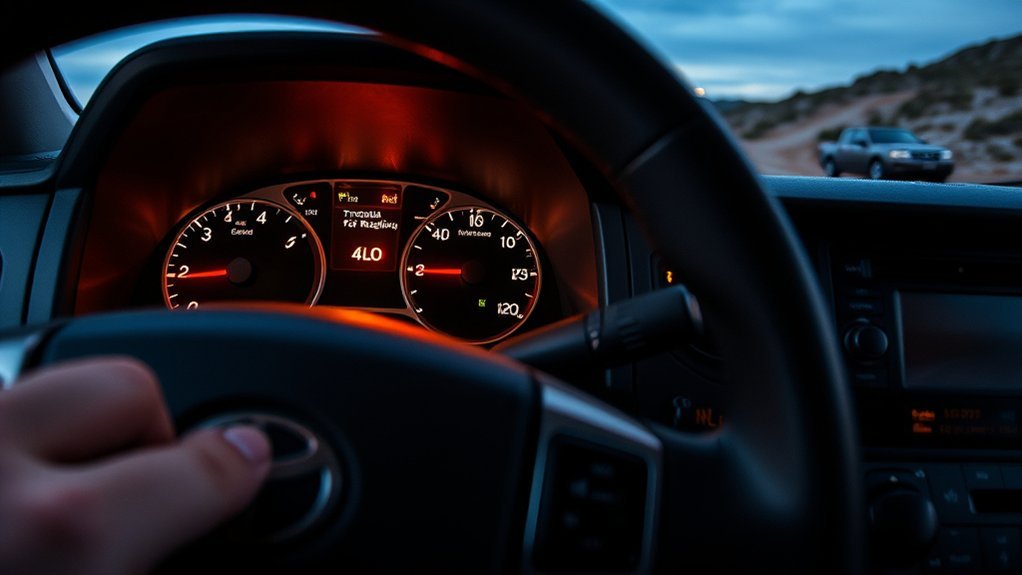
A flashing 4LO or 4L light on a Toyota Tundra means the transfer case has not yet confirmed the requested low-range position, or a related control-system fault is preventing the shift from completing. The correct response depends on the model year, whether you just commanded a range change, which other warning lights are on, and whether the truck can move normally.
Quick Answer
If your Tundra’s 4LO or 4L light keeps flashing, stop safely and use the exact shift procedure in your model-year owner’s manual. On recent Tundras, stop completely, hold the brake, shift to Neutral, and select 4L or 4H. If the light continues flashing, scan every relevant control module before clearing codes or replacing parts.
Key Takeaways
- Brief flashing during a commanded shift can be normal; continuous flashing means the range change has not been confirmed.
- Recent Tundras require a complete stop, the brake pedal held down, and the transmission in Neutral when shifting between 4H and 4L.
- Engine codes such as P2440 or P2442 are not transfer-case codes, even when several dashboard lights appear together.
- Read and record all engine, ABS/VSC, 4WD, and communication codes before disconnecting the battery or clearing memory.
- Stop driving if the truck is stuck in Neutral, binds severely, grinds, loses substantial power, or displays a red brake-system warning.
At a Glance
| Time Required | About 15–30 minutes for safe checks and an initial scan |
| Difficulty | Basic checks: beginner; circuit, actuator, and transfer-case diagnosis: advanced |
| Tools Needed | Model-year owner’s manual, flashlight, multimeter if qualified, and a Toyota-capable scan tool |
| Cost | Basic checks may cost nothing; professional diagnosis and repair vary widely with the fault and location |
Warning: Do not repeatedly switch between 4WD ranges while the wheels are spinning. Do not continue driving if the transfer case grinds, the truck will not leave Neutral, the drivetrain binds severely, or a red brake warning appears. Park safely and arrange professional diagnosis or towing.
Identifying Common Causes of a Flashing 4LO Light
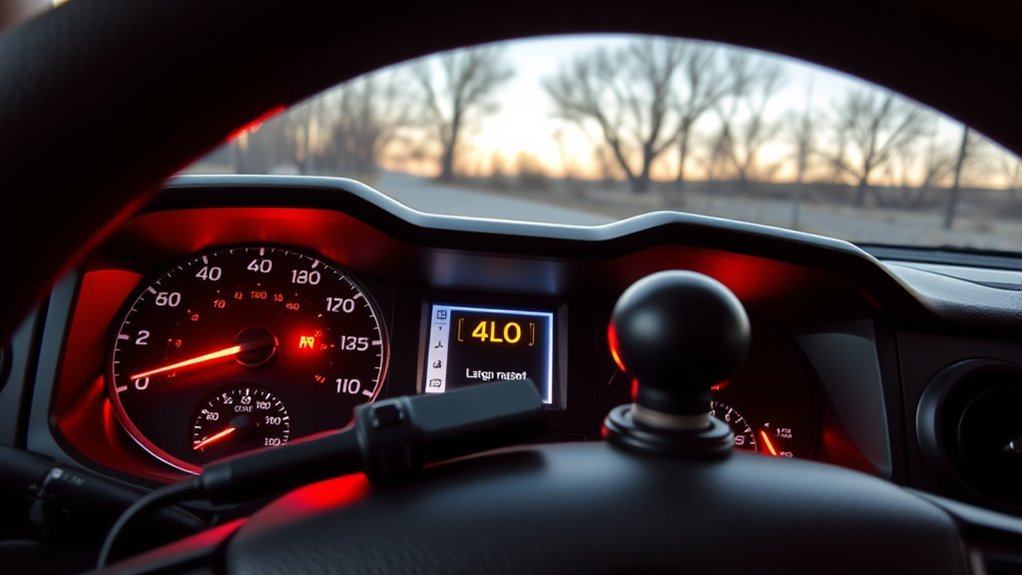
On some Tundras, the indicator is labeled 4LO; newer models commonly display 4L. Both refer to the transfer case’s low-range four-wheel-drive setting. The light may flash briefly while the system moves the transfer-case mechanism and verifies its position.
If the indicator continues flashing, the control system has not confirmed the requested range. That does not automatically mean the transfer case or actuator must be replaced. The cause may be as simple as an unmet shift condition, or it may involve an electrical, control-module, actuator, sensor, or mechanical fault.
Normal Flashing During a Range Change
A brief flash immediately after selecting 4L or returning to 4H can occur while the range change is in progress. Allow the system time to complete the shift without accelerating or repeatedly moving the selector.
Older Tundra manuals may instruct the driver to move forward or backward a short distance before retrying an incomplete shift. Newer trucks use different controls and procedures, so consult the Toyota manual for your exact model year rather than applying instructions from another generation.
Common Reasons the Light Keeps Flashing
- The required shift conditions were not met: The truck was still moving, the brake was not held, or the transmission was not securely in Neutral.
- Driveline load or wind-up: Tire scrub or torque trapped in the drivetrain can prevent the transfer case from completing a shift, especially on dry, high-traction pavement.
- Weak battery voltage or poor electrical connections: Low voltage, loose terminals, damaged grounds, or communication interruptions can interfere with electronically controlled shifting.
- Selector-switch, fuse, or wiring fault: The control module may not receive the requested range or may lose the actuator feedback signal.
- Transfer-case actuator or position-sensor fault: The actuator may not move fully, or the system may not recognize its final position.
- Internal transfer-case problem: Binding, damaged components, contamination, or an incorrect fluid condition can require mechanical inspection.
- Engine, ABS, or stability-control fault: Some faults illuminate several indicators together. The primary code may be outside the 4WD system, so every relevant module must be scanned.
Note: A loose fuel cap can cause certain emissions codes, but it is not a reliable diagnosis for a flashing 4LO light. Read the stored codes instead of assuming the cap caused the 4WD warning.
How to Troubleshoot and Reset the 4LO System
There is no universal button combination that safely “resets” every Tundra 4WD system. Begin with the approved operating procedure, record all warning information, and diagnose the system before clearing codes.
[Amazon Products Picked for You]
【Comprehensive Performance Testing】V011 OBD2 Scanner provides a complete diagnostic solution, giving you a thorough understanding of your vehicle's condition. It supports a variety of performance tests, support 9 protocols,👍automotive fault clearing,including fast reading of DTCs, access to electronic emission readiness, turning off CEL or MIL, resetting monitors, reading live data and retrieving the vehicle's VIN, freeze frame, sensor data, data streaming, diagnostic reports, onboard monitoring, live data streaming, and more. With these features, you can monitor your car's performance in real time and discover potential problems before they become major issues.

Multi-Functions - Practical Multi-Functions OBD2 code reader features built-in OBD2 DTC lookup library, which help you to determine the cause of the engine light, read code, erase code, view freeze frame, I/M ready, vehicle information, data flow, real-time curve, get vehicle speed information, calculate load value, engine coolant temperature, get engine speed.
1. Stop in a Safe Location
Move away from traffic and stop on a level surface where possible. Keep your foot on the brake. If the truck will not move normally, is stuck in Neutral, or makes grinding noises, do not force it to drive.
2. Record Every Warning Light and Message
Before switching off the ignition, photograph the instrument panel and note:
- Whether the 4LO/4L indicator is flashing or steadily illuminated
- Whether the 4H indicator is also flashing
- Check-engine, ABS, traction-control, stability-control, brake, or master-warning lights
- Any message shown in the multi-information display
- Whether the problem began while shifting, starting the engine, driving in cold weather, or operating off-road
3. Use the Correct 4H-to-4L Procedure
For 2022 and 2024 Tundras equipped with the applicable selector, Toyota’s quick-reference guides instruct the driver to:
- Stop the vehicle completely.
- Continue pressing the brake pedal.
- Shift the transmission to Neutral.
- Push and move the four-wheel-drive control selector from 4H to 4L.
- Wait for the 4L indicator to confirm engagement before selecting a drive gear.
The reverse procedure is used to return from 4L to 4H: stop completely, hold the brake, select Neutral, and move the selector to 4H. Review the 2024 Toyota Tundra Quick Reference Guide or your exact model-year manual before operating the system.
Note: Older Tundras may use separate 4HI and 4LO buttons, a rotary control, or a transfer-case lever. Their indicator and recovery procedures can differ from the recent-generation instructions above.
4. Attempt One Controlled Re-command
If you had not used the correct procedure, return the selector to the previous confirmed setting and attempt the shift once more while stationary, with the brake held and the transmission in Neutral. Do not rapidly toggle the selector or continue trying if the system grinds, binds, or displays a new warning.
If driveline load appears to be preventing disengagement, follow only the model-specific instructions in your owner’s manual. Do not perform a forward-and-reverse maneuver in traffic, on a slope, or where people or objects are close to the truck.
5. Scan the Truck Before Clearing Anything
Use a scanner capable of reading Toyota engine, transmission, ABS/VSC, four-wheel-drive, and communication modules. A basic emissions code reader may reveal a check-engine code while missing the chassis or 4WD code that explains the flashing indicator.
Record the complete code number, description, status, freeze-frame data, and the module that stored it. Do not replace an actuator or sensor solely because an online code list mentions that component.
Pro Tip: Scan and save the codes before disconnecting the battery or using a scanner’s clear function. Erasing the evidence can turn an intermittent problem into a much harder diagnosis.
6. Perform Safe Visual Checks
With the ignition off and the truck safely parked, check accessible items without crawling under an unsupported vehicle:
- Battery terminals for looseness or heavy corrosion
- Relevant fuses identified in the model-year owner’s manual
- Visible wiring and connectors near the selector and transfer-case harness for impact damage, water intrusion, or disconnection
- Evidence of a transfer-case fluid leak beneath the vehicle
- Recent accessory installations, collision damage, underbody work, or pressure washing that may have affected wiring
7. Decide Whether the Truck Needs Professional Service
| Finding | Recommended Action | Reason |
|---|---|---|
| Light stops after the correct procedure and the selected range works normally | Confirm operation and monitor for recurrence | The original shift conditions may not have been satisfied |
| Light keeps flashing, but the truck remains securely in 2H or 4H and drives normally | Avoid further range changes and schedule diagnosis promptly | A control, feedback, wiring, or actuator fault may be stored |
| Truck is stuck in 4L | Drive only far enough to reach a safe location at an appropriate low speed, then seek service | Low range is unsuitable for ordinary road speed and dry-pavement use |
| Truck will not leave Neutral, grinds, binds severely, or shows a red brake warning | Stop and arrange towing | Continuing may create a safety risk or additional drivetrain damage |
| Check-engine light, reduced power, or several warning lights appear together | Scan all modules and diagnose the primary code first | The apparent 4WD warning may accompany an engine, ABS, voltage, or communication fault |
Key Diagnostic Codes for 4LO Issues
There is no single universal “flashing 4LO code.” The useful question is which module stored the code and whether it describes an engine fault, an ABS/VSC fault, a communication problem, or an actual transfer-case control failure.
| Code or Code Group | What It Indicates | How to Use It |
|---|---|---|
| P2440 / P2442 | Secondary air-injection switching-valve faults on applicable engines and model years | Treat them as engine/emissions codes, not proof of a transfer-case failure. Check bulletin applicability by year, engine, calibration, and VIN. |
| C1201 | On applicable Toyota systems, it may accompany an engine-control fault reported to the stability-control system | Find and diagnose the primary engine DTC instead of replacing an ABS or 4WD component based on C1201 alone. |
| P032C | An engine knock-sensor circuit code, not a transfer-case code | Diagnose the engine circuit using the correct repair manual. Do not assume it requires 4WD recalibration. |
| ABS/VSC C-codes | Possible wheel-speed, brake-control, power-supply, or communication problems | Use live data and circuit tests. A flashing ABS-related indicator does not automatically prove a failed wheel-speed sensor. |
| 4WD or transfer-case codes | Selector, actuator, position-feedback, range-recognition, or circuit faults | Follow the model-specific diagnostic tree, including active tests and wiring checks, before replacing the actuator. |
| U-codes or low-voltage codes | Lost communication or unstable module power | Test the battery, charging system, grounds, connectors, and network before condemning a module. |
Toyota issued model-specific bulletins for P2440 and P2442 on certain Tundras. A bulletin for some 2012–2013 3UR-equipped trucks describes debris or ice in the secondary air-injection switching-valve assembly, while a separate bulletin covers specified 2014–2016 1UR-FE Tundras and notes that sub-freezing temperatures may trigger the condition. Review the 2012–2013 Toyota bulletin and the 2014–2016 Toyota bulletin only after confirming that the year, engine, VIN range, and stored codes match.
The code that turned on the check-engine light may explain several companion warnings, but it does not automatically identify the transfer case as the failed component.
[Amazon Products Picked for You]
OBD2 SCANNER FOR ALL SYSTEMS – The INNOVA SD35 is a tablet-based OBD2 scanner designed for advanced diagnostics. Read and clear check engine light, ABS, SRS, and TPMS codes, plus test your car battery and alternator to prevent unexpected failures. Vehicle coverage may vary. Please use Innova’s Coverage Checker to verify compatibility.

【Save on Maintenance Costs】Meet the All-New LAUNCH Creader Elite X500, engineered specifically for Toyota & Lexus owners, DIYers, and small shop pros. No more guesswork. No more expensive dealer trips. This Bidirectional scan tool puts professional-grade diagnostics in your hands-with an easy-to-use interface that makes complex repairs feel simple.
Effective Repair Solutions for 4LO and Warning Light Issues
The correct repair depends on the confirmed cause. Avoid replacing several parts at once or using a battery disconnect to hide the symptom.
[Amazon Products Picked for You]

Designed for efficient, consistent performance and manufactured using only the highest quality materials

【Compatibility】Transmission Actuator Assembly Fits for Toyota Tundra 2007-2014

VEHICLE FITMENT: Compatible with select 2012-2020 Toyota 4Runner, 2005-2017 Toyota Tacoma and 2000-2006 Toyota Tundra 4WD models. Use as a Tacoma transfer case actuator or Tundra transfer case actuator only when the OE number, connector layout, housing shape and transfer case configuration match the original part.
Incorrect or Incomplete Shift Procedure
If the system works after using the correct stop-brake-Neutral sequence, no component replacement may be needed. Review the manual and avoid commanding 4L on dry pavement unless the operating instructions specifically permit the situation.
Battery, Power, or Communication Fault
Test the battery and charging system under appropriate conditions. Clean and secure defective battery connections and grounds, repair damaged wiring, and resolve communication codes before testing the actuator again.
Selector, Fuse, or Wiring Problem
Confirm that the control module sees the selector request. Inspect the correct fuse and circuits using the model-specific wiring diagram. Replace a switch only after verifying its input or resistance is outside specification.
Actuator or Position-Feedback Problem
A technician may use Toyota-compatible bidirectional controls to command the actuator while monitoring the requested and actual transfer positions. Wiring integrity, power, ground, mechanical movement, and position feedback should be checked before actuator replacement.
Transfer-Case Fluid or Mechanical Problem
Repair leaks and verify the fluid type, level-check method, and maintenance requirements for the exact model year. Grinding, repeated binding, metal contamination, or an actuator that cannot move the mechanism may require transfer-case removal and mechanical inspection.
Engine or Emissions Fault With Multiple Warning Lights
Repair the primary engine code according to Toyota service information. For applicable P2440/P2442 cases, the correct repair may involve a calibration update or air-injection-system work rather than a transfer-case component.
ABS or Wheel-Speed Fault
If ABS, traction-control, and 4WD indicators appear together, scan the brake-control module and inspect live wheel-speed data. Check the circuit and sensor signal before replacing a wheel-speed sensor, hub, or brake-control component.
Warning: Transfer-case actuator removal can disturb internal timing or position alignment on some systems. Do not remove or rotate the actuator without the correct Toyota repair procedure for the model year.
Simple Tips to Prevent Future 4LO Issues
- Follow the exact owner’s-manual sequence: Do not assume all Tundra generations shift the same way.
- Do not shift while the wheels are spinning: Stop the slipping before changing transfer ranges.
- Use 4WD only on suitable surfaces: Avoid driveline wind-up by following Toyota’s surface and speed limitations.
- Maintain the battery and grounds: Electronic 4WD controls depend on stable voltage and reliable communication.
- Repair fluid leaks promptly: Use only the transfer-case fluid and checking procedure specified for the truck.
- Protect underbody wiring: Inspect for trail damage, road debris, corrosion, or disconnected harness clips after off-road driving or repairs.
- Do not ignore intermittent warnings: Scan the truck while the code and freeze-frame data are still available.
- Check service information by VIN: Use Toyota’s manuals and the NHTSA recall lookup to identify open recalls and relevant manufacturer communications.
There is no universal requirement to keep the truck warm to prevent a 4LO fault. Cold weather is relevant only when the diagnostic evidence and model-specific service information identify a temperature-sensitive condition.
Frequently Asked Questions
What does a flashing 4LO or 4L light mean on a Toyota Tundra?
It means the transfer-case control system has not yet confirmed the requested low-range position. Brief flashing during a shift may be normal. Persistent flashing can indicate unmet shift conditions, driveline load, an electrical problem, an actuator or position-sensor fault, a transfer-case problem, or a related engine or chassis fault.
Why is my 4 Low light blinking while driving?
The requested transfer range may not have completed, or the system may have detected a control fault. Reduce speed smoothly, avoid forcing another shift, and pull over safely. Record the other warning lights and scan all relevant modules before clearing codes.
Why are the 4LO, ABS, and traction-control lights on together?
The systems share information, so an engine, wheel-speed, brake-control, low-voltage, or communication fault may cause several indicators to appear together. Read the engine and ABS/VSC modules as well as the 4WD module. Do not assume the ABS sensor or transfer-case actuator is faulty without testing.
How do I reset the 4LO light?
First use the approved range-change procedure for your model year. On recent Tundras, stop completely, hold the brake, select Neutral, and command 4H or 4L. If the indicator keeps flashing, there is no reliable universal reset; retrieve the codes and repair the cause.
Will disconnecting the battery fix a flashing 4LO light?
No. Removing power may clear a warning or stored information temporarily, but it does not repair a failed actuator, damaged wire, low-voltage condition, sensor fault, or mechanical problem. Scan and save the diagnostic information before clearing memory.
Can I drive with the 4LO light flashing?
Only move the truck far enough to reach a safe location if it drives normally and remains securely in a usable range. Do not continue if it is stuck in Neutral, binds severely, grinds, loses substantial power, or displays a red brake warning. Arrange towing when normal range engagement cannot be confirmed.
Conclusion
A flashing Toyota Tundra 4LO or 4L light means the requested transfer range has not been confirmed. Begin with the correct model-year shift procedure, record every warning light, and scan all relevant modules before clearing codes. Do not assume that a gas cap, ABS sensor, or transfer-case actuator is responsible without diagnostic evidence. If the truck cannot select a stable range or shows severe binding, grinding, reduced power, or a brake warning, stop driving and arrange qualified service.
Sources
- Toyota Manuals and Warranties — model-year-specific operating instructions and owner information
- 2024 Toyota Tundra Quick Reference Guide — recent 2H, 4H, and 4L selection procedure
- 2001 Toyota Tundra Owner’s Manual — older button- and lever-type 4WD controls and indicator behavior
- Toyota T-SB-0143-14 — P2440/P2442 secondary air-injection guidance for certain 2012–2013 Tundras
- Toyota T-SB-0079-16 — P2440/P2442 guidance for specified 2014–2016 Tundras
- NHTSA Recall Lookup — VIN-based open-recall and manufacturer-communication checks