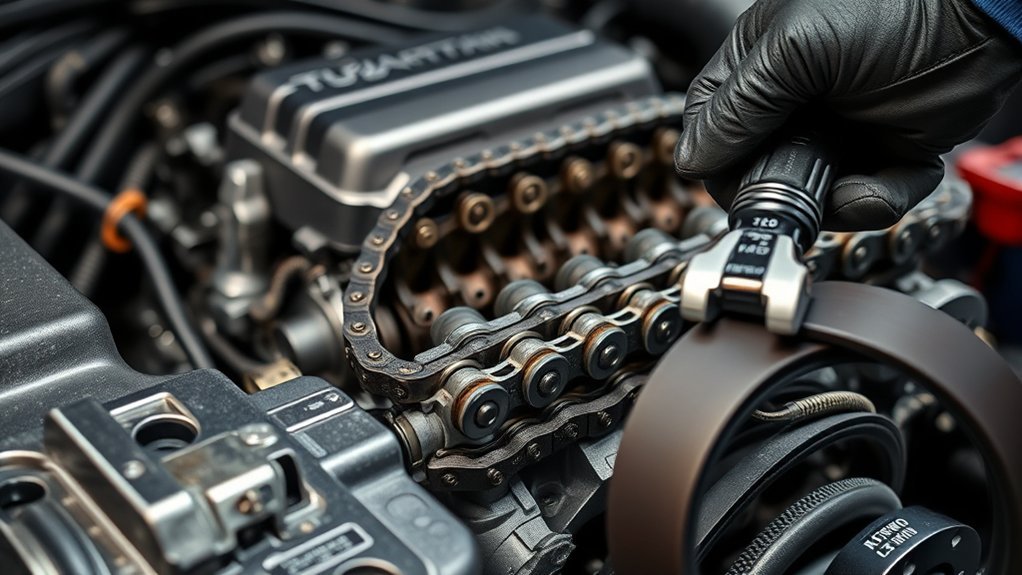
Whether a Toyota Tundra has a timing belt or timing chain depends on its engine and model year—not simply its generation. The key exceptions are older trucks with the 3.4-liter V6 or 4.7-liter V8, which use timing belts. Other Tundra engines use timing chains with no routine replacement interval under normal service.
Quick Answer
Toyota Tundras with the 3.4-liter 5VZ-FE V6 or 4.7-liter 2UZ-FE V8 use a timing belt. The 4.0-liter V6, 4.6-liter V8, 5.7-liter V8, and 2022-and-newer twin-turbo V6 use timing chains. Belt-equipped trucks generally have a 90,000-mile replacement service, subject to the exact Toyota maintenance guide.
Key Takeaways
- Timing-belt engines: 3.4-liter 5VZ-FE V6 and 4.7-liter 2UZ-FE V8.
- Timing-chain engines: 4.0-liter V6, 4.6-liter V8, 5.7-liter V8, and 2022-and-newer twin-turbo V6.
- The 2005–2006 first-generation 4.0-liter V6 uses a chain, while the 2007–2009 second-generation 4.7-liter V8 still uses a belt.
- Toyota commonly specifies timing-belt replacement at 90,000 miles, but the guide for the exact model year is the controlling source.
- Timing chains have no normal scheduled replacement interval, but poor lubrication, damaged guides, or tensioner problems can still require repair.
What Timing Mechanism Does My Tundra Use?
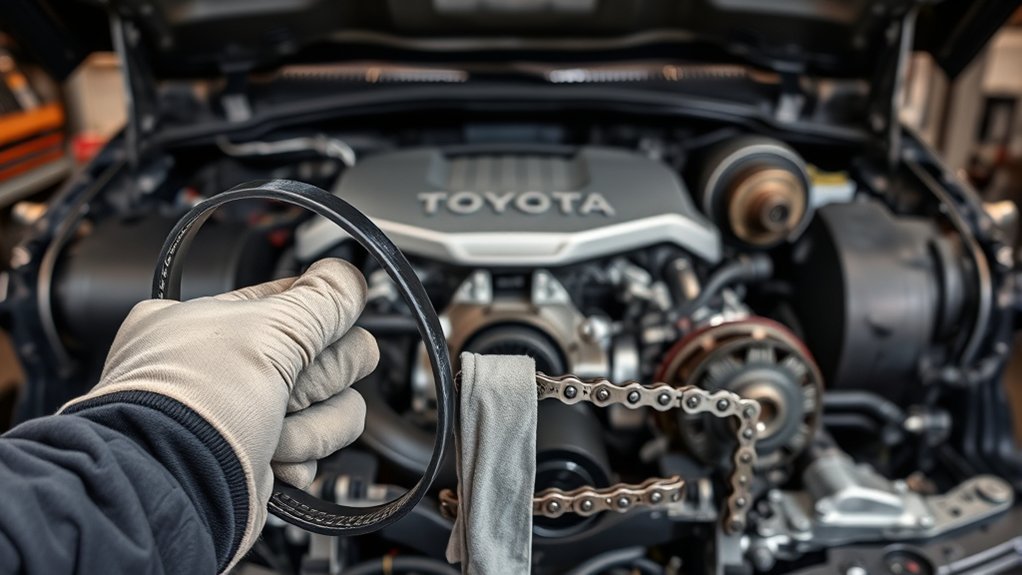
The most reliable way to answer this question is to identify the engine. Model year alone can be misleading because Toyota offered belt- and chain-driven engines during overlapping years.
| U.S. Model Years | Engine | Engine Code | Timing System | Maintenance Approach |
|---|---|---|---|---|
| 2000–2004 | 3.4-liter V6 | 5VZ-FE | Timing belt | Scheduled replacement; check the exact Toyota guide. |
| 2000–2009 | 4.7-liter V8 | 2UZ-FE | Timing belt | Scheduled replacement; commonly listed at 90,000 miles. |
| 2005–2014 | 4.0-liter V6 | 1GR-FE | Timing chain | No routine chain-replacement interval under normal service. |
| 2010–2019 | 4.6-liter V8 | 1UR-FE | Timing chain | Condition-based diagnosis; maintain the specified engine oil. |
| 2007–2021 | 5.7-liter V8 | 3UR-FE or 3UR-FBE | Timing chain | No routine chain-replacement interval under normal service. |
| 2022–present | 3.4-liter twin-turbo V6, including i-FORCE MAX | V35A-FTS | Timing chain | Condition-based diagnosis and strict oil maintenance. |
Note: The table covers common U.S.-market configurations. Engine availability can differ by market, production date, or previous engine replacement. Verify the engine code or VIN before ordering parts or authorizing service.
How to Identify Your Tundra’s Engine
Use more than one of the following checks if the truck’s maintenance history is incomplete:
- Check the model year and engine size on the registration, original window sticker, service invoices, or owner records.
- Read the emissions-information label under the hood. It may identify the engine family or displacement.
- Decode the VIN with the NHTSA VIN Decoder. Confirm the result against Toyota documentation because VIN output can describe an engine family rather than every service detail.
- Use Toyota’s manuals portal to select the exact model year and open its Warranty and Maintenance Guide: Toyota Manuals and Warranties.
- Confirm parts by VIN through Toyota Genuine Parts or ask a Toyota parts department to identify the applicable belt, chain, tensioner, and related components.
Pro Tip: Do not rely on the appearance of the plastic engine cover. Use the VIN or engine code, especially on an older truck that may have received a replacement engine.
How Timing Belts and Chains Differ in Performance and Maintenance
Both systems synchronize the crankshaft and camshafts so the valves open at the correct time. Their main difference for an owner is how they are maintained.
| Factor | Timing Belt | Timing Chain |
|---|---|---|
| Material | Reinforced rubber and fiber construction | Metal chain with guides and one or more tensioners |
| Lubrication | Runs behind covers but outside the engine’s pressurized oil circuit | Operates inside the engine and depends on proper oil supply |
| Normal service | Replaced at the scheduled mileage | No routine replacement interval; repaired when diagnosis confirms wear or failure |
| Typical warning | May provide little or no warning before failure | May produce startup rattle, timing-related fault codes, or poor running |
| Main maintenance priority | Replace on schedule and prevent oil or coolant contamination | Use the specified oil, maintain the oil level, and investigate abnormal noise promptly |
A timing chain normally eliminates scheduled belt replacement, but it does not eliminate the need for correct oil service or prompt diagnosis of timing-related noise and fault codes.
Maintenance Requirements for Timing Mechanisms in Tundras
Timing-Belt Maintenance
For a belt-equipped Tundra, use the Warranty and Maintenance Guide for the exact model year. Toyota commonly lists timing-belt replacement at 90,000 miles for applicable engines.
Do not assume that a belt is safe simply because the engine runs normally. Timing belts are enclosed behind covers and may not provide a clear warning before they fail. Mileage and documented service history are usually more useful than a casual visual inspection.
If the truck is older and has no proof of replacement, treat the belt’s history as unknown. Ask a qualified technician to confirm the engine, inspect for oil or coolant leakage around the timing covers, and prepare an itemized service recommendation.
A comprehensive quote may include:
- The timing belt
- Belt tensioner and idler pulleys
- Water pump when labor substantially overlaps
- Thermostat or accessory belts when condition justifies replacement
- Camshaft and crankshaft seals if they are leaking
- Coolant, gaskets, and other one-time-use parts required by the repair procedure
Warning: Do not postpone an overdue timing-belt service because the belt “looks fine” or the engine has no symptoms. Belt failure stops the engine immediately and may cause internal damage depending on the engine and operating conditions.
Timing-Chain Maintenance
A timing chain is normally serviced according to condition rather than at a fixed mileage. That does not mean it is maintenance-free. The chain, guides, tensioners, variable-valve-timing components, and oil passages must all work together.
Follow the oil viscosity and service interval specified for the truck. Low oil, sludge, incorrect viscosity, or delayed oil changes can interfere with hydraulic tensioners and variable-valve-timing controls.
A chain should not be replaced merely because the truck reaches a particular mileage. It should be tested when symptoms, fault codes, oil-pressure concerns, or measured cam-to-crank timing indicate a problem.
Timing Issues in Tundras
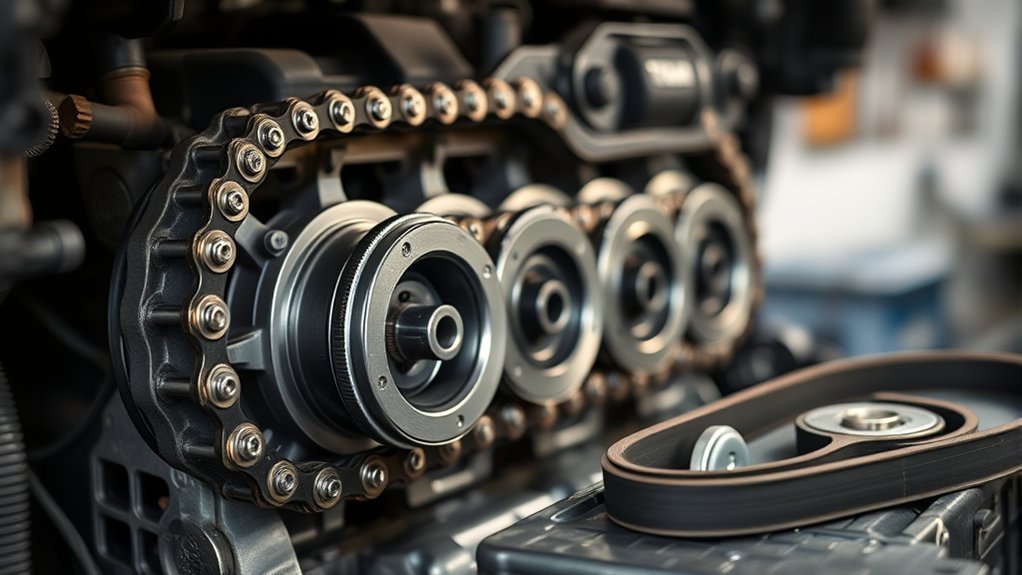
Possible Timing-Belt Problems
A timing belt can age, lose teeth, become contaminated, or fail because of a seized pulley, tensioner, or water pump. Possible clues include oil or coolant leakage near the timing cover, unusual front-engine noise, a no-start condition, or an engine that stopped suddenly. However, many belts provide no dependable warning before failure.
Dry cracks and frayed edges are signs of deterioration when the belt is actually exposed during service, but the installed belt is not normally visible without removing covers. Do not dismantle the timing area unless you have the correct repair information, tools, and experience.
Possible Timing-Chain Problems
Symptoms that deserve diagnosis include:
- A persistent metallic rattle at startup or from the front of the engine
- A check-engine light with camshaft, crankshaft, or valve-timing correlation codes
- Rough idle, misfires, reduced power, or hard starting
- Metal debris found during an oil or filter inspection
- Low oil pressure or a history of severe sludge and oil neglect
A brief noise does not prove the chain is stretched. Similar sounds can come from an accessory drive, exhaust leak, oil-drainback issue, variable-valve-timing actuator, or another component. Proper diagnosis should include code scanning, oil-level and pressure checks, noise localization, and comparison of commanded and actual valve timing.
Warning: If the engine stops suddenly, develops severe mechanical noise, or shows an oil-pressure warning, shut it off as soon as it is safe. Repeated restart attempts can worsen damage. Arrange a tow and have the cause diagnosed.
Timing Belt and Chain Replacement Cost Factors
There is no trustworthy single price for every Tundra. A timing-belt service is scheduled work, while a timing-chain repair may range from replacing a failed external control component to extensive internal engine work.
The final quote depends on:
- Engine and model year
- Two-wheel-drive or four-wheel-drive configuration when it affects access
- Local labor rate and required labor time
- Original-equipment, equivalent, or economy-grade parts
- Whether the water pump, seals, tensioner, guides, or actuators are included
- Oil or coolant leaks that must be corrected
- Whether the engine already suffered internal damage
- Taxes, shop supplies, diagnostic time, and warranty coverage
Compare itemized quotes rather than comparing only the total. Each estimate should identify the engine, parts brands or part numbers, included fluids and seals, labor warranty, and whether diagnostic work is included.
What Tundra Owners Say About Timing Mechanisms
The most useful lesson from long-term Tundra ownership is simple: maintenance records matter more than assumptions. A low-mileage older truck may still have an undocumented belt, while a high-mileage chain-driven truck may be healthy because it received consistent oil service.
When buying a used belt-equipped Tundra, ask for an invoice showing the replacement mileage, date, parts installed, and shop name. A sticker under the hood can be helpful, but an invoice is stronger evidence. If no proof exists, include the service in the purchase budget.
For chain-driven models, review oil-change records and listen for abnormal startup noise during a cold start. Do not replace a chain solely because another owner reached a particular mileage. Diagnose the individual truck.
Pro Tip: After completing a timing-belt service, keep the itemized invoice and place a durable label under the hood showing the date and mileage. This prevents uncertainty for you, a future technician, or the next owner.
Frequently Asked Questions
Does a Toyota Tundra have a timing belt or chain?
It can have either. The 3.4-liter 5VZ-FE V6 and 4.7-liter 2UZ-FE V8 use timing belts. The 4.0-liter V6, 4.6-liter V8, 5.7-liter V8, and 2022-and-newer twin-turbo V6 use timing chains.
How can I tell whether my engine has a timing belt or chain?
Identify the engine size and code using the VIN, emissions label, registration, service records, Toyota manuals portal, or a Toyota parts lookup. Do not rely only on the Tundra’s generation because belt- and chain-driven engines overlapped.
Does the 5.7-liter Tundra have a timing belt?
No. The 5.7-liter 3UR-FE and flex-fuel 3UR-FBE V8 engines use timing chains. They do not have a normal scheduled chain-replacement interval, but they still require correct oil service and diagnosis of abnormal noise or timing faults.
Does the 4.7-liter Tundra have a timing belt or chain?
The 4.7-liter 2UZ-FE V8 used in 2000–2009 U.S.-market Tundras has a timing belt. Check the Warranty and Maintenance Guide for the exact model year; 90,000 miles is the commonly specified replacement point.
Does the 4.0-liter Tundra V6 use a timing belt?
No. The 4.0-liter 1GR-FE V6 uses a timing chain. This includes the 2005–2006 first-generation Tundra, which is why generation alone cannot identify the timing system.
Should the water pump be replaced with the timing belt?
Many technicians recommend replacing it when access labor overlaps substantially, particularly if the pump’s age or condition is uncertain. It is not a substitute for an inspection or an itemized quote. Ask which pump, tensioner, idlers, seals, coolant, and gaskets are included.
Does a timing chain really last the life of the engine?
It may last for the engine’s normal service life, but that is not a guarantee. Chains, guides, tensioners, and valve-timing components can wear or fail, especially when lubrication is poor. Replace them when diagnosis confirms a problem rather than at an arbitrary mileage.
Sources
- Toyota Manuals and Warranties — model-specific Warranty and Maintenance Guides and owner documentation.
- Toyota Technical Information System — official repair procedures, service specifications, wiring information, and technical publications.
- Toyota Genuine Parts — VIN-specific parts identification for timing components and related hardware.
- NHTSA VIN Decoder — official VIN-based vehicle and engine identification support.
- Toyota Tundra Specifications — current Tundra powertrain and model information.
Conclusion
A Toyota Tundra may have a timing belt or timing chain, depending on the engine. The 3.4-liter V6 and 4.7-liter V8 use belts, while the 4.0-liter V6, 4.6-liter V8, 5.7-liter V8, and current twin-turbo V6 use chains.
If your truck has a belt, verify its replacement history and follow the model-specific Toyota schedule, commonly 90,000 miles. If it has a chain, keep up with the correct oil service and investigate persistent rattling, timing fault codes, or poor running rather than assuming the chain will never need attention.