You can improve your Toyota Tundra’s MPG without engine tunes, lift changes, or other modifications. The biggest gains usually come from smoother driving, lower legal highway speeds, correct tire pressure, less idling, and keeping the truck in proper mechanical condition. Your results will vary by model year, powertrain, tires, weather, traffic, payload, towing, and trip length.
Quick Answer
To improve Toyota Tundra MPG without mods, accelerate gently, anticipate stops, obey the speed limit, limit idling, combine short trips, remove unnecessary cargo, and inflate cold tires to the pressure on the driver-door label. Use the exact oil grade and fuel specified for your model year, and repair mechanical problems promptly.
Key Takeaways
- Smooth acceleration and braking usually matter more than fuel additives or premium gasoline.
- Do not use a universal 35–40 psi target. Follow your Tundra’s cold-tire pressure label.
- Highway MPG normally falls as speed rises, especially above about 50 mph.
- Keep the spare tire and essential safety equipment; remove only unnecessary cargo.
- Track several full tanks before judging whether a change improved fuel economy.
At a Glance
| Time Required | About 10 minutes for the first check; ongoing while driving |
| Difficulty | Easy |
| Tools Needed | Accurate tire-pressure gauge, air source, and a fuel log or calculator |
| Cost | Usually no added cost if you already own a tire gauge |
Measure Your Tundra’s Real MPG First
Start with a baseline so you can separate a real improvement from normal tank-to-tank variation. Fill the tank, reset the trip meter, drive normally, and refill at the next convenient full-tank stop. Divide miles driven by gallons added. In Canada, divide kilometres by litres and multiply by 2.352 to estimate U.S. MPG.
Track at least three to five tanks. Use the same calculation method each time, and note major changes such as towing, winter temperatures, heavy traffic, or long idling. The dashboard estimate is useful for trends, but hand calculations provide a consistent second check.
Note: Compare similar driving. A winter tank filled with short trips should not be compared directly with a summer highway tank.
How to Drive for Maximum MPG in Your Tundra
Your driving style has a major effect on fuel use. The U.S. Department of Energy reports that aggressive driving, including speeding, rapid acceleration, and hard braking, can sharply reduce gas mileage. Build speed progressively, leave extra following distance, and lift off the accelerator early when traffic is slowing.
Choose an Efficient Highway Speed
Do not treat 65–70 mph as a fuel-saving target. Every vehicle has a different efficiency curve, but gas mileage usually drops quickly above 50 mph. Obey posted limits and, when traffic and conditions allow, choose a steady legal speed instead of repeatedly accelerating to pass.
FuelEconomy.gov says gas mileage usually decreases rapidly at speeds above 50 mph, although the exact effect varies by vehicle.
Use Cruise Control Selectively
Cruise control can save fuel on relatively flat, dry highways because it holds a steady speed. Switch it off in heavy traffic, on slippery roads, or when steep hills make the transmission hunt between gears. On rolling terrain, a careful driver may use less fuel by allowing small speed changes rather than forcing an exact set speed.
Accelerate Smoothly Without Fixating on RPM
A universal “stay under 2,000 rpm” rule does not fit every Tundra engine, load, grade, or traffic situation. Use moderate throttle and let the transmission shift normally. Avoid both full-throttle launches and lugging the engine in an unsuitable gear.
Anticipate Stops and Limit Idling
Look well ahead, coast when safe, and brake smoothly. Turn the engine off during extended parked waits when it is safe and legal to do so. Do not shut it off while moving or when vehicle systems must remain active. Excessive warm-up idling wastes fuel because the truck travels zero miles while the engine runs.
Pro Tip: Use your Tundra’s trip computer as immediate feedback. Watch how hard acceleration, high speed, headwinds, and long idle periods change the average, then confirm the trend over several fill-ups.
Simple Maintenance Tips to Boost Your Tundra’s MPG
Maintenance restores lost efficiency; it does not turn a full-size pickup into a small car. Follow the schedule and specifications in the Toyota manual for your exact model year.
- Address warning lights: A check-engine light can point to faults that increase fuel use or emissions. Diagnose it instead of clearing the code and hoping it stays off.
- Use the specified oil: Choose the viscosity and performance standard listed by Toyota. Synthetic oil alone does not guarantee a major MPG increase; using the correct grade matters more.
- Replace filters when due: A clean air filter protects the engine and can restore acceleration if the old filter is badly restricted. On modern fuel-injected gasoline vehicles, replacing a clogged filter generally does not improve MPG by itself.
- Correct alignment or brake drag: Have the truck inspected if it pulls, the steering wheel sits off-centre, tires wear unevenly, a wheel runs unusually hot, or the truck does not coast normally.
- Keep up with spark plugs and fluids: Use Toyota’s service intervals rather than replacing parts early based on a generic mileage claim.
Use the Correct Fuel, Not MPG Gimmicks
Use the octane and fuel type required by your Tundra’s owner’s manual. Higher octane is not automatically more efficient. FuelEconomy.gov notes that vehicles not requiring premium may receive little or no benefit during normal driving. Do not rely on routine fuel-injector cleaners or “mileage booster” additives as a substitute for diagnosis and maintenance.
How Weight Affects Your Tundra’s Fuel Economy
Extra cargo requires more energy during acceleration and climbing. The Department of Energy uses a general estimate that an extra 100 pounds can reduce MPG by about 1% in a 3,200-pound vehicle, while also noting that the effect is smaller in heavier vehicles. A fixed claim that removing 100 pounds adds 0.5 MPG to every Tundra is therefore unsupported.
Remove tools, materials, sports equipment, and other items you do not need for the trip. Take off unused external cargo carriers or roof-mounted accessories when practical because aerodynamic drag can matter more than their weight at highway speed.
Warning: Do not remove the spare tire, jack, wheel tools, first-aid supplies, or other essential safety equipment just to chase a small MPG gain. Never exceed the payload, axle, tire, or towing limits shown for your truck.
Expect Lower MPG When Towing or Hauling
Towing adds weight and substantial aerodynamic drag, so lower MPG is normal. Safety comes first: use the correct hitch setup, tire pressures, trailer brakes, and speed for the load. Reduce unnecessary speed, plan fuel stops, and avoid abrupt acceleration, but do not use unsafe techniques to protect a mileage number.
Tire Care Tips for Better MPG
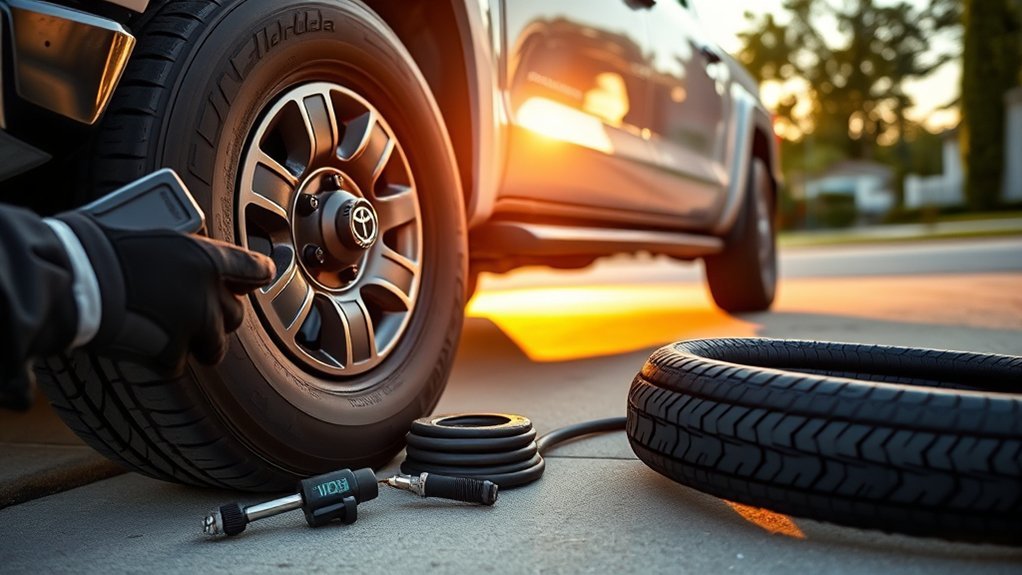
Correct tire pressure supports fuel economy, handling, tire life, and load capacity. Check all tires when cold, ideally before driving or after the truck has been parked for several hours. Use the pressure on the driver-side Tire and Loading Information label or in the owner’s manual, not a universal 35–40 psi range and not the maximum pressure molded into the tire sidewall.
FuelEconomy.gov estimates that proper inflation improves gas mileage by about 0.6% on average and up to 3% in some cases. The Tire Pressure Monitoring System is a warning system, not a replacement for monthly checks.
- Inspect tread and sidewalls for damage, embedded objects, or uneven wear.
- Rotate tires at the interval and pattern Toyota specifies for your configuration.
- Check alignment if the truck pulls, the wheel is off-centre, or wear is uneven.
- Use the correct tire size, load rating, and type for your Tundra and its work.
- When replacement is already due, compare rolling resistance without sacrificing wet grip, winter capability, durability, or load capacity.
Reduce Aerodynamic Drag and Plan Trips
A full-size pickup pushes a large area through the air, so speed and external accessories matter. Remove an unused roof box, rooftop tent, tall rack, or other external carrier when practical. Keep windows closed at highway speed when comfortable because open windows add drag.
Combine errands so the engine reaches normal operating temperature and you avoid repeated cold starts. FuelEconomy.gov says several short trips from a cold start can use twice as much fuel as one longer multipurpose trip covering the same distance.
Seasonal Strategies to Enhance Your Tundra’s Fuel Efficiency
Cold weather lowers fuel economy because fluids are thicker, the engine takes longer to warm, tire pressure falls, winter gasoline can contain slightly less energy, and snow or four-wheel drive adds resistance. Check cold tire pressure more often, combine trips, clear snow and ice, and drive gently after a brief start-up period instead of idling for a long warm-up.
Use 4H or 4L only when road or terrain conditions require it and follow your owner’s manual. Keep traction and stability systems enabled during normal driving. Toyota describes the VSC/TRAC off control as a way to help free a stuck vehicle in conditions such as mud, dirt, or snow, not as an MPG setting.
In hot weather, air conditioning and open windows can both affect fuel use. Vent hot air briefly, avoid idling with the A/C running before departure, use a reasonable temperature setting, and choose windows at low speed or A/C at highway speed based on comfort and conditions.
Why Your Tundra’s MPG May Suddenly Drop
A sudden change deserves investigation, especially when your route and weather have not changed. Check these common causes:
- One or more underinflated tires
- Cold weather, winter fuel, snow, or stronger headwinds
- More short trips, traffic, remote starts, or idling
- New all-terrain tires, a roof rack, external cargo, or heavier payload
- Frequent towing, four-wheel-drive use, or steep routes
- A check-engine light, misfire, dragging brake, alignment problem, or other mechanical fault
If the drop persists for several tanks or comes with warning lights, rough running, fuel smell, smoke, overheating, or abnormal braking, arrange a qualified inspection.
Related Guides
Frequently Asked Questions
How do you make a Tundra get better gas mileage?
Drive smoothly, reduce legal highway speed, limit idling, combine short trips, remove unnecessary cargo, and use the cold tire pressures, oil grade, fuel, and maintenance schedule specified for your exact model year.
What year Toyota Tundra should you stay away from?
No model year should be rejected solely because of a generic online claim or MPG figure. Condition, maintenance history, configuration, open recalls, and a pre-purchase inspection matter more. Check the VIN with the NHTSA recall lookup and review records before buying.
Does turning off traction control improve gas mileage?
No meaningful MPG benefit is established. Leave traction and stability control on during normal driving. Toyota’s off function is intended for limited situations such as helping free a stuck vehicle; follow the instructions for your model year.
What can you do to a truck to get better gas mileage without modifications?
Start with driving behavior and maintenance: avoid rapid acceleration, slow down when legal and practical, check cold tire pressure, remove unused cargo and exterior carriers, limit idling, combine trips, and repair faults that cause rough running or rolling resistance.
Will premium gas improve Tundra MPG?
Use the octane specified in your owner’s manual. When premium is not required, normal driving may show little or no fuel-economy benefit, so the added cost may not be recovered through fuel savings.
Why is my Tundra getting worse MPG than the EPA estimate?
EPA figures come from standardized testing. Real MPG changes with speed, traffic, temperature, trip length, tires, payload, towing, four-wheel-drive use, fuel, maintenance, and driver behavior. Compare several similar tanks before deciding that the truck has a fault.
Conclusion
The most reliable way to improve Toyota Tundra MPG without mods is to reduce wasted energy. Drive smoothly, keep speed reasonable and legal, limit idling, use the pressure on the tire label, remove unnecessary cargo, and follow Toyota’s maintenance specifications. Measure results over several comparable tanks, and treat a persistent sudden drop as a possible maintenance problem rather than reaching first for premium fuel or additives.
Sources
- FuelEconomy.gov: Driving More Efficiently — speed, aggressive driving, idling, cruise control, cargo, and weight
- FuelEconomy.gov: Keeping Your Vehicle in Shape — tire pressure, oil grade, warning lights, and air-filter effects
- NHTSA TireWise — cold tire-pressure checks, label location, rotation, tread, and alignment
- Toyota Manuals and Warranties — model-year-specific operating and maintenance instructions
- FuelEconomy.gov: Fuel Economy in Cold Weather — winter MPG losses, warm-up, pressure, and four-wheel-drive effects
- FuelEconomy.gov: Selecting the Right Octane Fuel — manufacturer fuel requirements and premium-fuel limitations