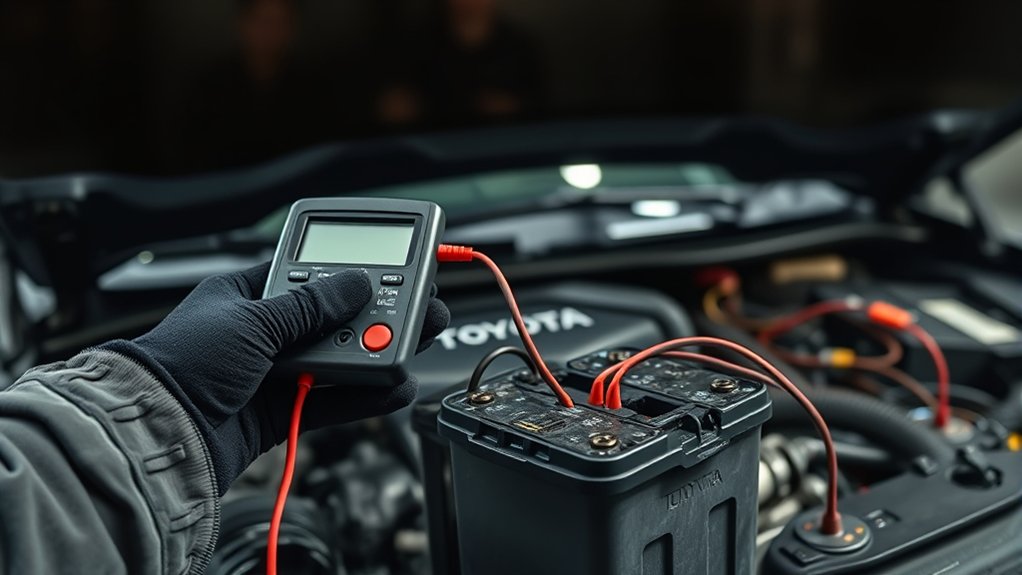
If your Toyota Tundra’s battery keeps dying, first determine when the failure happens. A truck that goes dead after sitting usually has a weak battery, an excessive key-off electrical draw, or both. A truck that loses electrical power while running is more likely to have a charging-system, cable, belt, ground, or power-distribution problem.
Last updated: September 19, 2026. This revision adds Tundra-specific service-bulletin context and rechecks battery-drain testing guidance against current sources.
Quick Answer
Fully charge and test the 12-volt battery before looking for a drain. Then inspect the terminals, cables, grounds, alternator belt, trailer wiring, and aftermarket accessories. If the truck still dies while parked, let every control module enter sleep mode and measure key-off current safely. Treat 50 milliamps as a rough screening level, not a universal Toyota specification.
Key Takeaways
- Test the battery’s capacity after charging it; resting voltage alone cannot prove that the battery is healthy.
- A parasitic draw must be measured only after doors, lights, accessories, and vehicle modules have shut down.
- Normal key-off current varies by model year and equipment, so use Toyota service information for the final specification.
- Aftermarket remote starters, dashcams, trailer equipment, amplifiers, bed lights, and OBD devices are common places to investigate.
- Never crank the engine or operate a high-current accessory while a standard multimeter is connected in series.
At a Glance
| Time Required | About 30–90 minutes after the battery is fully charged; intermittent faults may take longer to reproduce |
| Difficulty | Intermediate; professional help is recommended for unstable readings, hybrid-system concerns, or module/network faults |
| Tools Needed | Safety glasses, battery charger, digital multimeter with a fused high-current input or low-amp DC clamp meter, basic hand tools, and the correct fuse chart |
| Cost | Testing may require no parts if the tools are already available; meter, battery-test, repair, and shop-diagnostic costs vary |
Why Does My Toyota Tundra Battery Keep Dying?
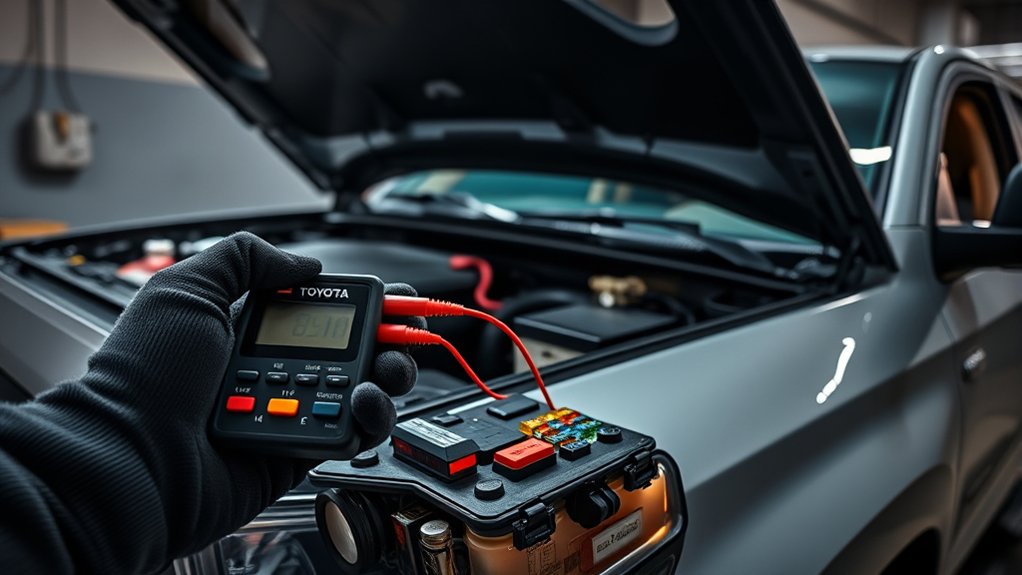
Start by noting exactly how the truck fails. That detail helps separate a parked-vehicle draw from a battery, starter, or charging-system problem.
- Dead after sitting overnight or for several days: Suspect a discharged or damaged battery, an excessive key-off draw, an accessory that remains active, or a control module that does not enter sleep mode.
- Slow cranking every morning: Check the battery’s state of charge, capacity, terminal condition, cable voltage drop, starter demand, and overnight draw.
- Starts after a jump but dies again soon: The battery may no longer hold a charge, or the charging system may not be replenishing it.
- Lights dim or warning lamps appear while driving: Inspect the alternator drive belt, charging system, battery cables, grounds, and main electrical connections before blaming a parked-current draw.
- No crank despite normal lights: Check the battery under load, terminal connections, starter circuit, shift-position input, and immobilizer or control-system faults.
Record how long the Tundra was parked, the weather, whether a trailer or accessory was connected, and whether the doors, tailgate, bed lights, or hood were recently used. Intermittent drain problems often follow a repeatable event.
Safety Before Testing the Battery or Electrical System
Warning: Wear eye protection, remove metal jewelry, and keep sparks, cigarettes, and open flames away from the battery. Do not charge, jump-start, or test a battery that is cracked, leaking, swollen, frozen, unusually hot, or giving off a strong odor. Follow the jump-starting and battery-disconnection procedure in the owner’s manual for your exact model year.
Keep tools from bridging the positive terminal to metal bodywork. When measuring current in series, use the meter’s properly fused current input and begin on its highest supported DC-amp range.
Never crank the engine, switch on the headlights, operate power seats, use the winch, or activate another high-current load while a normal handheld multimeter is connected in series. The resulting current can blow the meter fuse, damage the meter, interrupt vehicle electronics, or create an arc.
Note: An i-FORCE MAX Tundra has a conventional 12-volt electrical system and a separate high-voltage hybrid system. Limit DIY battery-drain testing to the 12-volt system. Do not touch, probe, disconnect, or remove orange high-voltage cables or hybrid components.
Use the Toyota owner-manual portal to select the correct year and configuration before disconnecting a battery or jump-starting the truck.
Common Causes of Battery Drain in Your Tundra
A repeated dead battery is not always caused by an electrical draw. The complete list of likely causes includes:
- An aged, internally damaged, or deeply discharged 12-volt battery
- Loose, corroded, contaminated, or damaged battery terminals and cables
- Insufficient charging caused by a belt, alternator, wiring, fuse, sensor, control, or ground problem
- Interior, vanity, glove-box, console, cargo, bed, or trailer lights remaining on
- A door, hood, or tailgate latch switch that reports the wrong position
- A relay that sticks closed after the ignition is switched off
- A control module that repeatedly wakes up or never enters sleep mode
- An alternator diode that leaks current when the engine is off
- Trailer wiring, a brake controller, a battery isolator, or moisture in a connector
- Frequent short trips that do not replace the energy used during starting
- Long periods of storage without an appropriate maintainer
- Extreme heat or cold reducing available battery performance
Aftermarket Accessories Impact
Aftermarket equipment deserves early attention because it may bypass factory power-management logic. Remote starters, security systems, amplifiers, subwoofers, winches, auxiliary lighting, dashcams, GPS trackers, two-way radios, trailer devices, and USB chargers can draw power after the truck is parked.
Inspect every added fuse holder, relay, splice, ground, and constant-power connection. A device may work normally while driving yet fail to shut down because its ignition-sense wire, relay, or software is incorrect.
Pro Tip: Create a list of everything that was added after the truck left the factory. Temporarily unplug low-risk accessories one at a time, then repeat the same overnight test. This is often faster than examining every factory circuit first.
Parasitic Draw Sources
A parasitic draw is current that continues to leave the battery after the vehicle should be asleep. Some key-off current is normal because clocks, alarm functions, memory, keyless entry, and communication modules need standby power.
Excessive draw can come from a lamp, relay, accessory, damaged wire, wet connector, alternator diode, or networked module. On newer Tundras, opening a door, keeping a smart key nearby, using a connected-service feature, or unplugging and reinstalling a fuse may wake several modules and temporarily increase the reading.
Toyota Tundra Battery-Drain Bulletins to Check by Model Year
Toyota has published battery-related service information that matters for specific Tundra years and equipment. These bulletins do not mean every truck in the listed years has a defect; they narrow the diagnosis when the truck matches the bulletin’s conditions.
| Tundra / Condition | Toyota Bulletin | Diagnostic Meaning |
| 2007 Tundra with Toyota accessory Remote Engine Starter (RES) | AX006-07 | Addresses discharged batteries after short-term storage caused by RES ECU parasitic draw. |
| 2008–2009 Tundra with Toyota accessory RES | T-SB-0103-10 | Uses a specified shutdown sequence and a 75 mA branch point to determine whether the RES ECU is the cause. That 75 mA value belongs to this bulletin’s procedure; it is not a universal Tundra specification. |
| 2026 Tundra and Tundra HV during dealer storage / pre-delivery service | T-SB-0005-26 Rev1 | Toyota notes that storage period, temperature, parasitic drain, and battery load can reduce battery performance and life, so battery inspection and maintenance are required during PDS. This is a maintenance bulletin, not proof of a model-wide drain defect. |
If your truck matches one of these conditions, use the exact Toyota procedure for that bulletin and model year. For other Tundras, diagnose the battery, charging system, key-off draw, wiring, and accessories rather than applying a bulletin threshold out of context.
Understanding Parasitic Draw: What You Need to Know
Do not treat a current reading taken immediately after shutting off the engine as the final parasitic draw. Modules may remain awake while saving data, communicating, checking systems, or waiting for doors and latches to stabilize.
Many technicians use approximately 50 milliamps, or 0.05 amp, as a rough screening point after full sleep. It is not a universal Toyota limit. A properly equipped newer truck may have a different normal value, and a module that wakes periodically can produce brief increases. The final decision should be based on the service information for the truck’s model year, equipment, and powertrain.
A continuous 0.05-amp draw consumes about 1.2 amp-hours every 24 hours. A marginal or cold battery may therefore become unable to start the truck well before it appears completely discharged.
Common Causes Identified
The most useful clues are the size and timing of the draw:
- Steady draw: Often points to a lamp, relay, hard-wired accessory, alternator diode, or module that remains powered.
- Periodic spikes: May come from a module waking, a communication fault, connected equipment, keyless-entry activity, or an accessory timer.
- Draw that appears after rain, washing, or towing: Inspect trailer plugs, rear lighting, bed accessories, and moisture-prone connectors.
- Draw that disappears when the battery is disconnected and reconnected: A module may have reset, so continue testing rather than assuming the problem is permanently fixed.
Testing Techniques Explained
Use the following sequence so a weak battery or incomplete sleep period does not produce a false diagnosis.
- Fully charge the battery. A parasitic-draw test performed on a deeply discharged battery can be misleading because modules may behave abnormally at low voltage.
- Test battery capacity. Use an appropriate conductance or load tester after charging. Replace a battery that cannot meet the correct test standard before chasing a small key-off draw.
- Shut down the truck. Remove chargers and accessories, turn off every lamp, close or simulate the closing of doors and latches, keep the key well away, and allow the vehicle to enter sleep mode.
- Use a low-amp DC clamp meter when available. Clamp it around one battery cable without disconnecting the circuit. Confirm the meter can accurately measure low DC current.
- For an in-series test, preserve the circuit if possible. A temporary bypass lead can keep modules powered while the meter is connected. Remove the bypass only after the meter is safely installed on its fused high-current range.
- Wait for the reading to settle. Depending on model year and equipment, this may take 20–45 minutes or longer. Do not touch the handles, press the remote, or open a door during the test.
- Record the baseline. Note both the stable current and any periodic spikes.
- Isolate the affected circuit. Use fuse voltage-drop testing or remove fuses carefully while watching the reading. Remember that fuse removal can wake modules.
- Inspect everything powered by the identified fuse. The circuit name alone does not prove which component is faulty.
A detailed parasitic-current procedure from a test-equipment manufacturer is available in Fluke’s parasitic battery drain guide.
Mitigation Strategies Available
Once the affected circuit is known, repair the cause rather than routinely disconnecting the battery. Depending on the diagnosis, the solution may include:
- Repairing a damaged wire, wet connector, or corroded terminal
- Adjusting or replacing a faulty latch or lamp switch
- Replacing a sticking relay
- Correcting an accessory’s ignition-sense or constant-power wiring
- Updating, reprogramming, or replacing a control module
- Repairing trailer wiring or removing a defective trailer accessory
- Replacing an alternator with a leaking diode or charging fault
- Replacing a battery damaged by age or repeated deep discharge
A battery disconnect switch may be useful for certain stored or specialty vehicles, but it should not be used to hide an unresolved drain. Disconnecting power can erase settings, interrupt monitoring functions, and temporarily reset the component causing the fault.
Essential Components to Inspect for Battery Drain
Before dismantling the fuse panels, inspect the components most likely to create a repeat failure:
- Battery case and date: Look for swelling, cracks, leakage, heat damage, and evidence of repeated deep discharge.
- Battery terminals: Confirm they are clean, fully seated, correctly tightened, and free of movement.
- Positive cable and fuse links: Inspect for heat, corrosion, loose connections, and damaged insulation.
- Negative cable and grounds: Check the battery-to-body, body-to-engine, and related ground connections.
- Alternator drive belt: Check for looseness, glazing, contamination, cracking, or tensioner problems.
- Trailer connector and harness: Look for bent pins, corrosion, water, damaged insulation, and nonfactory splices.
- Bed and cargo equipment: Check lights, toppers, tonneau-cover wiring, inverters, compressors, refrigerators, and auxiliary batteries.
- Cabin accessories: Unplug dashcams, OBD dongles, phone chargers, trackers, and adapters during diagnosis.
Electrical architecture differs substantially between early Tundras, 2007–2021 trucks, and 2022-and-newer models. Hybrid and nonhybrid trucks also have different systems. Do not use a parasitic-current specification, fuse chart, or disconnection procedure from another generation.
Testing Your Tundra’s Battery Drain and Health
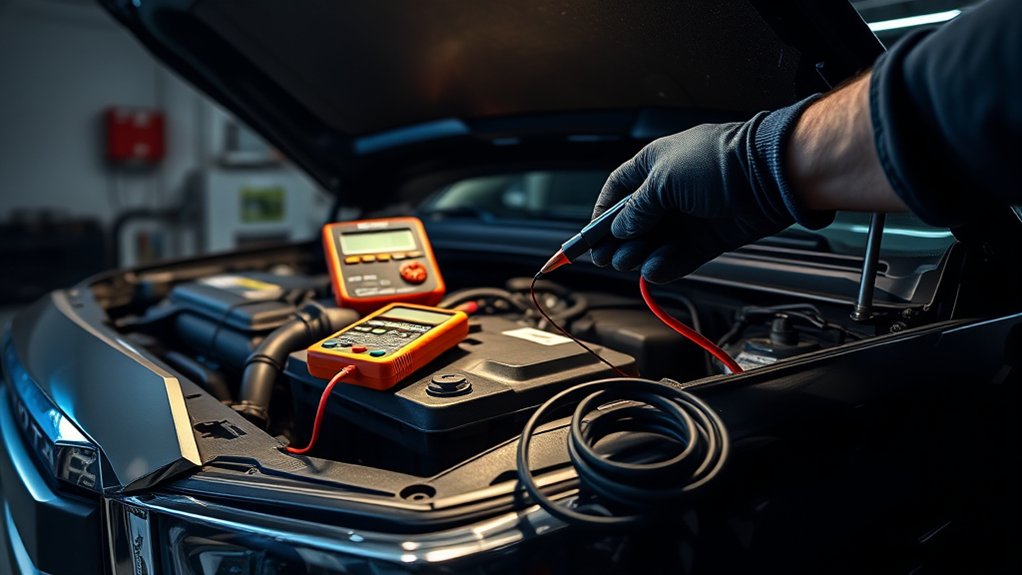
Battery condition, charging performance, and key-off current must be tested separately. Passing one test does not guarantee that the other two systems are healthy.
Voltage Measurement Techniques
Measure resting voltage only after the battery has been charged and allowed to rest with major loads off. A healthy, fully charged conventional lead-acid starting battery is commonly near 12.6 volts at rest, while some AGM batteries may read slightly higher. A reading around 12.4 volts generally indicates a lower state of charge rather than a fully charged battery.
Temperature, battery design, recent charging, and recent electrical loads affect the reading. Voltage therefore provides a useful state-of-charge clue, but it does not reveal how much current the battery can supply during cranking.
Follow resting-voltage measurement with a conductance or load test appropriate for the battery type and rating. Interstate Batteries provides additional background in its car-battery testing guide.
Parasitic Draw Identification
After obtaining a stable baseline, isolate the circuit without repeatedly waking the truck.
Fuse voltage-drop method: With the fuses installed and the truck asleep, measure the tiny voltage drop across the exposed test points on each fuse. A fuse carrying current will show a measurable drop. The result must be interpreted with a fuse-type conversion chart and a sufficiently sensitive meter.
Fuse-pull method: Remove one fuse at a time and watch for a meaningful current decrease. Reinstall it before moving to the next circuit unless the service procedure says otherwise. If pulling or reinstalling a fuse wakes modules, wait for the current to settle again.
Accessory-disconnection method: For nonfactory equipment, unplug the accessory or remove its dedicated fuse, then repeat the same sleep-state test.
Alternator-isolation method: A shorted or leaking alternator diode can create a draw with the engine off. Because the alternator cable is unfused or protected by high-capacity links on many vehicles, this test is best performed with the correct service procedure or by a qualified technician.
How Your Alternator Affects Battery Life
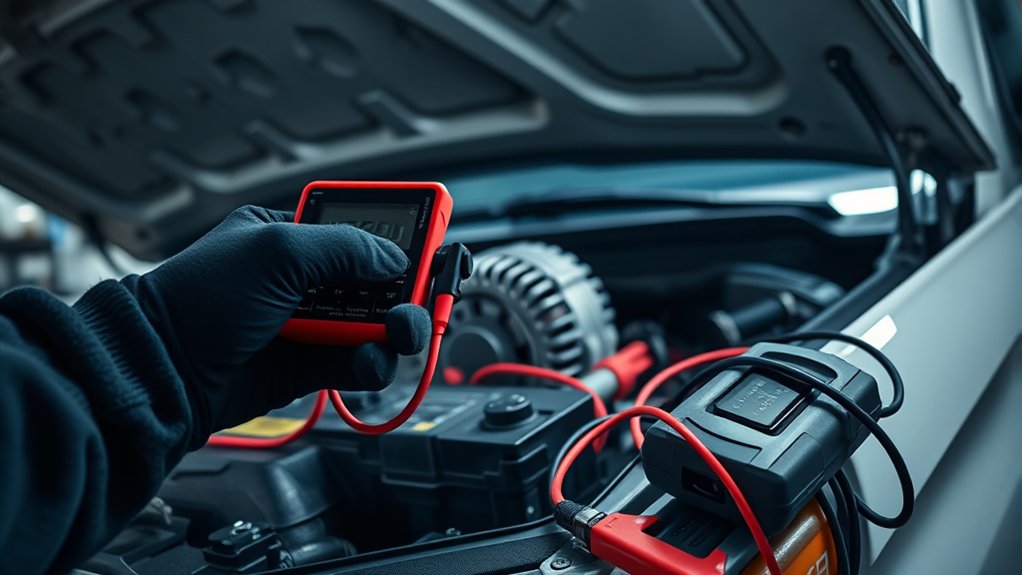
The alternator supplies vehicle electrical power and replenishes the 12-volt battery while the engine runs. A weak battery can overload the charging system, while an undercharging or intermittently charging system can leave a good battery discharged.
Do not diagnose an alternator from one no-load voltage reading. Charging voltage on a modern truck can vary with battery temperature, state of charge, engine speed, electrical demand, and control-system commands.
A useful charging-system check includes:
- Inspecting the drive belt, tensioner, connectors, cables, fuses, and grounds
- Measuring voltage directly at the battery before and after starting
- Repeating the measurement with headlights, blower, and other normal loads operating
- Checking for excessive voltage drop in the positive and ground paths
- Scanning for charging-system or communication fault codes when applicable
- Testing alternator output and diode ripple with suitable equipment
- Comparing the results with Toyota specifications for the exact truck
If the charging warning light appears, the belt is damaged, the battery becomes hot, or voltage changes erratically, stop relying on a simple range and have the system tested properly.
Troubleshooting Steps for Battery Drain Issues
| Symptom | Check First | Likely Direction |
| Dead after one night | Battery capacity and sleep-state current | Large draw, lamp, relay, accessory, module, alternator diode, or damaged battery |
| Dead after several days | Battery age, state of charge, storage pattern, and smaller continuous draw | Marginal battery, normal standby load combined with infrequent driving, or moderate parasitic draw |
| Dies while driving | Charging warning, belt, alternator, cables, grounds, and main fuses | Charging-system or power-distribution fault rather than a simple parked draw |
| Problem started after accessory installation | Accessory fuse, relay, ground, splice, ignition-sense wire, and programming | Accessory remains awake or was connected to the wrong power source |
| Problem follows rain or trailer use | Trailer plug, rear harness, bed accessories, lamps, and moisture-prone connectors | Water intrusion, corrosion, damaged insulation, or trailer-equipment fault |
After each repair, fully charge the battery and repeat the same overnight or multiday test. A battery damaged by repeated deep discharge may still need replacement even after the original drain is fixed.
Importance of Proper Ground Connections and Wiring
Ground connections complete the electrical paths used by the starter, alternator, body electronics, sensors, and control modules. Corrosion or looseness can cause slow cranking, charging errors, communication faults, flickering lights, voltage drops, and intermittent no-start conditions.
Inspect the battery negative terminal, body ground, engine ground, and any accessory grounds. A connection can look clean while having resistance between the terminal and the cable or between the ground eyelet and mounting surface.
When checking a cable under load, measure voltage drop from one end of the connection to the other rather than relying only on a visual inspection. Follow the Toyota wiring diagram for the exact model year because ground locations and circuit paths differ among generations.
Tips for Preventing Future Battery Drain Problems
- Keep the battery fully charged, especially after a jump-start or deep discharge.
- Have the battery tested before winter, before long storage, and whenever cranking speed changes.
- Clean and secure the terminals and inspect the cables during routine service.
- Disconnect unnecessary OBD devices, adapters, chargers, and accessories when the truck is parked for long periods.
- Configure dashcam parking modes and cutoff voltages correctly.
- Inspect trailer wiring and connectors after water, salt, mud, or off-road exposure.
- Use a battery maintainer approved for the installed battery type during extended storage.
- Avoid relying exclusively on short trips; the charging system needs sufficient operating time to replace starting and accessory use.
- Keep accessory installation diagrams and fuse locations for future diagnosis.
- Check for applicable software updates, service campaigns, and recalls by model year and VIN.
The NHTSA recall lookup can identify unrepaired safety recalls and provide access to investigations, complaints, and manufacturer communications. A zero-recall result does not rule out a technical service bulletin, software update, accessory fault, or ordinary component failure.
When to Consult a Professional for Battery Issues
Arrange professional diagnosis when:
- The battery becomes hot, swells, leaks, freezes, or repeatedly emits a strong odor
- The truck loses electrical power while driving
- The charging warning light remains on
- The parasitic reading is unstable or appears only intermittently
- A control module repeatedly wakes up or will not enter sleep mode
- The suspect circuit contains multiple networked modules
- The alternator or main cable must be disconnected to continue testing
- There is evidence of melted insulation, overheated terminals, or water intrusion
- The truck is an i-FORCE MAX and the diagnosis approaches high-voltage components
- A new, fully charged, tested battery continues to discharge with no clear circuit identified
A Toyota dealer or qualified repair facility can use factory wiring diagrams, scan-tool data, service bulletins, software information, and model-specific current specifications. Toyota’s subscription-based Technical Information System is the authoritative source for detailed service procedures.
Frequently Asked Questions
Why does my Toyota Tundra battery keep dying?
Common causes include a weak or deeply discharged battery, poor cable connections, insufficient charging, a light or relay remaining on, a module that does not sleep, an alternator diode leak, trailer wiring, or an aftermarket accessory. Charge and capacity-test the battery before measuring key-off current.
Why does my truck keep dying even though the battery tests good?
A battery can test well immediately after charging but later discharge because of an intermittent draw or charging fault. Check cable voltage drop, charging performance under load, alternator-diode leakage, module sleep behavior, trailer equipment, and aftermarket accessories.
How do I find what is draining my Tundra battery?
Fully charge and test the battery, shut down the truck, keep the key away, allow every module to sleep, and measure current with a suitable low-amp clamp meter or a safely connected fused multimeter. Isolate the affected circuit with fuse voltage-drop testing or careful fuse removal, then inspect every component on that circuit.
Is a 50-milliamp draw normal on a Toyota Tundra?
Fifty milliamps is a useful general screening level, not a universal Toyota specification. Normal draw depends on the Tundra’s model year, options, connected services, accessory installation, measurement method, and sleep state. Compare a stable reading with service information for the exact truck.
How long should I wait before measuring parasitic draw?
Wait until the vehicle’s current has settled after shutdown. Twenty to 45 minutes is a practical starting range, but some configurations can require longer or wake periodically. Do not open doors, press the remote, move the key near the truck, or disturb fuses while waiting.
Can a bad alternator drain the battery while the truck is off?
Yes. A failed alternator diode can allow current to flow when the engine is off, while another alternator fault can leave the battery undercharged during driving. Alternator isolation and diode testing should follow the correct service procedure because the main cable carries high current.
Is there a Toyota TSB for Tundra battery drain?
Yes, but applicability depends on year and equipment. Toyota AX006-07 addressed 2007 Tundras with the Toyota accessory Remote Engine Starter, and T-SB-0103-10 covered certain 2008–2009 Tundras with the RES system. Toyota’s T-SB-0005-26 Rev1 covers 2026 Tundra and Tundra HV battery inspection and maintenance during pre-delivery service; it is not a model-wide battery-drain defect bulletin.
What is the most common battery-related problem on a Toyota Tundra?
There is no single fault that applies to every Tundra generation. Battery condition, cable connections, charging performance, accessories, trailer wiring, software, and module behavior all vary by model year. Diagnose the actual symptom and check the truck’s VIN, owner manual, and service information.
Conclusion
A reliable diagnosis begins with a fully charged, capacity-tested battery and a clear description of when the Tundra loses power. Inspect the cables, grounds, belt, trailer wiring, and added accessories before performing a sleep-state current test. If a circuit is identified, repair the component causing the draw rather than repeatedly disconnecting the battery.
Use general numbers such as 12.6 volts or 50 milliamps as screening clues, not universal Toyota specifications. When the readings are intermittent, the truck will not enter sleep mode, or the work approaches hybrid or high-current components, use model-specific Toyota service information or arrange professional diagnosis.
Sources
- Toyota Manuals and Warranties — model-year-specific operating, battery, jump-starting, and safety instructions
- Toyota Technical Information System — factory service procedures, wiring information, specifications, and technical publications, including model-specific bulletin verification
- Fluke: How to Find Parasitic Battery Drain — safe current-measurement and circuit-isolation principles
- Interstate Batteries: How to Test a Car Battery — battery-voltage and health-testing background
- National Highway Traffic Safety Administration Recall Lookup — VIN recalls, investigations, complaints, and manufacturer communications