Your Toyota Tundra VIN is the 17-character identifier that separates your truck from every other vehicle. You can use it to confirm the model year, assembly plant, body and engine attributes, recall status, and the right starting point for parts lookup. The key is to read the VIN in sections, not as 17 random characters.
Quick Answer
A Toyota Tundra VIN has 17 characters. Positions 1–3 identify the manufacturer/type code, positions 4–8 describe vehicle attributes, position 9 is the check digit, position 10 shows model year, position 11 shows plant, and positions 12–17 are the production sequence for most Tundra VINs.
Key Takeaways
- Your Tundra VIN is usually visible through the lower driver-side windshield and on the driver-side door jamb label.
- Do not decode each character alone. VIN sections work together, and Toyota codes can vary by model year and market.
- Position 9 is a check digit, so it verifies VIN transcription rather than describing your truck’s trim or engine.
- Use official tools such as the NHTSA VIN Decoder and Toyota recall lookup before relying on third-party information.
- A VIN can help you search recalls and history records, but it does not prove accident or service history by itself.
At a Glance
| Time Required | 5–10 minutes for a basic VIN decode and recall check |
| Difficulty | Easy |
| Tools Needed | Your 17-character VIN, registration or insurance card, and a phone or computer |
| Cost | Free for VIN decoding and recall checks; paid reports are optional for deeper title-history research |
Where to Find Your Toyota Tundra VIN
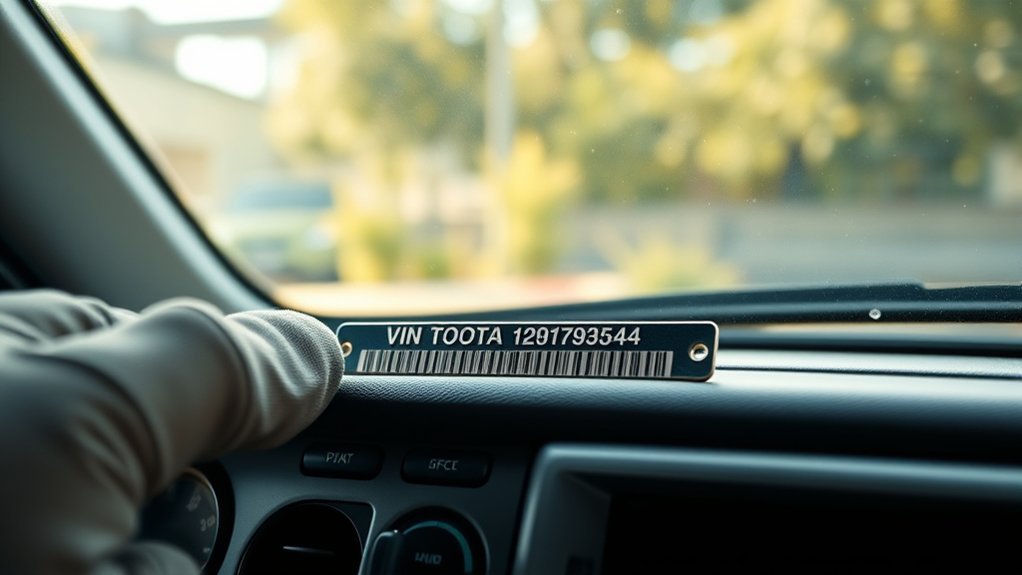
Start with the easiest location: the lower driver-side corner of the windshield. Stand outside the truck and look through the glass near the base of the dashboard. U.S. rules require the VIN to be readable through the vehicle glazing on many passenger vehicles and light trucks, and NHTSA also points owners to the lower left windshield area.
Next, open the driver’s door and check the certification label on the door jamb or door frame. This label often shows the VIN along with tire, weight, and manufacturing information.
You can also find the VIN on your registration card, title, insurance card, sales paperwork, service records, or Toyota owner account. If the windshield plate and paperwork do not match, stop and verify the truck before buying parts, scheduling service, or purchasing a used Tundra.
Pro Tip: Take a clear photo of the VIN plate and door jamb label before ordering parts. A single mistyped character can point you to the wrong model year, engine, or trim data.
Why Your Toyota Tundra VIN Matters
Your Toyota Tundra VIN does more than identify the truck. It helps you confirm build details, check for open safety recalls, compare paperwork during a used-truck purchase, and narrow down compatible replacement parts.
Under 49 CFR Part 565, each VIN uses 17 characters and includes required sections for manufacturer identification, vehicle attributes, a check digit, model year, plant, and production sequence. The allowed character set excludes the letters I, O, and Q, which helps reduce confusion with 1 and 0.
The VIN is especially helpful when your Tundra has multiple possible engines, cab styles, drivetrains, or production changes within the same model year. Still, the VIN should be a starting point, not the only proof of fitment. Always verify parts against Toyota parts data, your owner’s manual, and the actual component on your truck.
What the First Three Characters Tell You
The first three characters form the World Manufacturer Identifier, often called the WMI. For a high-volume manufacturer, these three positions identify the manufacturer and vehicle type. This is why you should read the first three characters as a group instead of assigning a universal meaning to each character by itself.
For a Toyota Tundra, the WMI can point to Toyota and the broad vehicle type, but exact codes vary by market, model year, and manufacturing details. A VIN decoder can translate the WMI more safely than a simple one-character chart.
Use the NHTSA VIN Decoder when you want a structured readout from manufacturer-submitted VIN data. It can show details such as make, model, model year, body class, engine information where available, and plant information.
Decoding VIN Positions 4–8 on Your Toyota Tundra
Positions 4 through 8 describe vehicle attributes. For trucks, the VIN information can include items such as make, model or line, series, chassis, cab type, engine type, brake system, gross vehicle weight rating, and restraint information when required.
Toyota decides the exact code meanings and reports the decoding information to NHTSA. That means one position may not always mean the same thing across every Tundra generation. A 2007 Tundra and a 2026 Tundra can use different internal coding patterns.
Body Type and Cab Identification
VIN attribute positions can help identify whether the truck is tied to a particular cab, chassis, or body configuration. This matters when you order items such as mirrors, weatherstripping, seat parts, body panels, bed accessories, or interior trim.
Do not rely only on a product listing that says “fits Tundra.” Match the model year, cab style, bed length, drivetrain, and trim notes before you buy.
Engine and Drivetrain Clues
The VIN can help narrow engine information, but the exact decode depends on the model year and Toyota’s submitted data. For newer Tundra models, that may help separate powertrain families and related service parts.
This is useful for oil filters, belts, ignition parts, sensors, cooling parts, and other engine-specific components. For expensive repairs, confirm the VIN decode with a Toyota dealer, repair manual, or the part number stamped on the existing component.
Safety and Restraint Information
VIN attribute data can include restraint-device information for certain vehicle types. This can help identify airbag and safety-system configurations, but it should not replace a diagnostic scan or Toyota service information when a warning light is on.
If your Tundra has an airbag, seat belt, braking, camera, or driver-assistance warning, treat it as a safety issue and have it checked by a qualified technician.
Understanding Position 9: The Check Digit
Position 9 is not a trim, engine, cab, or plant code. It is the check digit. Its job is to help verify that the VIN was typed or transcribed correctly.
Under U.S. VIN rules, the check digit is calculated from the other VIN characters using a defined mathematical process. If a VIN fails the check digit test, one or more characters may be wrong, or the VIN may not follow the expected U.S. format.
Warning: Do not ignore a VIN mismatch between the windshield plate, door label, title, and registration. A mismatch can point to a paperwork error, prior body repair, theft issue, or title problem that needs investigation.
What Positions 10–17 Tell You
Positions 10 through 17 form the Vehicle Identifier Section. This section helps identify the model year, assembly plant, and production sequence.
Position 10 is the model-year code. For example, current U.S. year codes include R for 2024, S for 2025, T for 2026, V for 2027, W for 2028, X for 2029, and Y for 2030 under the current federal table.
Position 11 represents the plant of manufacture. Positions 12 through 17 usually carry the sequential production number for high-volume manufacturers.
Note: Model-year codes repeat over time. For many passenger vehicles and lighter trucks, position 7 helps distinguish older 1980–2009 codes from 2010–2039 codes. Use a decoder instead of guessing from position 10 alone.
Toyota Tundra VIN Position Table
| VIN Position | Section | What It Helps Identify |
|---|---|---|
| 1–3 | WMI | Manufacturer and vehicle type code |
| 4–8 | Vehicle attributes | Model line, series, cab/chassis, engine, brake system, GVWR, and restraint data where applicable |
| 9 | Check digit | Helps verify that the VIN was copied correctly |
| 10 | Model year | The model-year code for the truck |
| 11 | Plant code | The plant where the VIN was affixed |
| 12–17 | Production sequence | The sequential number assigned during production for most high-volume manufacturers |
How to Decode a Toyota Tundra VIN Step by Step
- Write down all 17 characters. Use the windshield plate or door jamb label, not memory.
- Check for invalid letters. Standard U.S. VINs do not use I, O, or Q.
- Split the VIN into sections. Read positions 1–3, 4–8, 9, 10, 11, and 12–17 separately.
- Run the VIN through the NHTSA VIN Decoder. Review the make, model, model year, body class, engine data where available, and plant information.
- Check Toyota recall status. Use the Toyota recall page or NHTSA recall search with the full VIN.
- Verify parts before buying. Match the VIN decode with trim, engine, drivetrain, cab, bed, and production notes.
How VIN Decoding Helps With History and Maintenance
VIN decoding helps you identify your Tundra more precisely before you buy parts, schedule repairs, or evaluate a used truck. It can point you toward model year, plant, cab or chassis information, engine family, restraint data, and other vehicle attributes.
For recall checks, use the NHTSA recall search or the Toyota Safety Recalls & Service Campaigns lookup. Toyota explains that safety recall campaign inspections and repairs are performed at no charge when a covered safety recall applies.
For title and fraud research, a VIN can also be used with the National Motor Vehicle Title Information System and other history-report providers. This is separate from decoding. A VIN identifies the truck, while a history report gathers records tied to that VIN.
Vehicle History Insights
A VIN-based history search may help uncover title brands, salvage records, theft records, odometer issues, or other reported events, depending on the database used. It may not include every accident, repair, or private service record.
When buying a used Tundra, compare the VIN on the windshield, door label, title, registration, and seller documents. Then run recall and history checks before you commit.
Maintenance Precision Identification
VIN decoding improves maintenance accuracy because it narrows the exact truck configuration. That matters for engine parts, brake parts, sensors, electronics, interior trim, suspension parts, and accessories.
| Use Case | How the VIN Helps | Owner Tip |
|---|---|---|
| Recall check | Searches for open safety recalls tied to your specific truck | Check both NHTSA and Toyota when possible |
| Parts lookup | Narrows model year, engine, trim, and build information | Confirm with Toyota parts data before ordering |
| Used-truck review | Lets you compare the truck, title, registration, and history records | Walk away from unresolved VIN mismatches |
What a Toyota Tundra VIN Can and Cannot Tell You
A VIN can tell you how the truck is identified in official manufacturer and regulatory data. It can help confirm the model year, make, model, plant, and some vehicle attributes.
A VIN cannot prove that the truck has never been crashed, flooded, stolen, repaired, modified, or neglected. Those details depend on inspection results, title records, service records, recall databases, insurance records, and seller documentation.
For the best used-truck check, combine a VIN decode with a recall search, title-history report, pre-purchase inspection, and a careful review of maintenance records.
Common Toyota Tundra VIN Mistakes to Avoid
- Confusing 0 and O: VINs use zero, but not the letter O.
- Confusing 1 and I: VINs use one, but not the letter I.
- Ignoring position 9: The ninth character is the check digit, not a feature code.
- Using only position 10 for model year: Year codes repeat, so use the full VIN or a decoder.
- Ordering parts from a partial fitment note: Always match cab, bed, engine, drivetrain, trim, and production notes.
- Sharing your VIN carelessly: It is not as sensitive as a password, but you should avoid posting full documents that include your name, address, plate number, or title details.
Common Questions About Toyota Tundra VIN Decoding
If you only remember one rule, remember this: decode the VIN in sections. A reliable decoder reads Toyota’s submitted code information and avoids the common mistake of assigning the same meaning to every single character across every Tundra year.
The VIN identifies the truck. Recall tools, title systems, service records, and inspections tell the larger ownership story.
Related Guides
Frequently Asked Questions
How do you read a Toyota Tundra VIN number?
Write down all 17 characters, then read the VIN in sections. Positions 1–3 identify the manufacturer/type code, positions 4–8 describe vehicle attributes, position 9 is the check digit, position 10 is model year, position 11 is plant, and positions 12–17 usually identify the production sequence.
What does each digit in a Toyota VIN mean?
Each VIN position has a role, but the meaning is not always universal across every Toyota model and year. The safest method is to decode the VIN by section and confirm the result with an official decoder or Toyota parts/service source.
What do Toyota model codes mean?
Toyota model codes are internal identifiers that can describe model families, body styles, engines, drivetrains, or market-specific configurations. They are related to vehicle identification, but they are not the same thing as the 17-character VIN.
How do you decipher a VIN code?
Start by confirming the VIN has 17 characters and no I, O, or Q. Then use the section layout: WMI, vehicle attributes, check digit, model year, plant, and production sequence. For accuracy, run the full VIN through the NHTSA VIN Decoder.
Can a Toyota Tundra VIN show accident history?
The VIN itself does not prove accident history. It lets you search records tied to that truck. Use title-history systems, recall tools, service records, and a pre-purchase inspection for a more complete picture.
Where is the VIN on a Toyota Tundra?
Look through the lower driver-side windshield first. Then check the driver-side door jamb label. You can also find the VIN on the registration, title, insurance card, sales paperwork, or service records.
Conclusion
Decoding your Toyota Tundra VIN is a practical step for ownership, maintenance, used-truck shopping, and recall checks. Once you know how the sections work, the VIN becomes easier to read and much less confusing.
Use the windshield or door jamb VIN, confirm all 17 characters, run an official decoder, and check both NHTSA and Toyota recall resources. For parts or used-truck decisions, treat the VIN as an important starting point and verify the details before you spend money.
Sources
- eCFR 49 CFR Part 565 — VIN structure, check digit, model-year codes, and content requirements.
- NHTSA VIN Decoder — official VIN decoding tool using manufacturer-submitted information.
- NHTSA Recalls — VIN location guidance and safety recall lookup information.
- Toyota Safety Recalls & Service Campaigns — Toyota recall, service campaign, and limited service campaign lookup.
- National Motor Vehicle Title Information System — vehicle history and title-fraud consumer resource.
