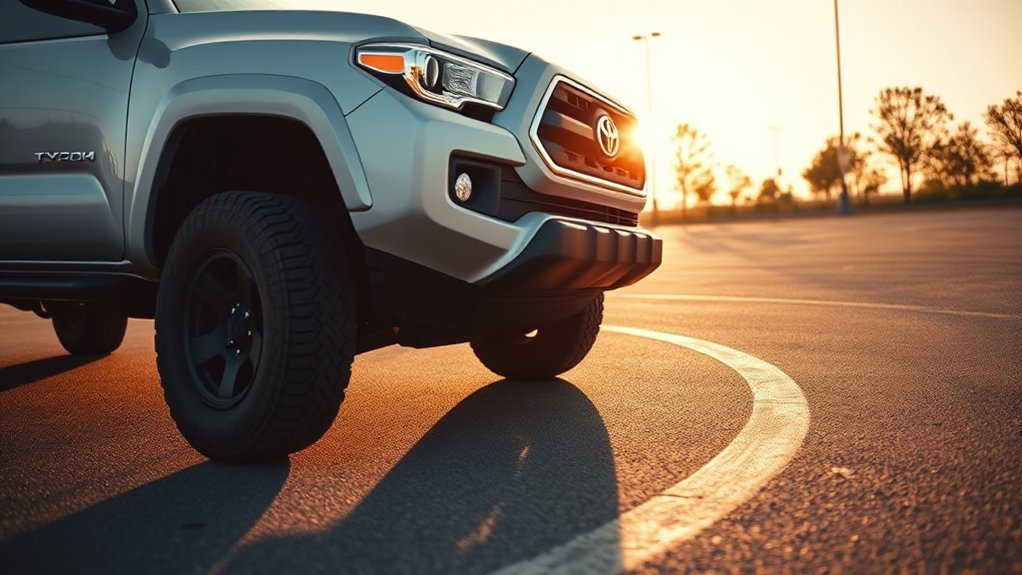
The 2024 and 2025 Toyota Tacoma can feel wide in a parking lot, but no single turning-circle number accurately describes every configuration. Toyota lists two fourth-generation wheelbases, and published turning-diameter data must be matched to the exact cab, bed, trim, tires, and drivetrain. Checking those details gives you a more useful answer than applying one number to every Tacoma.
Quick Answer
Published specifications for the 2024 and 2025 Tacoma SR XtraCab list a 45.8-foot curb-to-curb turning diameter, or about a 22.9-foot radius. Treat that as configuration-specific, not universal. Toyota lists 131.9- and 145.1-inch wheelbases, so long-wheelbase Double Cab models generally need more maneuvering room.
Key Takeaways
- The often-repeated 44.1-foot figure belongs to certain 2023 long-bed configurations, not every 2024 or 2025 Tacoma.
- Toyota lists 131.9- and 145.1-inch wheelbases for the fourth-generation Tacoma.
- A 6-foot bed does not always mean a 145.1-inch wheelbase because XtraCab models pair a 6-foot bed with the 131.9-inch wheelbase.
- The TRD Pro uses a Double Cab, 5-foot bed, and 131.9-inch wheelbase. A long-bed TRD Pro is not offered.
- Alignment and repairs can restore normal steering, but they do not safely redesign the factory turning circle.
How Big Is the Tacoma’s Turning Radius?
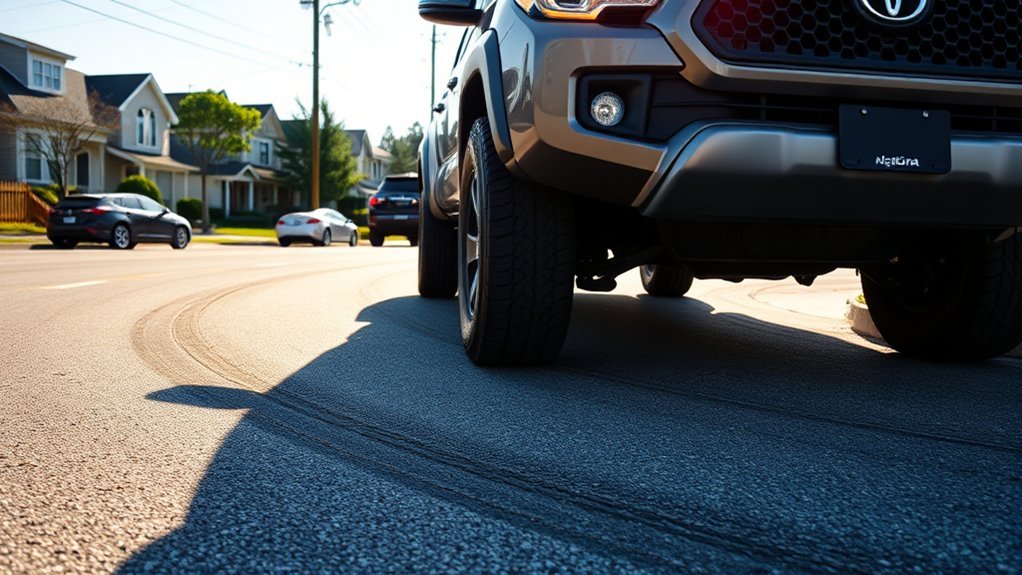
First, separate turning diameter from turning radius. Turning diameter measures the full curb-to-curb circle. Turning radius is half that distance.
A published specification for the 2024 Tacoma SR XtraCab lists a 45.8-foot curb-to-curb figure. The equivalent 2025 SR XtraCab listing gives the same number. Dividing 45.8 by two produces an approximate 22.9-foot radius.
That does not prove that every trim turns in exactly 45.8 feet. Toyota’s official 2024 brochure provides cab, bed, length, and wheelbase measurements, but it does not publish a curb-to-curb figure for every configuration. Tire packages, steering calibration, suspension components, and measurement methods can also affect published results.
Note: When a specification page uses “turning radius” for a figure in the mid-40-foot range, it is usually describing the full curb-to-curb diameter. Always check the label and measurement method before comparing vehicles.
Factory Specs by Cab, Bed, and Wheelbase
The official 2024 Toyota Tacoma brochure lists two wheelbases: 131.9 inches and 145.1 inches. The shorter wheelbase appears on XtraCab models, 5-foot-bed Double Cab models, and TRD Pro. The longer wheelbase is used on eligible Double Cab models with a 6-foot bed.
| Configuration | Bed | Wheelbase | Practical Meaning |
|---|---|---|---|
| XtraCab | 6 feet | 131.9 inches | A 6-foot bed does not automatically mean the longer wheelbase. |
| Double Cab, short bed | 5 feet | 131.9 inches | Generally easier to position than a comparable 145.1-inch-wheelbase truck. |
| Double Cab, long bed | 6 feet | 145.1 inches | Requires more space for the wheel path and the truck body’s swept area. |
| TRD Pro | 5 feet | 131.9 inches | TRD Pro is not offered as a long-bed model. |
| Trailhunter | 5 or 6 feet, depending on configuration | 131.9 or 145.1 inches | Check the exact bed and wheelbase instead of relying on the trim name. |
Turning Circle by Trim
Toyota does not provide a complete 2024 or 2025 trim-by-trim turning-circle table in the official brochure. That makes it unsafe to claim that one trim has the smallest or largest circle without configuration-specific test data.
Trim names alone can also mislead you. TRD Pro has off-road tires and unique suspension hardware, but it retains the 131.9-inch wheelbase and a 5-foot bed. Trailhunter can use either wheelbase, depending on the bed configuration. SR5, TRD Sport, and TRD Off-Road models can also vary by cab and bed.
For an accurate comparison, record all of these details:
- Model year
- Cab style
- Bed length
- Wheelbase
- Two-wheel drive or four-wheel drive
- Factory or aftermarket wheel and tire size
- Suspension and wheel-offset modifications
Bed Length Differences
Bed length affects the amount of body extending behind the rear axle, which changes how much space the truck’s rear corner sweeps through during a turn. However, the bed itself does not determine the front tires’ turning circle.
The wheelbase and available steering angle are more important. This distinction explains why a 6-foot-bed XtraCab can use the same 131.9-inch wheelbase as a 5-foot-bed Double Cab, while an eligible 6-foot-bed Double Cab stretches to 145.1 inches.
A longer bed can increase the body’s rear-corner sweep, but wheelbase and steering angle determine the basic curb-to-curb wheel path.
Which Tacoma Configurations Are Easiest to Maneuver?
If low-speed maneuverability is your priority, begin with a 131.9-inch-wheelbase configuration. Options include XtraCab models, 5-foot-bed Double Cab models, and TRD Pro.
Do not assume every XtraCab will feel more agile than every Double Cab. Both can use the same wheelbase, and tire width, wheel offset, suspension height, visibility, and body dimensions influence how comfortable the truck feels in a confined area.
A 145.1-inch-wheelbase Double Cab with a 6-foot bed will generally require more planning in parking garages, narrow driveways, alleys, and U-turn locations. It also has more body length to monitor around nearby vehicles and fixed objects.
The most reliable buying test is a low-speed drive in the exact truck you plan to purchase. Try a legal U-turn, a three-point turn, a narrow parking aisle, and a normal residential driveway. Test both left and right turns and note how many corrections you need.
[Amazon Products Picked for You]

Fitment: Toyota RAV4 TUNDRA TACOMA

[Vehicle Fitment]: Compatible with Toyota RAV4 2014-2018(Rear; Built In US), Tacoma 2015-2022(Rear), Tundra 2014-2021(Rear Outer/Rear Inner/Front; without Rubber Spacer) --- Reverse Backup Parking Sensors

Fitment: Replacement for Toyota RAV4 2014 2015 2016 2017 2018, Tacoma 2015 2016 2017 2018 2019 2020 2021 2022, and Tundra 2014 2015 2016 2017 2018 2019 2020 2021. Please confirm your vehicle model, year, and part number before purchase.
How the 2024 and 2025 Tacoma Compare With Older Models
The original 44.1-foot claim comes from third-generation data. Toyota’s official 2023 brochure lists a 40.6-foot curb-to-curb diameter for many standard-bed configurations, 44.1 feet for certain long-bed configurations, and 40.7 feet for TRD Pro.
A published 2024 and 2025 SR XtraCab specification lists 45.8 feet. That comparison suggests the selected fourth-generation configuration requires more room than a comparable 40.6-foot third-generation example. It does not establish one generation-wide number for every truck.
| Model and Configuration | Published Curb-to-Curb Diameter | Source Context |
|---|---|---|
| 2023 Tacoma, many standard-bed configurations | 40.6 feet | Official Toyota brochure |
| 2023 Tacoma, certain long-bed configurations | 44.1 feet | Official Toyota brochure |
| 2023 Tacoma TRD Pro | 40.7 feet | Official Toyota brochure |
| 2024 Tacoma SR XtraCab, published listing | 45.8 feet | Configuration-specific secondary specification |
| 2025 Tacoma SR XtraCab, published listing | 45.8 feet | Configuration-specific secondary specification |
| 2012 Tacoma 2WD Regular Cab, published listing | 36.7 feet | One specific older configuration, not the entire model year |
[Amazon Products Picked for You]

[Upside Down Digital Display]:Adjust the display orientation for optimal visibility,and get an accurate distance reading through the digital display regardless of the installation location,ensuring accurate parking every time
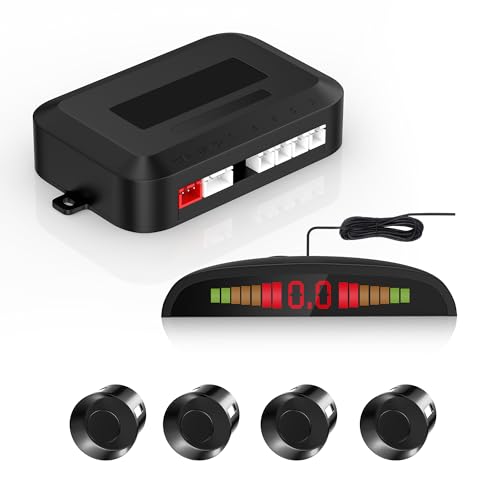
Parking Sensors for Cars with Hole Saw This reverse parking sensor kit comes with a universal hole saw and drill head for easy installation on most vehicle bumpers. A perfect solution for enhancing any car’s safety with a car reverse backup sensor.

[Auto Tow Bar Recognition]:58 KHz OE quality sensor with full detection coverage,ensures accurate detection,even with a tow-bar or rear protrusions installed,eliminating false alerts
Larger Wheelbase Effect
A longer wheelbase usually increases the space required to turn when the steering system provides a similar maximum wheel angle. The rear axle follows a tighter path than the front axle, so increasing the distance between them generally widens the truck’s low-speed path.
Wheelbase is not the only variable. Maximum steering angle, steering stops, tire dimensions, wheel offset, track width, suspension clearance, and the test method can change the published result. That is why wheelbase alone cannot produce an exact turning-diameter calculation.
Generation-to-Generation Differences
The fourth-generation Tacoma changed more than its exterior styling. Toyota moved the truck to its TNGA-F platform and revised the available cab, bed, suspension, tire, and wheel combinations. It also discontinued the regular-cab configuration offered in older generations.
These changes mean that a fair comparison must match similar configurations. Comparing a 2012 regular cab with a 2024 Double Cab, for example, measures differences in body style and wheelbase as well as differences between generations.
Why Wheelbase, Steering, and Body Dimensions Matter
The Tacoma’s turning behavior comes from several connected dimensions and components. No single suspension feature explains the entire result.
- Wheelbase: A greater distance between the front and rear axles generally requires a wider path at low speed.
- Maximum steering angle: The amount the front wheels can turn has a direct effect on the curb-to-curb circle.
- Tire and wheel package: Wider tires, different wheel offsets, and larger tire diameters can reduce clearance or create rubbing before full steering lock.
- Track and body width: A wider truck needs more lateral clearance even when its wheel path is unchanged.
- Rear overhang: Bodywork behind the rear axle swings outward during a turn and can approach vehicles, posts, or walls.
- Aftermarket modifications: Lift kits, control arms, wheels, spacers, and oversized tires can change clearance and steering feel.
Suspension firmness does not automatically produce a wider or tighter circle. The critical questions are whether the front wheels can reach their intended steering angle and whether any tire or component interferes with that travel.
Real-World Effects on U-Turns, Parking, and Urban Driving
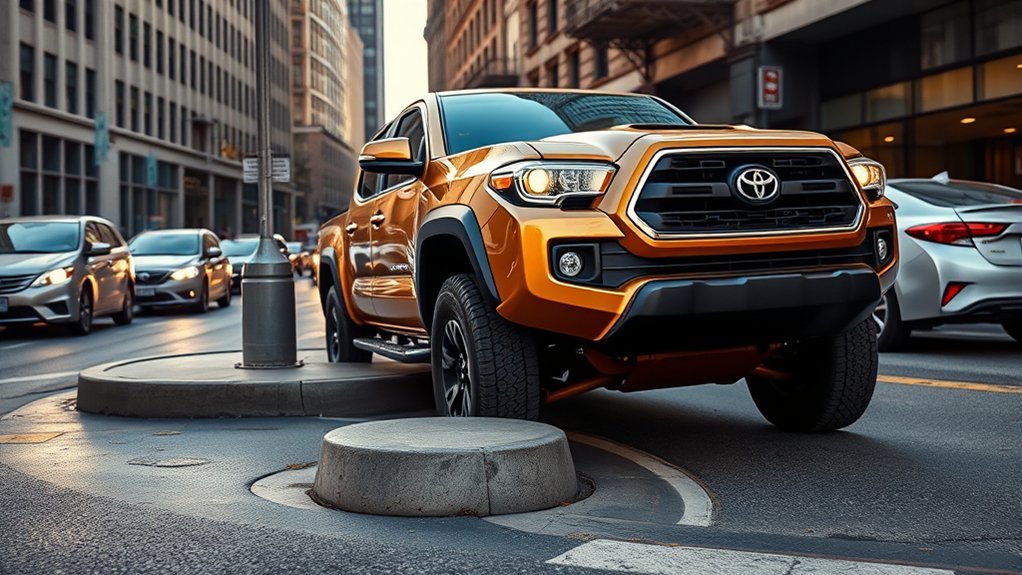
A turning diameter in the mid-40-foot range can make a Tacoma feel cumbersome on narrow roads. You may need a three-point turn where a smaller vehicle can complete one continuous U-turn.
Parking also requires attention to both ends of the truck. The front outside corner travels through a wide arc, while the rear corner can swing toward a neighboring vehicle or post. A long-wheelbase Double Cab with a 6-foot bed adds overall length and may require more forward-and-reverse corrections.
In city traffic, avoid beginning a turn too close to the inside curb. Use a slow approach and position the truck within your legal lane to create room for the rear wheels to follow. Check for cyclists, pedestrians, parked vehicles, and traffic before allowing the front of the truck to swing outward.
Warning: Do not cross the centerline, enter an occupied lane, or swing toward pedestrians to avoid making a multi-point turn. Stop and reset the maneuver when the available space is uncertain.
Driver Techniques for a Wide Turning Circle
You cannot change the truck’s factory geometry through driving technique, but you can reduce unnecessary corrections. The safest approach combines low speed, early observation, and controlled steering.
Mastering Tight Turns
- Reduce speed before the turn: Low speed gives you more time to monitor both the front corner and the rear wheel path.
- Use the available lane legally: Set up toward the outside of your lane without crossing markings or approaching nearby traffic.
- Turn smoothly: Apply steady steering instead of abrupt inputs that make the truck harder to place.
- Check both sides: Use mirrors and direct shoulder checks to monitor obstacles, pedestrians, and the rear corner.
- Use a multi-point turn: Stop before clearance becomes tight, straighten as needed, reverse under control, and complete the turn only when the path is clear.
If you are unfamiliar with the truck, practice in a large empty lot where vehicle operation is permitted. Use cones or other soft markers to learn where the front tires track and how far the rear corner swings.
Strategic Parking Maneuvers
Pull-through spaces and end spaces reduce the number of tight corrections. When conditions allow, backing into a space can also make the later exit easier because you can drive forward with a clearer view.
Begin far enough from the parking row to give the front of the truck room to swing. Move slowly, check both mirrors, and stop before the tires contact a curb or wheel stop. Parking cameras can help you judge distance, but they do not show every obstacle.
Pro Tip: Before entering a crowded row, identify how you will leave. A space that is easy to enter may be difficult to exit after larger vehicles park beside you.
What Can and Cannot Improve the Turning Circle
A normal alignment, tire replacement, or steering repair should restore the Tacoma to its intended condition. These services do not safely redesign the factory turning diameter.
| Symptom | Possible Cause | Appropriate Action |
|---|---|---|
| The truck turns noticeably tighter in one direction | Steering centering, repair, damage, or interference issue | Have the steering and alignment checked by a qualified technician. |
| Tires rub near full steering lock | Incorrect tire size, wheel offset, spacer, lift, liner position, or damaged part | Verify the approved tire size and inspect modified or damaged components. |
| Steering clunks, binds, or becomes unusually heavy | Steering, suspension, tire, or four-wheel-drive-related fault | Stop forcing the steering and arrange a professional inspection. |
| Truck pulls on a straight, level road | Tire pressure, tire wear, alignment, brake, or suspension issue | Check tire pressure and have the vehicle inspected and aligned as needed. |
| Wide circle has been present since new | Normal configuration and factory geometry | Confirm the specification and use suitable maneuvering techniques. |
Follow NHTSA tire guidance and use the original tire size or another size recommended by Toyota. The approved size appears on the driver-side Tire and Loading Information label and in the appropriate owner documentation.
A professional alignment can correct toe, camber, caster, and steering-wheel centering when adjustment is available. It can improve tracking, tire life, and steering consistency. It normally will not add steering angle beyond the vehicle’s factory design.
Warning: Do not lengthen tie rods, remove or alter steering stops, install unapproved wheel spacers, or change tire size solely to obtain a tighter turn. Extra steering travel can cause tire, brake-hose, axle, suspension, or body interference.
How to Measure Your Tacoma’s Turning Diameter
You can estimate curb-to-curb turning diameter in a large, level, empty area where vehicle testing is permitted. Use a helper and soft, visible markers.
- Confirm that the tires are correctly inflated and that the area is clear.
- Drive forward slowly with the steering held at full lock without forcing it against the stop.
- Complete one full circle at walking speed.
- Mark the outer path of the outside front tire.
- Measure across the widest part of that tire path.
- Repeat in the opposite direction and compare the results.
Small differences can result from marking and measurement error. A large left-to-right difference, rubbing, binding, noise, or an off-center steering wheel deserves professional inspection.
Visibility and Safety During Tight Maneuvers
The 2024 Tacoma offers an available 14-inch multimedia screen and available front, rear, and side camera views through its Multi-Terrain Monitor. These features can help you see nearby obstacles, but Toyota also instructs drivers to keep their attention on the road.
Sunlight, dirt, water, darkness, lens distortion, and objects outside the camera’s field of view can reduce the usefulness of a displayed image. Use the screen as an aid rather than a replacement for mirrors and direct observation.
| Condition | Possible Effect | Response |
|---|---|---|
| Screen glare | Camera details become difficult to see | Adjust brightness when parked, shade the display if safe, and rely on mirrors and direct checks. |
| Dirty camera lens | Blurred or obscured image | Clean the lens with a suitable soft cloth before driving. |
| Low obstacle near a corner | Obstacle may sit outside a useful camera angle | Stop and inspect the area directly when clearance is uncertain. |
| Crowded parking aisle | Pedestrians or vehicles can enter the truck’s path | Move at walking speed and pause whenever your view is blocked. |
| Wide rear-corner sweep | Rear bodywork approaches nearby objects | Watch the outside mirror and allow extra side clearance. |
Decision Checklist: Is the New Tacoma Right for Your Driving Needs?
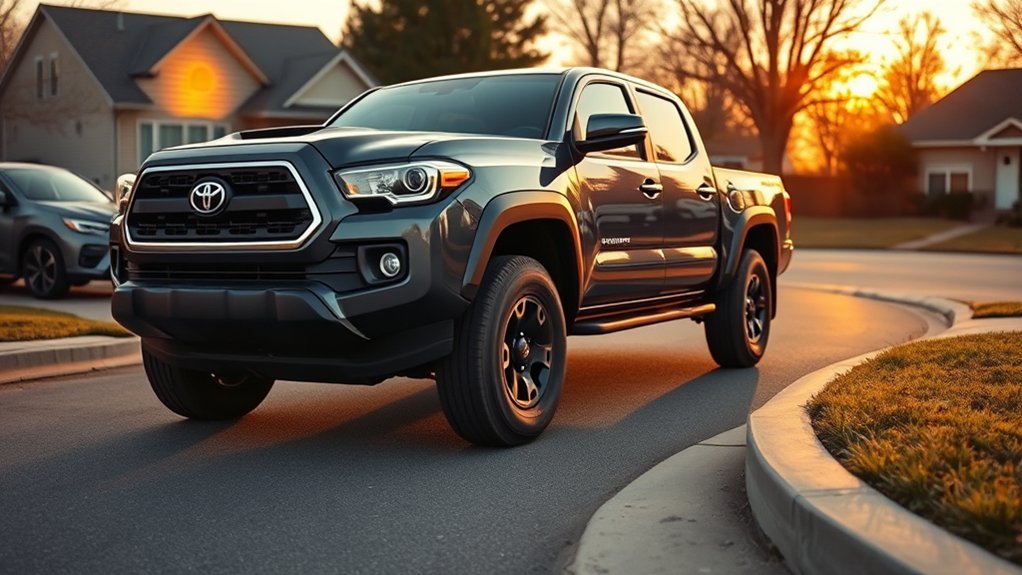
Choose a Tacoma configuration by matching its dimensions to the roads and parking areas you use most often. A test drive should include more than highway acceleration.
- Identify the configuration: Confirm the cab, bed, wheelbase, drivetrain, tires, and any modifications.
- Measure your parking space: Include the opening, aisle width, posts, walls, and room needed to open the doors.
- Test both turning directions: Check for equal steering travel, rubbing, noise, or binding.
- Try a realistic U-turn: Use a safe, legal location that resembles your normal route.
- Practice your driveway approach: Consider gates, curbs, parked vehicles, slopes, and traffic.
- Compare wheelbases: Test a 131.9-inch model and a 145.1-inch model when both meet your hauling needs.
- Check visibility: Evaluate mirrors, direct sightlines, cameras, and screen legibility in daylight and darkness.
- Consider modifications: Oversized tires, different wheels, spacers, and suspension changes can reduce clearance.
If you frequently use narrow garages or compact city parking, the 131.9-inch wheelbase deserves priority. If passenger room and a 6-foot Double Cab bed matter more, decide whether the additional length and wider maneuvering path fit your daily environment.
[Amazon Products Picked for You]

UPGRADED 4K UHD CLARITY - Experience stunning detail with the front camera's upgrade to 4K UHD (2160p) resolution, paired with a 1080p rear camera. The extra-large 12" display provides 1.5 times the viewing area of a standard mirror, significantly reducing blind spots for enhanced safety.

Easy to Install: The backup camera for car takes only 25 minutes from start to finish installation, just 2 steps: ① First connect the camera and monitor through the 4-pin video power cable made of 3.0MM pure copper that comes with the camera. ② Then plug the backup camera system into the cigarette lighter, manual switch, plug and play. Or you can also connect it to the reversing lights only as a reversing use, automatically triggering the reversing image when reversing

Dual 1080P Front and Rear Camera : Chip upgrade, clearer pixels! By optimizing image processing technology and enhancing light suppression, greatly improved night vision for the rear camera. 1080P front camera and 1080P IP68 waterproof rear camera use high-definition streaming technology, mirror dash cam can provide ultra clear video and capture license plates from a distance. Rear view mirror camera is wide angle lens reduce blind spots to capture many details on the road.
Frequently Asked Questions
What is the turning radius of a 2024 or 2025 Toyota Tacoma?
A published specification for the 2024 and 2025 SR XtraCab lists a 45.8-foot curb-to-curb turning diameter, equal to an approximate 22.9-foot radius. That number is configuration-specific. Toyota does not publish one universal turning diameter for every fourth-generation trim in its brochure.
Does a long bed always give the Tacoma a wider turning circle?
No. The wheelbase matters more than the bed label alone. A fourth-generation XtraCab combines a 6-foot bed with a 131.9-inch wheelbase. Eligible Double Cab models with a 6-foot bed use the longer 145.1-inch wheelbase.
Can an alignment improve a Tacoma’s turning radius?
An alignment can restore proper tracking, steering-wheel centering, and tire wear when the settings are incorrect. It normally cannot reduce the factory turning diameter or safely add steering travel beyond Toyota’s design.
What is considered a good turning radius for a pickup?
No single number defines a good pickup turning radius. Smaller curb-to-curb diameters generally make parking and U-turns easier, but the fair comparison is between trucks with similar cab styles, beds, wheelbases, and payload capability.
What is the most common problem with the Toyota Tacoma?
No single problem applies to every Tacoma generation, trim, powertrain, and VIN. Review the truck’s service history and use the official NHTSA recall lookup for VIN-specific safety information. A suddenly wider, uneven, noisy, or binding turn should be inspected rather than treated as a normal model trait.
Where is the hidden storage in a fourth-generation Tacoma?
XtraCab models can include a lockable rear storage panel and floor storage. Eligible gas-powered Double Cab models provide storage under and behind the rear seats. Hybrid packaging differs, so check the exact model’s owner information before lifting panels or trim.
Why does my Tacoma turn tighter in one direction?
A slight measurement difference may come from the surface or test method. A clear difference can point to steering centering, alignment, tire interference, a damaged component, or an incorrect previous repair. Have the truck inspected if the difference is repeatable.
Conclusion
Do not use 44.1 feet as a universal turning measurement for the 2024 or 2025 Toyota Tacoma. That figure appears in Toyota’s 2023 data for certain long-bed configurations. A published fourth-generation SR XtraCab specification lists a 45.8-foot curb-to-curb diameter, but other configurations should be verified separately.
Start with the truck’s cab, bed, and wheelbase. A 131.9-inch-wheelbase Tacoma will usually be easier to position than a comparable 145.1-inch-wheelbase Double Cab, although tires, wheels, modifications, and visibility also affect the experience.
A consistently wide circle can be a normal design characteristic. A sudden change, uneven left-to-right steering, rubbing, binding, or unusual noise is not something to solve with improvised steering changes. Keep approved tires and steering components in place, use controlled multi-point maneuvers, and arrange a qualified inspection when the truck does not steer normally.
Sources
- 2024 Toyota Tacoma Official Brochure — cab styles, bed availability, wheelbases, dimensions, screen, cameras, and storage features.
- 2023 Toyota Tacoma Official Brochure — official third-generation curb-to-curb turning-circle figures.
- Toyota Tacoma Manuals and Warranties — model-specific operating, maintenance, tire, and safety information.
- NHTSA TireWise — approved tire-size, inflation, balance, and alignment guidance.
- 2024 Tacoma SR XtraCab Specification — configuration-specific 45.8-foot curb-to-curb listing.
- 2025 Tacoma SR XtraCab Specification — configuration-specific 45.8-foot curb-to-curb listing.
