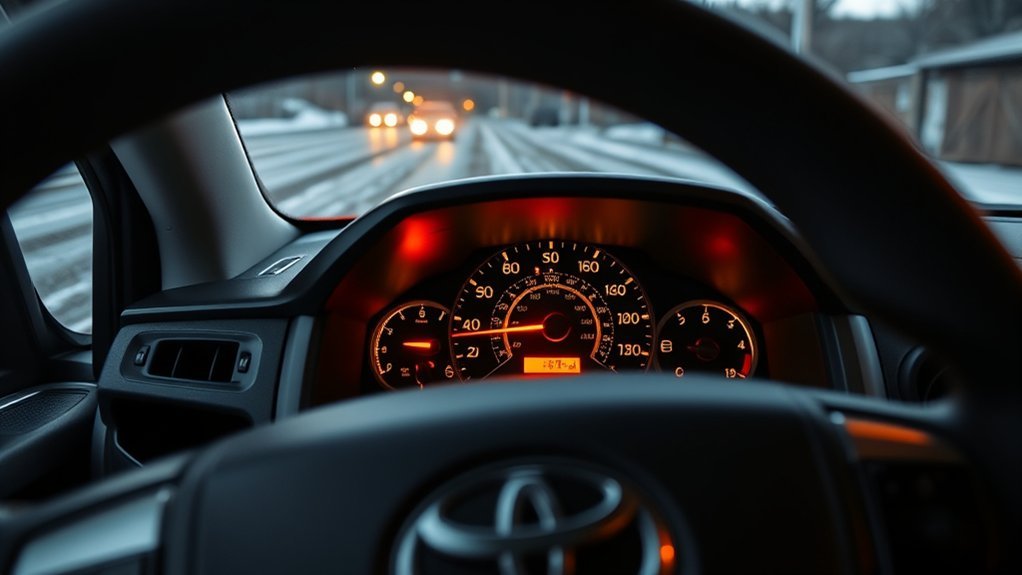
If the traction-control or slip indicator in your Toyota Tundra stays on, first identify exactly which light is illuminated and whether it is flashing or steady. A flashing slip indicator during wheel slip usually means TRAC or VSC is actively working. A steady TRAC OFF or VSC OFF light can reflect a selected mode, while a steady slip, ABS, or VSC warning can indicate a fault or, on some model years after sustained intervention, temporary brake-system heat protection. If the warning appears with a red brake light or abnormal braking, stop driving and arrange service.
Quick Answer
There is no universal battery-disconnect reset for a Toyota Tundra traction-control light. A flashing slip indicator normally means the system is intervening. A steady TRAC OFF or VSC OFF indicator may reflect a selected mode, while a steady slip, ABS, or VSC warning may indicate a fault. Check the selected mode, tires, brake lights, and related warning lamps, then scan the ABS/VSC module with a compatible tool. Record the codes before clearing them and repair the underlying cause first.
Key Takeaways
- A flashing slip indicator commonly means traction or stability control is actively working; a steady warning needs its exact indicator and model-year context identified.
- Do not disconnect the battery simply to hide the light. Record ABS/VSC and engine diagnostic codes before clearing anything.
- Unequal tires, wheel-speed signal faults, damaged wiring, brake-switch faults, low system voltage, ABS/VSC faults, and some engine-control faults can produce traction-related warnings.
- On some Tundra model years, prolonged traction-control operation can temporarily suspend the system because of brake-system heat; a persistent warning still requires diagnosis.
- A red brake warning, abnormal braking, fluid loss, or severe instability calls for immediate professional help.
At a Glance
| Slip indicator flashes while tires are slipping | Usually normal TRAC/VSC intervention. Ease the throttle and use smooth steering inputs. |
| TRAC OFF or VSC OFF stays on after using the switch | A selected mode may have reduced or disabled part of the system. Check the exact model-year manual and current 2WD/4WD mode. |
| Slip, ABS, or VSC warning stays on unexpectedly | Scan the ABS/VSC system. If the warning followed prolonged traction-control activity, allow the system to cool safely; diagnose it if the warning persists or returns. |
| Red brake warning or abnormal braking | Stop safely and arrange professional inspection or towing rather than continuing normal driving. |
What Does the Toyota Tundra Traction Control Light Mean?
Your Tundra’s traction-control system helps limit drive-wheel spin during acceleration. It shares sensors and brake-control hardware with the anti-lock braking system (ABS) and Toyota’s vehicle stability control (VSC). Depending on the situation and model year, the system can reduce engine torque and apply braking force at individual wheels.
Electronic stability control is designed to help the driver maintain directional control by monitoring vehicle motion and steering input, then adjusting individual wheel braking and engine torque when needed. It supports the driver; it cannot create grip that the tires and road surface do not provide. See the federal electronic stability control standard for the system’s general operating principles.
If you are trying to understand normal system operation rather than diagnose a warning, see our Toyota Tundra traction control and VSC guide. For transfer-case settings and 2H, 4H, or 4L operation, see the Toyota Tundra 4WD system guide.
What Does Each Dashboard Indicator Mean?
- Flashing slip or traction indicator: The system is usually intervening because it detects wheel slip or loss of stability.
- Steady TRAC OFF or VSC OFF indicator: A driver-selected mode may have reduced or disabled part of the system. Button behavior varies by generation and drive mode.
- Steady slip, VSC, ABS, or master-warning indicator: The truck may have stored a fault and reduced one or more driver-assistance functions.
- Steady slip indicator after prolonged traction-control activity: On some model years, brake-system heat protection can temporarily suspend traction control. Stop in a safe place and allow the system to cool. Diagnose the truck if the warning does not clear or repeatedly returns.
- Light during startup only: A brief lamp check can be normal if the indicator turns off after the engine starts.
Toyota’s 2024 Tundra manual identifies the slip indicator as flashing while TRAC, VSC, ABS, or Trailer Sway Control is operating and identifies the VSC OFF indicator with a disabled stability-control state. Use the 2024 Tundra warning-light guide as a current-generation example, then check the manual for your exact model year.
Model-Year Differences Matter
Tundra traction-control controls are not identical across generations. Toyota’s 2021 Tundra documentation, for example, describes normal VSC/TRAC operation along with TRAC Off, Auto LSD, and VSC Off modes, while newer trucks use a different combination of drive and off-road controls. That is why a button sequence found for one Tundra should not be assumed to apply to another. See Toyota’s 2021 Tundra system overview and the Toyota manuals portal for model-year-specific instructions.
Warning: Stop driving and arrange service if the red brake warning stays on, braking feels abnormal, brake fluid is visibly leaking, the pedal sinks, or the truck becomes difficult to control. Do not rely on traction control to compensate for a brake or tire problem.
Common Signs of Traction Control Issues
A traction-control problem may show up as more than one dashboard light. Watch for patterns rather than assuming the traction-control module itself has failed.
- A slip, TRAC, VSC, or ABS indicator that remains on after startup.
- The traction-control light appearing together with the ABS, brake, check-engine, or master-warning light.
- Traction or stability control activating on dry pavement during gentle acceleration or turns.
- Unexpected engine-power reduction when the tires are not slipping.
- ABS pulsing, unusual braking, or inconsistent wheel-speed readings.
- A warning that began after tire replacement, suspension work, wheel-bearing work, alignment, battery service, or off-road driving.
A flashing indicator during actual wheel slip is not automatically a defect. The concern is a steady warning that does not match the selected mode, repeated false activation, or behavior that does not match road conditions.
How Do You Diagnose a Toyota Tundra Traction Control Light?
Use this sequence to separate normal system operation from a stored fault. The exact codes, connector locations, calibrations, and button functions vary across Tundra generations, so use the manual and service information for your VIN.
[Amazon Products Picked for You]

[Easy to Use—Work Out of the Box] + [FOXWELL 2026 New Version] FOXWELL NT604 Elite scan tool is the 2026 new version from FOXWELL, designed for car owners who want to figure out the cause of issues before fixing car problems by scanning common systems like ABS, SRS, engine, and transmission. The NT604 Elite obd2 scanner diagnostic tool comes with the latest software—no need to waste time downloading software first. Plug the scanner into the OBDII port with OBDII cable to start the diagnosis.

⚠️【Important Tips Before Purchase】1️⃣ Compatible with standard OBD II vehicles manufactured from 1996 onward in the US market. 2️⃣ Due to the Secure Gateway (SGW) / FCA AutoAuth security system, this tool is unable to access OBDII modules or clear codes for FCA vehicles (including Chrysler, Dodge, Jeep, etc.) produced after 2017. ⚠️3️⃣Vehicles equipped with an SGW module are also not supported. 4️⃣Functions are not universal. Please send a mes-sage via 📞auteldirect @ outlook . com📞 to check compatibility before ordering. Need any help? Please don't histate to con-tact us via above em-ail.
1. Note When and How the Light Appears
Record whether the light flashes or stays on, which other indicators appear, the road and weather conditions, the selected 2WD/4WD mode, and whether the issue began after recent work. Also note whether the warning followed prolonged wheelspin or repeated traction-control intervention. A photo of the instrument cluster can help a technician identify the correct indicator.
2. Check Whether the System Was Switched Off
With the truck safely parked, review the traction-control or VSC button instructions in the owner’s manual. Some modes intentionally change intervention thresholds. Reactivation behavior can also vary with model year, drivetrain, selected 4WD range, vehicle speed, and ignition cycle, so confirm the dashboard indicator rather than assuming the system has returned to its default state.
3. Inspect Tire Size, Pressure, and Condition
Confirm that all four tires match the size and configuration specified for the truck, have compatible rolling circumference, and are inflated to the cold pressures on the driver-door placard. Look for a low tire, severe tread mismatch, damage, or a temporary spare. NHTSA recommends following the vehicle manufacturer’s recommended cold inflation pressure rather than treating the maximum pressure molded on the tire sidewall as the normal operating pressure; see its tire-maintenance guidance.
4. Check Brake Lights and Visible Brake-System Items
Ask a helper to confirm that the brake lamps illuminate consistently when you press the pedal. Check the brake-fluid level only on level ground and follow the owner’s manual. A failed brake-switch circuit can affect several vehicle functions on some model years, but working brake lamps do not rule out every switch or circuit fault.
5. Scan the Correct Control Modules
Use a scan tool that can read Toyota ABS, VSC, and chassis diagnostic trouble codes, not only generic engine codes. Save the code numbers, status, freeze-frame information, and relevant live data before clearing anything. Toyota’s Technical Information System provides factory service information and Techstream diagnostic resources.
The warning light is a symptom, not the diagnosis. Record the ABS/VSC and engine codes first; clearing them too early can erase evidence needed to find an intermittent fault.
6. Inspect Wheel-Speed Sensor Areas and Wiring
Without disconnecting components or crawling under an unsupported truck, look for obvious damage near the wheel hubs: a loose connector, rubbed wire, impact damage, packed mud, or debris from recent off-road use. A wheel-speed-sensor code does not prove the sensor itself is bad. The harness, connector, encoder, bearing, power supply, or control module may instead be responsible.
7. Test and Repair the Code-Defined Circuit
Electrical testing, wheel-speed live-data comparison, signal analysis, and any steering-angle or yaw-rate initialization should follow the Toyota procedure for the stored code and exact model year. Calibration may be required after specific sensor, ECU, steering, alignment, or repair procedures when Toyota’s service information calls for it. Replace parts only after testing identifies the fault.
Pro Tip: Before authorizing a wheel-speed sensor, ask whether the shop compared all four wheel-speed signals and inspected the harness, hub/encoder, and bearing. A code naming one wheel identifies the affected circuit, not necessarily the failed part.
Why Do ABS and Traction-Control Lights Come On Together?
Traction control, VSC, and ABS share wheel-speed information and brake-control hardware. A fault that prevents the ABS module from trusting a wheel-speed signal can also disable or limit traction and stability functions. That is why the ABS and traction-related warnings often appear together.
The brake-pedal switch is another input used by multiple systems. On some Tundra model years, a switch or circuit fault may affect brake lamps, shift-interlock operation, cruise control, engine management, or stability-control logic. Do not assume the switch is the cause based only on the dashboard light; verify the relevant codes and circuit tests.
- Brake lamps do not work: Check the applicable fuse, bulbs or lamp assemblies, connector, and switch circuit according to the wiring diagram.
- ABS and traction lights are both on: Scan the ABS/VSC module and inspect the code-defined wheel-speed or brake-control circuit.
- Red brake warning is on: Treat it as a higher-priority brake-system warning and follow the owner’s manual immediately.
- Brake lamps stay on: Avoid driving until the cause is corrected because other drivers cannot accurately read your braking intent.
Cleaning a brake-light switch is not a universal repair. If testing confirms an internal switch fault or an adjustment problem, use the model-specific replacement or adjustment procedure.
What Causes a Toyota Tundra Traction-Control Warning?
The most likely cause depends on the stored code and the conditions that trigger the warning. Common diagnostic paths include:
- Tire or wheel mismatch: Incorrect tire size, a temporary spare, very unequal tread depth, or major pressure differences can change wheel-speed relationships.
- Wheel-speed signal fault: A damaged sensor, harness, connector, encoder ring, or wheel bearing can create an erratic or missing signal.
- Brake-switch circuit fault: An implausible brake-pedal signal can affect systems that need to know when the driver is braking.
- Brake-system heat protection: On some model years, sustained traction-control activity can heat the brake system enough for TRAC or A-TRAC to suspend operation temporarily. If the warning persists after the system cools, diagnose it as a fault.
- Low voltage or charging problem: Weak battery voltage, poor grounds, or charging faults can create multiple warning lights and communication codes.
- Steering-angle or yaw-rate calibration issue: Some sensor, ECU, steering, alignment, or repair procedures require model-specific initialization or calibration.
- ABS actuator, ECU, or communication fault: Module, power, ground, network, or hydraulic-control problems require code-guided testing.
- Engine or throttle-control fault: On some models, stability or traction functions may be limited when the powertrain system cannot provide the requested torque-control function.
- 4WD mode or transfer-case input: Normal indicator behavior and available stability functions can change with the selected drive mode; a transfer-case input fault is only one model-specific possibility.
[Amazon Products Picked for You]

【Fitment】 Compatible with Toyota Tundra 4.0L v6 2007-2014, 4.6L v8 2010-2017, 4.7L v8 2007-2009, 5.7L v8 2007-2017 Front & Rear, Left & Right ABS Wheel Speed Sensor. Please confirm OEM part numbers before ordering

Warranty: One Year
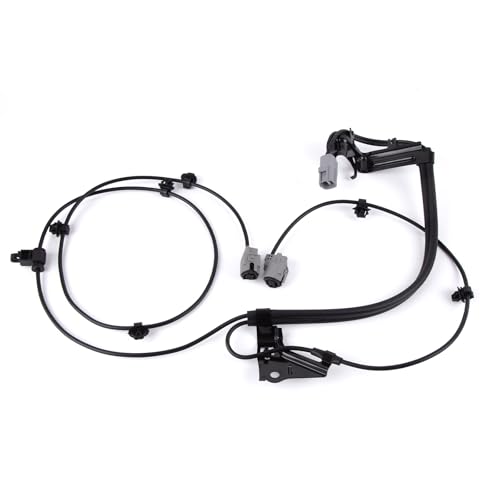
【Compatible With】ABS Speed Sensor Compatible With Toyota Tundra 1794,1794 Edition,Base,Limited,Ltd,Nightshade,Platinum,SR,SR5,Trail,TRD Off-Road,TRD Off-Road Premium,TRD Pro,TRD Sport,TRD Sport Premium 2007 2008 2009 2010 2011 2012 2013 2014 2015 2016 2017 2018 2019 2020 2021 4.0L 4.6L 4.7L 5.7L V6 V8
What If the Check-Engine and Traction-Control Lights Are On Together?
Do not assume that the traction-control system itself has failed. On some Tundras, an engine-control fault can produce companion VSC or traction-related warnings because the stability system depends partly on controlled engine torque. Read the powertrain codes and the ABS/VSC chassis codes before replacing a wheel-speed sensor, brake switch, or ABS component. Repair the primary code-defined fault first, clear the codes only after the repair, and then confirm which warnings return.
Note: Do not press the traction-control button merely to suppress unwanted activation while continuing normal-speed driving. Use the control only as described in the owner’s manual, such as for a permitted low-speed recovery situation, and restore the default mode as soon as practical.
Essential Maintenance Tips for Traction Control Reliability
There is no separate routine “traction-control service,” but several maintenance habits protect the systems it depends on:
- Keep all tires at the placard pressure and use compatible sizes and load ratings.
- Rotate tires according to the owner’s manual when the tire configuration allows it.
- Address wheel-bearing noise, damaged hub wiring, and ABS warnings promptly.
- Keep battery terminals and grounds secure and correct charging-system problems.
- Maintain the brake system and brake-fluid level according to Toyota’s schedule.
- After off-road or winter driving, inspect exposed wheel-area wiring for impact damage, ice, or packed debris.
- Use correct lifting points and support equipment before any under-vehicle inspection.
- Check for open safety recalls or service campaigns by VIN through Toyota’s recall lookup or NHTSA’s recall database.
[Amazon Products Picked for You]

Kit Includes: 1 Front Driver Side Wheel Bearing & Hub Assembly; 1 Front Passenger Side Wheel Bearing & Hub Assembly

[Vehicle Fitment]: Compatible with Toyota Sequoia 2008-2022, Tundra 2007-2021 --- RWD Only

COMPATIBILITY – Fits 2007-2019 Toyota Tundra; 2008-2019 Toyota Sequoia
When Should You Get Professional Help?
Basic checks can identify an accidental button press, a low tire, or an obvious damaged wire. Persistent warnings and braking-related symptoms need a qualified technician with Toyota-capable diagnostic equipment and model-specific service information.
Signs of Serious Issues
- The red brake warning light remains on or the brake pedal feels abnormal.
- The traction, ABS, and master-warning lights appear together.
- The truck pulls, skids, brakes a wheel unexpectedly, or repeatedly reduces power on dry pavement.
- Wheel-speed data drops out, spikes, or disagrees during a controlled test.
- The warning returns immediately after codes are cleared.
- There is visible wiring damage, fluid leakage, a noisy wheel bearing, or impact damage near a hub.
- The truck is used for towing, hauling, snow travel, or off-road driving where reduced stability assistance raises the risk.
If braking is normal and only an amber stability-related warning is on, drive cautiously and arrange diagnosis soon. Avoid high speed, heavy towing, slippery routes, and abrupt maneuvers until the system is repaired.
What Diagnostic Tools Are Required?
A complete diagnosis may require an ABS/VSC-capable scan tool, live wheel-speed data, a digital multimeter, an oscilloscope for intermittent sensor signals, wiring diagrams, and Toyota calibration procedures. A basic code reader that only accesses generic powertrain codes may report no fault even when the ABS/VSC module has stored chassis codes.
| Situation | Recommended Action |
|---|---|
| Light flashes only during wheel slip | Reduce throttle and drive smoothly; this is normally system intervention |
| TRAC OFF/VSC OFF is steady after selecting a mode | Check the selected drive mode and owner’s-manual button procedure |
| Steady warning follows prolonged traction-control activity | Stop safely and allow the system to cool; diagnose it if the warning persists or returns |
| Amber traction or ABS warning stays on unexpectedly | Scan the ABS/VSC module and schedule diagnosis promptly |
| Red brake warning or abnormal braking | Stop safely and arrange professional inspection or towing |
| Codes return after repair or clearing | Perform code-guided circuit, live-data, and required calibration checks |
Frequently Asked Questions
How do you reset the traction control light on a Toyota Tundra?
There is no universal battery-disconnect reset. If the system was intentionally switched off, restore the default setting according to the exact model-year owner’s manual. If a fault caused the light, diagnose and repair it first. The warning may turn off after a successful self-check, or a compatible ABS/VSC scan tool may be needed to clear repaired codes.
What causes the traction control system light to come on?
A flashing light usually means the system is actively controlling wheel slip. A steady light may indicate a selected OFF mode, a stored fault, or on some model years temporary brake-system heat protection after sustained traction-control activity. Other possible causes include tire mismatch, a wheel-speed signal problem, damaged wiring, a brake-switch circuit fault, low voltage, an ABS/VSC fault, an engine-control fault, or a model-specific calibration issue.
Why are the ABS and traction-control lights on together?
ABS, traction control, and VSC share wheel-speed information and brake-control hardware. A wheel-speed signal, wiring, brake-control, power, or communication fault can therefore affect more than one system and illuminate several warnings together. Read the ABS/VSC chassis codes before replacing parts.
Why are the check-engine and traction-control lights on together?
On some Tundras, an engine-control fault can cause companion traction or stability warnings because those systems depend partly on controlled engine torque. Read both powertrain and ABS/VSC codes before assuming the traction-control hardware has failed, then repair the primary code-defined fault first.
Can you drive a Toyota Tundra with the traction control light on?
A flashing light during actual wheel slip can be normal. With a steady amber warning and otherwise normal braking, drive cautiously to obtain service because traction or stability assistance may be limited. Stop driving if a red brake warning appears, braking feels abnormal, the truck becomes unstable, or fluid is leaking.
Can mismatched tires trigger traction control warnings?
They can contribute. A different tire size, a temporary spare, large pressure differences, or very uneven tread can change rolling circumference and wheel-speed relationships. Use the tire size and configuration specified for the truck, inflate the tires to the door-placard pressure, and investigate any warning that began after tire or wheel work.
Conclusion
A Toyota Tundra traction-control light is a symptom, not a diagnosis. First separate normal flashing intervention from a selected OFF mode, temporary heat protection, or a persistent malfunction warning. Check the tires, brake lamps, related warning lights, and selected drive mode, then read the ABS/VSC and relevant engine codes before clearing them. Avoid battery-disconnect shortcuts and parts replacement based on a code name alone. If a red brake warning appears or braking is abnormal, stop driving and arrange professional inspection.
Sources
- Toyota Manuals and Warranties — model-year owner’s manuals and official operating guidance
- 2024 Toyota Tundra Warning Lights and Indicators — current-generation slip, VSC OFF, ABS, and warning-indicator guidance
- Toyota 2021 Tundra Overview — Toyota documentation of VSC, TRAC, Auto LSD, A-TRAC, and generation-specific operating modes
- Toyota Warning Lights — official guidance for identifying dashboard warnings and consulting the correct manual
- Toyota Technical Information System — factory repair information, diagnostics, and Techstream resources
- 49 CFR 571.126: Electronic Stability Control Systems — system operation, malfunction telltales, and ESC-off requirements
- NHTSA Tire Safety — tire size, placard pressure, tread, and maintenance guidance
- NHTSA Recall Lookup — VIN-based safety recall information