
Last updated: September 19, 2026.
Use 4HI in a Toyota Tundra when you need extra drive traction on a loose or slippery surface while still maintaining useful momentum. Use 4LO when very low speed, torque multiplication, or engine braking matters more than speed. Keep the truck in 2HI/2H for normal dry pavement. Toyota procedures vary by model year, so the exact owner’s manual remains the final authority.
Quick Answer
Use 2HI for normal dry pavement. Select 4HI on snow, ice, loose gravel, dirt, mud, or sand when the surface permits tire slip and you need added drive traction. Select 4LO for very slow travel over steep, deep, soft, rocky, or heavily rutted terrain. As a current-generation reference, Toyota’s 2024 Tundra Quick Reference Guide specifies less than 62 mph (100 km/h) when shifting between 2H and 4H; shifting between 4H and 4L requires a complete stop, the brake held, and Neutral. That 62-mph figure is a shift threshold, not a recommended speed for slippery conditions.
Key Takeaways
- 2HI/2H is the normal setting for dry pavement and ordinary paved-road driving.
- 4HI/4H is for surfaces that permit tire slip, including snow, ice, loose gravel, dirt, mud, and sand on newer Tundras.
- 4LO/4L is for slow, difficult work, such as steep grades, rocks, deep mud, deep snow, soft terrain, or controlled recovery.
- Current-generation Toyota guidance uses less than 62 mph for 2H↔4H shifts, but this is not a safe-speed recommendation for snow, ice, gravel, or mud.
- Older Tundras can have different wording and procedures. Some first-generation manuals explicitly permit high-range 4WD on wet roads, so verify your exact model year.
- Four-wheel drive helps the truck move, but it does not create extra tire grip for braking on snow, ice, gravel, or mud.
At a Glance
| Time Required | Usually less than 2 minutes to select a mode and confirm engagement |
| Difficulty | Easy, provided you follow the model-year procedure |
| Tools Needed | None; keep the owner’s manual available for reference |
| Cost | $0 |
Warning: Do not use a part-time Tundra’s 4HI or 4LO on dry, high-traction pavement. The front and rear axles need to rotate at slightly different speeds while turning. Without enough tire slip, the drivetrain can bind, steering can become heavy, and transfer-case or driveline components can be stressed. Four-wheel drive also does not provide extra braking grip.
4HI vs. 4LO: Key Differences and Applications
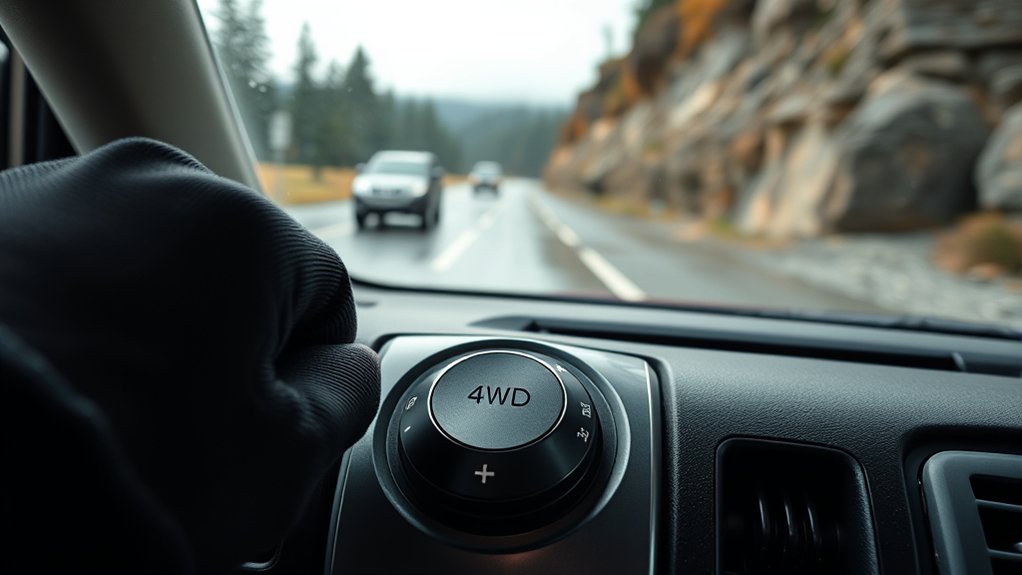
Understanding the difference between 4HI and 4LO helps you choose the mode that provides traction without placing unnecessary stress on the truck. Both settings drive the front and rear axles, but 4LO also uses the transfer case’s low-range gearing.
| Mode | Best Use | Driving Style | Avoid |
| 2HI / 2H | Dry pavement and normal paved-road driving | Normal road speeds and steering | Deep snow, mud, or loose terrain when rear-wheel traction is insufficient |
| 4HI / 4H | Snow, ice, loose gravel, dirt, mud, and sand where the surface permits tire slip | Low-to-moderate speeds appropriate for the surface | Dry high-grip pavement, tight turns on firm surfaces, and severe low-speed obstacles |
| 4LO / 4L | Steep grades, rocks, deep mud, deep snow, soft sand, and controlled recovery | Very slow travel with smooth throttle and deliberate steering | Normal cruising, dry pavement, high speed, or attempts to exceed rated towing limits |
Use 4HI when you need added drive traction but still need enough wheel speed to travel along a snowy road, loose gravel trail, muddy track, or sandy route. On later part-time Tundras, the surface should permit enough tire slip to release driveline windup.
Use 4LO when slow control matters more than speed. Low-range gearing multiplies torque at the wheels and reduces the amount of throttle needed to climb, descend, crawl over obstacles, or move through deep material.
Current-generation reference: Toyota’s 2024 Tundra Quick Reference Guide specifies less than 62 mph (100 km/h) when shifting between 2H and 4H. For 4H↔4L, it instructs the driver to stop completely, keep the brake depressed, shift to Neutral, and then select the requested range. Do not treat 62 mph as a recommended driving speed on a slippery road. Older Tundras can have different controls and limits, so check the Toyota Manuals and Warranties portal for your exact truck.
For a broader explanation of 2H, 4H, 4L, driveline binding, terrain systems, and maintenance, see our Toyota Tundra 4WD system explained guide.
When to Use 4HI for Traction
Engage 4HI before the rear tires begin spinning when you can safely anticipate a low-traction section. Early engagement gives the transfer case time to complete the shift and helps you maintain steady momentum.
Appropriate 4HI conditions include:
- Snow-covered or icy roads: Use smooth steering, braking, and throttle inputs. Four-wheel drive can help you move forward, but it cannot create extra stopping grip.
- Loose gravel or dirt roads: 4HI can reduce rear-wheel spin when climbing or accelerating.
- Shallow mud: Use 4HI when maintaining moderate momentum is more useful than low-range torque.
- Firm sand or a maintained beach route: 4HI often provides the wheel speed needed to maintain momentum without the slow gearing of 4LO.
- Mixed off-road trails: Use 4HI for easier sections and change to 4LO before steep, rocky, deeply rutted, or unusually soft terrain.
Wet-road guidance is model-year dependent. Later Tundra manuals describe 4H for surfaces that permit tire slip, such as off-road, icy, or snow-covered roads. Some first-generation Tundra manuals explicitly included wet roads in their high-range 4WD guidance. Do not assume one wet-pavement rule applies to every Tundra; follow the wording in the owner’s manual for your exact year.
Warning: Slow down and increase your following distance on snow or ice. The National Highway Traffic Safety Administration states that slick and snow-covered surfaces make vehicles harder to control or stop. Four driven wheels do not replace suitable tires, safe speed, or extra stopping distance.
When to Use 4LO for Difficult Terrain
Select 4LO when the truck needs controlled wheel torque at very low speed. Low range is useful when normal gearing would require excessive throttle, repeated braking, or excessive transmission slip.
Typical 4LO situations include:
- Steep climbs: Low range lets the truck climb with less throttle and more controlled wheel speed.
- Steep descents: Lower gearing can improve engine braking, although the driver must still control speed and follow the manual’s instructions.
- Rocky trails: Slow gearing makes it easier to place the tires accurately and avoid abrupt impacts.
- Deep mud or snow: Use 4LO when the truck needs torque and careful progress rather than higher-speed momentum.
- Soft sand: Use 4LO when you must crawl, climb, recover, or move through especially deep or loose sections. Firmer sand may be better handled in 4HI.
- Controlled recovery: Low range may help apply power gradually during an appropriate, properly rigged recovery.
Do not use 4LO for extended cruising or high-speed travel. Low range changes the transfer-case reduction ratio specifically for low-speed operation, so excessive vehicle speed is contrary to its intended use.
A brief engagement sound or small movement may occur when the transfer case shifts. Persistent grinding, repeated hard clunks, strong vibration, a warning message, or an indicator that never becomes steady should not be dismissed as normal.
Pro Tip: Select 4LO before the most difficult obstacle, not after the tires are already spinning. Stop in a secure position, complete the shift, confirm the indicator, and then approach with smooth throttle.
Real-Life Examples: How 4HI and 4LO Perform in the Tundra
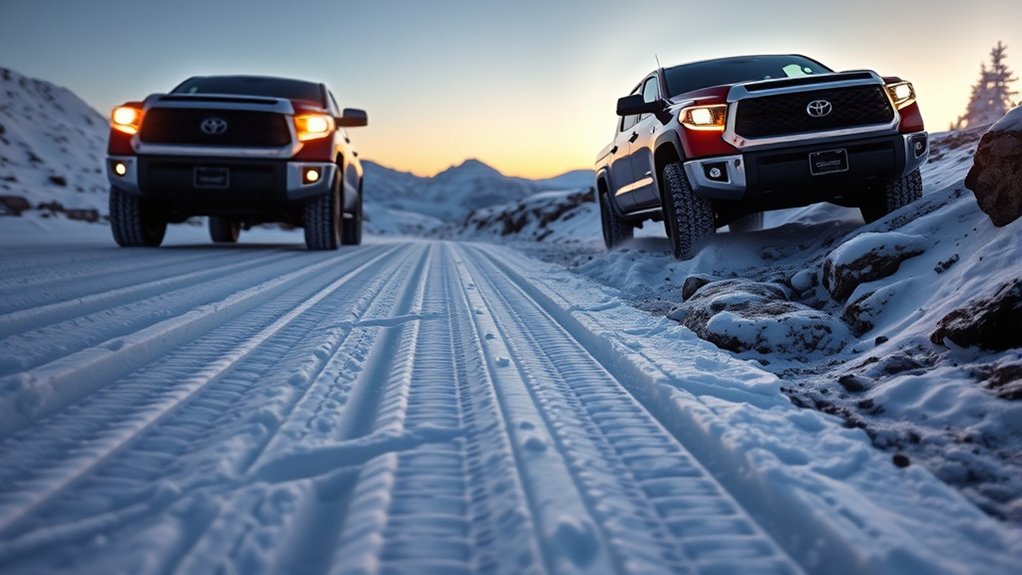
Real conditions often change within the same trip. The better range depends on surface grip, depth, grade, obstacles, required momentum, and how slowly you need to travel.
Use 4HI when momentum and traction matter; use 4LO when slow control and torque multiplication matter.
| Situation | Likely Choice | Reason |
| Snow-covered highway | 4HI | Added drive traction while traveling at a cautious speed suitable for conditions |
| Wet but clear paved road | Model-year dependent | Later manuals emphasize slip-permitting surfaces; some first-generation manuals explicitly included wet roads |
| Loose gravel road | 4HI | The surface permits tire slip while 4WD improves drive traction |
| Firm beach sand | Often 4HI | Moderate wheel speed can help maintain momentum |
| Deep soft sand or a steep dune approach | 4LO may be appropriate | Low range can provide controlled torque, but required momentum and terrain must also be considered |
| Deep snow, rocks, or a steep rutted climb | 4LO | Slow control and torque multiplication are more useful than speed |
Tire Pressure and Sand Driving
Do not reduce every Tundra tire to 12 PSI. There is no universal aired-down pressure that is safe for every tire, wheel, payload, terrain, or driving speed. Excessively low pressure can allow the tire bead to unseat, increase sidewall damage, create heat, reduce load capacity, and make steering less predictable.
For normal road use, follow the cold inflation pressure on the driver-door Tire and Loading Information label. NHTSA TireWise directs drivers to the vehicle manufacturer’s placard or owner’s manual for the correct road-use tire size and inflation guidance rather than treating the tire sidewall maximum as the vehicle’s recommended pressure.
Experienced off-road drivers sometimes air down with a suitable gauge, compressor, recovery equipment, and knowledge of the tire and wheel limits. Reinflating to the vehicle’s required road pressure before returning to pavement or highway speeds is essential.
How to Effectively Engage 4WD in a Toyota Tundra
Tundra generations use different selectors and can have different shift-speed requirements. The following process is a safe model-aware guide. For current-generation reference, Toyota’s 2024 Quick Reference Guide uses less than 62 mph for 2H↔4H and requires a complete stop, brake application, and Neutral for 4H↔4L. Instructions for your exact model year take priority.
How to Shift From 2HI to 4HI
- Confirm that the surface and your model-year instructions permit high-range four-wheel drive.
- Straighten the steering wheel and reduce speed before reaching the difficult section.
- Make sure the tires are not spinning.
- Select 4HI according to your model-year instructions. Toyota’s 2024 current-generation reference specifies less than 62 mph (100 km/h) for this shift.
- Ease the accelerator if needed and wait for the 4WD indicator to stop flashing and remain steadily illuminated.
- Continue at a speed appropriate for traction, visibility, traffic, and terrain—not merely the highest shift speed the system permits.
How to Shift From 4HI to 2HI
- Move onto a straight section and reduce driveline load by easing the accelerator.
- Reduce speed to the limit specified by your exact manual. Toyota’s 2024 current-generation reference uses less than 62 mph.
- Select 2HI/2H using the correct control for your Tundra.
- Wait for the 4WD indicator to turn off or show that the shift is complete.
- Complete the change before extended dry-pavement driving or tight parking maneuvers when your model uses part-time 4WD.
How to Shift From 4HI to 4LO
- Stop in a safe, stable location before the difficult terrain.
- Keep your foot on the brake.
- Place the transmission in Neutral when required by your model’s instructions. The 2024 current-generation Toyota procedure requires Neutral.
- Operate the 4WD selector as directed to request 4LO.
- Wait until the low-range indicator stops flashing and remains steady.
- Shift into the appropriate forward or reverse gear and proceed slowly with smooth throttle.
How to Shift From 4LO to 4HI
- Stop on a stable surface while keeping the wheels straight.
- Hold the brake and place the transmission in Neutral when required.
- Select 4HI and wait for the low-range indicator to turn off and the requested range to become steady.
- Return to 2HI/2H before normal dry, high-traction pavement driving when required by your model’s part-time system.
Warning: Do not request a transfer-case change while one or more tires are spinning. Toyota manuals warn drivers to stop wheel slip or spinning before operating the 4WD control.
What to Do if the 4WD Indicator Keeps Blinking
A flashing indicator during the first moments of a shift can mean the transfer case is still changing modes. If it continues flashing:
- Confirm that you followed the correct speed, brake, transmission, and selector procedure.
- Straighten the wheels, reduce throttle, and follow any message shown in the multi-information display.
- For a delayed high-range shift, some Toyota procedures instruct the driver to travel straight while gently accelerating or decelerating, or to reverse as directed by the manual.
- For a delayed 4HI↔4LO shift, recheck that the truck is fully stopped and in the required transmission position before attempting the manual-defined procedure again.
- Check that all four tires have compatible sizes, types, wear levels, and inflation pressures.
- Do not continue repeatedly cycling the control if a warning message appears or engagement never completes.
- Have the system inspected by a Toyota dealer or qualified technician if the warning persists, the indicators flash rapidly, grinding occurs, or the truck develops vibration or binding.
4WD usage note: Toyota has specified in multiple Tundra manuals that the truck should be driven in four-wheel drive for at least 10 miles (16 km) each month to lubricate front-drive components. Carry out that exercise only in conditions permitted by the manual for your exact model year; do not use the maintenance recommendation as a reason to make tight turns or drive extended distances in part-time 4WD on dry, high-traction pavement.
Using 4WD While Towing
4HI may provide useful traction while towing on snow, loose gravel, mud, or another low-grip surface when the owner’s manual permits it. Use the normal road-driving range when traction is adequate.
4LO can provide slow, controlled torque for an appropriate maneuver on a loose or slippery grade, but it does not increase the Tundra’s rated towing capacity, payload, gross vehicle weight rating, gross axle weight ratings, tire limits, or gross combined weight rating. All published limits still apply.
Frequently Asked Questions
When should I use 4H and 4L in a Toyota Tundra?
Use 4H, also called 4HI, on snow, ice, loose gravel, dirt, mud, or sand when you need added drive traction and the surface is appropriate for your model’s part-time four-wheel-drive system. Use 4L, or 4LO, for very slow travel over steep, rocky, deeply rutted, muddy, snowy, or soft terrain.
When should you use 4 High and 4 Low?
Use 4 High when added drive traction and some momentum are required. Use 4 Low when slow control, torque multiplication, or engine braking is more important than speed. Avoid ordinary dry-pavement operation in a part-time 4WD Tundra.
At what speed can I shift a Toyota Tundra into 4H?
Toyota’s 2024 current-generation Tundra Quick Reference Guide specifies reducing speed to less than 62 mph (100 km/h) before shifting between 2H and 4H. That is a transfer-case shift threshold, not a recommended speed for snow, ice, gravel, mud, or another low-traction surface. Older model years can have different limits, so check the exact owner’s manual.
When should you use 4H and 4L in a Toyota?
The basic distinction is similar across many part-time Toyota 4WD systems: 4H is for travel where added drive traction is needed, while 4L is for difficult low-speed terrain. Selector operation, permitted surfaces, shift-speed limits, dashboard indicators, and required transmission position can vary, so consult the manual for the exact Toyota model and year.
Should I use 4H or 4LO for snow?
Use 4H for most snow-covered roads where your model permits part-time 4WD because it provides drive traction without low-range gearing. Use 4LO for deep snow, a steep snow-covered grade, a slow recovery, or another situation requiring very low speed. Reduce speed and leave extra stopping distance in either range.
Can I use 4HI on wet pavement?
It depends on model year and available traction. Later Tundra manuals describe 4H for roads or tracks that permit tire slip, while some first-generation manuals explicitly included wet roads. Do not apply one rule to every Tundra; follow the four-wheel-drive section of your exact owner’s manual and avoid driveline binding on high-grip pavement.
Why is my Toyota Tundra’s 4WD light blinking?
The transfer case may still be changing modes or the requested shift conditions may not have been satisfied. Verify the required speed and transmission position, stop wheelspin, straighten the truck, and follow any dashboard message or owner’s-manual procedure. Seek service if the indicator never becomes steady, flashes rapidly, or a warning, grinding noise, vibration, or binding occurs.
Does 4LO increase the Tundra’s towing capacity?
No. Low range can provide controlled torque for a suitable low-speed maneuver, but it does not increase the truck’s towing, payload, axle, tire, vehicle-weight, or combined-weight ratings.
Conclusion
Use 2HI/2H for normal dry pavement, 4HI/4H when your Tundra needs added drive traction on an appropriate low-grip surface, and 4LO/4L when difficult terrain requires slow, controlled torque. Toyota’s current-generation reference uses less than 62 mph for 2H↔4H shifts and a complete stop, brake application, and Neutral for 4H↔4L, but older Tundras can differ. Confirm every shift on the dashboard, follow your exact owner’s manual, avoid driveline binding, and remember that four-wheel drive improves the ability to apply drive torque—it does not erase the braking limits of the tires and road surface.
Sources
- Toyota Manuals and Warranties — model-year-specific operating instructions, warnings, controls, and shift procedures.
- Toyota 2024 Tundra Quick Reference Guide — 2H, 4H, and 4L uses and current-generation shifting procedure.
- Toyota 2026 Tundra eBrochure — current 4WDemand part-time 4WD and two-speed transfer-case specification.
- NHTSA TireWise — tire-size, inflation, inspection, and tire-safety guidance.
- NHTSA Winter Driving Tips — winter speed, stopping, following-distance, and tire guidance.
- Transport Canada Winter Driving — winter-road and tire-safety guidance.
