
In a Toyota Camry, traction control and stability control work together, but they solve different problems. Toyota commonly calls these systems TRAC and Vehicle Stability Control (VSC). TRAC limits drive-wheel spin during acceleration, while VSC helps keep the car following the direction you intend during a developing skid or sudden maneuver.
Last updated: September 22, 2026
Quick Answer
Toyota Camry traction control, called TRAC, reduces drive-wheel spin during acceleration. Vehicle Stability Control, or VSC, helps correct developing understeer or oversteer when the car moves away from the driver’s intended path. Leave both systems on during normal driving. Temporarily turn TRAC off only when controlled wheel spin is needed to free a stuck car from deep snow, mud, dirt, or sand, then turn it back on as soon as the Camry is moving normally.
Key Takeaways
- TRAC manages acceleration: It reduces engine or motor output and may brake a spinning drive wheel.
- VSC manages direction: It compares steering input with the Camry’s actual movement and may brake individual wheels.
- A flashing slip indicator is usually normal: It commonly means TRAC or VSC is actively intervening.
- A steady warning needs attention: Check the exact model-year manual and arrange diagnosis if the light remains on.
- Neither system creates tire grip: Correct tire pressure, adequate tread, suitable tires, and safe speed remain essential.
Note: Controls, icons, messages, and disablement procedures differ among Camry model years, trims, and hybrid or all-wheel-drive versions. Select your exact vehicle on the Toyota Owner’s Manuals page before following a dashboard-light or switch procedure.
Understanding Traction Control
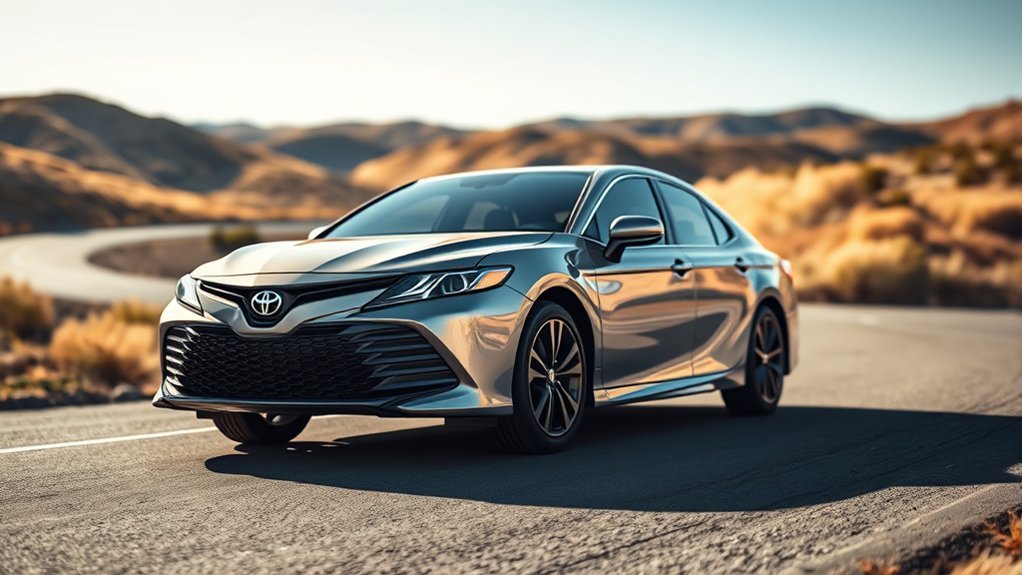
Traction control is an active safety feature designed to reduce excessive wheel spin during acceleration. Toyota usually labels this function TRAC rather than TCS in Camry owner information.
TRAC monitors wheel-speed information through components shared with the anti-lock braking system. When the system detects that a driven wheel is spinning faster than conditions allow, it may reduce engine or electric-motor torque, apply brake pressure to the spinning wheel, or use both actions together.
You are most likely to notice TRAC when accelerating on rain, snow, ice, gravel, loose dirt, or a painted road surface. Its purpose is not to make the car accelerate faster. It helps the tires use the available grip more effectively and reduces the chance that uncontrolled wheel spin will affect steering or vehicle movement.
What Traction Control May Feel or Sound Like
Normal TRAC intervention may include a flashing slip indicator, a brief reduction in acceleration, engine or motor output that feels limited, light vibration, or sounds from the brake actuator. These signs can be normal while the system is actively controlling wheel spin.
TRAC cannot create traction where little or none exists. Worn tires, unsuitable all-season tires in severe winter conditions, excessive speed, or ice can still cause the Camry to slide.
How Stability Control Enhances Safety
Vehicle Stability Control helps when the Camry begins moving in a direction that does not match the driver’s steering input. This can happen during an abrupt lane change, a turn entered too quickly, or a skid on a low-grip surface.
VSC uses information that may include wheel speed, steering angle, yaw rate, and lateral acceleration. Yaw describes how quickly the vehicle rotates around its vertical axis, or how quickly its nose turns left or right.
The system compares the direction requested through the steering wheel with the vehicle’s actual motion. If it detects developing understeer or oversteer, it can reduce power and apply braking to selected wheels to create a corrective turning force.
- Understeer: The front tires lose grip and the car turns less than the driver intends.
- Oversteer: The rear tires lose grip and the car rotates more than the driver intends.
- VSC response: The system selectively brakes one or more wheels and may reduce torque to help restore directional stability.
Electronic stability control is regulated in the United States under Federal Motor Vehicle Safety Standard No. 126. The standard is intended to reduce deaths and injuries from crashes involving loss of directional control, including rollover crashes.
Warning: VSC cannot overcome the laws of physics. It may not prevent a skid or collision if the Camry is traveling too fast for the road, the tires are badly worn, or the available grip is extremely low. Slow down before a turn and use tires appropriate for the conditions.
What’s the Difference Between Traction and Stability Control?
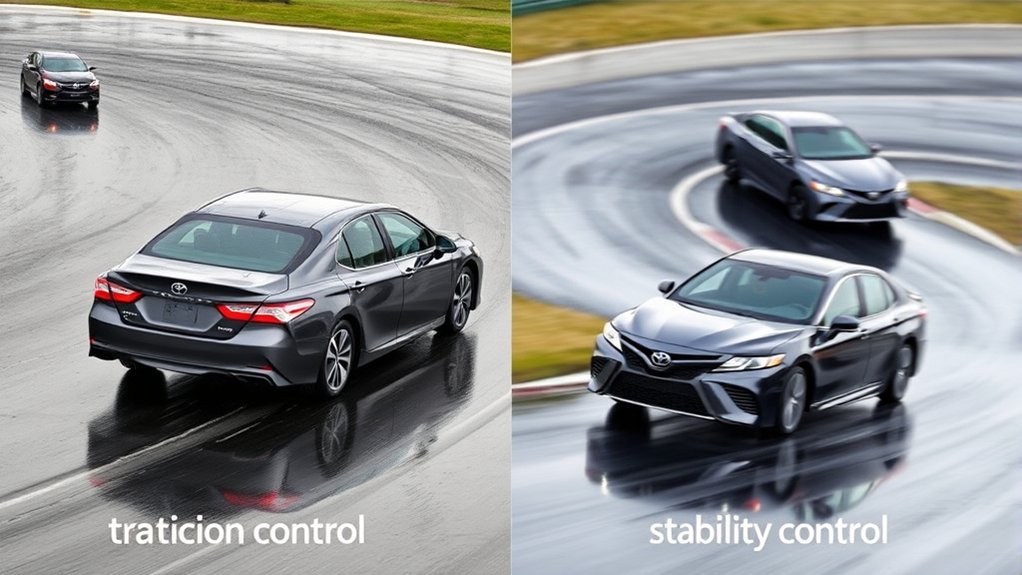
The simplest difference is that TRAC controls wheel spin during acceleration, while VSC controls developing directional instability. They share sensors and braking hardware, but their immediate goals are different.
| Feature | TRAC: Traction Control | VSC: Stability Control |
|---|---|---|
| Main purpose | Limits excessive drive-wheel spin. | Helps correct a difference between intended and actual vehicle direction. |
| Typical activation | Accelerating from a stop or adding power on a slippery surface. | Cornering, an evasive maneuver, understeer, or oversteer. |
| Key information | Primarily wheel-speed and torque information. | Wheel speed, steering angle, yaw, and lateral movement. |
| Possible intervention | Reduces torque and may brake a spinning drive wheel. | Reduces torque and selectively brakes individual wheels. |
| Normal setting | On. | On. |
[Amazon Products Picked for You]

Compatible with - 2010 2011 2012 2013 2014 2015 2016 2017 Equinox, 2010-2017 Terrain

Package: 2pcs rear left and right ABS wheel speed sensors, reference OE number: 68293133AB, 68404545AA, 68404545AB, 68627496AA

TARGETED SAFETY & PERFORMANCE: This ABS Wheel Speed Sensor / ABS Sensor is critical for your anti-lock braking system (ABS). It directly addresses ABS warning lights, loss of traction control, and unstable braking by providing precise wheel speed data to prevent wheel lock-up and maintain steering control during emergency stops.
Key Functional Differences
TRAC responds to longitudinal grip problems—what happens as the car accelerates forward. VSC responds to directional problems—what happens when the car is not rotating or turning as expected.
For example, if one front drive wheel spins while you pull away on snow, TRAC may brake that wheel and reduce power. If the rear of the Camry begins rotating outward during a turn, VSC may brake a selected wheel and reduce torque to help the car follow the intended path.
VSC does not replace driver steering, and TRAC does not operate like a locking differential. Both systems make limited corrections within the traction available from the tires.
System Activation Indicators
Many Camrys use a shared slip indicator, commonly represented by a car with wavy skid marks, rather than separate flashing “TCS” and “VSC” lights. The exact icon and message depend on model year.
- Slip indicator flashing while driving: TRAC or VSC is normally intervening. Ease off the accelerator and drive smoothly.
- Slip indicator staying on: A system fault may be present, especially if it remains illuminated after the startup check.
- TRAC OFF indicator: Traction control has been switched off or has been limited.
- VSC OFF indicator: Stability-control operation has been disabled or reduced.
- Brief illumination at startup: Several indicators may turn on momentarily as the vehicle performs a lamp and system check.
A warning that stays on should be interpreted with the exact Camry owner’s manual. Do not assume that every skidding-car icon means the same thing under every condition.
How Traction Control and Stability Control Work Together
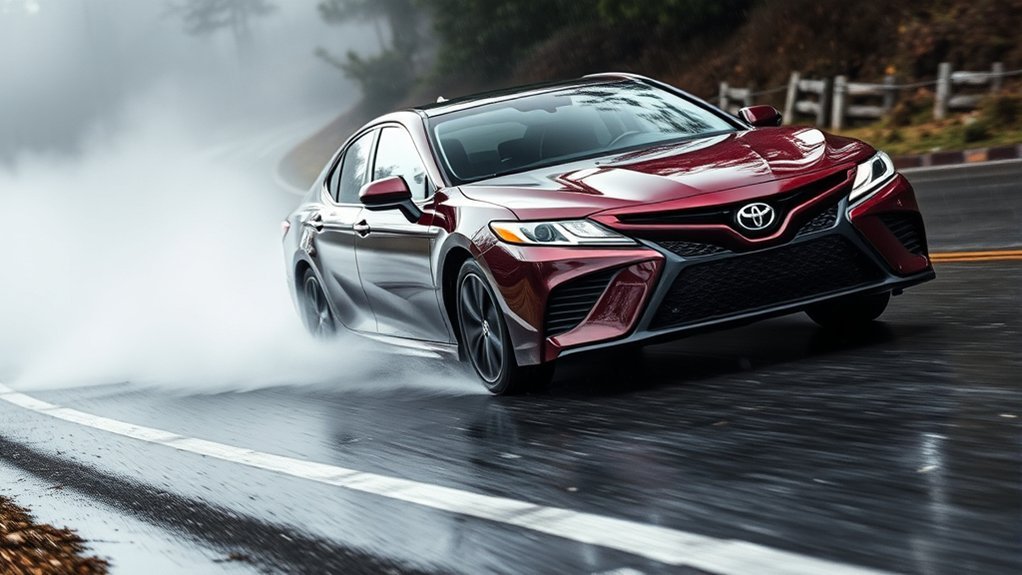
TRAC and VSC are integrated with the Camry’s anti-lock braking and electronic control systems. Sharing wheel-speed sensors and a brake actuator allows the vehicle to make rapid adjustments without requiring the driver to pump the brakes or manually reduce torque.
- TRAC identifies excessive drive-wheel acceleration relative to vehicle movement.
- VSC compares steering input with the Camry’s actual rotation and lateral motion.
- The brake-control computer decides whether torque reduction, individual-wheel braking, or both are appropriate.
- ABS remains focused on preventing wheel lock during hard braking.
The systems may operate at the same time. For example, during acceleration through a slippery bend, TRAC may limit wheel spin while VSC monitors whether the vehicle is following the intended path.
Toyota introduced Vehicle Stability Control technology in the 1990s and later developed broader integrated vehicle-dynamics systems. Regardless of the specific Camry generation, the driver remains responsible for speed, steering, braking, and tire condition.
[Amazon Products Picked for You]
Applicable for Lexus IS300 2016-2018, LC500 2018, LX570 2016-2018, RX350 2016-2018, IS350 2014-2017, NX200t 2015-2017, RC F 2015-2017, RC300 2016-2017, RC350 2015-2017, IS200t 2016, RC200t 2016, IS250 2014-2015
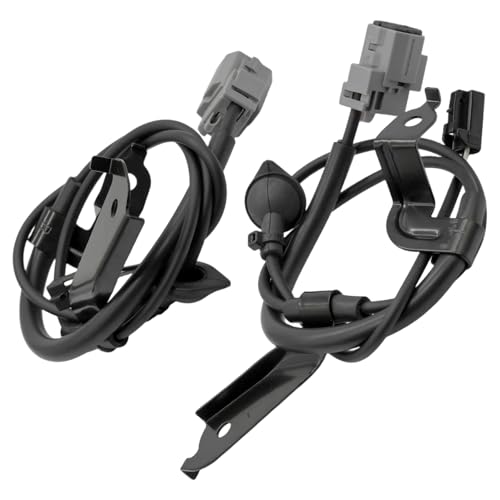
[Replaces Part Number:] ALH56 ALH57 # 8951606150 8951606160 Please Check the OEM Part Number and Make Sure Your Part Number Matches this Part Number Before Buying!

【Applicable Models】Compatible with Toyota Camry 2019 2020 2021 2022,for Toyota Avalon 2018 2019 2020 2021 2022
When Should You Use Traction or Stability Control?
Keep TRAC and VSC enabled during normal driving. They are especially valuable when rain, snow, loose gravel, abrupt steering, or changing road grip increases the chance of wheel spin or a skid.
When Temporarily Turning TRAC Off May Help
If the Camry is stuck in deep snow, mud, dirt, or sand, limited wheel spin may be necessary to build momentum or rock the vehicle free. Temporarily switching off TRAC may allow that movement.
2025 Camry example: Toyota’s 2025 quick reference guide says to press and release the VSC OFF switch while stopped to disable TRAC. Press and hold the switch for at least 3 seconds while stopped to disable both TRAC and VSC. Other model years can differ, so confirm the procedure in the manual for your exact Camry.
For a step-by-step stuck-vehicle procedure, see when to turn off traction control in a Toyota Camry.
Use light accelerator pressure and avoid prolonged high-speed wheel spin. Once the vehicle is moving normally, turn TRAC back on. On many vehicles, the default stability mode returns after the ignition is restarted, but you should confirm the behavior in the applicable manual.
Pro Tip: Before disabling TRAC, straighten the steering wheel, clear packed snow from around the driven tires, and use the least accelerator pressure needed. Spinning the tires rapidly can dig them deeper, overheat components, or damage a tire.
Should You Turn VSC Off?
Leave VSC on while driving on public roads. Disabling it removes part of the vehicle’s ability to correct a developing skid, and it does not increase the tires’ physical grip.
Some Camry model years allow a brief press of the VSC OFF switch to disable TRAC and a longer press while stopped to reduce or disable both TRAC and VSC. Other years behave differently. Use only the procedure in your exact owner’s manual.
Disabling VSC can also make other driver-assistance functions unavailable on some Camrys. For example, Toyota owner information for applicable models notes that pre-collision brake assist and pre-collision braking may be disabled when VSC is off. Read the dashboard message and the exact model-year manual before driving with VSC disabled.
Closed-course drivers should follow the rules of the facility and the vehicle manufacturer rather than treating a VSC OFF mode as a performance upgrade. A Camry’s stability system is calibrated primarily for safe road operation.
How to Troubleshoot Traction and Stability Control Problems
A flashing slip indicator during a brief loss of traction is usually normal. A light that remains on, an OFF indicator that you did not select, or a message that returns after restarting the vehicle needs further attention.
[Amazon Products Picked for You]
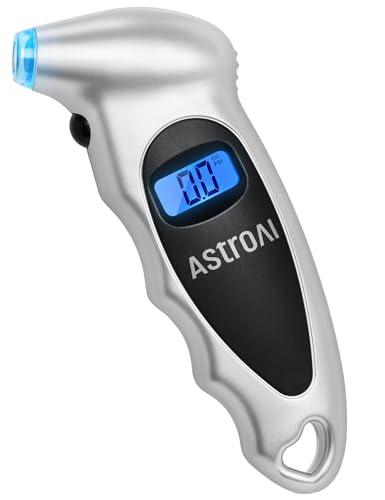
Accurate, Dependable Readings: Factory‑calibrated to ±1 PSI, so you can confidently match your vehicle’s recommended PSI (check the door jamb sticker). Ideal for monthly checks and road trips — consistent results every time, cold or warm.

HIGH ACCURACY: Every ETENWOLF's pencil tire gauge is calibrated to ANSI B40.1 Grade B, it is accurate to 2% of span in the middle 50% of range and 3% of span in the lower and upper 25% of range. Each ETENWOLF pencil tire pressure gauge is manually calibrated and has its unique calibration number printed on the pencil
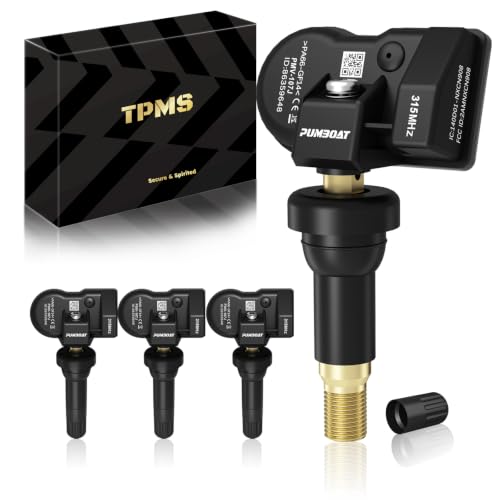
🚗 【315MHz Tire Pressure Sensor-Vehicle Fitment,Year Range,OE Number】 ★:-TOYOTA Camry (2007-2025) | Prius (2007-2022)| RAV4 (2006-2012) | Avalon (2006-2022). ★:-LEXUS RX350 (2006-2025). ★:-Other Compatible Models,2004-2025:TOYOTA Highlander.Corolla.4 Runner.Tacoma.Lander Cruiser.Matrix.Venza.FJ Cruiser.Sequoia.Tundra.Yaris.C-HR.LEXUS ES350.IS350.RX400H.RX450H.ES300H.ES250.IS250.IS300.NX300.NX200T.NX300H.GS350.GS450H.UX200.UX200H.GX460.GX470. ⚙ 【OE Number】PMV-107J.42607-06011.42607-0C020.42607-30030.42607-33011.42607-33021.42607-35010 etc. ⚠️Please Refer to The Main Image for The Complete Vehicle Fitment List.
1. Reduce Speed and Check How the Car Feels
If braking and steering feel normal, drive cautiously to a safe location. Avoid hard acceleration, abrupt turns, and slippery roads because TRAC or VSC may be unavailable.
If a red brake warning appears, the brake pedal feels abnormal, steering assistance changes significantly, or several safety warnings appear together, stop in a safe place and arrange professional assistance.
2. Confirm the Systems Were Not Switched Off
Check for a TRAC OFF or VSC OFF indicator. If you intentionally pressed the switch, restore the normal mode according to the owner’s manual. Restarting the vehicle may also restore the default setting, depending on the model.
3. Inspect All Four Tires
Check cold tire pressure against the driver-door placard. Look for a visibly low tire, severe tread wear, damage, or different tire sizes.
TRAC, ABS, and VSC compare wheel-speed information. A tire with the wrong diameter, very low pressure, or substantially different tread depth can create unexpected readings and may affect system performance.
4. Note Other Warning Lights
Record whether the ABS, brake, check-engine, electric-power-steering, or tire-pressure warning is also illuminated. The combination of lights often provides more useful information than the VSC or slip indicator alone.
On some Camry model years, an engine or electronic-throttle fault can cause VSC to be disabled and produce an additional stability-related warning. That does not automatically mean a wheel-speed sensor has failed.
5. Check for a Weak 12-Volt Battery
Low or unstable 12-volt supply voltage can trigger brake- and stability-system diagnostic faults on some Camry generations. Check the battery and charging system if the warnings appeared after a jump-start, extended storage, slow cranking, or another low-voltage event.
A battery and charging-system test is more useful than repeatedly clearing warning lights without finding the cause.
6. Inspect Recent Wheel or Brake Work
If the warning appeared after tire, brake, hub, axle, or wheel-bearing service, inspect the area for a disconnected or damaged wheel-speed-sensor wire. A damaged tone ring, incorrect bearing installation, or debris caused by component damage may also affect the signal.
Do not pry on a sensor or spray chemicals into electrical connectors unless the Toyota repair procedure specifically calls for it.
7. Scan the Correct Control Modules
A basic engine-code reader may not retrieve ABS, TRAC, or VSC trouble codes. Use a scan tool that can communicate with the brake and stability-control modules, or have a qualified technician perform the diagnosis.
Record the codes and freeze-frame information before clearing them. A code identifies the circuit or condition that requires testing; it does not always prove that the named sensor itself must be replaced.
8. Arrange Service if the Warning Returns
A restart can clear a temporary voltage or communication error, but it does not repair a persistent fault. If the warning returns, have the system diagnosed before relying on the Camry in winter weather or other low-grip conditions.
Common Causes of TRAC or VSC Warnings
- Low tire pressure or mismatched tire diameter
- Damaged wheel-speed sensor or wiring
- Wheel-bearing or tone-ring problem
- Weak 12-volt battery or charging-system voltage issue
- ABS or brake-control fault
- Steering-angle or yaw-sensor calibration issue
- Engine or electronic-throttle fault that disables stability functions on some models
- Communication fault between vehicle control modules
If the warning began after an alignment, steering repair, suspension work, or sensor replacement, review the Toyota Camry steering-angle sensor calibration guide before assuming the sensor itself has failed.
Limits of Toyota Camry Traction and Stability Control
TRAC and VSC are driver aids, not substitutes for safe driving. Their corrective ability depends on the same tire-to-road friction available to the driver.
- They cannot shorten every stopping distance.
- They cannot prevent every spin, slide, rollover, or collision.
- They cannot compensate for severely worn or inappropriate tires.
- They cannot make excessive cornering speed safe.
- They may intervene later or differently when tire sizes or pressures are incorrect.
During winter, suitable winter tires can provide more usable grip than electronic controls alone. TRAC and VSC work best when all four tires are correctly inflated, in good condition, and appropriate for the weather. For driving technique and winter-preparation details, see how to drive a Toyota Camry safely in snow and ice.
TRAC and VSC can manage the traction your tires have, but they cannot create grip that the road and tires do not provide.
Frequently Asked Questions
What is the difference between traction control and stability control?
Traction control reduces drive-wheel spin during acceleration. Stability control monitors whether the vehicle is following the driver’s intended direction and may brake individual wheels or reduce torque to correct developing understeer or oversteer.
What is traction control called in a Toyota Camry?
Toyota commonly calls its traction-control function TRAC. The stability-control function is called Vehicle Stability Control, or VSC. The exact abbreviations, icons, and messages vary among Camry model years.
Should I keep Toyota Camry traction control on or off?
Keep TRAC on during normal driving. Temporarily turning it off may help when the Camry is stuck in deep snow, mud, or sand and limited wheel spin is needed. Restore normal operation as soon as the vehicle is free.
Can I drive with the VSC or traction-control warning light on?
If braking and steering feel normal, you may be able to drive cautiously for diagnosis, but TRAC or VSC may not be available. Avoid slippery roads and abrupt maneuvers. Stop and seek assistance if a red brake warning appears, braking feels abnormal, or steering control changes.
Why does my Toyota Camry not say “Service StabiliTrak”?
StabiliTrak is terminology used by General Motors, not Toyota. A Camry normally uses Toyota terms such as VSC, TRAC, slip indicator, TRAC OFF, or VSC OFF. Always diagnose the wording and icon shown by your exact vehicle.
Why is the skidding-car light flashing in my Camry?
A flashing slip indicator commonly means TRAC or VSC is actively controlling wheel spin or vehicle stability. Reduce accelerator pressure and make smooth steering inputs. If the light remains steadily illuminated after conditions improve, consult the owner’s manual and arrange diagnosis.
Does turning off TRAC also turn off VSC in a Toyota Camry?
Not always. On the 2025 Camry, a quick press of the VSC OFF switch turns off TRAC, while pressing and holding the switch for at least 3 seconds while the vehicle is stopped turns off both TRAC and VSC. Procedures differ by model year, so confirm the switch behavior in your owner’s manual.
What should I do if the Camry slip indicator stays on instead of flashing?
A steady slip indicator can mean a fault or another condition that has disabled TRAC, VSC, or ABS. Check whether you intentionally selected an OFF mode, note any ABS, brake, engine, steering, or tire-pressure warnings, and use an ABS/VSC-capable scan tool if the light remains on.
Conclusion
Traction control and stability control support different parts of the same goal. Toyota Camry TRAC limits excessive drive-wheel spin during acceleration, while VSC helps correct developing directional instability during turns or sudden maneuvers.
Keep both systems active during ordinary driving, maintain correct tire pressure and tread condition, and treat a persistent warning as a fault that deserves proper diagnosis. A flashing slip indicator during a brief low-traction event is often normal; a steady warning, unexpected OFF indicator, or change in braking or steering should not be ignored.
Sources
- Toyota Manuals and Warranties — model-year-specific owner’s manuals, controls, warning indicators, and operating instructions.
- 2025 Toyota Camry Quick Reference Guide — VSC/TRAC OFF switch behavior and stuck-vehicle guidance.
- Toyota Dashboard Symbols and Warning Lights — Toyota guidance for TRAC OFF and VSC OFF indicators.
- 49 CFR 571.126 — Electronic Stability Control Systems — federal ESC definitions, performance requirements, malfunction indicators, and OFF controls.
- NHTSA: Crash Prevention Effectiveness of Light-Vehicle Electronic Stability Control — research on ESC and real-world crash reduction.
- Toyota Motor Corporation: 75 Years of Toyota Technical Development — Toyota’s development history for VSC, yaw sensing, and integrated vehicle-control technology.
