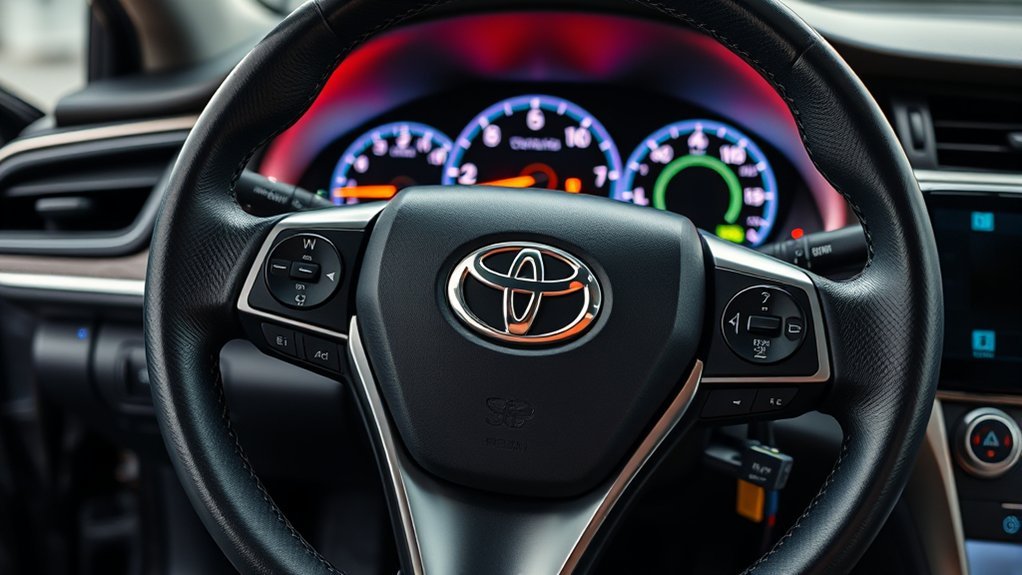
A Toyota Camry steering angle sensor does not have one universal reset sequence. The correct procedure depends on the model year, drivetrain, installed brake or stability-control system, and why the steering reference was lost. Start by correcting any wheel-alignment or steering-centering problem, recording relevant diagnostic trouble codes, and checking Toyota service information for the exact vehicle.
Last updated: September 19, 2026. This guide focuses on U.S.-market Toyota Camry and Camry Hybrid service information. Procedures can differ by model year, drivetrain, equipment, and market.
Quick Answer
To reset or calibrate a Toyota Camry steering angle sensor safely, first make sure the front wheels and steering wheel are mechanically centered, correct any alignment problem, and record relevant ABS/VSC or skid-control codes before clearing anything. Then follow the exact Toyota procedure for your model year and system. Depending on the Camry, Toyota may specify a driving method, a Techstream method, or a separate initialization procedure. Do not assume battery disconnection, repeated full-lock turns, or one generic scan-tool routine applies to every Camry.
Key Takeaways
- Toyota Camry steering-angle procedures vary by model year, drivetrain, equipment, and diagnostic condition.
- Correct a crooked steering wheel, tire problem, or wheel-alignment issue before calibration.
- Read and record relevant chassis-system codes before clearing them.
- Use the Driving Method, Techstream utility, or other procedure specified by Toyota for the exact Camry.
- Stop driving and arrange service if the steering feels loose or binds, the car is difficult to control, braking is abnormal, or a red brake warning remains on.
At a Glance
| Time Required | Varies by model, calibration method, stored faults, alignment condition, and verification steps |
| Difficulty | Moderate to advanced because model-specific diagnosis may be required |
| Tools Needed | Model-specific Toyota repair information; tire-pressure gauge; ABS/VSC-capable scan tool when diagnosis or the specified Techstream method requires one |
| Cost | Calibration may require no replacement parts; diagnostic, alignment, scan-tool, and labor charges vary |
How Do You Safely Reset a Toyota Camry Steering Angle Sensor?

There is no single reset procedure for every Toyota Camry. Toyota provides vehicle-specific repair manuals and diagnostic information through its Technical Information System. Use the procedure listed for your Camry’s exact model year, drivetrain, market, and installed brake, steering, and parking systems.
Toyota’s U.S. pre-delivery bulletins for the 2021, 2022, and 2023 Camry and Camry Hybrid identify both a Driving Method and a Techstream Method for steering-sensor zero-point calibration, but they direct technicians to the applicable repair manual for the complete sequence. That is a useful example of why a generic internet reset routine should not be applied to every Camry.
| Toyota Procedure | Main System | What It Means |
|---|---|---|
| Steering-sensor zero-point calibration | ABS/VSC or skid-control system | Establishes or reacquires the steering reference used by the brake and stability-control system. Use the exact Toyota driving or diagnostic-tool method specified for the vehicle. |
| Steering-angle neutral-point initialization | Parking assist or panoramic-view system when equipped | Initializes the recognized steering center used for functions such as parking guidelines. Toyota lists this separately from steering-sensor zero-point calibration in applicable Camry service information. |
| Torque-sensor zero-point calibration | Electric power steering | An EPS procedure required after specified steering-system repairs or diagnostic conditions. Do not assume it is the same operation as an ABS/VSC steering-sensor calibration. |
Verified Toyota example: The 2021, 2022, and 2023 U.S. Camry/Camry Hybrid PDS bulletins separately reference steering-angle neutral-point initialization and steering-sensor zero-point calibration, and the zero-point section identifies Driving and Techstream methods. See the 2021 bulletin, 2022 bulletin, and 2023 bulletin. These examples do not prove that another Camry generation uses the same sequence.
1. Prepare the Car Before Calibration
- Park on a level surface with enough space to work safely.
- Set the parking brake and place the transmission in Park.
- Inflate all four tires to the pressure shown on the driver’s door-jamb label.
- Point the front wheels straight ahead and center the steering wheel as closely as possible.
- Make sure the 12-volt battery is charged and stable.
If the steering wheel is visibly crooked while the car travels straight, correct the wheel alignment or steering installation first. Calibration cannot repair a mechanical alignment problem.
2. Scan the ABS/VSC System Before Clearing Anything
If warning lights are active or you are diagnosing a failed calibration, connect Toyota Techstream or a compatible scan tool that can communicate with the applicable ABS, VSC, skid-control, EPS, or related chassis system. A basic engine-code reader may not access the module, live data, or utility you need. If Toyota’s procedure for your exact Camry specifies a driving-only calibration, do not add an unnecessary scan-tool calibration step just because another model uses one.
- Read and save all relevant diagnostic trouble codes before clearing them.
- Check steering-angle live data when supported while the wheels are centered.
- Inspect related data and codes for wheel-speed, yaw-rate, acceleration, battery-voltage, and communication faults when the applicable diagnostic procedure calls for them.
Pro Tip: Take a photo or save a scan report before clearing codes. The complete code, suffix or subcode, and available freeze-frame data can help distinguish an initialization problem from a wiring, sensor, power-supply, or other chassis fault.
3. Run the Model-Specific Calibration
Open the applicable Toyota repair procedure and use the method it specifies: a driving method, a Techstream or compatible-tool utility, or another initialization sequence. Follow every required condition for ignition mode, wheel position, brake-pedal use, vehicle speed, drive time, electrical supply, and whether the engine or hybrid system should be running.
Do not substitute a copied jumper-wire procedure, a lock-to-lock routine, or instructions from another Camry generation. A terminal-bridging or steering-wheel movement sequence should be used only when Toyota service information for the exact vehicle specifically requires it.
4. Verify the Repair
- Complete the ignition cycle or restart only when the applicable procedure tells you to do so.
- Confirm relevant ABS, VSC, slip, traction-control, EPS, or other chassis warnings complete their normal check and remain off when the procedure says they should.
- Recheck supported steering-angle live data with the wheels straight and confirm that the reading changes smoothly as the steering wheel turns.
- Perform the Toyota-specified road verification only when the steering and braking feel normal and no critical warning is present.
- Scan the applicable chassis systems again after the verification drive and check whether relevant codes returned.
- If the vehicle has parking guidelines affected by steering-angle neutral-point initialization, confirm their operation using the procedure for that system.
What Confirms a Successful Calibration?
- Relevant active chassis codes do not immediately return.
- Supported steering-angle live data agrees with the physical steering position and responds smoothly to wheel movement.
- Applicable warning lights remain off during the required verification conditions.
- The model-specific driving, scan-tool, or parking-system procedure reaches its stated completion condition.
Warning: Do not road-test the Camry if the steering is loose, binding, difficult to control, or severely off-center. Also stop if braking behavior is abnormal or a red brake warning remains on. Arrange professional inspection or towing instead.
Why Disconnecting the Battery Is Not, By Itself, a Steering Angle Reset
Disconnecting the 12-volt battery may clear temporary memory or interrupt power to vehicle modules, but power removal by itself does not correct wheel alignment, repair wiring, diagnose a failed sensor, or complete every required steering-angle calibration. In some Camrys, loss of steering-sensor power can instead create a need for initialization or calibration after power is restored.
For example, Toyota’s 2021 and 2023 U.S. Camry/Camry Hybrid PDS bulletins state that removal of the D/C cut fuse interrupts steering-angle-sensor power and then call for applicable steering-angle neutral-point initialization and steering-sensor zero-point calibration after the fuse is installed. Follow the service procedure for your exact Camry rather than treating battery disconnection as the reset itself.
Only disconnect the battery when the repair procedure or another necessary repair step requires it. If battery service is necessary, follow the safety instructions for the exact Camry, especially on hybrid models. Power removal should not replace code diagnosis, alignment correction, or a required calibration routine.
Note: A warning light that disappears after power is removed may return as soon as the control unit detects the original fault again. Clearing a symptom is not the same as correcting its cause.
When Might a Toyota Camry Need Steering Angle Calibration?
Calibration may be required after work or power interruption that changes, removes, or invalidates the steering reference, but the exact trigger depends on the model-specific Toyota procedure. Situations that can require checking the applicable calibration instructions include:
- A wheel-alignment or steering-wheel centering correction when Toyota specifies recalibration afterward
- Steering rack, steering column, spiral cable, steering-angle sensor, or related control-module replacement when the repair procedure requires initialization
- Suspension or collision repairs that changed wheel alignment or steering position
- Skid-control ECU replacement or another repair identified by Toyota
- Loss of steering-sensor power on vehicles or procedures that require relearning afterward
- A steering-angle or zero-point diagnostic trouble code after mechanical repairs are complete
Calibration should not be your first response to every warning light. Diagnose the stored code and inspect the mechanical condition before starting a relearn.
Warning Lights and Stored Codes
A steering-angle problem may illuminate VSC, traction-control, ABS, EPS, slip, or other chassis warnings depending on the Camry’s model year and equipment. Toyota advises owners to use the correct vehicle manual for warning-light details and to arrange inspection when a safety-system warning remains active. See Toyota’s warning-light guide and owner’s-manual selector.
The check-engine light alone is not proof of a steering-angle sensor fault. Read the applicable control-module codes instead of diagnosing the sensor from a dashboard symbol alone.
Steering Behavior Changes
An off-center steering wheel, pulling, or poor straight-line tracking can come from wheel alignment, unequal tire pressure, tire damage, worn suspension parts, collision damage, brake drag, or incorrect steering-component installation. A sensor calibration cannot correct those mechanical causes.
| What You Notice | Possible Cause | Best Next Step |
|---|---|---|
| Steering wheel is crooked while driving straight | Alignment or steering installation issue | Inspect and align before calibration |
| ABS/VSC light stays on after repairs | Stored fault, incomplete initialization, or another chassis issue | Read codes and follow the repair manual |
| Steering-angle data does not change when the wheel turns | Sensor, wiring, power, communication, or scan-data issue | Diagnose the circuit instead of recalibrating repeatedly |
| Vehicle pulls to one side | Tire, brake, alignment, or suspension problem | Inspect the mechanical cause first |
What Does the Steering Angle Sensor Do in a Toyota Camry?
The steering angle sensor reports the driver’s steering input to vehicle control systems. Federal electronic-stability-control requirements define ESC as a system that monitors driver steering inputs and can apply individual wheel-brake torque to help control understeer or oversteer. Toyota commonly calls its stability system Vehicle Stability Control, or VSC.
Sensor Functionality Overview
The applicable control system can compare steering input with information such as wheel speed, yaw rate, and vehicle motion. When the readings do not agree as expected, the system may set a trouble code, limit an electronic function, or illuminate a warning.
A correct steering reference matters because the control system needs to understand the driver’s intended direction. However, the relevant target, completion condition, and allowable values must come from the repair information for the exact vehicle and diagnostic procedure. A single internet value should not be applied to every Camry.
Impact on Vehicle Handling
An incorrect or missing steering signal can affect systems that rely on steering input. It may also contribute to unwanted or unavailable stability-control operation when the signal does not agree with the vehicle’s actual path. That does not mean the steering-angle sensor is the cause of every pull, jerk, warning light, or alignment complaint.
Calibrate only after the steering and alignment are mechanically correct. Software cannot compensate for a crooked wheel, worn part, damaged tire, or incorrect steering installation.
What Are the Symptoms of a Malfunctioning Steering Angle Sensor?
A failed sensor or circuit is more likely when scan data, diagnostic codes, and the model-specific test procedure support the diagnosis. Possible signs include:
- Steering-angle live data that is frozen, missing, implausible, or changes erratically
- A steering-angle, communication, power-supply, or skid-control diagnostic trouble code
- VSC, traction-control, ABS, EPS, slip, or related chassis warnings that return after the correct calibration procedure
- A calibration that repeatedly fails even though the wheels and steering wheel are correctly centered and mechanical alignment is correct
- Evidence of damage to the spiral cable, steering column, connector, wiring, or sensor
Do not replace the sensor based on a warning light alone. Confirm the applicable power, ground, communication, wiring, live-data, alignment, and diagnostic checks first.
Is It Safe to Drive With a Steering Angle Sensor Fault?

A steering-angle fault can affect an electronic stability-control system that monitors steering input. Federal rules require an ESC malfunction telltale for malfunctions that affect control or response signals in the stability system. Depending on the fault and Camry configuration, some electronic support may be unavailable even though the vehicle can still be steered mechanically.
If the steering and braking feel normal and the vehicle manual does not require an immediate stop, drive cautiously only as needed to obtain diagnosis. Reduce speed, avoid slippery conditions and abrupt maneuvers, and do not rely on a disabled stability or driver-assistance function. Do not drive if the car cannot hold a lane, the steering binds or feels loose, braking behavior is abnormal, or a red brake warning remains on.
When Should You Seek Professional Help?
Arrange professional diagnosis when:
- Your scan tool cannot access the required chassis data or calibration functions.
- The Toyota-specified calibration fails or a warning returns immediately.
- The steering wheel remains off-center after a proper alignment.
- The car has collision damage, steering-column work, or a replaced steering rack.
- Live steering-angle data is missing, implausible, or does not respond normally to steering movement.
- You see multiple chassis communication or low-voltage codes.
- The steering or braking does not feel safe.
A Toyota dealer or qualified repair shop can use model-specific repair information, inspect wheel alignment and steering components, test the sensor circuit, and complete the required procedure. Toyota’s service-center locator can help you find dealer service.
If the problem followed windshield or forward-camera work rather than steering or suspension work, do not confuse steering-angle calibration with camera calibration. See the related Camry ADAS camera calibration after windshield replacement guide.
Additional Resources for Steering Angle Sensor Maintenance
Steering angle sensors do not have a routine mileage-based reset interval. Focus on correct tire pressure, sound steering and suspension components, and proper wheel alignment. After steering, suspension, collision, electrical-power, or skid-control work, check whether the exact Toyota repair procedure calls for calibration or initialization.
Use these resources in this order:
- Your exact Camry owner’s manual for warning-light meanings and operating cautions
- Toyota TIS for the current model-specific repair and calibration procedure
- An applicable Toyota service bulletin when one covers the model year or repair condition
- An ABS/VSC-capable scan report with complete codes, available subcodes, and live data when diagnosis requires it
- A professional alignment and steering inspection when the wheel is off-center or the vehicle pulls
Frequently Asked Questions
Do you need to reset the steering angle sensor after an alignment?
Sometimes. The requirement depends on the Camry’s model year, system, and Toyota repair procedure. Correct the mechanical alignment and steering-wheel position first, then perform any steering-sensor calibration or related initialization specified by Toyota.
Can you reset a Toyota Camry steering angle sensor without a scan tool?
On some Camrys, yes, if Toyota provides a driving method or another non-scan-tool procedure for that exact model and system. Toyota’s U.S. 2021–2023 Camry and Camry Hybrid PDS bulletins identify both Driving and Techstream methods for steering-sensor zero-point calibration. Do not assume that proves a driving method applies to another model year.
How long does Toyota Camry steering angle calibration take?
There is no reliable universal time. The calibration step may be brief, but diagnosis, wheel alignment, electrical checks, stored faults, the required driving conditions, and post-calibration verification can make the full job take longer. Judge completion by the Toyota procedure’s success criteria rather than elapsed time.
Can turning the steering wheel fully left and right reset the sensor?
Do not use full-lock steering as a universal Camry reset. A model-specific Toyota procedure may include steering-wheel movement as one part of neutral-point memorization or another initialization, but that does not make a generic lock-to-lock routine equivalent to steering-sensor zero-point calibration. Follow the exact procedure for the vehicle.
Will disconnecting the battery reset the steering angle sensor?
Not by itself. Battery or sensor-power interruption may erase or disturb a learned steering reference on some Camrys and can create a need for initialization or calibration after power is restored. Use battery disconnection only when the applicable Toyota repair procedure or another necessary repair step requires it.
Can a basic OBD2 scanner reset the steering angle sensor?
A basic engine-and-emissions code reader may not access Toyota chassis modules, steering-angle live data, or calibration utilities. If the applicable procedure requires Techstream or another diagnostic utility, use a tool that supports the required Toyota ABS/VSC, skid-control, EPS, or related function for that Camry.
Why did the steering angle calibration fail?
Possible causes include incorrect wheel alignment, an off-center steering wheel, unstable battery voltage, active chassis-system faults, sensor or wiring problems, incompatible scan-tool coverage, unmet driving conditions, or use of a procedure for the wrong model year or system. Diagnose the failed condition instead of repeatedly rerunning the calibration.
Conclusion
A Toyota Camry steering angle sensor reset is not one universal steering-wheel or scan-tool trick. First make sure the tires, alignment, steering wheel, and steering components are mechanically correct. Record relevant chassis codes, identify which Toyota procedure actually applies, complete the specified Driving Method, Techstream method, or initialization sequence, and verify the result before considering the repair finished. If warnings return, live data remains abnormal, or the steering or braking does not feel normal, stop repeating the calibration and have the underlying fault diagnosed.
Sources
- Toyota Technical Information System: Toyota’s North American repair manuals, service bulletins, diagnostics, and Techstream information
- Toyota T-SB-0096-20 — 2021 Camry/Camry HV Pre-Delivery Service: steering-angle neutral-point initialization and steering-sensor zero-point calibration
- Toyota T-SB-0058-21 — 2022 Camry/Camry HV Pre-Delivery Service: applicable steering-angle and steering-sensor calibration procedures
- Toyota T-SB-0063-22 — 2023 Camry/Camry HV Pre-Delivery Service: Driving Method and Techstream Method references for steering-sensor zero-point calibration
- Toyota Manuals and Warranties: model-specific owner’s manuals and vehicle information
- Toyota Warning Lights: owner guidance for safety-system indicators
- 49 CFR 571.126, Electronic Stability Control Systems: ESC function, steering-input monitoring, and malfunction-telltale requirements
- Toyota Service Centers: dealer service locator
