Last updated: September 22, 2026 — reviewed against the 2026 Toyota Camry Hybrid owner’s manual (OM06147U) and federal brake-fluid requirements.
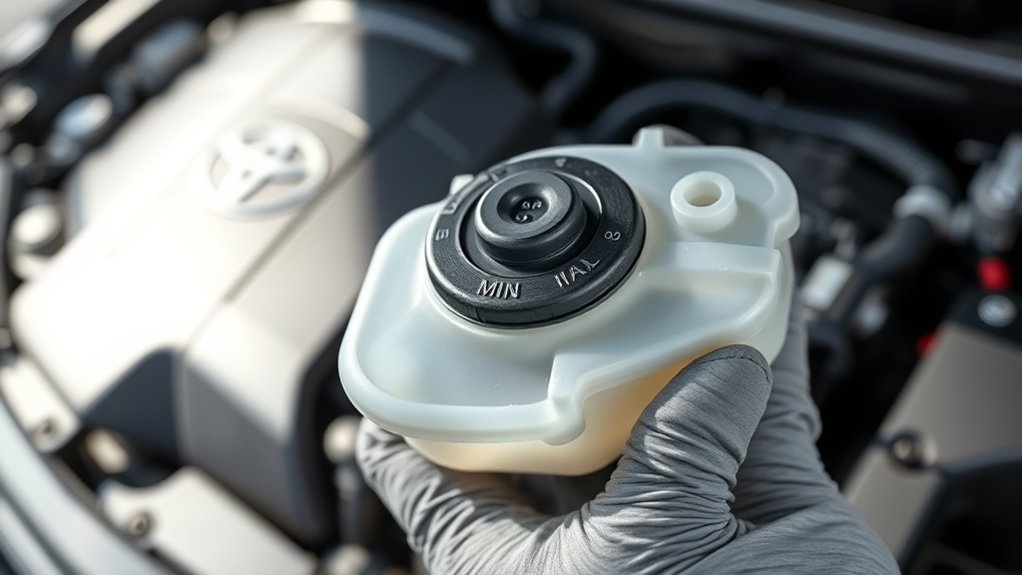
To check your Toyota Camry’s brake fluid, park on level ground, switch the vehicle off, locate the translucent brake-fluid reservoir, and read the level through its wall. The fluid should be between the MIN and MAX marks. A low or repeatedly falling level should be investigated instead of treated as an automatic reason to add fluid.
Brake-fluid specifications vary by model year. For the 2026 U.S./Canada Camry Hybrid, Toyota lists FMVSS No. 116 DOT 3 or SAE J1703 and FMVSS No. 116 DOT 4 or SAE J1704. Always confirm the requirement for your exact Camry before opening the reservoir.
Quick Answer
Park your Camry on level ground and switch it off. Identify the brake-fluid reservoir using the engine-compartment diagram and cap label, then read the fluid through the translucent reservoir without opening it. The level should be between MIN and MAX. If it is low, falling, accompanied by a red brake warning, or associated with abnormal pedal feel or a visible leak, investigate the brake system instead of simply topping it up.
Key Takeaways
- Check the reservoir with the Camry parked on level ground, the vehicle switched off, and the parking brake applied.
- Read the level through the translucent reservoir before removing the cap; a normal level check does not require opening it.
- A low or repeatedly falling level can accompany brake-pad wear, a leak, or another hydraulic-system problem.
- The 2026 Camry manual lists FMVSS No. 116 DOT 3/SAE J1703 or DOT 4/SAE J1704; other model years can differ.
- Stop safely and arrange service if a red brake-system warning remains on or braking performance is abnormal.
At a Glance
| Time Required | About 5 to 10 minutes |
| Difficulty | Easy inspection; leaks, bleeding, flushing, and hydraulic diagnosis require appropriate service procedures |
| Tools Needed | Flashlight and clean lint-free cloth; protective gloves, a clean funnel, and newly opened specified brake fluid only if adding fluid is appropriate |
| Cost | No cost to inspect; fluid, diagnosis, towing, or repair costs vary |
What Does the 2026 Toyota Camry Manual Say About Brake Fluid?
The 2026 Toyota Camry Hybrid owner’s manual gives specific guidance for checking and adding brake fluid. These details are useful for the current generation but should not automatically be applied to an older Camry.
| 2026 Camry Check | Toyota Guidance |
|---|---|
| Correct level | Between the MAX and MIN lines on the reservoir |
| Brake-fluid specification | FMVSS No. 116 DOT 3 or SAE J1703; FMVSS No. 116 DOT 4 or SAE J1704 |
| Item for adding fluid | Clean funnel |
| Opened fluid | Use newly opened brake fluid because brake fluid can absorb moisture from the air |
| Level changes | The level can fall slightly as brake pads wear or as accumulator fluid level changes; frequent refilling may indicate a serious problem |
| Red brake warning | Stop in a safe place and arrange service when the warning indicates low brake fluid or a brake-system malfunction |
Model-year note: Earlier Camry manuals do not all list the same fluid specification. Use the reservoir label and Toyota manual for your exact year and market.
Why Should You Check Brake Fluid in a Toyota Camry?
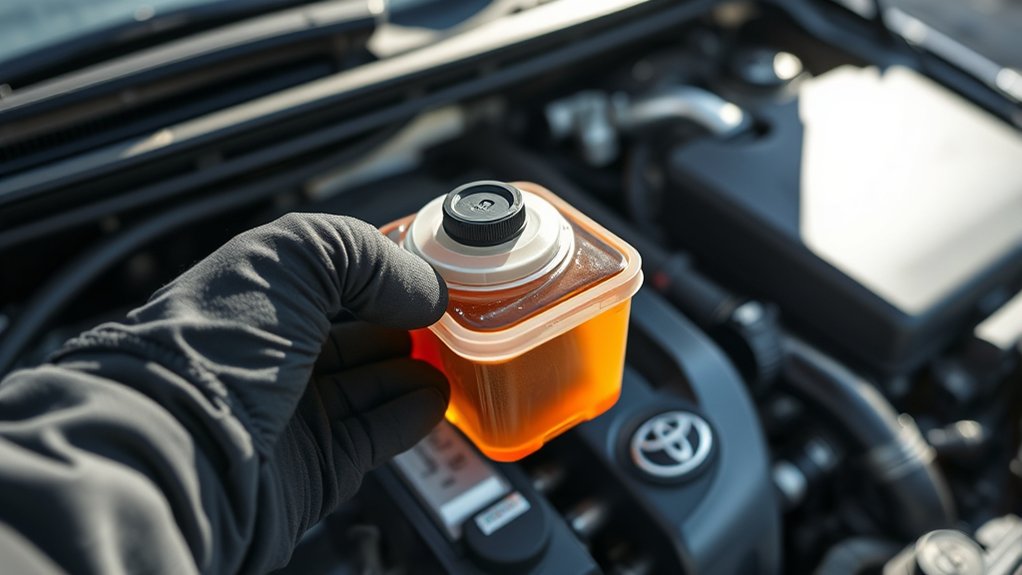
Your Camry’s hydraulic braking system uses brake fluid to transmit braking force through the system. The system depends on the correct fluid level, compatible fluid, intact seals, and leak-free hydraulic components.
A reservoir inspection can reveal a low or changing level, visible contamination, dampness near the reservoir or master cylinder, or another reason to investigate. It cannot prove that the entire braking system or the fluid itself is in good condition.
A low reading is a reason to find the cause, not an automatic instruction to keep pouring in more fluid.
Federal brake-fluid requirements direct users to follow the vehicle manufacturer’s recommendation and keep brake fluid clean and dry. Dirt, water, petroleum products, or other contamination can cause brake-system problems, and opened fluid should be kept tightly closed to limit moisture absorption.
Where Is the Brake-Fluid Reservoir in a Toyota Camry?
Toyota identifies the brake-fluid reservoir in the engine-compartment diagram of the owner’s manual. Its exact position and the components around it vary by Camry generation, powertrain, and market, so use the diagram and reservoir markings instead of relying only on a generic left/right location.
Use Toyota’s official manuals and warranties portal to select the instructions for your exact model year.
Use the Engine-Compartment Diagram for Your Model Year
Open the hood and compare what you see with the engine-compartment illustration in your manual. The brake-fluid reservoir is normally a translucent container with MIN and MAX level markings and a cap or nearby label identifying the required brake fluid.
Do not confuse it with the windshield-washer reservoir, engine-coolant reservoir, or a hybrid-system coolant reservoir. Those containers contain completely different fluids.
Confirm the Reservoir Before Opening It
A flashlight can make the molded level markings easier to see without touching hoses, wiring, or hot components.
If a cover obstructs the reservoir or you cannot identify it confidently, stop and check the owner’s manual. Do not open an unidentified reservoir or select a fluid based only on cap color.
Note: Your model-year manual and under-hood labels take priority over photographs or instructions for another Camry.
How Do You Check Toyota Camry Brake Fluid Step by Step?
- Park safely. Place the Camry on level ground, switch the vehicle off, apply the parking brake, and allow the engine compartment to become safe to access.
- Open and secure the hood. Keep loose clothing, jewelry, and tools away from hot or moving components.
- Locate the correct reservoir. Confirm it with the engine-compartment diagram, cap label, and MIN/MAX markings for your model year.
- Inspect the outside first. Look for cracks, dampness, staining, or visible fluid around the reservoir, master cylinder, and accessible hydraulic components.
- Read the level without opening the cap. View the fluid through the translucent reservoir wall. It should be between the MIN and MAX marks.
- Compare it with previous checks. A small change can accompany brake wear, but a sudden or repeated drop requires investigation.
- Look at the visible fluid. Note obvious cloudiness, separation, particles, or sediment, but do not decide that fluid is good or bad from color alone.
- Decide whether any further action is appropriate. Do not casually top up the reservoir if the level is below MIN, keeps falling, a leak is visible, a red brake warning remains on, or braking feels abnormal.
Pro Tip: Photograph the reservoir from the same angle during routine checks. Dated photos can make a slow change in level easier to recognize.
What Should Toyota Camry Brake Fluid Look Like?
Check the fluid level, visible appearance, reservoir condition, nearby hydraulic components, and any change in braking behavior. No visual inspection can confirm the condition of every part of the brake system.
Color of Brake Fluid
Under Federal Motor Vehicle Safety Standard No. 116, compliant new DOT 3, DOT 4, and DOT 5.1 non-silicone brake fluids are colorless to amber. Fluid can darken in service, so a darker shade by itself does not prove that replacement is required.
| Observation | What It May Mean | Recommended Action |
|---|---|---|
| Colorless to amber | Normal specified color range for new DOT 3, DOT 4, and DOT 5.1 non-silicone fluid | Still check level, service history, and vehicle-specific maintenance guidance |
| Darker but transparent | Possible service discoloration or aging | Do not replace fluid from color alone; check maintenance history and condition as required |
| Cloudy or separated | Possible contamination or incompatible material | Do not top up casually; arrange professional inspection |
| Visible particles or sediment | Possible contamination or component deterioration | Have the brake system inspected promptly |
Clarity and Transparency
Use a flashlight against the side of the reservoir and look for obvious particles, separation, or cloudiness. Remember that stained or aged reservoir plastic can make the fluid appear darker than it actually is.
A technician can evaluate brake-fluid condition with methods that provide more information than appearance alone. Follow the maintenance guidance for your exact model year instead of applying a universal fluid-change interval.
What Does a Low Toyota Camry Brake-Fluid Level Mean?
A low level does not identify one specific fault. It can accompany movement of the brake pistons as friction material wears, a hydraulic leak, another brake-system problem, or an incorrect level left during previous service. On the 2026 Camry, Toyota also notes that reservoir level can change with the brake accumulator.
Check accessible areas for wetness, but remember that a hydraulic leak may not leave a large puddle. Repeatedly adding fluid without finding the cause can hide an active problem.
| What You Find | What to Do |
|---|---|
| Level is between MIN and MAX, stable, and no warning or braking symptom is present | Close the hood and continue normal monitoring according to the maintenance schedule |
| Level is near or below MIN, or it has changed noticeably since the previous check | Check for leakage and brake wear and confirm the model-year procedure before adding fluid |
| Level repeatedly falls or hydraulic components are wet | Do not keep refilling the reservoir; have the source of the fluid loss diagnosed |
| Red brake warning, soft or sinking pedal, reduced braking, or an obvious leak | Stop driving normally, secure the vehicle, and arrange professional assistance or towing |
Warning: On the 2026 Camry, Toyota instructs the driver to stop immediately in a safe place when the red brake-system warning indicates low brake fluid or a brake-system malfunction. Do not continue normal driving to see whether the condition clears.
When Should You Stop and Check the Camry Brake System?
Inspect the brake system promptly if you notice any of these conditions:
- The fluid is below the MIN mark.
- The level falls again after fluid has been added.
- You see wetness near the master cylinder, reservoir, brake hoses, lines, calipers, or wheels.
- The brake pedal feels soft, spongy, unusually low, or slowly sinks while held.
- The vehicle takes longer to stop or pulls unexpectedly while braking.
- A red brake-system warning remains illuminated after the parking brake is fully released.
- The reservoir contains obvious cloudiness, separation, particles, or sediment.
Squeaking or grinding can indicate worn or damaged brake components, but those noises are not reliable measurements of brake-fluid level. They still warrant a brake inspection.
Use Toyota’s official warning-light resource and your model-year manual to interpret the exact symbol and dashboard message.
How Do You Safely Top Up Toyota Camry Brake Fluid?
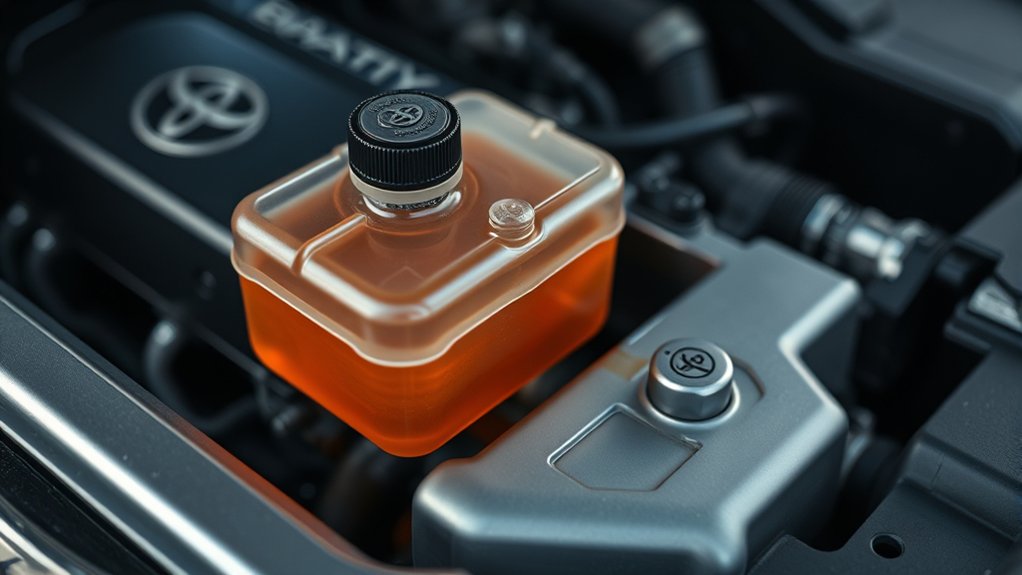
Top up the reservoir only after you have confirmed that no urgent brake fault is present and identified the exact fluid specification for your model year. The 2026 Camry manual permits fluid meeting FMVSS No. 116 DOT 3/SAE J1703 or DOT 4/SAE J1704, but that does not mean every older Camry has the same specification.
- Verify the required fluid. Match the specification printed on the reservoir label or listed in the owner’s manual for your exact Camry. Do not substitute DOT 5 silicone fluid or another product that is not approved.
- Use newly opened brake fluid. Brake fluid can absorb moisture from the air, so use fluid from a clean, newly opened container.
- Prepare a clean funnel. Toyota specifies a clean funnel for adding fluid on the 2026 Camry.
- Clean around the cap. Use a clean lint-free cloth so dirt cannot fall into the reservoir.
- Open the cap carefully. Keep the cap and its sealing surface clean and away from dirty engine components.
- Add fluid slowly. Watch the reservoir level and do not exceed the MAX mark.
- Reinstall the cap securely. Confirm that it is seated and sealed correctly.
- Avoid painted surfaces. Brake fluid can damage vehicle paint. Prevent spills and follow the vehicle and fluid-container safety instructions if contact occurs.
- Recheck the system. If the level falls again, the red brake warning remains on, or the pedal or braking performance feels abnormal, stop driving normally and arrange service.
Caution: Topping up restores reservoir level only. It does not repair a leak, replace worn brake parts, remove air, or renew contaminated fluid. Bleeding or flushing must follow the correct model-specific service procedure.
Frequently Asked Questions
How do you check a Toyota Camry’s brake-fluid level?
Park on level ground, switch the vehicle off, apply the parking brake, identify the brake-fluid reservoir using your model-year manual, and read the level through the translucent reservoir. It should be between the MIN and MAX marks.
Do you need to open the brake-fluid reservoir to check the level?
No. For a routine level check, read the fluid through the translucent reservoir without removing the cap. Open it only when the correct model-year procedure calls for adding fluid.
What is a safe brake-fluid level?
The fluid should be within the marked operating range on the reservoir. Toyota’s 2026 Camry manual specifies a level between the MAX and MIN lines. A reading below MIN or a level that keeps falling needs investigation.
How can you tell if the brake fluid is low?
Compare the visible level with the MIN and MAX marks. A red brake warning, damp hydraulic components, a soft or sinking pedal, or reduced braking can accompany a low level and require diagnosis rather than a routine refill.
Should you check brake fluid when the Camry is hot or cold?
Park the vehicle level, switch it off, and wait until the engine compartment is safe to access. Follow any additional instructions in the owner’s manual for your exact model year. You normally read the level without opening the reservoir.
What type of brake fluid does a Toyota Camry use?
For the 2026 U.S./Canada Camry Hybrid, Toyota lists FMVSS No. 116 DOT 3 or SAE J1703 and FMVSS No. 116 DOT 4 or SAE J1704. Earlier Camry model years can differ, so always use the specification on the reservoir label or in the matching owner’s manual.
Can you mix different brake-fluid types?
Use only a fluid specification approved for your exact Camry. A higher DOT number does not automatically make a fluid appropriate for every model year, and DOT 5 silicone fluid is fundamentally different from common DOT 3 and DOT 4 glycol-based fluids. If the existing fluid is unknown, do not improvise a mixture.
Conclusion
Checking Toyota Camry brake fluid is straightforward: park level, identify the correct reservoir, and confirm that the fluid is between MIN and MAX without opening the cap unnecessarily. The important part is interpreting what you find.
A stable level within the marked range can be monitored normally. A low or repeatedly falling level, visible leak, red brake warning, or abnormal pedal requires investigation rather than repeated topping up. If adding fluid is appropriate, use only a specification approved for your exact model year and keep dirt and moisture out of the reservoir.
Sources
- Toyota Manuals and Warranties — Toyota 2026 Camry HV Owner’s Manual, publication OM06147U; supports the MAX/MIN level guidance, approved DOT 3/DOT 4 specifications, clean-funnel instruction, moisture warning, frequent-refilling warning, and brake-system warning guidance.
- Toyota Warning Lights — manufacturer guidance for interpreting vehicle-specific dashboard warnings.
- 49 CFR §571.116, Motor Vehicle Brake Fluids — federal requirements covering brake-fluid performance, fluid color, packaging, contamination warnings, and manufacturer recommendations.


1 thought on “How to Check Brake Fluid Level on a Toyota Camry (Safe Guide)”