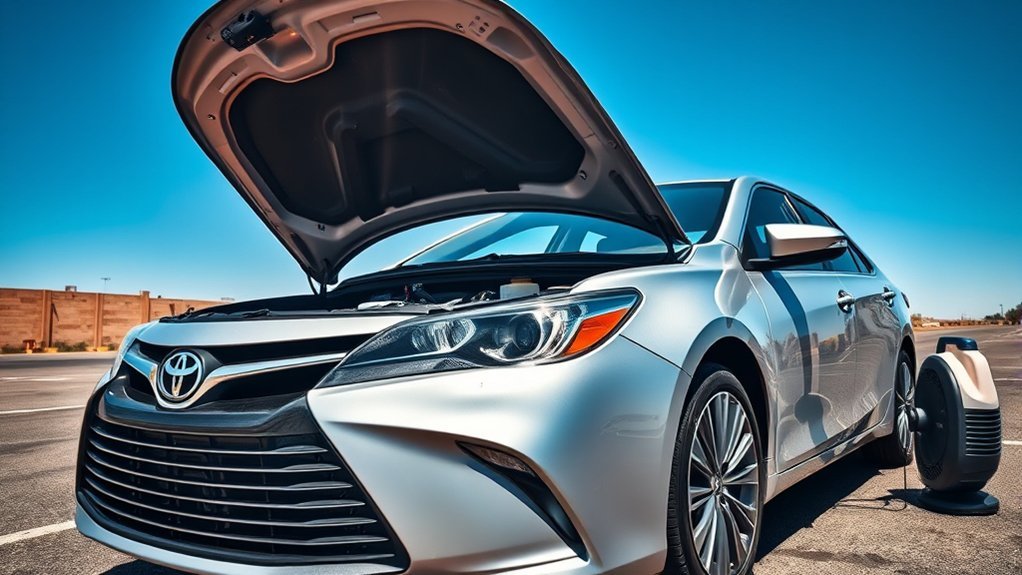
Hot weather increases the load on your Toyota Camry’s cooling system, but outdoor temperature alone should not make a properly operating car overheat during normal driving. Low coolant, leaks, failed cooling fans, restricted airflow, thermostat trouble, poor coolant circulation, or an internal engine problem usually contributes to a rising gauge or temperature warning. A cold-engine inspection and a safe roadside response can prevent a manageable cooling-system fault from becoming major engine damage.
Quick Answer
To prevent a Toyota Camry from overheating in hot weather, check the cold-engine coolant level, inspect for leaks and damaged hoses, keep radiator airflow clear, and follow the maintenance schedule for your model year. If a warning light, hot gauge, or steam appears, pull over safely, shut the engine off, and let it cool completely.
Key Takeaways
- Check the coolant reservoir only when the engine is cold, and use the coolant specified for your exact Camry model year and powertrain.
- Never open a radiator cap or pressurized coolant cap while the engine is hot.
- Overheating mainly in stopped traffic can point to a fan or low-speed airflow problem, while overheating at road speed can suggest low coolant, poor circulation, or a restricted radiator.
- Treat these driving patterns as clues, not a final diagnosis.
- Shade and windshield sunshades reduce cabin heat, but they do not repair or replace the engine cooling system.
- If the temperature rises again after cooling, coolant is actively leaking, or a hose is damaged, shut the engine off and arrange a tow.
At a Glance
| Time Required | About 5 minutes for a cold-engine visual inspection. There is no universal safe cooldown time after overheating; wait until steam has stopped and the engine and coolant container are completely cool. |
| Difficulty | Easy for cold-engine visual checks. Cooling-system diagnosis, pressure testing, fan-circuit work, and repairs may require a trained technician. |
| Tools Needed | Flashlight, protective gloves, clean cloth, and the Toyota-approved premixed coolant specified in your owner’s manual. |
| Cost | A visual inspection costs nothing. Coolant, pressure testing, towing, and repairs vary by model year and the failed component. |
Warning: Never remove the radiator cap or any pressurized coolant cap while the engine is hot. Escaping steam and coolant can cause severe burns. Do not pour cold water over a hot engine. Keep hands, hair, clothing, and tools away from electric cooling fans because they may start unexpectedly. Avoid bare-skin contact with leaking coolant, and keep spills away from children and animals.
Common Causes of Overheating and How to Prevent Them
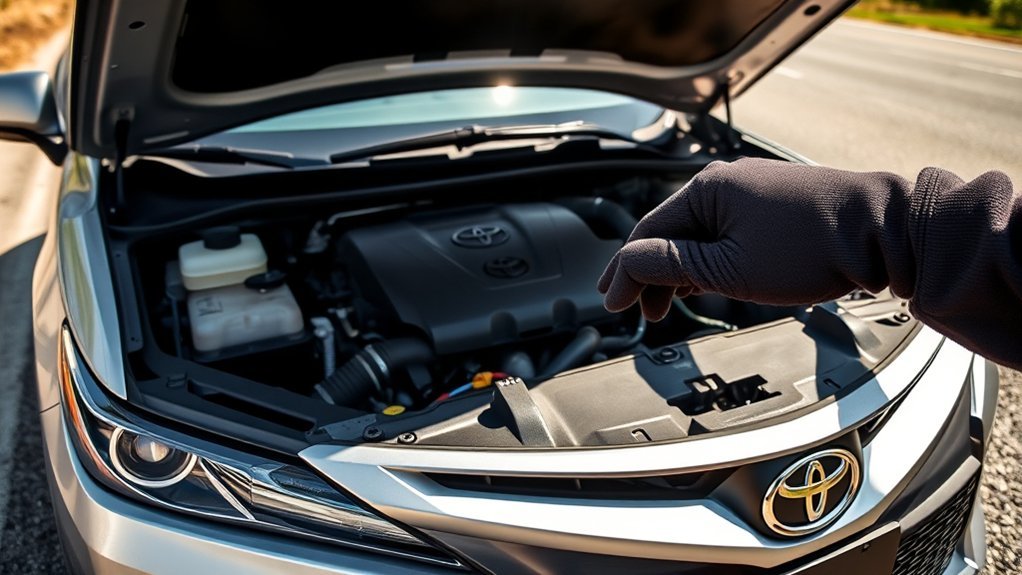
Your Camry depends on coolant circulation, radiator airflow, pressure control, and working fans to maintain a safe operating temperature. Hot weather can expose a weak component sooner, but it is not a complete diagnosis by itself.
The most common causes include:
- Low coolant: A low reservoir level reduces the cooling system’s ability to carry heat away from the engine.
- External coolant leak: Cracked hoses, loose clamps, a damaged radiator, a leaking pump, or another failed seal can gradually empty the system.
- Cooling-fan failure: A failed fan motor, relay, fuse, sensor, control module, or wiring connection can cause overheating in traffic or while idling.
- Stuck thermostat: A thermostat that does not open can restrict coolant flow to the radiator.
- Weak or damaged coolant pump: Poor circulation can make the temperature rise during acceleration, hill climbing, or highway driving.
- Restricted radiator: Internal deposits, damaged passages, bent fins, or external debris can reduce heat transfer and airflow.
- Faulty pressure cap: A damaged or incorrect cap may release pressure too early or allow coolant loss.
- Air trapped in the system: An air pocket after coolant service can interrupt circulation and cause unstable temperatures.
- Damaged belt or tensioner: On Camry engines that use a belt-driven cooling component, belt or tensioner damage can affect coolant circulation.
- Internal engine problem: A failed head gasket, cracked component, or combustion-gas leak can repeatedly force coolant from the system.
The National Highway Traffic Safety Administration recommends making sure the vehicle has enough manufacturer-specified coolant, checking the cooling system for leaks, and inspecting belts and hoses for bulges, blisters, cracks, cuts, and loose connections.
Hot weather can reveal a weak cooling system, but repeat overheating is a fault to diagnose—not a normal summer condition to tolerate.
| When It Overheats | Possible Clues | Recommended Action |
|---|---|---|
| Mostly in stopped traffic | Cooling fan, fan controls, blocked airflow, or another low-speed cooling problem | Stop driving if the temperature continues rising and have the fan and airflow system tested. |
| At highway or steady road speed | Low coolant, thermostat, coolant pump, radiator restriction, or internal leak | Check the cold coolant level and arrange a complete cooling-system inspection. |
| Soon after coolant service | Trapped air, incorrect fill level, loose connection, or unsuitable coolant | Return to the service provider or have the system filled and bled according to Toyota’s procedure. |
| Temperature changes with cabin heat | Low coolant or interrupted circulation | Do not rely on the heater as a repair. Check for coolant loss and seek service. |
| Repeatedly after topping off | Unrepaired leak, cap failure, pump leak, trapped air, or internal engine problem | Have the system pressure-tested instead of repeatedly adding coolant. |
[Amazon Products Picked for You]

[Vehicle Fitment]: Compatible with Lexus ES350 2007-2011 V6 3.5L (Sedan; fit for Type 2), ES350 2012 V6 3.5L (Sedan); Compatible with Toyota Avalon 2005-2012 V6 3.5L (Sedan), Camry 2007-2011 V6 3.5L (Sedan), Venza 2009-2015 V6 3.5L (Sport Utility)---For 2011 Toyota Camry it fit the model Without Towing Package; JAPAN BUILT

Replaces part numbers: 8942833010, 1S1386, 011609, 2011797, 88923763, 8942833010, SW1434, 2011609, 89422-35010, 89422-30030, 8942220010, 8942230030, 8942235010, 5S1517, SU4007, B593-18-840

【Vehicle Fitment】Compatible with 2010-2011 for Toyota for Camry 2.5L 2009-2016 for Toyota for Venza 2.7L
Hot-Weather Checklist Before You Drive
Perform these checks with the Camry parked on level ground and the engine completely cold, especially before a long trip or a period of extreme heat:
- Check the reservoir level: Confirm that coolant sits within the marks specified in the owner’s manual.
- Look beneath the vehicle: Check for fresh drips, dried residue, or a sweet coolant smell.
- Inspect visible hoses: Look for cracking, swelling, collapsed areas, wet connections, or loose clamps.
- Check the grille and radiator area: Remove accessible leaves and loose debris without bending fins or reaching near moving parts.
- Review the temperature display: Know the normal gauge position or warning-light behavior for your model year.
- Carry the correct coolant: Keep only the premixed coolant approved for the vehicle, securely stored and away from children and animals.
- Check for recalls: Use the NHTSA recall lookup with your VIN and complete any open safety recall through an authorized repair facility.
Do not warm the engine intentionally until it nearly overheats just to test the fan. Fan operation and control signals can be checked more safely with proper diagnostic equipment.
Immediate Actions to Take When Your Camry Overheats
If the temperature warning appears, the gauge enters the hot range, or steam rises from under the hood, treat the situation as urgent. Continuing to drive can damage gaskets, seals, cylinder-head components, and other engine parts.
[Amazon Products Picked for You]

Engine Radiator Coolant Water Tank Black Reservoir Cap. Perfect compatible with most car models of Infiniti Nissan Renault. Please confirm the size and compatibility of the product before purchase. Any issues or questions please feel free to contact us.

High Quality Material: Radiator coolant reservoir tank cap made of high-quality ABS plastic with characteristics of high temperature resistance, corrosion resistance, rust resistance, oxidation resistance and deformation resistance for long-term use

【Compatible with Nissan】Our coolant antifreeze reservoir tank cap is compatible with Nissan: 350Z 2003-2009, 370Z/Cube 2009-2014, Juke 2011-2017, Leaf 2011-2017, Murano 2003-2014, Nissan NV200 2013-2020, Nissan NV200 TAXI 2014-2018, Nissan Quest 2011-2017, Nissan Rogue 2008-2020, Nissan Versa 2007-2012, Nissan Sentra 2015-2018, Nissan Pathfinder.
Safely Pull Over
- Turn off the air conditioner. This reduces immediate engine load while you move toward a safe stopping area.
- Activate the hazard lights. Slow down smoothly and avoid sudden lane changes.
- Pull completely off the road. Choose a level, well-lit location away from moving traffic when possible.
- Shift into Park and shut the engine off. Do not continue driving to see whether the warning improves.
- Stay clear of steam. If steam is escaping, keep away from the front of the vehicle and do not open the hood until the steam has stopped.
- Let the engine cool completely. Do not rely on a fixed 15-, 20-, or 30-minute waiting period.
Turning the cabin heater to its hottest setting may temporarily remove a small amount of engine heat while you are moving only far enough to reach a safe stopping place. It is not a repair and should never be used to justify continued driving with a rising temperature gauge or active warning.
Check Coolant Levels
After the engine and coolant container are completely cool, inspect the translucent coolant reservoir. Do not open a hot pressurized cap. The level should sit between the marked low and full lines under the conditions described in the owner’s manual.
| Action | What to Look For | What to Do |
|---|---|---|
| Check the reservoir | Coolant below the low mark or an empty reservoir | Look for leaks before adding any fluid. |
| Inspect beneath the car | Colored liquid, dripping, puddles, steam, or a sweet smell | Do not restart if coolant is actively leaking. |
| Inspect hoses visually | Split, collapsed, swollen, wet, or disconnected hose | Arrange towing and repair. |
| Add approved coolant | Low level with no obvious major leak and a fully cool engine | Use the premixed coolant specified for the exact model year and powertrain. |
| Monitor after a cautious restart | Gauge rises again, warning returns, rough running begins, or steam appears | Shut the engine off immediately and request a tow. |
Note: Do not choose coolant by color alone. Different formulas can look similar, and mixing incompatible products can reduce corrosion protection or create deposits. Check the exact specification in the Toyota manual for your Camry’s model year. Toyota also advises owners to confirm that a coolant product is recommended in the vehicle manual.
What Not to Do When the Engine Is Hot
- Do not remove a radiator cap or pressurized reservoir cap.
- Do not pour or spray cold water over the engine, radiator, exhaust components, or hybrid-system components.
- Do not reach near an electric cooling fan, even when it is not moving.
- Do not crawl beneath a vehicle stopped on an active roadside.
- Do not keep driving because the warning temporarily disappears.
- Do not repeatedly top off coolant without finding the cause of the loss.
- Do not allow spilled coolant to remain where a child or animal can reach it.
When You Should Tow the Car
Arrange roadside assistance instead of driving when any of these conditions apply:
- Coolant is pouring or steadily dripping from the vehicle.
- The reservoir is empty and you cannot identify why.
- A hose is split, detached, or badly swollen.
- Heavy steam continues after the engine is shut off.
- The fan system appears inoperative and the vehicle overheats while stopped.
- The gauge rises again soon after adding approved coolant.
- The engine runs roughly, produces persistent white exhaust, or shows milky residue in the oil.
- A temperature warning returns after a restart.
- You are unsure whether the engine has cooled enough for a safe inspection.
Even if the temperature returns to normal, arrange an inspection after a significant overheating event. A temporary return to normal does not prove that the leak, trapped air, fan fault, or circulation problem has been corrected.
Cooling System Maintenance Tips to Prevent Overheating
Preventive maintenance gives you the best chance of finding a weak hose, small leak, airflow restriction, or failing component before summer heat exposes it. Perform visual checks when the engine is cold, particularly before a long trip.
- Check the reservoir level: Watch for a level that slowly drops between inspections. Coolant does not normally disappear without a cause.
- Inspect hoses and connections: Look for cracks, swollen sections, dried coolant residue, wet clamps, and rubber that appears brittle or damaged.
- Check the radiator area: Remove loose leaves and debris from accessible grille openings without bending the delicate fins.
- Verify fan symptoms safely: If the Camry heats up in traffic but cools while moving, have the electric fan controls and airflow tested. Do not place hands or tools near the fan.
- Watch the temperature display: Learn its normal position or warning behavior so you can notice a change early.
- Investigate coolant odors: A sweet smell inside or outside the vehicle may indicate a leak even when no puddle appears.
- Pressure-test unexplained loss: A technician can test the system and pressure cap for leaks that appear only when hot and pressurized.
- Follow the correct replacement schedule: Use the maintenance guide for your exact model year rather than a universal mileage or time interval.
- Complete recall repairs: Check the VIN through Toyota or NHTSA before long-distance travel.
Avoid automatically requesting an aftermarket chemical “radiator flush.” Toyota may specify a drain, refill, air-bleeding, or replacement procedure for a particular model. The maintenance guide identifies the proper interval, fluid specification, and applicable cooling circuits.
Depending on model year and powertrain, a hybrid Camry may have distinct cooling components or reservoirs for the gasoline engine and hybrid electronics. A normal-looking engine-coolant reservoir does not confirm that every applicable circuit is correctly filled. Follow the labels and procedures for the specific vehicle, and do not open or service an unfamiliar hybrid-system reservoir without the proper instructions.
Pro Tip: Photograph the cold coolant level when it is correct. Comparing later photos taken on the same level surface can help you spot gradual coolant loss before the reservoir becomes empty.
Driving Practices That Help Keep Your Engine Cool
Driving habits can reduce temporary engine load, but they cannot compensate for a failed fan, leak, blocked radiator, stuck thermostat, or circulation problem. A properly maintained Camry should control its temperature during ordinary city and highway driving.
Gentle Acceleration Techniques
Use smooth acceleration and avoid unnecessary high-speed driving, repeated full-throttle starts, and prolonged heavy loads during extreme heat. These habits reduce fuel use and avoid adding unnecessary heat while you watch for a developing cooling-system problem.
FuelEconomy.gov reports that rapid acceleration, hard braking, and speeding waste fuel. However, normal acceleration should not cause an otherwise healthy Camry to overheat. If it does, arrange a cooling-system inspection.
Minimize Engine Idling
Turn the engine off during long parked waits when it is safe and appropriate for the vehicle and local conditions. This saves fuel and reduces unnecessary running time. The U.S. Department of Energy explains that reducing idling can lower fuel use, pollution, noise, and engine wear.
Ordinary idling should not make the engine overheat. If the temperature rises mainly while stopped and falls once the car moves, the electric cooling fans, fan controls, or low-speed airflow need prompt attention.
Regular Speed Maintenance
Maintain a safe, legal, and steady speed when road conditions allow. Avoid racing the engine or placing unnecessary load on the vehicle during extreme heat.
- Accelerate smoothly: Build speed gradually instead of using repeated hard throttle.
- Observe the speed limit: Higher speeds generally increase fuel use and can increase cooling demand.
- Use cruise control selectively: It can maintain a steady speed on suitable, level highways, but switch it off in heavy traffic, severe weather, slippery conditions, or steep terrain.
- Monitor the temperature display: Pull over if it enters the hot range or a temperature warning appears.
Effective Parking Strategies to Cool Your Engine
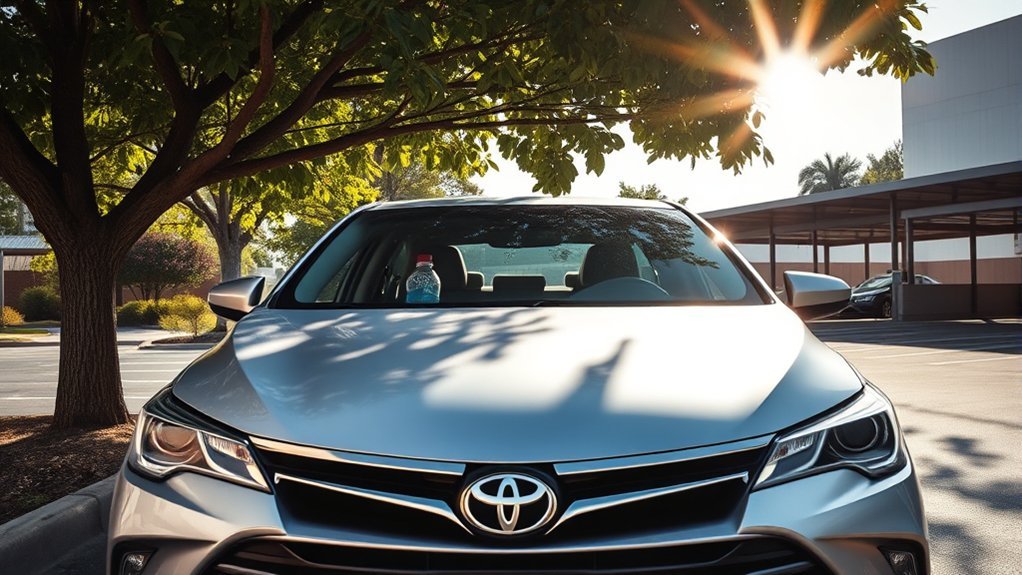
Parking in the shade and using a windshield sunshade can reduce cabin and dashboard temperatures. These steps improve comfort and reduce sun exposure inside the car, but they do not prevent a mechanical engine-overheating problem.
After a normal drive, park on a level surface and allow the vehicle to cool naturally. Do not spray water over the engine, radiator, exhaust parts, wiring, or other hot components. If the Camry has already overheated, shut it off in a safe location and wait until it is completely cool before inspecting the reservoir.
Avoid parking over dry grass, leaves, or other combustible material because hot exhaust-system components may create a fire risk. Never leave a child, pet, or vulnerable person inside a parked vehicle, even with the windows partly open.
Signs of Overheating That Require Professional Cooling System Service
Schedule professional diagnosis when overheating repeats, the coolant level continues falling, or the cause is not obvious. Repeatedly topping off the reservoir may hide a leak without correcting it.
- Temperature warning or hot gauge: A warning that returns or a gauge that repeatedly rises above its normal position needs investigation.
- Steam from under the hood: Steam suggests boiling coolant or coolant contacting a hot component.
- Recurring coolant loss: A reservoir that keeps dropping may indicate an external or internal leak.
- Overheating mainly at idle: This pattern can point toward fan operation, fan controls, or restricted low-speed airflow.
- Overheating at highway speed: This can indicate low coolant, poor circulation, a thermostat problem, radiator restriction, or an internal leak.
- Cold cabin air with a hot engine: A sudden loss of heater output can accompany low coolant or interrupted flow.
- Sweet smell or dried residue: Pink, white, or crusty deposits can identify a slow coolant leak.
- Persistent white exhaust or rough running: These symptoms may indicate an internal engine problem.
- Milky oil residue: Possible coolant contamination requires immediate diagnosis.
- Warning returns after repair: Trapped air, an unresolved leak, an incorrect fill procedure, or another failed component may remain.
[Amazon Products Picked for You]
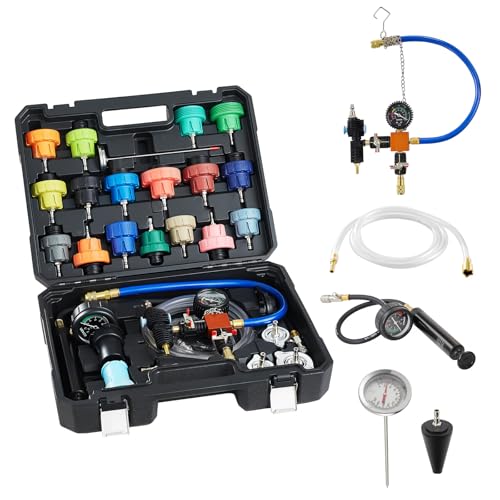
Radiator Pressure Tester Refill Kit: 31pcs radiator pressure tester kit includes a pressure pump, vacuum & coolant fill tool, metal adapters, color-coded test caps, and universal tapered adapter. A complete solution for leak detection, temperature checks, and fluid filling

【TROUBLESHOOTING & SAVING MONEY】28pcs universal radiator pressure tester and vacuum refill kit with functions of leak detection, temperature measurement, liquid filling, etc. If you use the coolant pressure tester, the tester can quickly and easily solve any problems related to radiator pressure, making your job easier and faster.Note: Please select the corresponding adapter according to the user manual; otherwise, leakage may occur. If a suitable adapter is not available, please use a universal adapter, which is suitable for all vehicle models.

Comprehensive Tool Set: Orion Motor Tech's 19 pcs coolant pressure tester kit makes detecting internal & external pressure leaks in your vehicle's cooling system easy, including 15 adapters, a manual vacuum pump, a probe thermometer, a wrench, and O-rings
What a Technician May Check
A complete diagnosis may include:
- A cooling-system pressure test for external leaks.
- A pressure-cap inspection or test.
- A scan for temperature-sensor, fan-control, and engine-management faults.
- A commanded cooling-fan test performed with diagnostic equipment.
- Thermostat operation and coolant-circulation checks.
- Coolant-pump operation and leak inspection.
- Radiator airflow and internal-flow testing.
- Verification that the system was filled and bled correctly after service.
- A combustion-gas or related test when an internal engine leak is suspected.
- Inspection of every applicable cooling circuit on hybrid models.
Stop driving immediately when the gauge reaches the hot zone, steam appears, or the warning returns after a restart. Engine damage can occur before the vehicle feels noticeably different from the driver’s seat.
Related Guides
Frequently Asked Questions
How do you stop a car from overheating in hot weather?
Turn off the air conditioner, pull over safely, switch off the engine, and stay clear of steam. Let the engine cool completely before inspecting the reservoir. Do not open a hot pressurized cap. If coolant is leaking, the reservoir is empty, or the temperature rises again, arrange a tow.
What are 10 common causes of overheating on a Toyota?
Ten common causes are low coolant, an external leak, failed cooling fans, a stuck thermostat, a weak coolant pump, a restricted radiator, a faulty pressure cap, trapped air, a damaged belt or tensioner on applicable engines, and an internal engine leak such as a failed head gasket.
Does pouring water on an engine help cool it down?
No. Do not pour or spray water over a hot engine. Sudden cooling can damage hot components, and water around wiring or hybrid components creates additional risks. Shut the engine off and let it cool naturally.
Why does a Toyota Camry overheat?
A Camry may overheat because coolant is low, coolant is leaking, the electric fans or controls are not operating, the thermostat is stuck, the coolant pump is weak, the radiator is restricted, air is trapped, or combustion gases are entering the cooling system. The driving conditions under which it overheats provide clues but do not replace testing.
Why does my Camry overheat in traffic but cool down while moving?
That pattern often suggests inadequate airflow at low speed, such as a failed electric fan, fan-control fault, or blocked radiator or condenser area. It is a clue rather than proof, so stop driving if the temperature continues rising and have the fan system tested safely.
Can you drive a Camry after it cools down?
Only consider a cautious restart if the engine is completely cool, no major leak is visible, the reservoir has the correct approved coolant level, no hose is damaged, and the engine runs normally. Watch the temperature continuously. If the warning returns or the gauge rises, shut the engine off and tow the car.
How long should you wait for an overheated Camry to cool?
There is no universal safe number of minutes. Cooling time depends on the severity of overheating, coolant loss, outdoor temperature, and engine conditions. Wait until steam has stopped and the engine and coolant container are completely cool. When uncertain, do not open the system or restart the car.
Can you add plain water when the coolant is low?
Use the premixed coolant specified by Toyota whenever possible. Plain water does not provide the same freeze, boil, corrosion, or coolant-pump protection. In a true roadside emergency, follow the instructions in your exact owner’s manual and have the mixture corrected as soon as possible.
Conclusion
Preventing Toyota Camry overheating starts with a cold-engine coolant check, timely leak repairs, healthy hoses, clear radiator airflow, correct coolant, and properly operating cooling fans and controls. Smooth driving and avoiding unnecessary parked idling can reduce load and fuel use, but those habits cannot repair a weak cooling system.
If the gauge enters the hot range, a temperature warning appears, or steam rises from under the hood, pull over, shut the engine off, and let it cool completely. Never open a hot pressurized cap or reach near an electric fan. When coolant is leaking, the warning returns, or the cause is uncertain, protect the engine by arranging professional service or towing.
Sources
- Toyota Manuals and Warranties — model-year-specific owner’s manuals, maintenance guides, coolant specifications, and emergency procedures.
- Toyota Genuine Super Long Life Coolant — Toyota guidance to use the coolant recommended in the vehicle owner’s manual.
- NHTSA Summer Driving Tips — cooling-system, coolant, hose, belt, leak, and hot-weather vehicle checks.
- NHTSA Recall Lookup — VIN-based safety-recall searches and repair information.
- FuelEconomy.gov Driving More Efficiently — acceleration, speed, cruise-control, and parked-idling guidance.
- U.S. Department of Energy Idle Reduction — fuel, pollution, noise, and engine-wear effects of unnecessary idling.
