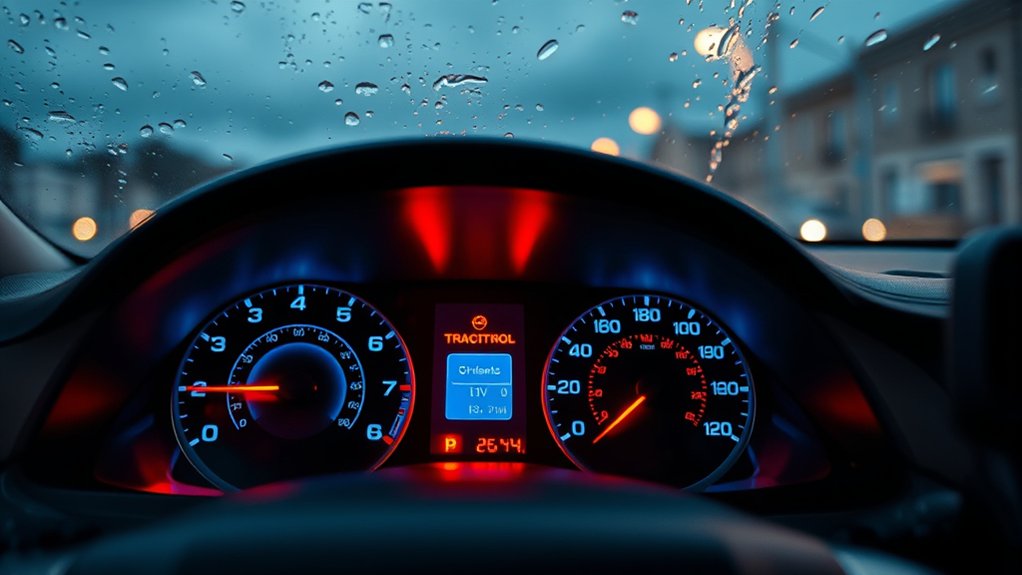
When the traction-control, slip, or stability indicator stays on in your Toyota Camry, first identify exactly which symbol is illuminated and whether it flashes or remains steady. Brief flashing while the tires lose grip can be normal. A steady slip, TRAC OFF, VSC OFF, ABS, or brake warning can require a different response, so check the owner’s manual for your Camry’s exact model year.
Quick Answer
A flashing Toyota Camry slip indicator usually means the system is controlling wheel spin or vehicle stability. A steady light can mean TRAC or VSC was switched off or that a fault was detected. Check the other warnings, inspect the tires, restart once, and retrieve ABS/VSC codes if the light remains on.
Key Takeaways
- Brief flashing during rain, snow, gravel, or hard acceleration can be normal system operation.
- A steady slip, TRAC OFF, or VSC OFF indicator can mean the system was disabled or a fault was stored.
- An ABS warning requires prompt diagnosis; a red brake warning or abnormal braking requires an immediate safe stop.
- Tire pressure, mismatched tire size, wheel-speed sensors, wiring, hubs, voltage, and control-system faults are possible areas to inspect.
- A generic engine-code reader may not communicate with the ABS/VSC module.
- Do not disconnect the battery or use a universal pedal sequence as a substitute for code-based diagnosis.
At a Glance
| Time Required | About 10–20 minutes for basic checks |
| Difficulty | Easy for tire and visual checks; advanced for electrical or hydraulic diagnosis |
| Tools Needed | Flashlight, tire-pressure gauge, owner’s manual, and an ABS/VSC-capable scan tool if available |
| Cost | Basic inspection may cost nothing; diagnosis and repair depend on the stored code and failed component |
Understanding the Traction Control Light in Your Toyota Camry

Toyota Camry models may use a slip indicator, TRAC OFF indicator, VSC OFF indicator, ABS warning, brake-system warning, or a message in the instrument display. The symbols and wording vary by model year, trim, drivetrain, and market.
The Toyota warning-light resource advises owners to select their exact vehicle and consult its manual. You can locate the correct publication through Toyota’s manual and warranty portal.
| What You See | Likely Meaning | What to Do |
|---|---|---|
| Slip indicator flashes briefly while driving | TRAC, VSC, or ABS may be operating because a wheel is slipping or the vehicle is approaching a stability limit. | Ease off the accelerator, steer smoothly, increase following distance, and slow for the surface. |
| Slip or stability indicator remains on steadily | A related system may have detected a malfunction or may not be available. | Check for other warnings, inspect the tires, restart once, and arrange an ABS/VSC scan if it stays on. |
| TRAC OFF or VSC OFF indicator appears | The driver may have switched off part or all of the traction and stability assistance. | Use the model-specific control or restart procedure in the owner’s manual to restore normal operation. |
| ABS warning appears | Anti-lock or related brake-control assistance may be unavailable. | Avoid hard or slippery-road driving and obtain prompt diagnosis. Follow any instrument message. |
| Red brake warning appears or braking changes | Brake fluid may be low or a serious brake-system malfunction may be present. | Stop in a safe place and arrange professional assistance or towing. |
| Check-engine and traction-related lights appear together | A powertrain fault may be present, and a stability function may also be limited or reporting a related condition. | Scan both the engine and ABS/VSC modules. Do not assume the wheel-speed sensor is the cause. |
Federal electronic-stability-control requirements permit an ESC telltale to flash while the system is operating and require steady illumination for certain malfunctions. They also permit a separate or combined indicator when the system has been switched off.
Flashing usually describes system intervention. Steady illumination usually means the system is switched off, unavailable, or reporting a fault.
Warning: Stop driving as soon as you can do so safely if the red brake-system warning appears, the brake pedal feels soft or unusually hard, braking distance increases, the car pulls sharply while braking, fluid is leaking, or severe grinding occurs. Arrange towing rather than testing the vehicle on the road.
What to Do When the Traction Control Light Comes On
- Reduce speed smoothly. Avoid abrupt acceleration, hard cornering, and sudden braking, especially on wet, icy, snowy, or loose surfaces.
- Identify the exact indicator. Determine whether you see the slip symbol, TRAC OFF, VSC OFF, ABS, a red or yellow brake warning, or a written instrument-panel message.
- Notice how the light behaves. Record whether it flashes, stays on, appears at startup, or comes on during acceleration, turning, or braking.
- Check for other warnings. Look for the ABS light, red brake warning, check-engine light, tire-pressure warning, charging warning, or master warning.
- Assess braking before continuing. If the brake pedal or stopping behavior feels abnormal, stop and arrange assistance.
- Park and restart once. A restart can restore a driver-selected default mode or clear a temporary initialization event, but it does not repair a recurring fault.
- Inspect the tires. Check cold pressure, visible damage, tread condition, and whether the installed tires appear to be the correct and matching size.
- Retrieve codes from every relevant module. If the warning remains, scan the ABS/VSC system and the engine module when the check-engine light is also present.
Write down every diagnostic trouble code before clearing anything. Save freeze-frame information and useful live data when the scan tool supports them. Those records may be the best evidence of an intermittent problem.
Note: A restart is a check, not a repair. If the light returns, continue with code-based diagnosis rather than repeatedly cycling the ignition.
Top Causes for Traction Control Light Activation
Normal System Operation or a Disabled System
A flashing slip indicator can be normal when the tires lose grip or the vehicle begins to deviate from the intended path. Snow, rain, ice, loose gravel, painted road markings, potholes, or aggressive acceleration can cause a brief intervention.
A steady TRAC OFF or VSC OFF indicator may mean someone pressed the system-control button. On a 2025 Camry, pressing the VSC OFF switch while stopped disables TRAC, while holding it for more than three seconds disables both TRAC and VSC. Older Camrys may use different controls or behavior, so follow the manual for the exact year.
Restarting the vehicle often restores its default stability-control mode. If an OFF or slip indicator remains illuminated after the correct control is used and the vehicle is restarted, treat it as a possible malfunction.
Uneven Tires or Wheel-Speed Differences
The ABS and stability-control module compares wheel-speed information. A substantially different rolling circumference can make one wheel appear to be rotating faster or slower than expected.
Possible contributors include severe pressure differences, an incorrect tire size, extreme tread-depth variation, a temporary spare, or mismatched tires. These conditions are preliminary checks, not proof that the tires caused the warning.
Inflate the tires when cold to the pressure shown on the driver-door Tire and Loading Information label. The NHTSA TireWise guidance confirms that the vehicle placard—not the maximum pressure molded into the tire sidewall—is the correct source for normal inflation.
Wheel-Speed Sensor, Tone Ring, or Hub Problems
Each wheel-speed sensor provides information used by the ABS and stability systems. Contamination, corrosion, impact damage, an incorrect sensor gap, or an internal sensor fault can disturb the signal.
Depending on the Camry’s design, the tone ring or magnetic encoder may be part of a bearing, hub, axle, seal, or separate component. A damaged encoder may not be visible without disassembly and the correct service procedure.
A worn wheel bearing can also change the sensor gap or damage an integrated encoder. Humming, growling, looseness, or a warning that changes during turns can justify a hub and bearing inspection, but the code and live wheel-speed data should guide the diagnosis.
Wiring Problems and Damage
Wheel-speed-sensor wiring moves with the steering and suspension. A harness can become stretched, pinched, rubbed through, twisted, or left unsecured during brake, bearing, axle, alignment, or suspension work.
Corroded terminals, loose connectors, moisture, broken locks, poor grounds, or damaged shielding can create intermittent warnings. A light that appears after a bump or steering movement can justify a careful harness inspection, but that pattern alone does not identify the failed part.
ABS or Stability-Control System Faults
The Camry’s traction-control, stability-control, and anti-lock braking functions share sensor information and may share hydraulic or electronic components. A fault involving the ABS actuator, skid-control module, steering-angle input, yaw or acceleration input, brake switch, power supply, or communication network may disable more than one function.
Several warning lights do not automatically mean the actuator or control module has failed. Power, ground, communication, sensor, wiring, connector, and calibration conditions should be tested before an expensive module is replaced.
Check-Engine and Traction-Control Lights Together
When the check-engine light appears with a traction, slip, or VSC warning, do not diagnose only the brake-control system. A powertrain fault may have triggered a separate fail-safe response, reduced available engine or hybrid-system torque control, or appeared at the same time as an unrelated chassis fault.
Use a scan tool that can read both the engine or hybrid-control module and the ABS/VSC module. Record every code and its status—current, pending, history, or permanent where applicable—before clearing anything.
A flashing check-engine light can indicate an active misfire that may damage the catalytic converter. Reduce load, avoid continued driving, and follow the Camry manual’s warning instructions.
Low Voltage, Power Interruption, or Recent Service
A weak 12-volt battery, poor battery connection, charging-system fault, or interrupted power can set low-voltage or communication codes. Some Toyota systems and model years may also require initialization or calibration after battery discharge, battery replacement, steering work, or module replacement.
Do not assume that every Camry loses the same calibration after a dead battery. Test the battery and charging system, retrieve the stored codes, and follow the exact repair manual procedure for the model year and code.
Recent wheel alignment, steering, suspension, brake, hub, bearing, tire, axle, or battery work is important diagnostic history. Tell the technician what was repaired and whether the warning appeared immediately or after several trips.
Model-Specific Service Information
Toyota has issued service information for particular Camry years and conditions. For example, Toyota Technical Service Bulletin T-SB-0086-13 addresses repeated ABS and TRAC warning lights with DTC C1231 on certain 2009–2011 North American-production Camrys equipped with a specified ABS/VSC system.
That bulletin is not a universal diagnosis and is not a safety recall. It applies only when the vehicle and stored code meet the bulletin’s conditions. A technician should confirm the VIN, production information, code, freeze-frame data, and current service instructions before using any bulletin.
How the Traction Control System Works With ABS
Traction control primarily helps limit excessive drive-wheel spin during acceleration. Vehicle Stability Control has a broader role: it compares the driver’s steering input with the vehicle’s actual movement and can intervene when it detects excessive understeer, oversteer, or loss of directional stability.
Depending on the situation and model, the system may reduce engine or electric-motor output, apply brake pressure to one or more individual wheels, or combine both responses. ABS helps prevent wheel lock during braking, while traction control manages excessive wheel spin during acceleration.
Because the systems share wheel-speed and other information, one sensor, wiring, communication, or power fault can illuminate both an ABS warning and a traction or stability warning.
The federal Electronic Stability Control standard in 49 CFR 571.126 describes ESC as a computer-controlled system that can apply individual wheel-brake torque and modify engine torque to help maintain directional stability.
Key Visual Checks for Traction Control Sensors and Wiring

You can perform a limited visual inspection without opening the brake hydraulic system or removing safety-critical components.
- Look behind each wheel: Check for a hanging, stretched, twisted, unsecured, or visibly cut sensor harness.
- Inspect accessible connectors: Look for broken locks, missing clips, moisture, dirt, bent terminals, or green corrosion.
- Check all tires: Confirm that the tire sizes match the vehicle specification and that no tire is severely underinflated, damaged, or unusually worn.
- Look for recent-work clues: A twisted harness, missing routing clip, disturbed connector, damaged dust shield, or fresh tool marks may point toward the affected area.
- Listen for bearing noise: Humming or growling that rises with road speed may justify a hub and bearing inspection.
- Check the battery connections: Make sure accessible terminals are secure and free of obvious heavy corrosion. Do not work near hybrid high-voltage components.
Do not assume the sensor is bad because a code names one wheel. The fault can involve the sensor, encoder or tone ring, bearing, wiring, connector, supply voltage, ground, or control module.
Pro Tip: Photograph each connector and harness route before moving anything. Evidence of rubbing, stretching, twisting, or a missing clip can disappear after the wiring is repositioned.
Practical Tools and Techniques for Diagnosing Traction Control Issues
Use an ABS/VSC-Capable Scan Tool
A basic generic reader may retrieve engine and emissions codes but fail to communicate with the anti-lock braking or stability-control module. Confirm that the tool specifically supports Toyota ABS, TRAC, VSC, chassis codes, and live data for the Camry’s model year.
Useful information can include:
- Current, pending, history, and manufacturer-specific chassis codes
- Freeze-frame or snapshot data associated with the fault
- Individual wheel-speed readings
- Battery and module voltage
- Brake-switch status
- Steering-angle information
- Yaw or acceleration data, where supported
- Communication faults between modules
- Engine or hybrid-control codes when the check-engine light is also on
Compare Live Wheel-Speed Data
During professional diagnosis, compare all four wheel-speed readings under controlled conditions. A signal that drops to zero, spikes, becomes noisy, or differs from the other wheels can identify the affected corner or circuit.
A different reading does not automatically condemn the sensor. The technician may still need to inspect the tire size, sensor mounting, encoder, bearing, connector, wiring, and waveform.
Road testing while watching live data requires a second person or a properly secured recording system. The driver should never hold or operate a scanner while the vehicle is moving.
Follow the Code-Specific Test
After retrieving the code, follow the Toyota diagnostic procedure for that exact model year, powertrain, drivetrain, and code. The process may involve connector checks, voltage testing, waveform analysis, continuity testing, encoder inspection, calibration verification, or communication-network diagnosis.
Do not apply one universal resistance specification to every Camry wheel-speed sensor. Passive and active sensor designs use different circuits and test methods, and an inappropriate resistance test can produce a misleading result.
What Not to Do
- Do not disconnect the battery as a reset trick. It can erase useful evidence and create additional initialization needs.
- Do not clear codes before recording them. Save the code, status, freeze-frame data, and relevant live readings first.
- Do not use a universal accelerator-pedal sequence. Toyota does not publish one procedure that repairs every Camry traction or VSC fault.
- Do not replace a wheel-speed sensor solely because its wheel is named in a code. Test the entire circuit and mechanical encoder area.
- Do not probe connectors or brake-control circuits without the correct wiring diagram and test method. An incorrect probe can spread terminals or damage a circuit.
How to Reset the Toyota Camry Traction Control Light
A warning should be cleared only after you identify and correct its cause. There is no universal accelerator-pedal, button, or battery-disconnection procedure that reliably repairs every Toyota Camry traction-control or stability-control fault.
- Confirm that TRAC or VSC was not intentionally switched off.
- Use the model-specific control to return the system to normal mode.
- Correct any obvious tire-pressure, tire-size, or temporary-spare issue.
- Turn the vehicle off and restart it once.
- If the light remains on, read and record ABS/VSC codes and any engine or hybrid-control codes.
- Follow the model-year-specific diagnostic procedure and repair the confirmed cause.
- Perform any required calibration or initialization stated in the repair procedure.
- Clear the code with a compatible scan tool only when the procedure calls for it.
- Rescan the modules and complete the specified verification drive.
- Confirm that the warning remains off and that no current or pending code returns.
Note: Disconnecting the battery may erase freeze-frame data, reset unrelated vehicle settings, or create new initialization requirements. It is not a substitute for repairing the stored fault.
When Should You Call a Mechanic About Traction Control Problems?
Arrange professional diagnosis when:
- The light remains on after the correct switch setting and one restart.
- The warning returns repeatedly or appears during ordinary dry-road driving.
- The ABS light or a brake-system message appears.
- The check-engine light appears at the same time.
- The warning began after brake, bearing, axle, steering, suspension, tire, alignment, or battery work.
- The speedometer or other vehicle-speed information behaves incorrectly.
- You hear wheel-bearing noise or detect looseness at a wheel.
- The vehicle unexpectedly reduces power or applies repeated intervention.
- Your scan tool cannot access the ABS/VSC module.
- You have a code but lack the correct wiring diagram, service procedure, or test equipment.
If only a yellow slip, TRAC, or VSC warning is steady, the service brakes feel completely normal, no red brake warning or urgent instrument message is present, and road conditions are dry, a direct low-speed trip to a nearby repair facility may be reasonable. Follow the owner’s manual, avoid unnecessary driving, and assume that traction or stability assistance may be unavailable.
If the ABS warning is on, obtain prompt inspection and avoid rain, snow, ice, emergency-style braking, and high-speed driving because anti-lock or related assistance may not operate as intended.
Stop and arrange towing if the red brake-system warning appears, braking behavior changes, fluid is leaking, severe grinding occurs, the vehicle is difficult to control, or the instrument display instructs you to stop.
Warning: Do not use an empty road as a test area for a suspected ABS, brake, or stability-system fault. Controlled brake and stability testing requires a safe facility, proper equipment, and a qualified technician.
Preventing Future Traction Control Problems

- Maintain correct tire pressure. Use the pressure listed on the vehicle placard and check it when the tires are cold.
- Use the specified tire size. Avoid mixing tires with substantially different rolling circumferences or extreme tread-depth differences.
- Address bearing noise promptly. A damaged hub or bearing can affect a nearby or integrated wheel-speed encoder.
- Protect sensor wiring during repairs. Restore every harness clip, grommet, bracket, and factory routing point after brake or suspension work.
- Maintain the 12-volt electrical system. Secure, clean connections and proper charging voltage help electronic modules operate reliably.
- Use appropriate lifting and service procedures. Incorrect jack placement or careless wheel-area work can damage harnesses and connectors.
- Investigate warnings early. Intermittent wiring, encoder, or bearing problems may become harder to diagnose after additional damage occurs.
- Retain repair records. Dates, mileage, codes, and previous wheel or battery work can reveal a repeating pattern.
- Check for recalls by VIN. Search the Toyota recall portal and the NHTSA recall lookup. A service bulletin and a safety recall are not the same.
Frequently Asked Questions
Why is my traction control light on in my Toyota Camry?
A steady light can mean TRAC or VSC was switched off or that the ABS, traction-control, or stability-control module detected a fault. Possible areas include tires, wheel-speed sensors, encoders, hubs, wiring, electrical voltage, brake switches, steering-angle input, and related control components.
What would cause my traction control light to come on?
The light may flash during normal intervention on a slippery surface. A steady warning can result from a disabled system, mismatched tire conditions, sensor or wiring damage, an encoder or hub problem, an ABS-related fault, low system voltage, a communication fault, or another code stored in a related module.
How do I reset the traction control light on a Toyota Camry?
Confirm that the system was not switched off, return it to normal mode, and restart the car once. If the light remains on, retrieve ABS/VSC codes, repair the confirmed cause, perform any required calibration, and clear the code only when the model-specific procedure calls for it.
Is it safe to drive with the traction control light on?
Brief flashing during wheel slip can be normal. If only a yellow traction or stability light is steady and braking is completely normal, drive only as needed for diagnosis and avoid slippery conditions. Stop and arrange towing for a red brake warning, abnormal pedal feel, fluid leak, severe noise, urgent stop message, or loss of control.
Why are the ABS and traction control lights on together?
The systems share wheel-speed information and may share control hardware, power, grounds, and communication circuits. A sensor, encoder, hub, wiring, voltage, communication, or ABS actuator fault can therefore illuminate both warnings.
Can low tire pressure turn on the traction control light?
A large pressure difference can change a tire’s rolling behavior and is worth correcting, but it does not prove that low pressure caused the traction warning. Inflate all tires to the driver-door placard specification and diagnose any warning that remains.
What does TRAC OFF mean on a Toyota Camry?
TRAC OFF usually means the traction-control function has been disabled through the vehicle’s control. The exact button action and automatic reactivation behavior vary by model year. Restore normal mode using the owner’s manual instructions; if the indicator will not turn off, scan the ABS/VSC system.
Why are the check-engine and traction control lights on together?
A powertrain fault and a traction-related warning can appear together because the systems exchange information or because more than one fault is present. Read codes from both the engine or hybrid-control module and the ABS/VSC module before replacing parts.
Why did the traction light come on after an alignment, brake job, hub repair, or battery replacement?
Recent work can disturb sensor wiring, connectors, wheel-speed encoders, steering position, battery voltage, or required initialization. Tell the technician exactly what was repaired, retrieve the stored codes, and follow the model-year-specific inspection or calibration procedure.
Conclusion
A flashing Toyota Camry traction-control or slip indicator can be normal when the system is correcting wheel slip. A steady slip, TRAC OFF, VSC OFF, or ABS warning needs a more careful response because traction, stability, or anti-lock assistance may be disabled or unavailable.
Begin by identifying the exact indicator, checking for a red brake warning or abnormal braking, inspecting the tires and recent repair areas, and scanning every relevant module. Avoid universal reset tricks and blind parts replacement. Correcting the verified fault, completing any required initialization, and confirming the repair with a rescan and verification drive are the reliable ways to restore normal operation.
Sources
- Toyota 2025 Camry Quick Reference Guide — current Camry indicator meanings and VSC/TRAC OFF switch operation
- Toyota Dashboard Warning Lights — Toyota warning-light guidance and owner-manual direction
- Toyota 2025 Camry Warning-Light Instructions — brake and safety-system warning responses
- 49 CFR 571.126, Electronic Stability Control Systems — ESC operation, malfunction telltales, OFF indicators, and system requirements
- NHTSA TireWise — tire size, cold inflation pressure, and driver-door placard guidance
- Toyota T-SB-0086-13 — model-specific 2009–2011 Camry ABS/TRAC warning information for DTC C1231
