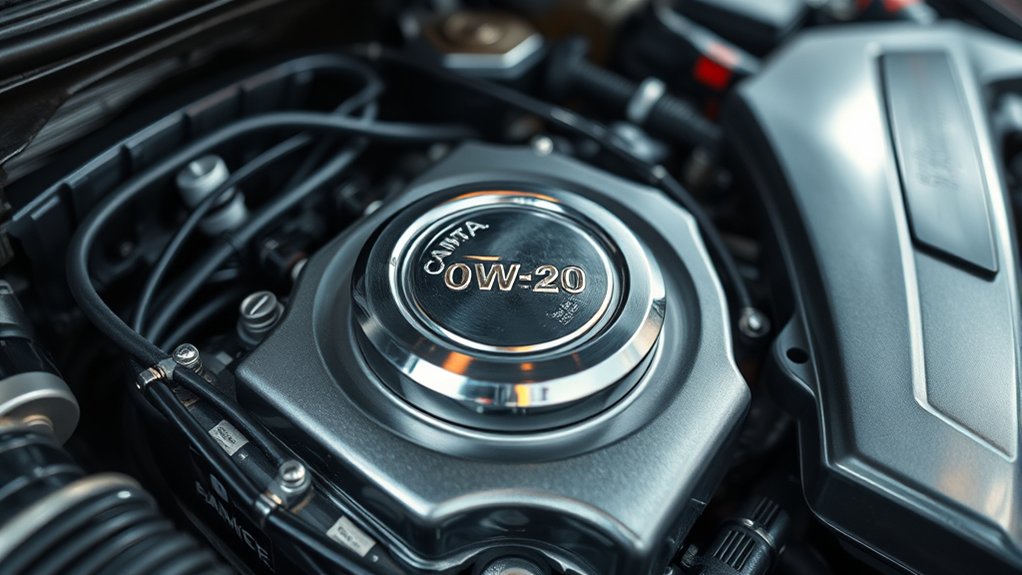
0W-20 is the correct engine oil for many Toyota Camry engines, but it is not a universal Camry specification. The required oil depends on the model year, engine, powertrain, market, and applicable owner’s manual. The 0W-20 label describes viscosity performance at low and operating temperatures; it does not, by itself, identify the oil as full synthetic.
Quick Answer
0W-20 is a multigrade engine-oil viscosity, not a universal Toyota Camry oil or a guarantee of full-synthetic formulation. “0W” covers low-temperature cranking and pumping, while “20” is the high-temperature viscosity grade. Use it only when the owner’s manual for your exact Camry engine specifies it.
Key Takeaways
- 0W-20 is an SAE viscosity grade, not a guarantee that the oil is full synthetic.
- Toyota Camry oil requirements vary by model year, engine, powertrain, production configuration, and market.
- Match the viscosity and the API or ILSAC performance level required by the vehicle.
- For a licensed 0W-20 oil in 2026, API SQ, ILSAC GF-7A, and the API Starburst may appear on the label.
- Oil-change intervals depend on the model-specific maintenance guide and operating conditions.
- Another oil brand or service provider does not automatically cancel a U.S. warranty, but damage caused by unsuitable oil or improper maintenance may not be covered.
Reviewed for accuracy: July 13, 2026. This guide focuses on U.S.-market Toyota Camry models; specifications and consumer laws can differ in other markets.
Why Choose 0W-20 Oil for Your Toyota Camry?
You should choose 0W-20 when Toyota specifies it for your Camry’s engine. In that application, the oil is formulated to meet the 0W winter-grade limits for cold cranking and pumping while remaining within the SAE 20 viscosity range at high test temperatures.
Engine bearings, oil passages, oil pumps, variable valve-timing components, piston cooling systems, and other lubricated parts are designed and validated around specified oil properties. Following the specification helps the engine operate as intended, but it does not support universal promises about a fixed fuel-economy gain or a guaranteed percentage increase in engine life.
Toyota has used different oil grades across Camry generations and engines. Check the engine-oil section of your printed manual or Toyota’s official manuals and warranties portal before buying oil. The oil-filler cap may also show a viscosity, but the manual provides the complete grade, performance, substitute, capacity, and interval instructions.
Which Toyota Camry Models Use 0W-20?
There is no safe model-name-only answer. Oil requirements can even differ between engines offered in the same model year. The following U.S. example from Toyota’s 2010 Camry manual demonstrates why the engine matters.
| Verified Example | Preferred Oil | Temporary Alternative Listed by Toyota |
|---|---|---|
| 2010 U.S. Camry, 2.5L four-cylinder 2AR-FE | SAE 0W-20 | SAE 5W-20, followed by a return to 0W-20 at the next change |
| 2010 U.S. Camry, 3.5L V6 2GR-FE | SAE 5W-30 | SAE 10W-30, followed by a return to 5W-30 at the next change |
You can verify these examples in Toyota’s 2010 Camry Owner’s Manual. They are examples, not a substitute for checking the manual for another Camry.
Note: A trim badge alone may not identify the engine, production specification, or market. Use the VIN, model year, engine information, and owner’s manual when there is any doubt.
Benefits of Using the Correct 0W-20 Oil in Your Camry
When your Camry specifically calls for 0W-20, using a properly licensed product provides practical benefits without relying on exaggerated percentages.
- Cold-start flow: The 0W winter grade meets defined cranking and pumping limits at low temperatures.
- Designed operating viscosity: The SAE 20 grade matches the engine’s intended hot-viscosity range.
- Modern performance protection: Oil carrying the required API or ILSAC category has passed tests involving deposits, wear, oxidation, sludge, timing-chain protection, low-speed pre-ignition, and emissions-system compatibility, as applicable to that category.
- Maintenance consistency: Using the specified product and retaining records makes it easier to follow Toyota’s maintenance requirements and document the service.
- Reliable oil-system operation: The correct viscosity supports the oil pump, passages, valve-timing hardware, bearings, and other parts designed around that grade.
The correct engine oil is a combination of viscosity grade, performance standard, approved service interval, and proper oil level—not simply a brand name or the word “synthetic.”
What Do the Numbers on 0W-20 Oil Mean?
SAE J300 classifies engine oils by measured viscosity performance. A multigrade oil such as 0W-20 must satisfy both a winter-grade requirement and a high-temperature viscosity-grade requirement. SAE J300 does not classify the oil’s base-stock formulation, additive quality, brand, or service interval.
Viscosity Ratings Explained
Viscosity describes a fluid’s resistance to flow. Engine oil generally becomes thicker as temperatures fall and thinner as temperatures rise. A multigrade oil is formulated to remain within defined limits over a broad range of test conditions.
The complete 0W-20 designation matters. Neither number is an outdoor temperature, percentage, oil-life measurement, or simple statement of thickness at every operating condition.
Cold-Weather and Operating-Temperature Performance
The “W” stands for winter. The 0W rating means the oil meets defined low-temperature cranking and pumping limits. It does not mean that the oil has zero viscosity, and it does not make the oil suitable for every engine merely because the climate is cold.
The “20” identifies the oil’s high-temperature SAE viscosity grade. It represents tested viscosity limits, not a maximum outdoor temperature or a promise that the oil remains equally thick as conditions change.
| Label Item | What It Tells You | What It Does Not Tell You |
|---|---|---|
| 0W | Low-temperature cranking and pumping performance | That the oil has zero viscosity or fits every cold-climate engine |
| 20 | The SAE viscosity range at specified high test temperatures | A maximum outdoor temperature or oil-change interval |
| Full synthetic | A separate formulation or marketing description on the product label | The product’s SAE viscosity or proof that it meets Toyota’s required performance level |
| API or ILSAC mark | A licensed performance category the oil meets | Permission to ignore Toyota’s required viscosity |
How to Read a 0W-20 Oil Bottle in 2026
Do not rely only on the large “0W-20” text on the front. Read the front and back labels and compare every relevant item with the vehicle manual.
| Label Detail | What to Check | Why It Matters |
|---|---|---|
| SAE viscosity | SAE 0W-20, when that is the grade specified for the engine | Confirms the required winter and operating-temperature viscosity grade |
| API Service Symbol | The API Donut showing the service category, viscosity, and Resource Conserving wording where applicable | Confirms that the product is licensed for the displayed performance level |
| API certification mark | The API Starburst on a qualifying 0W-20 passenger-car oil | The current Starburst represents ILSAC GF-7A; the Shield is reserved for qualifying 0W-16 GF-7B oils |
| Performance category | API SQ or another category permitted by the owner’s manual and current API guidance | API SQ with Resource Conserving corresponds to ILSAC GF-7A performance |
| Formulation wording | Full synthetic, synthetic blend, or another formulation description | Formulation wording is separate from SAE viscosity and API/ILSAC licensing |
The API Motor Oil Guide identifies API SQ and ILSAC GF-7A as the newest gasoline-engine standards. It also directs users to GF-7A where GF-6A or GF-5 oil was recommended. The vehicle manufacturer’s viscosity requirement still controls: a newer performance category does not turn an unapproved viscosity into an approved one.
Pro Tip: Read the back label before buying. The front may emphasize “full synthetic” or “high mileage,” while the back shows the SAE grade, API category, Resource Conserving status, and licensing marks needed for comparison with the manual.
Recommended Oil-Change Intervals for 0W-20
0W-20 does not have one universal change interval. The correct schedule comes from the Warranty and Maintenance Guide for the exact Camry and may include both mileage and time limits. Conditions classified by Toyota as special operating conditions can require a shorter interval regardless of the oil brand.
| Situation | What to Follow |
|---|---|
| Your exact Camry | The oil-and-filter schedule in its model-specific maintenance guide |
| 2025 U.S. Camry under the guide’s normal schedule | No more than 10,000 miles or 12 months between oil-and-filter changes |
| 2025 U.S. Camry primarily driven under listed special operating conditions | 5,000 miles or six months, regardless of the oil used |
| Low annual mileage | The guide’s time limit, even when the mileage limit has not been reached |
| Oil level falls between services | Top up promptly with the specified oil and investigate unusual consumption or leakage |
The 2025 figures above come from Toyota’s 2025 Camry Warranty and Maintenance Guide. They are a current example, not a universal schedule for every Camry year.
Note: A maintenance reminder tracks scheduled service; it does not measure the engine-oil level or prove that the oil pressure is safe. Check the dipstick at the frequency stated in the manual and before long trips.
How to Check the Engine-Oil Level Between Changes
- Park on level ground. Follow the manual’s instructions about warming the engine and waiting after shutdown.
- Remove and wipe the dipstick. Reinsert it fully so the first oil smear does not create a false reading.
- Remove it again and read the level. The oil should be within the marked range.
- Add oil slowly when needed. Use the specified product, recheck the dipstick, and avoid overfilling.
If the level repeatedly falls, visible leaks appear, blue exhaust smoke develops, or the engine consumes substantially more oil than usual, arrange an inspection rather than relying on repeated top-ups.
Does Every Toyota Camry Use 0W-20?
No. Toyota Camry oil specifications vary by model year, engine, hybrid or non-hybrid powertrain, market, and production configuration. Advice for one Camry should not be applied automatically to another, even when both vehicles have the same model name.
Confirm the exact vehicle before purchasing oil. Useful identifiers include the VIN, model year, engine code or displacement, powertrain, owner’s manual, maintenance guide, and any viscosity information printed on the oil-filler cap.
Warning: Never choose engine oil only from a general article, another owner’s Camry, an oil-store application with incomplete vehicle data, or the belief that thicker oil always provides better protection. Use the specification for your exact engine.
Importance of Following Toyota’s Oil Specifications
Oil selection involves more than matching the large viscosity numbers on the front of a bottle. You must also confirm the performance category, oil capacity, filter requirement, service interval, and any instructions for temporary alternative grades.
Engine Longevity and High-Mileage Camrys
No engine oil can guarantee a specific percentage increase in engine life. Long-term durability depends on using the correct specification, maintaining the proper level, replacing the filter on schedule, controlling engine temperature, and addressing leaks, contamination, or abnormal consumption promptly.
High mileage alone does not authorize a switch to thicker oil. “High-mileage” oil is a product type, not a vehicle-manufacturer viscosity instruction. Continue using Toyota’s specified viscosity unless the applicable manual, service information, or a qualified diagnosis supports another choice for a specific mechanical condition.
Warranty Compliance
You do not have to buy Toyota-branded oil or have every oil change completed at a Toyota dealer to keep a U.S. warranty in effect. The oil still must meet the vehicle’s viscosity and performance requirements, and the service must be performed correctly and on time.
The Federal Trade Commission’s auto-warranty guidance explains that warranty coverage cannot be denied solely because an aftermarket part or independent service provider was used. Coverage may be denied for damage shown to have resulted from an unsuitable product, defective part, improper repair, abuse, neglect, or missed maintenance.
Keep oil and filter receipts, service invoices, photographs of product labels, and a mileage-and-date log. Records are especially valuable when you perform the work yourself.
A Reliable Oil-Purchase Process
- Identify the exact vehicle. Record the model year, engine, powertrain, VIN, and market.
- Read the engine-oil section. Find the preferred viscosity and any explicitly permitted temporary substitute.
- Check the oil-filler cap. Use it as confirmation where labeled, not as a replacement for the manual’s complete instructions.
- Match the performance category. Choose oil meeting the API or ILSAC requirement, using current API backward-compatibility guidance where applicable.
- Inspect the certification marks. For a qualifying current 0W-20 passenger-car oil, look for the API Donut and Starburst rather than relying only on marketing text.
- Confirm capacity separately. Capacity varies by engine and whether the filter is replaced. Treat manual capacities as refill references and verify the final level with the dipstick.
- Follow the correct interval. Apply the maintenance guide’s mileage, time, and special-condition requirements.
Can You Use 5W-20 or 5W-30 Instead of 0W-20?
Use another viscosity only when the owner’s manual permits it. Some Toyota manuals list a temporary alternative and instruct the owner to return to the preferred grade at the next change. Other Camry engines have entirely different normal requirements.
Do not assume that hot weather, highway driving, towing, high mileage, engine noise, or another driver’s experience automatically permits a thicker grade. The manual’s temperature chart, substitute instructions, and special-condition schedule are more reliable than a general rule.
What If the Wrong Oil Was Added?
- A small top-up: Confirm what was added, how much was added, and whether the manual permits that grade. Correct the level and return to the preferred specification as Toyota directs.
- A full fill with an unapproved viscosity: Contact a qualified service provider and arrange a drain-and-refill with the correct oil rather than assuming it is harmless for a full interval.
- An unknown or contaminated product: Do not continue normal operation until the oil has been identified or replaced.
- An overfilled crankcase: Remove the excess before driving normally. Too much oil can also cause engine problems.
- A dangerously low level: Shut the engine off and correct the level before continued operation. Do not keep driving merely to reach a convenient service location.
Warning: If the engine-oil-pressure warning appears while driving, move to a safe location and shut off the engine. The warning concerns oil pressure, not simply the scheduled oil-change interval. Continuing to run the engine can cause severe damage.
Common Myths About Using 0W-20 Oil in Toyota Vehicles
- Myth: Every 0W-20 oil is full synthetic. SAE 0W-20 describes viscosity performance. The formulation description appears separately on the label.
- Myth: Every Toyota Camry uses 0W-20. Specifications vary by model year, engine, powertrain, production configuration, and market.
- Myth: Thicker oil always protects better. An engine is designed and tested for specified oil properties. An unapproved thicker grade can change cold flow, pumping losses, and component operation.
- Myth: 0W-20 is automatically too thin for summer. When Toyota specifies 0W-20, the complete grade is intended to meet the engine’s requirements across the operating conditions described in the manual. Outdoor temperature alone does not authorize a different grade.
- Myth: A high-mileage Camry automatically needs thicker oil. Mileage does not replace diagnosis or the manufacturer’s specification. Investigate leaks, wear, or abnormal consumption instead of masking them by guessing at viscosity.
- Myth: Any non-Toyota oil voids the warranty. Another brand can be suitable when it carries the required viscosity and licensed performance level.
- Myth: Synthetic oil always allows the longest possible interval. The maintenance guide—not the word “synthetic”—sets the service interval.
- Myth: Different brands instantly damage the engine when combined. When the level is low, add an appropriate oil that meets the required specification rather than operating below the safe range. Do not deliberately blend arbitrary products or assume every oil is interchangeable.
Environmental Impact of Using 0W-20 Oil
When Toyota specifies a low-viscosity oil, using that grade supports the engine and fuel-economy strategy developed for the vehicle. However, no single percentage reduction in fuel use or emissions applies to every Camry, oil product, driver, route, load, or climate.
The clearest environmental responsibility is proper used-oil handling. Collect drained oil in a clean, leakproof container with a secure lid. Do not mix it with antifreeze, gasoline, solvents, paint, pesticides, or other chemicals. Take the oil and drained filter to an approved collection or recycling location. The U.S. Environmental Protection Agency explains consumer recycling options in its guide to managing, reusing, and recycling used oil.
Best Practices for Maintaining Your Camry’s Engine With 0W-20 Oil
Good maintenance depends on the correct specification, a safe oil level, timely oil-and-filter service, leak detection, and accurate records.
| Task | When to Do It |
|---|---|
| Verify viscosity and performance standard | Before every oil purchase |
| Inspect API and ILSAC certification marks | Before opening the container |
| Check the oil level | At the frequency stated in the manual, before long trips, and whenever leakage or consumption is suspected |
| Change the oil and filter | At the model-specific mileage or time interval |
| Inspect for leaks or unusual consumption | Whenever the level falls, smoke appears, or spots collect under the vehicle |
| Record the service | After every oil change or top-up |
| Recycle used oil and the filter | After every do-it-yourself oil change |
Pro Tip: Photograph the front and back of the oil bottle before a do-it-yourself change. The images record the viscosity, API category, certification marks, formulation wording, brand, and exact product used.
Frequently Asked Questions
Why does Toyota use 0W-20 in some Camry engines?
Toyota specifies 0W-20 where the engine is designed and tested for that viscosity. The grade supports low-temperature flow and the intended operating-temperature viscosity while working with the engine’s lubrication, valve-timing, fuel-economy, and emissions strategy.
Can I use 0W-20 in my Toyota Camry?
Use 0W-20 only when the owner’s manual or oil specification for your exact Camry engine calls for it. Do not assume it is correct based only on the Camry name, trim, or another model year.
What does 0W-20 engine oil mean?
The 0W portion identifies defined low-temperature cranking and pumping performance. The 20 portion identifies the oil’s SAE high-temperature viscosity grade. Neither number identifies the oil as full synthetic or sets its change interval.
Is 0W-20 always full synthetic?
No. 0W-20 describes viscosity performance. Full synthetic, synthetic blend, and other formulation descriptions appear separately on the product label. Select a product that meets every requirement in the vehicle manual.
What API or ILSAC mark should I look for in 2026?
For a currently licensed 0W-20 passenger-car oil, you may see API SQ, Resource Conserving wording, ILSAC GF-7A performance, the API Donut, and the API Starburst. Always confirm that the viscosity and performance level are suitable for your manual.
Can I use 5W-30 instead of 0W-20 in a Toyota Camry?
Use 5W-30 only when Toyota permits it for your specific engine and conditions. If the manual lists another grade as a temporary substitute, follow its instructions for returning to the preferred viscosity.
Is 0W-20 too thin for hot weather?
Not when Toyota specifies it for the engine and operating conditions. The 20 is a high-temperature SAE viscosity grade, not a summer temperature limit. Change viscosity only when the applicable manual permits it.
Should a high-mileage Camry use thicker oil?
Not automatically. Continue using the specified viscosity unless Toyota’s instructions or a qualified diagnosis supports another grade. Investigate leaks, worn components, or abnormal consumption rather than changing viscosity solely because of mileage.
How often should I change 0W-20 oil in a Camry?
Follow the mileage and time limits in the maintenance guide for your model year. Use the shorter schedule when most of your driving matches Toyota’s listed special operating conditions.
Can I mix different brands of 0W-20?
When the oil level is low, add an appropriate oil meeting the required viscosity and performance standard rather than running below the safe range. Do not deliberately combine arbitrary products or assume that every oil is interchangeable.
What should I do if the wrong oil was put in my Camry?
Confirm the viscosity, performance category, quantity, and whether Toyota permits it as a substitute. A full fill with an unapproved or unknown oil should be corrected promptly. Stop the engine immediately if an oil-pressure warning appears.
Conclusion
0W-20 is the right choice only when Toyota specifies it for your Camry’s engine. It describes low-temperature and high-temperature viscosity performance, not a universal Camry requirement or guaranteed synthetic formulation. Confirm the model-specific viscosity, current performance standard, capacity, substitute instructions, and service interval before each oil change. Then monitor the level, address leaks or abnormal consumption, keep service records, and recycle the used oil responsibly.
Sources
- Toyota 2010 Camry Owner’s Manual — verified engine-specific viscosity examples, substitute grades, capacity guidance, and oil-label instructions.
- Toyota 2025 Camry Warranty and Maintenance Guide — current model-specific intervals, special operating conditions, maintenance records, and warranty responsibilities.
- SAE J300_202405 Engine Oil Viscosity Classification — current technical basis for multigrade viscosity labels such as 0W-20.
- API Motor Oil Guide — API SQ, ILSAC GF-7A, certification marks, category status, and backward-compatibility guidance.
- Federal Trade Commission Auto-Warranty Guidance — third-party parts, independent service, maintenance responsibilities, and warranty coverage.
- U.S. EPA Used-Oil Recycling Guidance — responsible collection, storage, reuse, and recycling of used engine oil and filters.
