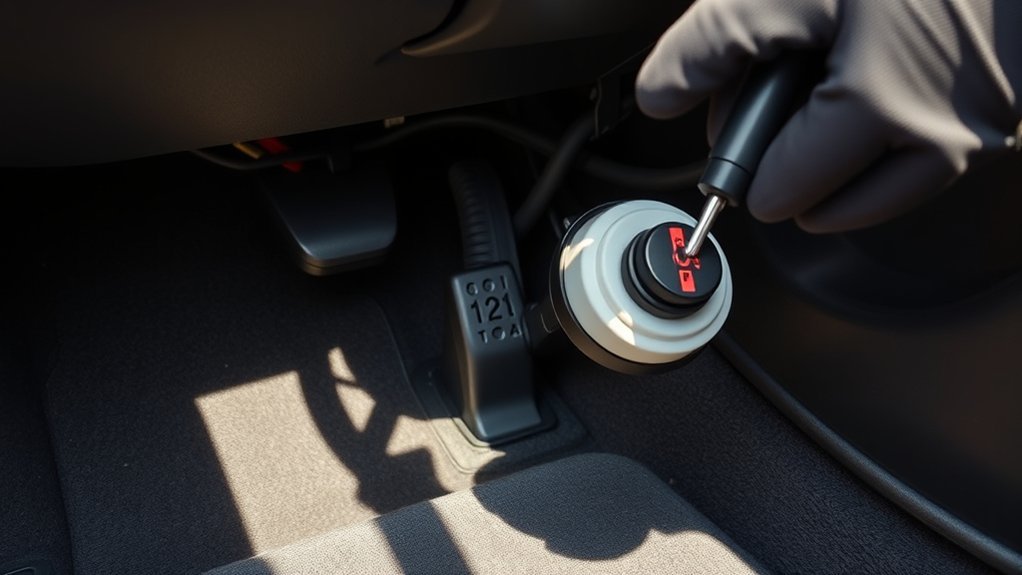
A soft, spongy, unusually low, or sinking brake pedal in your Toyota Camry can indicate trapped air, a hydraulic leak, internal master-cylinder bypass, overheated brake fluid, excessive component clearance, or another fault that reduces braking response. Because the cause can worsen without warning, identify the symptoms while the vehicle is safely parked and decide whether it must be towed before attempting any repair.
Last updated: September 19, 2026 — reviewed for Toyota brake-warning guidance, 2025 Camry pedal-behavior notes, hybrid/ECB bleeding cautions, and current safety references.
Quick Answer
A Toyota Camry brake pedal may feel soft because of air, a brake-fluid leak, internal master-cylinder bypass, hose expansion, overheated fluid, or excessive component clearance. Do not drive if the pedal approaches the floor, stopping power drops, fluid is leaking, or a red brake-system warning remains on.
Key Takeaways
- A soft pedal is usually a hydraulic, heat, or clearance problem rather than normal brake-pad wear by itself.
- A pedal that sinks under steady pressure may indicate an external leak or internal hydraulic bypass.
- Pumping that temporarily firms the pedal is a diagnostic clue, not proof that air is the only problem.
- Bleeding can remove trapped air, but it will not repair the leak, service error, or component fault that allowed the problem to develop.
- Camry brake layouts, warning systems, fluid requirements, and bleeding procedures vary by year and powertrain.
- Severe softness, visible leakage, a red brake warning, or reduced stopping power requires towing and professional inspection.
Warning: Do not drive your Camry if the brake pedal approaches the floor, braking distance increases, the reservoir is empty or rapidly losing fluid, fluid is visible near a wheel or brake line, or a red brake-system warning remains on after the parking brake is released. Park safely and arrange a tow.
At a Glance
| Time Required | About 10 minutes for basic parked-vehicle checks; complete diagnosis and repair time varies |
| Difficulty | Basic visual inspection: easy; hydraulic diagnosis and repair: advanced |
| Tools Needed | Flashlight, clean paper towel, wheel chocks, and the owner’s manual for your Camry; technicians may also need pressure gauges, a scan tool, and model-specific bleeding equipment |
| Cost | A visual check costs nothing; repair cost depends on whether the cause is air, a hose, a line, a caliper, a wheel cylinder, a master cylinder, an actuator, or another component |
What to Do Before Driving
Use the symptom severity, warning lights, and fluid condition to choose the safest next step. A parked inspection cannot prove that the vehicle is safe to drive.
| What You Find | Safest Response |
|---|---|
| Pedal approaches the floor, braking is weak, or the reservoir is empty | Do not drive. Arrange towing and hydraulic-system diagnosis. |
| Visible fluid near a wheel, hose, line, caliper, drum, or master cylinder | Treat it as a possible brake-fluid leak and tow the vehicle. |
| Red brake warning remains on after the parking brake is released | Follow the exact owner’s-manual warning and stop driving. |
| Pedal became soft immediately after brake service | Do not road-test it. Have the installation, fluid level, bleeders, fittings, and bleeding procedure rechecked. |
| Mild but unexplained softness with no visible leak | Arrange prompt inspection before returning to normal driving; hidden leaks and internal faults are still possible. |
Toyota’s warning instructions vary by year. Toyota’s 2025 Camry owner’s manual identifies a red brake-system warning for low brake fluid or a brake-system malfunction and instructs the driver to stop in a safe place. Use the manual for your own vehicle rather than assuming the same display, color, or instruction applies to every Camry.
It is also worth checking your VIN through Toyota’s and NHTSA’s recall tools. A recall lookup can identify an unrepaired safety recall, but it does not diagnose the current pedal problem and may not show completed recalls, every newly announced recall, or non-safety service campaigns.
What Does a Soft Brake Pedal Feel Like?
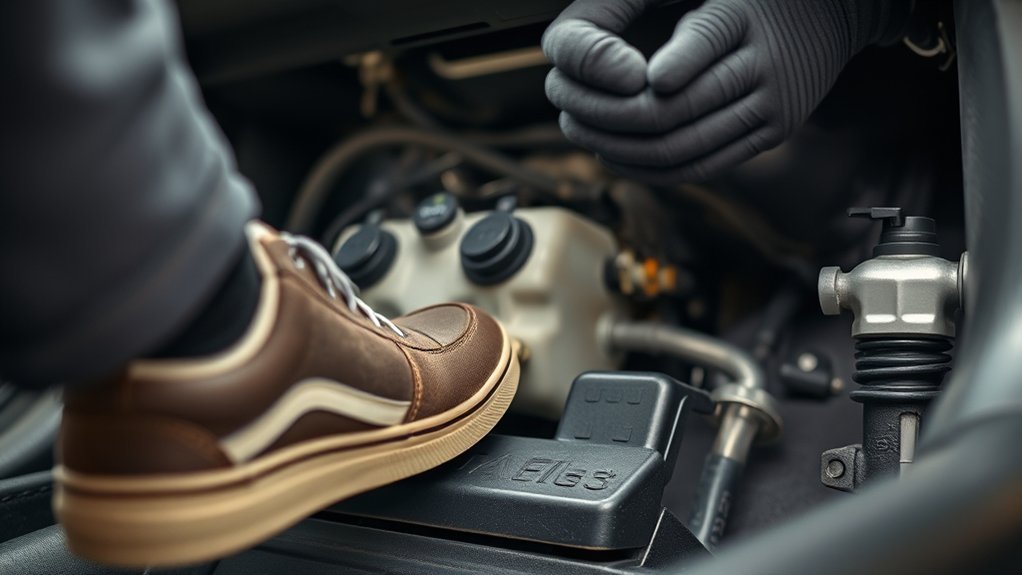
A soft brake pedal feels less firm than normal and may require more travel before the brakes respond. Drivers often describe the sensation as spongy, springy, low, or unusually easy to press.
The pedal may also sink gradually while you maintain steady pressure. That symptom can indicate an external leak or fluid bypassing worn seals inside a conventional master cylinder. On an electronically controlled brake system, an actuator or other hydraulic fault can produce similar symptoms, so pedal feel alone cannot identify the failed component.
If pumping the pedal briefly makes it firmer, trapped air, excessive mechanical clearance, pad knock-back, or another hydraulic fault may be involved. Temporary improvement does not prove that air is the cause or that the car is safe to drive.
Pedal feel can change after brake service if air entered the system, a bleeder remains loose, the reservoir ran low, a hydraulic fitting is leaking, rear drum brakes are out of adjustment, or the required bleeding procedure was not completed. A caliper installed on the wrong side may leave its bleeder below the trapped-air pocket, making complete bleeding impossible until the installation is corrected.
Can a 2025 Camry Brake Pedal Sink Normally?
During operation of certain driving-support braking functions, Toyota says brake-operation sounds may occur and pedal response can change. In the 2025 Camry driving-support manual, Toyota notes that the pedal may feel stiffer than expected or may sink while the system is operating, and that this behavior by itself does not indicate a malfunction.
That temporary, system-related response is different from a pedal that remains soft, repeatedly sinks under steady pressure, is accompanied by low fluid or a red brake warning, or causes reduced braking. If the change is persistent, unexplained, or not clearly tied to a driving-support event, treat it as a brake-system concern and follow the model-specific manual.
| Symptom | What It May Suggest |
|---|---|
| Soft or spongy pedal | Air, hydraulic leakage, hose expansion, overheated fluid, or excessive component clearance |
| Pedal slowly sinks under steady pressure | External leakage, internal master-cylinder bypass, or another hydraulic fault |
| First press is low but pumping raises it | Air, excessive drum clearance, pad knock-back, service error, or another hydraulic problem |
| Hard pedal requiring heavy effort | Possible brake-assist, vacuum, booster, pump, accumulator, or electronically controlled brake issue |
| Pulsation during braking | Normal ABS intervention in a skid or rotor, hub, wheel, or tire variation |
| Pulling or dragging | Sticking caliper, restricted hose, uneven friction, tire condition, or alignment issues |
| Softness appears after repeated or downhill braking | Possible overheated or boiling brake fluid; reduced friction can also cause brake fade |
A soft pedal is not the same as vibration, pulling, grinding, or a hard pedal. Those symptoms can occur together, but they point technicians toward different parts of the braking system.
Top Reasons Your Toyota Camry Has a Soft Brake Pedal
The most likely causes involve lost hydraulic pressure, compressible air or vapor, internal seal failure, damaged hoses, heat, service errors, or excessive clearance between braking components. The possibilities depend on the Camry’s year, brake layout, and powertrain.
Air in the Brake Lines
Brake fluid transfers pedal force because it resists compression. Air bubbles compress much more easily, so trapped air can create a springy or spongy pedal.
Air commonly enters after a hydraulic component is opened, the reservoir runs too low, a leak develops, or bleeding is incomplete. A technician should find and repair the entry point before or during bleeding. Otherwise, the symptom may return.
Brake fluid can absorb moisture over time. Moisture lowers the fluid’s wet boiling performance and may promote internal corrosion, but moisture absorption should not be described as the normal source of trapped air. Use only the fluid specified for your Camry and keep it clean and dry.
Brake-Fluid Leaks
A leak can reduce hydraulic pressure and increase pedal travel. Possible leak points include steel brake lines, flexible hoses, calipers, wheel cylinders on drum-brake models, a master cylinder, an actuator assembly, bleeder screws, and hydraulic connections.
Look for damp areas, residue, or fresh fluid near the inside of a wheel, beneath the master cylinder, along brake lines, or where flexible hoses connect. Brake fluid may appear clear, pale amber, or darker with age, so do not identify a spill by color alone.
Brake fluid can damage painted surfaces. Avoid spreading it, keep it away from eyes and skin, and rinse accidental paint contact according to the vehicle or fluid-container instructions.
A falling reservoir level deserves immediate attention. Normal pad wear can cause a gradual level change, but a sudden or continuing drop can indicate leakage. Do not simply refill the reservoir and continue driving without finding the cause.
Internal Master-Cylinder Bypass
A conventional master cylinder contains seals that build and maintain hydraulic pressure. Worn or damaged seals can allow fluid to bypass internally even when no external leak is visible.
A common clue is a pedal that initially feels firm but slowly sinks while you maintain constant pressure. A qualified technician may use manufacturer-approved isolation and pressure tests to separate a master-cylinder fault from a hidden leak, hose problem, actuator fault, or excessive component movement.
Damaged Flexible Brake Hoses
Flexible hoses allow the wheels and suspension to move while maintaining a hydraulic connection. A deteriorated hose may leak, swell under pressure, rub against another component, or become internally restricted.
External swelling can contribute to a soft or delayed response. An internal restriction more often causes dragging, pulling, uneven braking, or a brake that releases slowly. Replace a damaged hose rather than attempting to patch it.
Warning: Do not clamp a flexible brake hose with locking pliers or another improvised tool. Crushing the hose can damage its internal reinforcement and create a restriction or later failure.
Excessive Clearance or Service Errors
Excessive clearance between friction components can increase pedal travel. On Camrys equipped with rear drum brakes, poor adjustment, a failed automatic adjuster, worn hardware, or incorrect assembly may require extra fluid movement before the shoes contact the drum.
After disc-brake service, a loose bleeder, leaking fitting, damaged seal, improperly seated pad, incorrect caliper position, or failure to restore the piston and pad position can affect pedal feel. Before the vehicle moves, the pedal should be operated only as the repair procedure directs until the pads are seated and a normal firm response is confirmed.
If the reservoir was allowed to fall below its minimum level, air may have entered beyond the wheel circuit. Some ABS and electronically controlled systems then require a scan-tool procedure rather than a simple manual bleed.
Overheated Fluid and Brake Fade
A pedal that becomes soft during repeated hard stops, trailer-free mountain descents, or prolonged braking may indicate that the brake fluid has become hot enough to form compressible vapor. Old or moisture-contaminated fluid can reach its wet boiling threshold sooner than fresh fluid that meets the correct specification.
Brake fade can also occur at the pads and rotors. In that case, stopping power may fall while the pedal remains relatively firm. Both conditions are dangerous.
- Move to a safe location without continuing to ride the brakes.
- Stop driving if pedal travel increases or braking power falls.
- Do not touch wheels, calipers, rotors, or drums because they may be extremely hot.
- Have the fluid, friction components, calipers, hoses, and operating conditions inspected before driving normally again.
Pad Knock-Back, Hub Runout, or Bearing Movement
A less-common cause is movement that pushes the caliper pistons and pads away from the rotor. Excessive wheel-bearing play, hub or rotor runout, a loose caliper, impact damage, or severe cornering loads can produce a long first pedal followed by a temporarily higher second press.
This condition requires inspection of the wheel bearing, hub, rotor, caliper mounting, and suspension. Repeatedly pumping the pedal is not a repair.
How to Diagnose Brake Problems Safely
You can perform a few basic observations while the vehicle is parked on a level surface. Do not crawl under an unsupported vehicle, loosen hydraulic fittings, remove a brake drum, clamp a hose, or road-test a Camry with reduced braking.
Visual Inspection Techniques
Set the parking brake, place the transmission in Park, switch the vehicle off unless its manual directs otherwise for a specific check, and use wheel chocks when appropriate. Inspect the following areas without disassembling the brakes:
- Check the brake-fluid reservoir level against the MIN and MAX markings.
- Look beneath the vehicle for fresh fluid.
- Inspect visible portions of steel lines and flexible hoses for wetness, cracks, rubbing, corrosion, or bulges.
- Look behind each wheel for residue around the caliper, hose, backing plate, or drum area.
- Check beneath the master cylinder and around its connection to the brake booster.
- Note any red brake, yellow brake, ABS, stability-control, or related warning message.
- Check whether the concern began immediately after brake, hub, bearing, wheel, or suspension work.
Do not open the reservoir unnecessarily. Dirt, water, petroleum products, cleaning chemicals, or the wrong fluid can contaminate the system.
Limited Brake-Pedal Observations
Pedal feel can provide useful clues, but a generic stationary test cannot certify that the vehicle is safe. Conventional and electronically controlled Camry brake systems may respond differently depending on ignition state, stored pressure, and system operation.
With the vehicle secured and without repeatedly pumping the pedal, note the symptom in the operating condition described by your owner’s manual:
- Pedal remains at a consistent height: The fault may be intermittent, heat-related, service-related, or present only while the vehicle is moving.
- Pedal slowly sinks: External leakage, internal bypass, or another hydraulic fault may be present.
- A second press is temporarily higher: Air, excessive clearance, pad knock-back, or another fault may be involved.
- Pedal remains unusually hard: The concern may involve brake assist, an electric pump, an accumulator, vacuum supply, or a booster rather than hydraulic softness.
Do not hold the pedal down repeatedly to test a known leak. This observation does not identify the failed part and must not be used to declare the car safe.
Pro Tip: Write down whether the problem started suddenly, appeared after service, changes after one additional pedal press, occurs only when hot, follows a pothole or wheel-bearing repair, or activates a warning light. Those details can shorten diagnostic time.
Camry Hybrid Brake-System Behavior
Camry hybrids and some other electronically controlled configurations use pumps, accumulators, actuators, and computer-controlled coordination between regenerative and friction braking. A motor or pump sound during some brake-system operations can be normal on certain models, but a new increase in pedal travel, reduced braking power, persistent warnings, or frequent abnormal pump operation requires diagnosis.
Do not use a generic depressurization or bleeding sequence on a hybrid. Toyota’s technical instructions for the 2007–2011 Camry Hybrid E0U campaign require Techstream utilities, controlled accumulator operation, a pressure adapter, specific ignition states, and separate front and rear procedures. That document demonstrates why repair information for the exact year and system is essential; it is not a universal procedure for every Camry Hybrid.
Professional Pressure and Scan-Tool Checks
A repair facility may use hydraulic pressure gauges, scan data, diagnostic trouble codes, manufacturer-approved hydraulic isolation equipment, an ABS or electronically controlled brake utility, and component-specific tests. The technician should compare the results with Toyota repair information for the vehicle being serviced.
ABS and electronically controlled brake systems may require a scan tool to operate valves, pumps, or accumulators during bleeding. Improvised bleeding can leave air inside an actuator, damage components, create an unsafe pedal, or produce an incomplete repair.
Toyota’s Technical Information System provides service information for qualified users. Owners can obtain model-specific operating and maintenance information through Toyota’s Manuals and Warranties portal.
Signs of Damaged or Leaking Brake Lines
Steel brake lines can corrode, become damaged by road debris, rub against nearby parts, or leak at fittings. Flexible hoses may crack, swell, twist, rub, or leak around their crimps.
A soft pedal combined with a falling brake-fluid level or visible wetness should be treated as a possible hydraulic leak until a qualified inspection proves otherwise.
Possible warning signs include:
- Fresh clear, pale-amber, or dark fluid near a wheel or beneath the car
- A reservoir level that continues to fall
- Increasing pedal travel
- A red brake-system warning
- Reduced braking force
- Corroded, crushed, rubbed, cracked, twisted, or swollen lines and hoses
- Wetness around a fitting, bleeder, hose crimp, caliper, or backing plate
Hidden corrosion or damage can exist above a shield, near a mounting clip, or where a line is difficult to see. A technician may need to lift the vehicle safely, remove protective panels, and inspect the complete hydraulic circuit.
How Disc-Brake Calipers Affect Pedal Feel
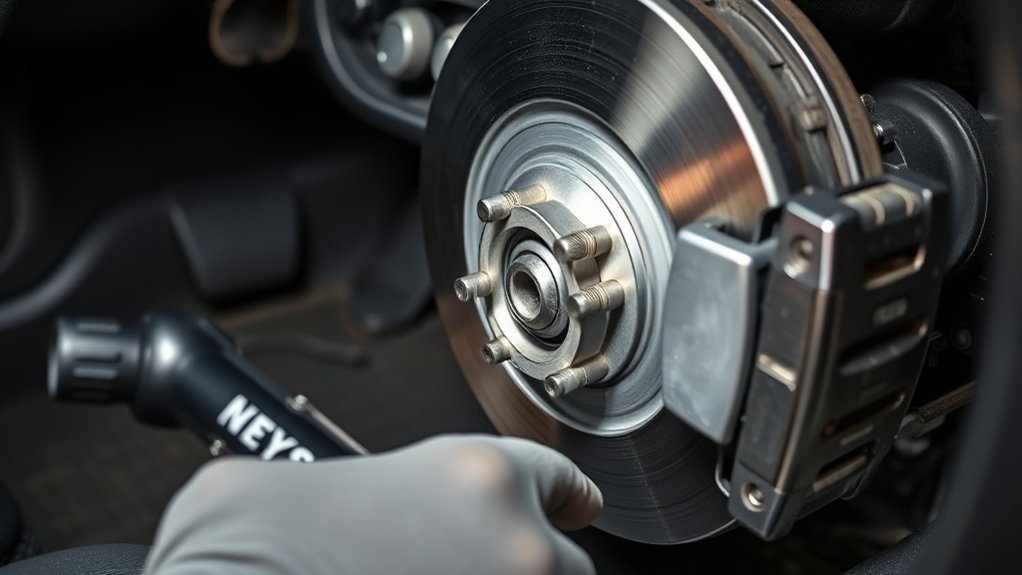
Disc-brake calipers use hydraulic pressure to move pistons and clamp the pads against the rotors. A leaking caliper can reduce fluid level and soften the pedal. Mechanical caliper faults more often cause uneven braking, dragging, overheating, pulling, noise, or abnormal pad wear.
Factors Affecting Caliper Performance
- Leaking piston seals or bleeder screws can cause fluid loss and added pedal travel.
- Corroded pistons can stick and prevent smooth application or release.
- Seized slide pins can create uneven pad pressure, dragging, pulling, or tapered wear.
- Improper installation can leave a bleeder loose, place the bleeder too low to release trapped air, or introduce air.
- Loose or damaged mounting hardware can permit movement, noise, or pad knock-back.
- A reservoir allowed to run low during service can introduce air beyond the repaired wheel circuit.
Do not assume that a seized slide pin alone explains a soft pedal. The hydraulic system should be checked separately for leakage, air, heat damage, or master-cylinder and actuator problems.
Caliper Pin Movement Issues
Floating calipers rely on slide pins to center the caliper as the brakes apply. Pins that are dry, corroded, bent, incorrectly lubricated, or seized may prevent equal pad contact.
Typical symptoms include pulling, uneven pad wear, overheating, reduced fuel economy from brake drag, or one wheel becoming hotter than the others. The pins, boots, bores, pads, mounting bracket, rotor, and hose routing should be inspected together.
Importance of Seal Integrity
Caliper piston seals retain brake fluid and contribute to normal piston movement after braking. A damaged seal may allow external fluid leakage around the piston and dust boot.
- Check for wetness around the piston and dust-boot area.
- Replace a leaking caliper or rebuild it only according to an approved procedure.
- Replace pads contaminated with brake fluid.
- Do not allow petroleum-based grease or incompatible cleaners to contact hydraulic seals.
- Bleed the system correctly after opening the hydraulic circuit.
Why the Master Cylinder Matters
A conventional master cylinder converts pedal movement into hydraulic pressure. Because it supplies more than one brake circuit, a fault can affect pedal travel and braking response at multiple wheels.
| Issue | Possible Symptoms | Appropriate Response |
|---|---|---|
| Internal seal bypass | Pedal slowly sinks without an obvious external leak | Confirm through approved system testing and replace or repair as specified |
| External leak | Wetness, falling fluid level, soft pedal | Do not drive; repair the leak and bleed the system correctly |
| Contaminated or incorrect fluid | Seal swelling, discoloration, poor performance, or widespread hydraulic problems | Have the system evaluated before flushing or replacing components |
| Air introduced during replacement | Spongy pedal after master-cylinder service | Complete any required bench-bleeding and vehicle-bleeding procedure |
Master-cylinder replacement should not be based on pedal feel alone. Air, leaks, hose faults, excessive clearance, pad knock-back, and ABS or electronically controlled hydraulic problems can produce similar symptoms.
How Worn Wheel Cylinders Affect Braking
This section applies only to Camrys equipped with rear drum brakes. A wheel cylinder uses hydraulic pressure to push the brake shoes outward against the drum.
Worn seals can leak fluid inside the drum assembly. The leak may reduce hydraulic pressure, contaminate the shoes, increase pedal travel, and weaken rear braking.
- Look for fluid around the lower edge of the backing plate or drum.
- Check for a continuing drop in reservoir level.
- Inspect the shoes for fluid contamination.
- Check the adjuster and hardware for correct operation.
- Replace contaminated friction material rather than cleaning and reusing it.
A drum normally must be removed to confirm a wheel-cylinder leak. This requires safe lifting, correct reassembly, adjustment, and brake-system bleeding.
Solutions for a Soft Brake Pedal
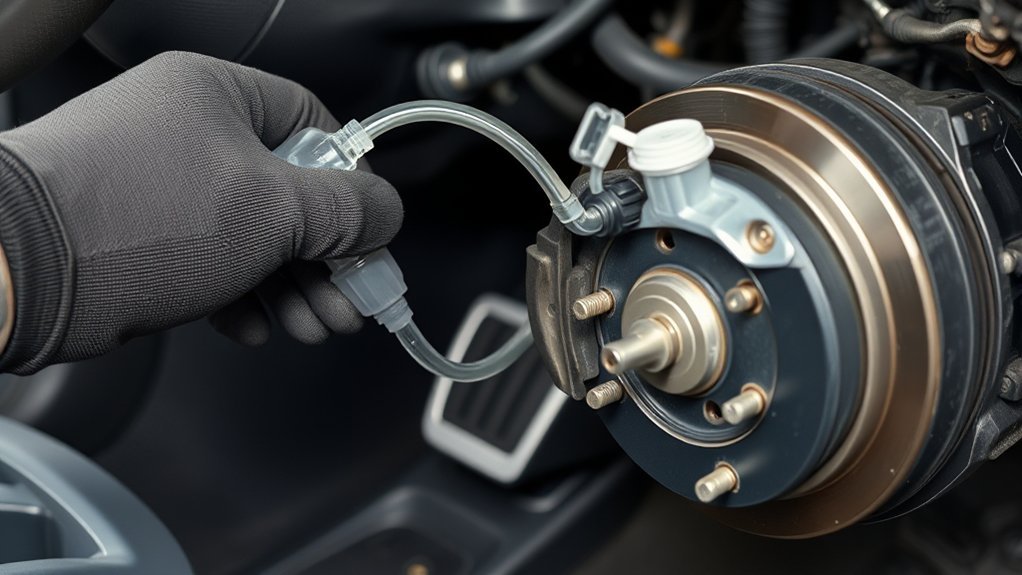
The correct fix depends on the confirmed cause. Bleeding should be one step in a complete repair, not the automatic answer to every soft pedal.
| Confirmed Cause | Repair | Important Follow-Up |
|---|---|---|
| Air introduced during service | Bleed the system using the specified sequence, equipment, and operating state | Confirm why air entered and verify a firm pedal before controlled testing |
| Leaking line or hose | Replace the damaged section with correctly specified parts | Bleed, inspect routing and clearances, and check every disturbed connection |
| Leaking caliper or wheel cylinder | Replace or properly rebuild the component | Replace contaminated pads or shoes and inspect the opposite side |
| Internal master-cylinder bypass | Replace or repair the master cylinder as specified | Bench-bleed when required and complete the correct vehicle procedure |
| Excessive drum-brake clearance | Repair and adjust the drum-brake hardware | Confirm automatic-adjuster operation and balanced braking |
| Pad knock-back or hub movement | Repair bearing, hub, rotor, caliper, or mounting faults | Measure runout and play according to Toyota specifications |
| Overheated or moisture-degraded fluid | Correct the overheating cause and replace fluid using the approved procedure | Inspect pads, rotors, drums, calipers, hoses, and driving conditions |
| Contaminated or incorrect fluid | Inspect for seal damage and perform the manufacturer-approved repair | Use only the exact specified fluid from a clean, sealed container |
| Air trapped in an ABS or brake actuator | Use the required scan-tool and actuator-bleeding procedure | Check diagnostic codes, fluid level, leakage, and system operation |
Do not adjust a brake-booster pushrod or “booster pin gap” without the exact service specification, measurement method, and approved procedure. Incorrect adjustment can cause excessive travel, brake drag, overheating, or incomplete brake release.
Note: Camry hybrids and other electronically controlled brake systems may use an electric pump, actuator, accumulator, or special bleed mode. Follow the repair information for the exact year and powertrain.
Preventive Measures for Maintaining Brake Performance
Routine inspection helps identify small leaks, damaged hoses, worn friction material, heat damage, and warning indicators before pedal feel changes significantly.
- Follow the maintenance guide for your model year rather than using a universal fluid-change interval.
- Use only the brake-fluid type listed in the owner’s manual or on the reservoir cap.
- Keep new fluid sealed, clean, and dry until use.
- Inspect visible hoses and lines for rubbing, cracks, corrosion, twists, bulges, or wetness.
- Investigate any unexplained reduction in reservoir level.
- Check pedal feel before moving the vehicle after work involving pads, calipers, wheel cylinders, lines, hoses, hubs, bearings, or the master cylinder.
- Confirm that bleeders, fittings, and hydraulic connections are leak-free after service.
- Never mix brake fluid with engine oil, power-steering fluid, petroleum products, coolant, cleaning chemicals, or other automotive liquids.
- Address red brake warnings and abnormal pedal feel immediately.
Federal Motor Vehicle Safety Standard No. 116 covers brake-fluid performance, containers, and labeling. Review the current requirements in 49 CFR 571.116.
You can obtain the appropriate manual and maintenance guide from Toyota’s Manuals and Warranties page.
As one model-year example, Toyota’s 2025 Camry maintenance data lists FMVSS No. 116 DOT 3 or SAE J1703 and FMVSS No. 116 DOT 4 or SAE J1704 brake fluid. Do not treat that as a universal Camry specification; confirm the reservoir cap and manual for the exact year and powertrain.
What to Do If a Brake Line or Hose Is Leaking
If you find a leaking steel line, fitting, caliper connection, or flexible hose, do not drive the vehicle. A small leak can worsen, and continued pedal application can lower the reservoir and reduce braking ability.
- Park the Camry in a safe location and switch it off.
- Do not repeatedly press the pedal to test a known leak.
- Keep people and pets away from spilled fluid.
- Avoid allowing brake fluid to remain on painted surfaces.
- Arrange towing to a qualified repair facility.
- Replace the damaged line, hose, fitting, or component with a correctly specified part.
- Inspect nearby lines for corrosion, impact damage, rubbing, or improper routing.
- Bleed the system using the procedure required for the vehicle.
- Verify pedal firmness, fluid level, warning-light status, and leak-free operation before any controlled road test.
Warning: Adding brake fluid does not repair a leak. It may temporarily raise the reservoir level while the system continues losing hydraulic pressure.
Sources
- Toyota Manuals and Warranties — model-specific owner’s manuals and maintenance information
- Toyota Warning Lights — Toyota dashboard-warning guidance and vehicle-specific manual access
- Toyota Safety Recall Lookup — VIN and license-plate recall and service-campaign checks
- NHTSA Recall Lookup — federal recall, investigation, complaint, and manufacturer-communication information
- 49 CFR 571.116 — federal motor-vehicle brake-fluid requirements
- Toyota Technical Information System — Toyota repair procedures and technical service information
- 2025 Camry Driving Support Systems Excerpt — Toyota guidance on brake-operation sounds and temporary pedal-response changes during certain system operation
- Toyota Camry Hybrid E0U Technical Instructions — model-specific Techstream, accumulator, and brake-bleeding procedures for the affected 2007–2011 Camry Hybrid campaign
Related Guides
Frequently Asked Questions
What would cause my Toyota Camry brake pedal to feel soft?
Common causes include air in the hydraulic system, a leaking line or hose, a leaking caliper or wheel cylinder, internal master-cylinder bypass, hose expansion, overheated fluid, excessive drum clearance, pad knock-back, or an incomplete repair procedure. The exact diagnosis depends on the symptoms and brake-system configuration.
What is the most common brake problem with a Toyota Camry?
No single brake fault is the most common across every Camry year. Brake layout, mileage, climate, service history, and powertrain all matter. Check the model-specific manual, inspect the vehicle, and search the VIN in Toyota’s and NHTSA’s recall databases.
What causes a dropping brake pedal when no fluid is visibly leaking?
A pedal that slowly drops under steady pressure may indicate internal master-cylinder bypass. A hidden leak, an ABS or actuator fault, hose expansion, or another hydraulic problem can produce a similar symptom, so the system should be professionally tested.
Why is my brake pedal spongy when no air is found in the lines?
Possible causes include internal hydraulic bypass, hose expansion, excessive rear-drum clearance on applicable models, pad knock-back, an undiscovered leak, overheated fluid, or air trapped inside an ABS actuator. Confirm that the correct model-specific bleeding procedure was used.
Why is the pedal soft immediately after brake service?
Air may have entered the system, the reservoir may have run low, a bleeder or fitting may be loose, a caliper may be installed with the bleeder too low, or the pads and pistons may not be seated. Some systems also require a scan-tool actuator procedure. Do not road-test the vehicle until the cause is corrected and a firm pedal is verified.
Why does the brake pedal become soft only when the brakes are hot?
Heat can cause moisture-degraded or overheated brake fluid to form compressible vapor. Friction material can also fade and reduce stopping power. Stop in a safe place, avoid touching hot brake parts, and have the fluid and braking components inspected before driving normally again.
Can low brake fluid cause a soft pedal even when I cannot see a leak?
Yes. A hidden leak may exist inside a drum, behind a shield, along a concealed line, or at another hard-to-see location. Pad wear can lower the level gradually, but a sudden drop or frequent need for fluid requires inspection. Adding fluid alone does not correct the cause.
Can I drive a Toyota Camry with a soft brake pedal?
Do not drive if the pedal approaches the floor, stopping power is reduced, fluid is leaking, the reservoir is rapidly losing fluid, or a red brake warning remains on. Arrange towing. Even mild unexplained softness should be inspected before normal driving resumes.
Does a Toyota Camry Hybrid require a special brake-bleeding procedure?
Some Camry Hybrid and electronically controlled brake systems require model-specific steps, scan-tool commands, accumulator operation, or actuator bleeding. Use the Toyota repair procedure for the exact year and powertrain rather than applying a generic manual sequence.
Conclusion
A soft Toyota Camry brake pedal is a warning symptom, not a diagnosis. Air, external leakage, internal hydraulic bypass, hose damage, overheated fluid, caliper or wheel-cylinder leakage, excessive clearance, pad knock-back, and service errors can feel similar from the driver’s seat.
Begin only with safe parked-vehicle observations. Do not drive when pedal travel is severe, braking power is reduced, fluid is leaking, or a red brake warning remains on. Once the underlying fault has been identified and repaired, the system must be bled, checked for leaks, and verified using the correct procedure for the Camry’s year and powertrain.
