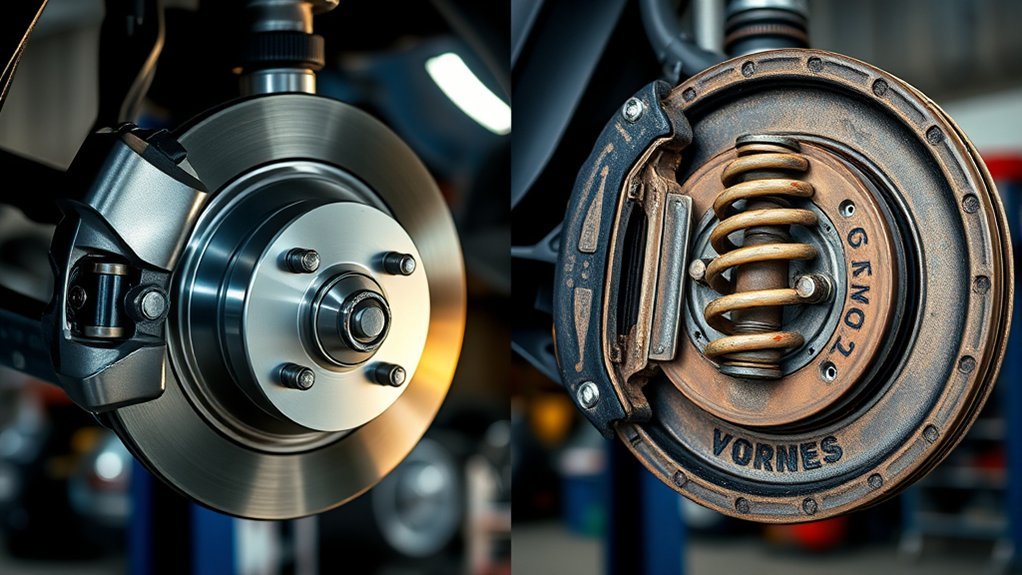
Disc brakes and drum brakes both convert a vehicle’s motion into heat, but they manage that heat in different ways. Disc brakes are usually better at cooling, wet-weather recovery, and repeated hard stops. Drum brakes cost less to manufacture, work well on lightly loaded rear axles, and integrate a parking brake efficiently.
Quick Answer
Disc brakes are generally the better choice for consistent performance, cooling, and easier inspection. Drum brakes remain useful because they are economical, durable in suitable rear-axle applications, and effective for parking brakes. Neither design alone determines stopping distance, which also depends heavily on tires, road grip, ABS, vehicle load, and system condition.
Key Takeaways
- Disc brakes shed heat more easily and resist fade better during repeated or high-energy braking.
- Drum brakes use a self-energizing action that can produce strong braking force with less hydraulic input.
- A well-designed disc or drum system can stop safely in normal use; tires, ABS, road grip, and maintenance strongly affect real stopping distance.
- Brake inspection and replacement limits are vehicle-specific, so use the owner’s manual and service specifications rather than a universal mileage rule.
- Changing a vehicle from drums to discs is an engineered system modification, not a simple parts swap.
Disc Brakes vs. Drum Brakes at a Glance
| Factor | Disc Brakes | Drum Brakes |
|---|---|---|
| Friction parts | Pads clamp a rotating rotor | Shoes press outward against a rotating drum |
| Heat control | Better airflow and cooling | More heat is retained inside the assembly |
| Repeated hard braking | Usually more consistent and fade-resistant | More likely to lose effectiveness as temperature rises |
| Wet recovery | Open design generally clears water faster | Enclosure can delay drying if water enters |
| Inspection and service | Pads and rotor are easier to see and access | More springs and hardware make service slower |
| Typical use | Front axles, performance vehicles, towing packages, four-wheel-disc systems | Rear axles on many economy vehicles, some EVs, and parking-brake applications |
| Main advantage | Consistent thermal performance | Low production cost and effective parking-brake integration |
Understanding Disc Brakes: Features and Benefits
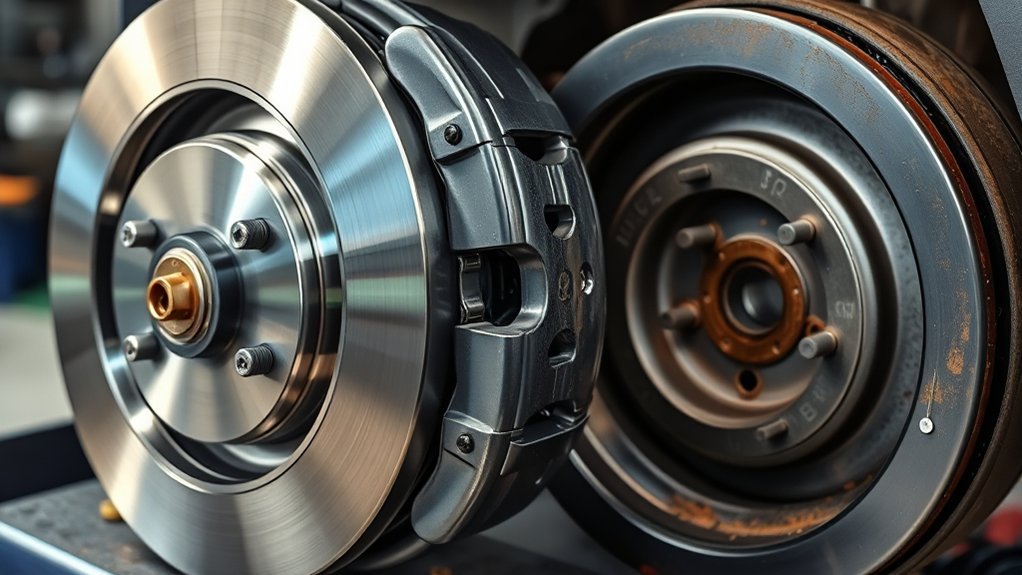
A disc brake uses a rotor that turns with the wheel, a caliper mounted over the rotor, and friction pads inside the caliper. When you press the brake pedal, hydraulic pressure moves one or more caliper pistons. The pads squeeze both sides of the rotor, creating friction that slows the wheel.
The open rotor is exposed to moving air. Many front rotors also have internal cooling vanes. This design helps the brake release heat between stops, so braking force remains more consistent during repeated stops, long descents, towing, or performance driving.
Main Advantages of Disc Brakes
- Better heat management: The rotor can release heat more directly to the surrounding air.
- Greater resistance to fade: Disc brakes usually maintain more consistent performance when braking repeatedly.
- Faster wet recovery: Water is less likely to remain trapped between the friction surfaces.
- Easier inspection: A technician can often view pad thickness and rotor condition without opening a sealed assembly.
- Predictable response: Disc brakes do not rely on the same self-energizing action used by many drum designs.
Limitations of Disc Brakes
- They generally cost more to manufacture than basic drum systems.
- Exposed rotors can develop surface rust when a vehicle sits, especially in humid or salted-road conditions.
- Pads may wear faster than drum shoes in comparable light-duty use.
- Rear disc parking-brake mechanisms can be more complex than a conventional rear drum setup.
The biggest practical advantage of a disc brake is not a magical single-stop distance. It is the ability to deliver more consistent braking as heat, water, and repeated use challenge the system.
The Mechanics of Drum Brakes: How They Work
A drum brake uses a round drum that turns with the wheel. Inside it are curved brake shoes, a wheel cylinder, return springs, hold-down hardware, an adjuster, and often a parking-brake lever. Hydraulic pressure pushes the shoes outward so their friction linings contact the inside of the drum.
Key Components
- Brake drum: The rotating friction surface attached to the hub or wheel assembly.
- Brake shoes: Curved steel shoes carrying the friction lining.
- Wheel cylinder: Hydraulic pistons that push the shoes outward.
- Return and hold-down springs: Hardware that controls shoe position and retracts the shoes.
- Adjuster: A mechanism that helps maintain the correct shoe-to-drum clearance.
- Parking-brake linkage: A mechanical lever and cable system that can apply the rear shoes without hydraulic pressure.
How the Self-Energizing Action Works
As a leading brake shoe contacts the rotating drum, the drum’s motion can pull the shoe more firmly into the friction surface. This self-energizing effect increases braking force without requiring the same increase in hydraulic pressure. It is one reason drum brakes can work efficiently on a lightly loaded rear axle.
Main Advantages of Drum Brakes
- Lower production cost: Drum systems are economical for manufacturers.
- Strong parking-brake function: The shoes can be applied mechanically by a cable or electric actuator.
- Long shoe life in suitable use: Rear drums may wear slowly because the rear axle often handles less braking energy.
- Protected components: The enclosure shields springs and shoes from direct road spray and impact.
- Low residual drag potential: Return springs pull the shoes away from the drum when the brake is released.
Limitations of Drum Brakes
- The enclosed design retains more heat during repeated braking.
- Heat can expand the drum and increase shoe travel, contributing to fade.
- Water or contamination that enters the drum may take longer to clear.
- Inspection and service require drum removal and careful handling of springs and adjusters.
- Leaking wheel cylinders or seized adjusters may remain hidden until the assembly is opened.
Note: “Enclosed” does not mean waterproof or maintenance-free. A drum can shield components from road debris while still trapping heat, dust, or moisture once contamination gets inside.
Performance Comparison: Disc Brakes vs. Drum Brakes
Stopping Distance
Brake design is only one part of stopping performance. In a modern vehicle, the available grip between the tires and road, tire condition, ABS calibration, vehicle load, suspension control, and road surface can matter as much as the friction hardware. A properly engineered drum system can activate ABS and stop safely in normal use.
Disc brakes gain a clearer advantage when the same vehicle must brake repeatedly or absorb more energy. Their better cooling helps them preserve friction and pedal consistency after several hard stops. A precise claim that disc brakes shorten stopping distance by a fixed percentage is not credible without a controlled test of the same vehicle, tires, speed, load, temperature, and road surface.
Heat and Brake Fade
Both systems turn kinetic energy into heat. If temperatures rise beyond the useful range of the friction material, braking force can fall. Brake fluid can also overheat, causing a soft or spongy pedal. Because a disc rotor is more exposed to airflow, it usually releases heat faster than an enclosed drum.
Wet-Weather Performance
Disc brakes generally clear water from the friction surfaces more quickly. Drum brakes can perform well in rain, but water that enters the drum may remain between the shoes and drum until friction and heat remove it.
Pedal Feel and Modulation
Disc-brake force follows hydraulic clamping pressure more directly. Drum brakes can feel more sensitive because the rotating drum helps pull the leading shoe into contact. Modern hydraulic controls, ABS, electronic stability control, and brake boosters reduce many of these differences at the pedal, but the underlying mechanical behavior remains different.
Why Many Vehicles Use Front Disc and Rear Drum Brakes
During braking, weight transfers toward the front axle. The front brakes therefore handle a larger share of the vehicle’s braking energy and heat. Manufacturers commonly place ventilated disc brakes at the front, where cooling capacity is most valuable, while using drums at the rear to reduce cost and simplify the parking brake.
This mixed layout is not automatically unsafe or outdated. The complete system is engineered around hydraulic balance, ABS, stability control, tire grip, axle loads, and federal performance requirements. In the United States, new light vehicles must meet Federal Motor Vehicle Safety Standard No. 135 regardless of whether the friction brakes use discs, drums, or a combination.
Brake Maintenance Frequency: How Often Should You Check Your Brakes?
There is no universal inspection interval that fits every vehicle. Follow the owner’s manual, maintenance minder, and service information for your year, make, and model. Driving in mountains, towing, carrying heavy loads, stop-and-go traffic, road salt, or frequent short trips may justify more frequent checks.
A practical time to inspect the brakes is when the wheels are already removed for tire service. A proper inspection should cover more than pad thickness. It should include fluid leaks, hose condition, caliper movement, rotor or drum condition, parking-brake operation, hardware, and warning lights.
Signs That Need Prompt Inspection
- Grinding, scraping, or repeated metal-on-metal noise
- A soft, sinking, or unusually hard brake pedal
- The vehicle pulls to one side while braking
- Steering-wheel or pedal vibration during braking
- A brake, ABS, or stability-control warning light
- Burning odor, smoke, or one wheel that feels much hotter than the others
- Longer stopping distance or reduced braking response
- Visible brake-fluid leakage
Warning: Do not keep driving if the brake pedal sinks, braking force drops sharply, fluid is leaking, smoke appears, or grinding is severe. Have the vehicle towed and inspected by a qualified technician.
Pad, Shoe, Rotor, and Drum Limits
Do not rely on a universal “1 to 3 mm” rule for every vehicle. Brake-pad and shoe service limits vary by design. Rotors and drums also have minimum thickness or maximum inside-diameter specifications. Use the specification stamped on the component or listed in the factory service information. A rotor or drum that is cracked, deeply scored, heat-damaged, or outside its service limit must not be reused.
Brake Fluid
Use only the brake-fluid type specified by the vehicle manufacturer. Brake-fluid labeling and performance are regulated under FMVSS No. 116. Fluid replacement intervals vary by manufacturer and market, so the owner’s manual remains the correct schedule.
Pro Tip: Ask for the measured pad or shoe thickness and rotor or drum specification in writing. “Looks low” is less useful than a measurement compared with the manufacturer’s service limit.
Cost: Disc vs. Drum Brake Maintenance
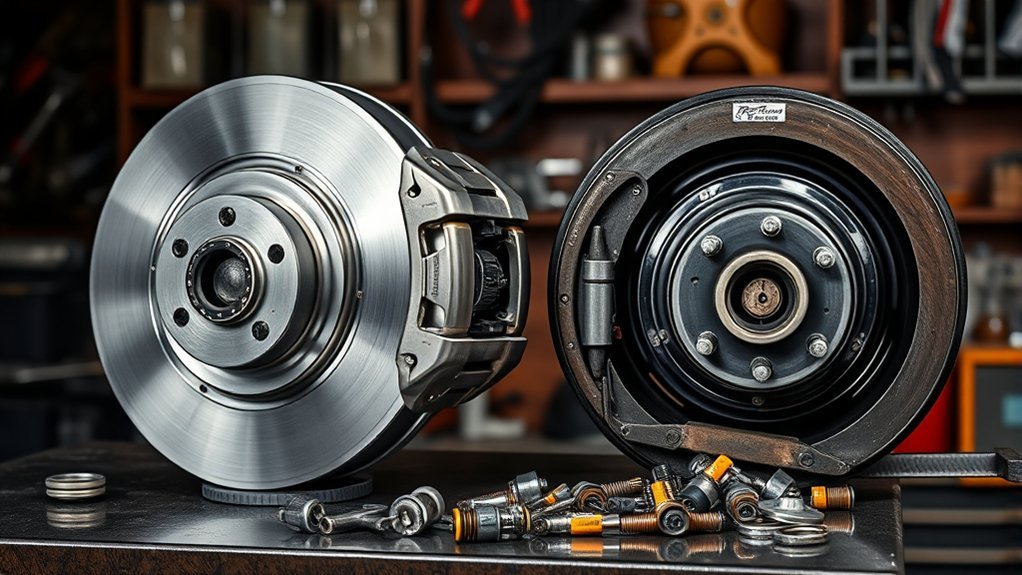
Drum brakes are usually cheaper for a manufacturer to install, but service cost is not determined by brake type alone. Vehicle design, parts quality, labor rate, corrosion, parking-brake hardware, electronic actuators, and whether rotors or drums can remain in service all affect the final bill.
[Amazon Products Picked for You]

Direct replacement - this drum brake hardware kit is designed to match the original hardware required to repair the drum brake on specified vehicles

【Fitment】Fit for Chevrolet Silverado 1500 ▶4.3L V6 (2008-2013), ▶4.8L V8 (2008-2013), ▶5.3L V8 (2008-2013), 6.0L V8 (2008-2009), ▶6.0L V8 Electric/Gas (2009-2013), ▶6.2L V8 (2009-2013). GMC Sierra 1500 ▶4.3L V6 (2008-2013), ▶4.8L V8 (2008-2013), ▶5.3L V8 (2008-2013), ▶6.0L V8 (2008-2009), ▶6.0L V8 (2008-2009), ▶6.0L V8 Electric/Gas (2009-2013), ▶6.2L V8 (2008-2013)
Disc-Brake Cost Factors
- Pad quality and axle configuration
- Rotor replacement or resurfacing requirements
- Seized caliper slide pins or pistons
- Electronic parking-brake service procedures
- Performance, towing, or large-diameter brake packages
Drum-Brake Cost Factors
- Time needed to remove the drum and clean the assembly
- Replacement of springs, adjusters, and hold-down hardware
- Wheel-cylinder leakage
- Parking-brake cable or actuator problems
- A drum that is seized to the hub, out of round, or beyond its diameter limit
Drum shoes may last a long time on a lightly loaded rear axle, but drum service is often more labor-intensive. Disc pads may require replacement sooner, yet inspection and routine pad service are usually simpler. Get a vehicle-specific estimate rather than using a broad national price range as a purchasing rule.
Safety: Which Brake Type Is More Reliable?
Disc brakes generally offer the stronger safety margin for repeated high-energy braking because they manage heat and water more effectively. That is why they dominate front-axle and performance applications. Drum brakes can still be reliable when they are correctly sized, adjusted, sealed, and maintained.
The safer system is the complete system that matches the vehicle’s weight, tire grip, ABS and stability-control programming, hydraulic balance, and intended use. A neglected four-wheel-disc system can be less safe than a properly maintained front-disc/rear-drum system.
For in-use vehicles, brake condition matters more than marketing labels. Federal inspection criteria address issues such as hydraulic leakage, damaged components, insufficient lining, and defective parking brakes. See the federal vehicle-in-use service-brake inspection standard for the types of defects that can make a brake system unsafe.
When Should You Choose Disc Brakes Instead of Drum Brakes?
Most owners do not choose the brake architecture when replacing worn parts. The safest approach is to keep the original system type and use parts that match the vehicle’s exact configuration. Disc brakes are especially appropriate when the vehicle was engineered for:
Heavy-duty pickups are a clear example. They run discs at all four corners because towing and hauling demand repeated high-heat stops, and on those trucks the pad compound does most of the work. That is why choosing brake pads built for towing and hauling matters more than the brake type itself.
- Repeated mountain descents or heavy towing
- Performance driving or track use
- High vehicle weight or high brake-energy demand
- Frequent wet-weather operation
- Large wheels and brake packages designed for added cooling
Drum brakes remain practical on rear axles that carry a smaller share of braking work, especially where production cost, parking-brake holding force, and low drag are priorities.
[Amazon Products Picked for You]

【Important NOTE】-- This set works on the principle of Left Front and Right Rear, which means the left lever controls front wheel brake, while the right lever controls rear wheel brake. The position of front and rear brake operation may vary due to different people or regions. You may switch the brake cable based on your actual needs. (Using a wrentch and a plier to disassemble the brake cable and swap the sides. There might be small amount of oil leakage, but it doesn't affect the usage.)

Premium Billet Aluminium Construction:Crafted from high-quality billet aluminium, this rear disc brake adapter strikes the perfect balance between lightweight design and exceptional strength.

✿Bicycle Disc Brake Adapter: This MTB disc brake adapter can transform ordinary bicycles into disc brake bicycles. The inner diameter of the modified ring is about 0.87" / 22mm. It is very suitable for cyclists and DIY enthusiasts.
What About a Drum-to-Disc Conversion?
A conversion can change hydraulic pressure requirements, front-to-rear brake balance, master-cylinder sizing, proportioning, parking-brake operation, wheel fitment, ABS behavior, and legal compliance. Use a complete engineered kit intended for the exact vehicle and have the finished system inspected. Mixing unrelated parts can create unstable braking or rear-wheel lockup.
Caution: Never remove a proportioning valve, defeat ABS components, or change caliper and wheel-cylinder sizes based only on physical fit. Brake balance must be engineered and tested.
Disc and Drum Brakes on Hybrid and Electric Vehicles
Hybrid and electric vehicles combine friction brakes with regenerative braking. During many routine slowdowns, the traction motor acts as a generator and returns energy to the battery. The friction brakes still handle emergency stops, low-speed holding, situations with limited regeneration, and backup braking.
Because regenerative braking can reduce use of the rear friction brakes, some EVs use rear drums to limit corrosion and drag while maintaining a strong parking brake. Other EVs use four-wheel discs. The correct design depends on the manufacturer’s full brake-control strategy, not simply whether the vehicle is electric. The U.S. Department of Energy’s Alternative Fuels Data Center explains how regenerative braking returns energy during deceleration.
Low friction-brake use can also allow rust or sticking components to develop unnoticed. EV and hybrid brakes still need periodic inspection even when pads or shoes wear slowly.
Debunking Myths About Disc and Drum Brakes
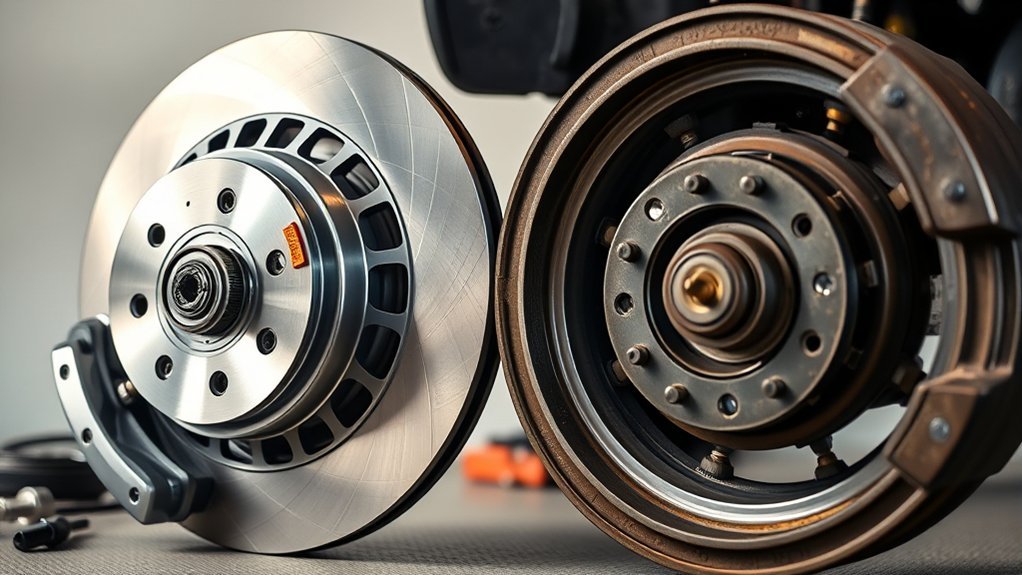
Myth: Disc Brakes Always Stop a Car Much Shorter
Reality: On a single stop, tire grip, road condition, ABS, speed, and vehicle setup can dominate the result. Disc brakes show their clearest advantage when heat, water, or repeated braking would reduce consistency.
Myth: Drum Brakes Are Obsolete
Reality: Drum brakes still make sense in some rear-axle and parking-brake applications. Their lower cost, self-energizing action, and return springs remain useful design features.
Myth: Disc Brakes Need No Adjustment or Inspection
Reality: Disc brakes compensate for normal pad wear, but calipers can seize, pads can wear unevenly, rotors can corrode, and fluid can leak or degrade. Regular inspection is still required.
Myth: A “30-30-30 Rule” Is the Standard Brake Schedule
Reality: There is no universal automotive standard requiring checks every 30 days, replacement at 30 percent wear, and inspection every 30,000 miles. Follow the vehicle manufacturer’s maintenance schedule and measured service limits.
Myth: Rear Drum Brakes Mean a Vehicle Is Unsafe
Reality: A front-disc/rear-drum vehicle can meet braking requirements when the complete system is properly engineered and maintained. Brake condition and system integration matter more than the rear hardware label.
Making the Right Choice for Your Vehicle
Use the brake type specified for the vehicle unless you are completing a properly engineered conversion. When comparing vehicles or brake packages, focus on the demands the system must handle:
- Daily commuting: Either a four-wheel-disc or front-disc/rear-drum system can work well.
- Towing and mountain driving: Favor larger, well-cooled discs and the manufacturer’s towing package.
- Performance use: Disc brakes provide better thermal consistency and easier pad changes.
- Low-cost rear-axle duty: Drum brakes may offer good value and long lining life.
- EV or hybrid use: Consider corrosion resistance, regenerative-brake blending, parking-brake design, and the manufacturer’s maintenance plan.
Do not judge a brake system from one feature. Rotor size, pad material, tire quality, cooling, brake fluid, ABS calibration, vehicle weight, and maintenance all contribute to the result.
[Amazon Products Picked for You]
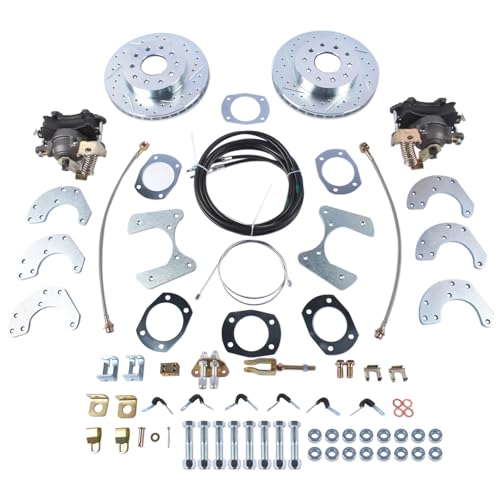
★【Application】: This Disc Brake Conversion Kit Replacement for Ford 8" and 9" Small Bearing Rear Disc Brake Conversion

✅Disc Brake Conversion Kit:The Kit refit normal or old bike to updated into disc brake bicycle model, The new kits will offers you more powerful stopping power and new riding experience.

【Material】These bike brake kits are made of premium steel,hard,durable and safe.
Frequently Asked Questions
What are the main advantages of disc brakes over drum brakes?
Disc brakes usually cool faster, recover from water sooner, resist fade better during repeated stops, and are easier to inspect. These advantages make them especially useful on front axles, performance vehicles, tow vehicles, and vehicles that regularly absorb high braking energy.
What is the biggest disadvantage of drum brakes?
The main disadvantage is heat retention. During repeated or prolonged braking, the enclosed drum can run hotter, expand, and become more prone to fade. Drum assemblies are also more complex to inspect and service because they contain multiple springs, retainers, adjusters, and parking-brake parts.
Do disc brakes always stop faster than drum brakes?
No. A single-stop result depends on tires, road grip, ABS, speed, load, and the condition of the complete system. Disc brakes usually provide a larger advantage during repeated hard stops because they release heat more effectively and maintain more consistent friction.
What is the 30-30-30 rule for brakes?
It is not a recognized universal maintenance standard. Brake inspection intervals and replacement limits vary by vehicle and component. Follow the owner’s manual, maintenance minder, factory service information, and measured pad, shoe, rotor, or drum limits.
Why are drum brakes often used on the rear?
The rear axle usually handles less braking energy because weight transfers forward during deceleration. A drum brake can meet that lower thermal demand while reducing production cost and providing a simple, strong parking-brake mechanism.
Can I replace rear drum brakes with disc brakes?
A conversion is possible on some vehicles, but it must address hydraulic balance, master-cylinder and proportioning requirements, parking-brake operation, ABS compatibility, wheel clearance, and local inspection rules. Use a complete vehicle-specific kit and qualified installation rather than mixing parts that merely bolt on.
Conclusion
Disc brakes are the stronger all-around design for cooling, wet recovery, repeated hard stops, and straightforward inspection. Drum brakes remain useful where cost, parking-brake integration, low drag, and lightly loaded rear-axle duty matter most. For replacement or repair, keep the factory-engineered system, follow vehicle-specific service limits, and correct warning signs before they become a braking emergency.
Sources
- 49 CFR § 571.135, Light Vehicle Brake Systems — federal performance requirements for light-vehicle braking systems.
- 49 CFR § 571.116, Motor Vehicle Brake Fluids — brake-fluid performance, labeling, and compatibility requirements.
- 49 CFR § 570.5, Service Brake System — federal in-use inspection criteria for service-brake defects.
- U.S. Department of Energy Alternative Fuels Data Center: How All-Electric Cars Work — regenerative braking and electric-vehicle energy flow.
