An F-250 Super Duty asks a lot of its brakes, especially with a trailer hitched or a loaded bed. The wrong pads can mean fade on long downgrades, squealing in traffic, heavy dust on your wheels, or a set that simply does not fit your model year.
Our top picks for 2026 are the PowerStop Z36-1680 Truck & Tow front pads for towing and severe duty, the BOSCH BSD1680 front and BSD1691 rear Severe Duty semi-metallic sets for work-truck durability, and the Detroit Axle P-1680 front ceramic pads for quiet, low-dust daily driving. Each set is listed for 2012–2022 or 2013–2022 Super Duty trucks, so confirm your model year, axle, included hardware, and warranty terms before you order.
Quick Picks: Best F-250 Super Duty Brake Pads for 2026
- Best Overall for Towing (Front): PowerStop Z36-1680 Truck & Tow – carbon-fiber ceramic pads built for trailers, heavy payloads, and long descents.
- Best Semi-Metallic Front Set: BOSCH BSD1680 Severe Duty – OE-style shims and chamfers for heavy payloads and stop-and-go work.
- Best for Quiet Daily Driving (Front): Detroit Axle P-1680 Ceramic – ceramic pads aimed at smooth, quiet, low-dust stops.
- Best Rear Pad Set: BOSCH BSD1691 Severe Duty – the rear-axle match for the BSD1680 front set.
Fitment Check: Read This Before You Order
- Model years: Every set in this guide is listed for 2012–2022 or 2013–2022 F-250 Super Duty trucks. Most 2023–2026 Super Duty trucks use a redesigned pad, so do not assume these fit a newer truck.
- Front vs. rear: Three picks are front sets and one is a rear set. Front and rear pads are different parts, so a complete front-and-rear brake job needs one set for each axle.
- Pad shape: The three front sets share the 1680 pad shape (often listed as D1680), and the Bosch rear set uses the 1691 shape (D1691). These numbers make cross-checking fitment easier.
- Confirm your truck: Use Amazon’s fitment checker or confirm by VIN, especially for 2012 and 2023 models, where catalog coverage varies.
How we picked: We compared listed fitment, axle position, friction material, included hardware, warranty information, and each manufacturer’s stated design goals for towing, heat, noise, and dust. These recommendations are based on published product information, not hands-on installation testing.
Quick Comparison: F-250 Super Duty Brake Pads
| Brake Pad Set | Axle | Material | Best For | Where to Buy |
|---|---|---|---|---|
| PowerStop Z36-1680 Truck & Tow Best Overall for Towing |
Front | Carbon-fiber ceramic | Towing, hauling, mountain grades | Check Price on Amazon |
| BOSCH BSD1680 Severe Duty Best Semi-Metallic Front Set |
Front | Semi-metallic | Heavy payloads, stop-and-go work | Check Price on Amazon |
| Detroit Axle P-1680 Ceramic Best for Quiet Daily Driving |
Front | Ceramic | Commuting, quiet stops, cleaner wheels | Check Price on Amazon |
| BOSCH BSD1691 Severe Duty Best Rear Pad Set |
Rear | Semi-metallic | Rear-axle refresh; pairs with BSD1680 | Check Price on Amazon |
On mobile, swipe sideways to see the full table. Fitment details for each set are in the reviews below; always confirm with Amazon’s fitment checker before ordering.
PowerStop Z36 Truck & Tow Brake Pad Set Front Z36-1680
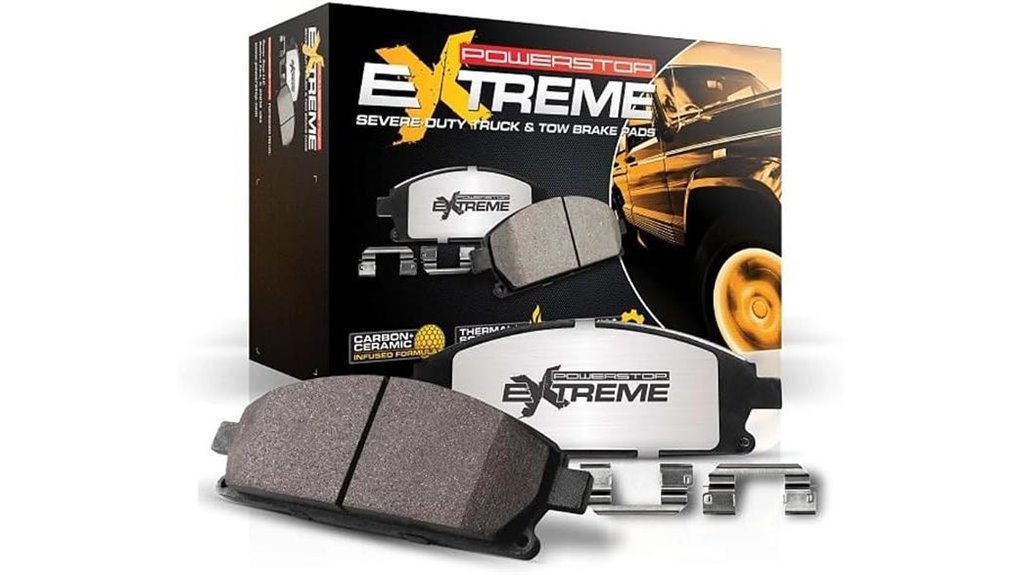
Best Overall for Towing & Hauling
At a Glance
- Why you’ll like it: Extra bite and fade resistance for towing and hauling, with less wheel dust than many metallic pads.
- Position: Front axle (one set covers both front wheels)
- Friction material: Carbon-fiber ceramic (Z36 Truck & Tow compound)
- Listed fitment: 2012–2022 F-250 and F-350 Super Duty; 2013–2016 F-450 Super Duty
- In the box: Pads with stainless-steel shims, stainless-steel installation hardware, and brake lubricant
The PowerStop Z36 Truck & Tow Z36-1680 front set is built for F-250 Super Duty owners who regularly tow, haul, or drive steep grades, where standard replacement pads can start to fade. Its carbon-fiber ceramic formulation is designed to add bite without the heavy dust of many metallic pads; PowerStop rates the Z36 compound’s friction coefficient about 17% higher than OE pads and markets it for fade resistance under load. The low-dust compound helps keep wheels cleaner, while chamfered, slotted pads and stainless-steel shims target noise and vibration. Included stainless-steel hardware and brake lubricant support a straightforward bolt-on installation. PowerStop’s Amazon listings describe a 30-day / 12-month / 12,000-mile limited warranty for Z36 pads, but terms can vary by seller, so confirm the current coverage before you buy.
Best For: F-250 and F-350 Super Duty owners who tow trailers, carry heavy payloads, drive mountain grades, or run larger wheel-and-tire packages.
Pros:
- Carbon-fiber ceramic compound is designed for extra stopping power and fade resistance under load.
- Low-dust, quiet-focused design helps keep wheels cleaner than many semi-metallic pads.
- Includes stainless-steel hardware, shims, and lubricant for a more complete brake job.
Cons:
- Listed for 2012–2022 trucks only; 2023-and-newer Super Duty models need a different pad.
- Likely more brake capability than you need if your truck rarely tows or hauls.
- Warranty wording varies by listing and seller, so check the current terms before ordering.
Skip It If: You mostly drive unloaded and want the simplest quiet replacement, or you own a 2023–2026 F-250.
BOSCH BSD1680 Severe Duty Semi-Metallic Disc Brake Pad Set – Front
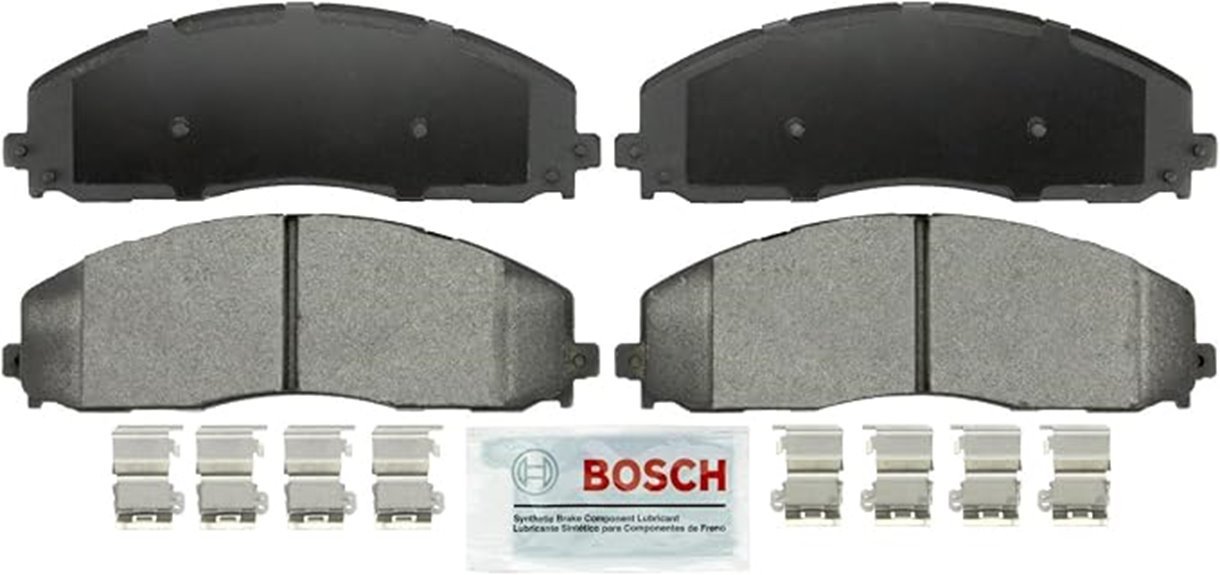
Best Semi-Metallic Front Set for Heavy Payloads
At a Glance
- Why you’ll like it: Work-truck durability with OE-style shims for consistent, quieter stops under heavy loads.
- Position: Front axle (one set covers both front wheels)
- Friction material: Severe Duty semi-metallic
- Listed fitment: Select 2013–2022 F-250 and F-350 Super Duty (some catalogs add certain 2023 builds); 2013–2016 F-450 Super Duty
- In the box: Pads for one axle, synthetic lubricant, and hardware where applicable
Heavy-duty F-250 owners who regularly haul payloads or face stop-and-go traffic may benefit from the BOSCH BSD1680’s durable semi-metallic friction material. Bosch designs its Severe Duty line for vehicles that carry heavy payloads or see constant stop-and-go use, aiming for consistent braking, quiet operation, and long life under demanding conditions. OE-style multilayer shims, slots, and chamfers (where specified) promote proper fitment and help manage noise and vibration. Each package covers one axle (two wheels) and includes synthetic lubricant plus hardware as applicable. Bosch states that its Severe Duty pads are engineered, tested, and manufactured in North America. For a matched refresh, pair this front set with the BOSCH BSD1691 rear set. Compatibility is limited to select Super Duty models, so vehicle-specific verification remains essential before purchase or installation.
Best For: Heavy-duty Ford F-250, F-350, and F-450 owners who frequently haul heavy payloads, run work routes, or drive in stop-and-go conditions.
Pros:
- Durable semi-metallic friction material designed for demanding, heavy-payload use.
- OE-style multilayer shims, slots, and chamfers support proper fitment and help reduce noise and vibration.
- Covers the full front axle and includes synthetic lubricant plus hardware where applicable.
Cons:
- Compatible only with select Super Duty models, so vehicle verification is required.
- Semi-metallic pads may produce more noise and dust than ceramic alternatives.
- Warranty terms are not spelled out on the Amazon listing (available on request from customer service), so confirm coverage before buying.
Skip It If: Clean wheels and near-silent stops matter more to you than work-truck durability; a ceramic set may suit you better.
Detroit Axle – Front Brake Pads for 2012-2022 Ford F-250 Super Duty
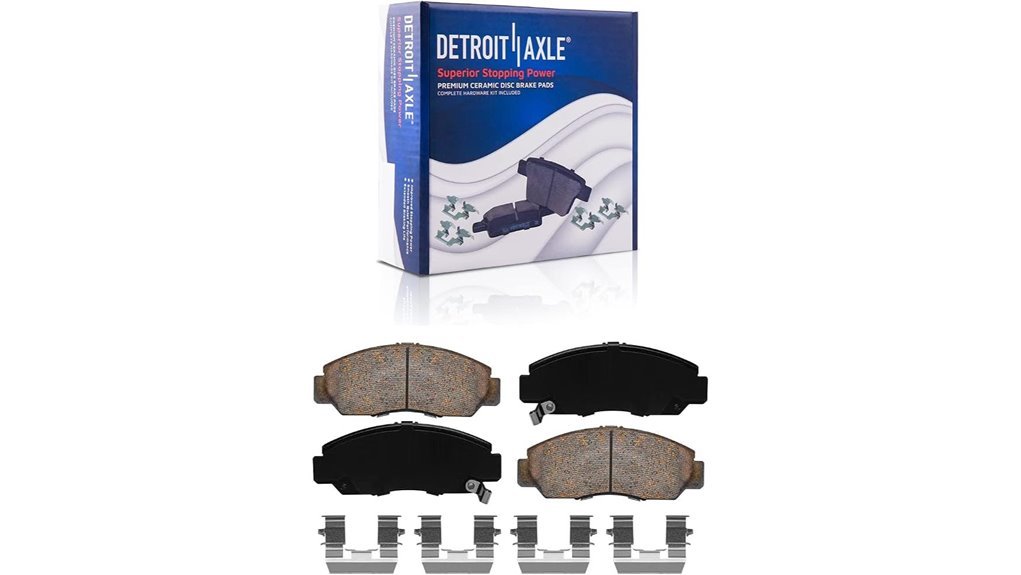
Best for Quiet Daily Driving
At a Glance
- Why you’ll like it: Quiet, low-dust front braking for daily driving and cleaner wheels.
- Position: Front axle
- Friction material: Ceramic
- Listed fitment: 2012–2022 F-250 Super Duty; 2013–2022 F-350 Super Duty
- Part number: P-1680
- In the box: Front ceramic pads; the listing title mentions hardware, so confirm contents in the listing photos
Detroit Axle front ceramic brake pads suit F-250 owners seeking quiet, low-dust stopping for everyday driving. This set, part number P-1680, is listed for 2012–2022 Ford F-250 Super Duty and 2013–2022 F-350 Super Duty trucks. Detroit Axle says its premium ceramic formulation delivers smoother, quieter stops and longer life than generic metallic pads, and that the pads are tested for impact, wear, and fatigue. It is a sensible choice for commuting and general driving when you want cleaner wheels and a quieter cabin. If you tow heavy trailers often, a severe-duty set such as the PowerStop Z36-1680 or BOSCH BSD1680 is the stronger match.
Best For: Ford F-250 and F-350 Super Duty owners who mainly commute or drive unloaded and want quiet, low-dust front braking.
Pros:
- Premium ceramic formulation is designed for smooth, quiet stopping.
- Low-dust design helps keep wheels cleaner than typical metallic pads.
- Manufacturer states the pads are tested for impact, wear, and fatigue.
Cons:
- Not marketed as a severe-duty or towing pad, so frequent heavy towing calls for a Truck & Tow or Severe Duty set.
- Package-contents wording is brief; check the listing photos to confirm you get inner and outer pads for both front wheels.
- Detroit Axle’s published warranty covers brake pads for 6 months only when purchased with rotors or drums, and it excludes commercial and fleet use.
Skip It If: You tow near your truck’s limits, run it as a commercial or fleet vehicle, or want warranty coverage on a pads-only purchase.
BOSCH BSD1691 Severe Duty Disc Brake Pad Set – Rear
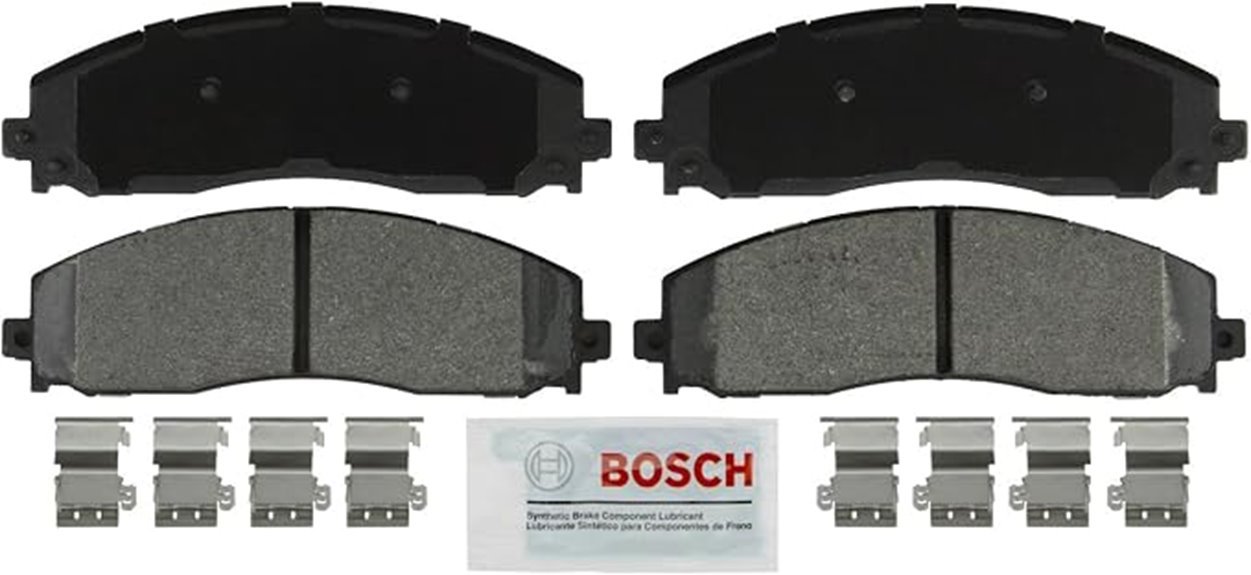
Best Rear Pad Set
At a Glance
- Why you’ll like it: The rear-axle partner to the BSD1680, built for payloads and stop-and-go use.
- Position: Rear axle (one set covers both rear wheels)
- Friction material: Severe Duty semi-metallic
- Listed fitment: Select 2013–2022 F-250 and F-350 Super Duty (some catalogs add certain 2023 builds); 2013–2016 F-450 Super Duty
- In the box: Pads for one axle, synthetic lubricant, and hardware where applicable
Bosch BSD1691 rear pads suit F-250 Super Duty owners who frequently haul heavy payloads or drive in stop-and-go traffic, and they are the only rear-axle set in this guide. Their severe-duty semi-metallic formulation uses what Bosch calls its latest friction technology to support consistent braking during rigorous operation. Bosch states the pads are engineered, tested, and manufactured in North America, with a focus on quiet performance and long service life. OE-style multilayer shims, slots, and chamfers are included where specified to help manage noise and promote proper fitment. Each package contains pads for one axle (two wheels), plus synthetic lubricant and hardware as applicable. A protective paper inner wrap helps safeguard the pads during shipping. Rear-pad listings for this shape generally start with 2013 trucks, so 2012 owners should confirm fit carefully.
Best For: F-250 Super Duty owners replacing worn rear pads, especially those pairing it with the BOSCH BSD1680 front set for a matched front-and-rear refresh.
Pros:
- Severe-duty semi-metallic formulation supports consistent braking under rigorous use.
- OE-style shims, slots, chamfers, hardware, and synthetic lubricant are included where applicable.
- Designed for quiet operation and long service life, with North American engineering, testing, and manufacturing.
Cons:
- Semi-metallic pads may produce more dust or noise than ceramic alternatives.
- Rear axle only; the front brakes need a separate set.
- Fitment varies by model year (2012 trucks typically use a different rear pad), so confirm compatibility before purchase.
Skip It If: You need front pads, or your truck is a 2012 or 2023-and-newer model without confirmed fit.
Factors to Consider When Choosing Brake Pads for F250 Super Duty
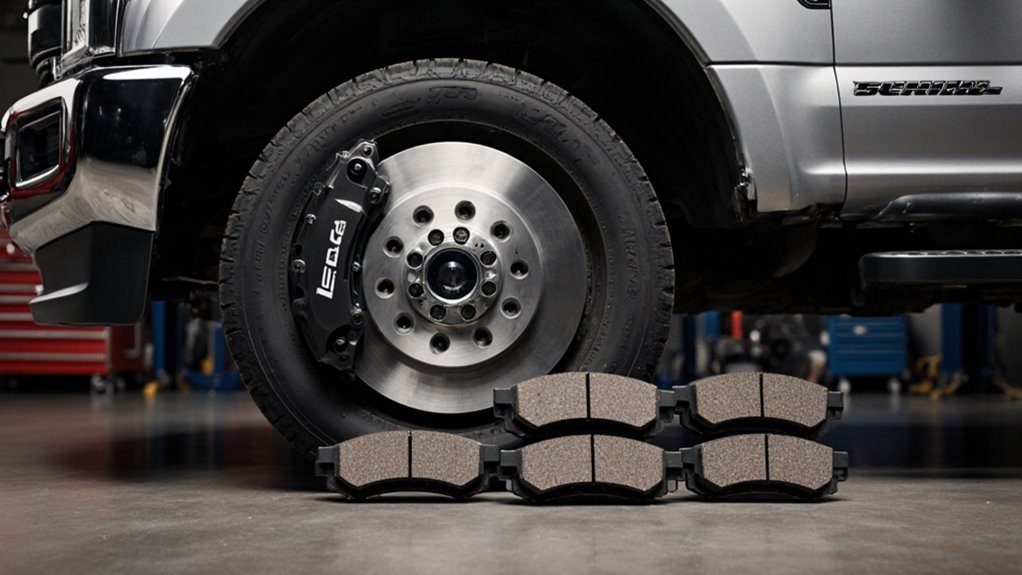
Choosing brake pads for an F-250 Super Duty requires considering towing and hauling demands, friction material, heat and fade resistance, and whether you are servicing the front or rear axle. Noise and dust control also affect daily driving comfort and maintenance. Accurate vehicle fitment remains essential for reliable installation and braking performance.
Towing And Hauling Demands
Towing and hauling place additional weight and heat demands on an F-250 Super Duty’s braking system, so its pads must deliver consistent stopping power without premature fade. Drivers who frequently tow trailers or carry heavy payloads should prioritize pads the manufacturer designs for severe-duty or truck-and-tow use, since those compounds are formulated to resist performance loss during repeated stops, long descents, and demanding routes. The pads must also match your truck’s model year, axle, and brake system, because proper fit is essential for contact, alignment, and safety. Low-dust formulations can help limit wheel buildup, while noise-reducing shims may improve cabin comfort. These considerations matter most when your F-250 regularly operates near its rated towing or payload limits.
Friction Material Selection
For an F-250 Super Duty, friction material selection directly affects stopping power, heat management, noise, and brake-dust levels under demanding use. Ceramic pads generally produce less noise and dust, making them suitable for drivers who prioritize clean wheels and quieter operation. Semi-metallic pads offer strong durability and effective heat transfer, which benefits trucks that haul, tow, or see frequent stop-and-go driving. Carbon-fiber ceramic materials, such as PowerStop’s Z36 compound, are designed to add stopping power and fade resistance for towing and hauling while keeping dust low. Regardless of material, compatibility with your specific F-250 Super Duty is essential for proper fitment, consistent braking, and maximum pad life. Balancing these factors helps match pads to your operating priorities.
Heat And Fade Resistance
Heat resistance is critical in F-250 Super Duty brake pads because heavy loads, towing, and repeated braking can generate enough heat to cause brake fade and reduce stopping power. Pads chosen for high-stress applications should maintain stable friction at elevated temperatures. Carbon-fiber ceramic compounds are formulated to hold up under towing heat, while semi-metallic formulations generally dissipate heat more effectively than organic materials, making them suitable for frequent, forceful stops. Independent fade-test data is rarely published for replacement pads, so a practical signal is whether the manufacturer specifically designs the pad for severe-duty, towing, or heavy-payload use. Healthy rotors and a proper bed-in also help keep stopping power predictable, particularly when the truck operates near its rated capacity.
Noise And Dust Control
Beyond heat and fade resistance, noise and dust control also influence the daily performance of F-250 Super Duty brake pads. Low-dust formulations help keep wheels cleaner, reducing washing frequency and preserving the truck’s appearance. Material selection strongly affects dust output: ceramic and carbon-fiber ceramic compounds generally produce less residue than traditional semi-metallic formulations. Noise also influences driving comfort, particularly during frequent stops or light braking. Ceramic pads typically operate more quietly than semi-metallic pads, which can generate more squeal and vibration. Multilayer shims and chamfered edges further help reduce unwanted sounds by controlling pad movement and contact. Proper installation matters as well: compatible hardware, correct lubrication where specified, and secure fitment minimize vibration and prevent avoidable noise.
Vehicle Fitment Accuracy
Vehicle fitment accuracy means the brake pads match your F-250 Super Duty’s specific model year, axle, and braking configuration. That match is essential for reliable performance, proper operation, and safe stopping. Pads designed for the correct specifications help prevent installation problems and support consistent contact with the rotor, minimizing noise, vibration, and uneven wear. For the pads in this guide, that means a 2012–2022 or 2013–2022 truck: most 2023–2026 Super Duty models use a different pad, and 2012 is a split year for rear pads. Use Amazon’s fitment checker, compare the pad-shape number (such as D1680 front or D1691 rear), or confirm by VIN with a parts counter. For trucks used for towing or hauling, getting the exact application right matters even more under heavier loads.
Front vs. Rear Pad Sets
Brake pads are sold per axle, and front and rear sets are different parts. The front brakes handle most of the stopping force, so front pads usually wear faster, especially on trucks that tow. Replace pads as a complete axle set (both wheels) and inspect the other axle while the wheels are off. In this guide, the PowerStop Z36-1680, BOSCH BSD1680, and Detroit Axle P-1680 are front sets, while the BOSCH BSD1691 is the rear set.
Rotor and Caliper Condition
New pads perform best on healthy rotors and free-moving calipers. Measure rotor thickness against the minimum stamped on the rotor, and look for deep grooves, cracks, or heat spots before installing new pads. Caliper slide pins on Super Duty trucks can corrode and seize, which causes dragging and uneven pad wear, so clean and lubricate them with the correct brake lubricant at every pad change.
Hardware And Warranty
Installation hardware and warranty coverage are important considerations when choosing brake pads for an F-250 Super Duty. Complete hardware kits can simplify installation and help confirm compatibility with the vehicle’s braking system. Stainless-steel clips, shims, and springs are particularly useful because they resist corrosion and may reduce operational noise. Check whether the set includes all required components or whether you need to buy hardware separately.
A limited warranty covers manufacturing defects, not normal wear. Terms vary widely by brand, seller, and whether you buy pads alone or as a pad-and-rotor kit, so read the current listing before you order. Look closely at exclusions: some policies exclude misuse, improper installation, racing, commercial or fleet use, or damage linked to towing. Brands with responsive customer support can make claims easier to manage if premature wear, defective materials, or fitment problems occur after purchase.
Before You Buy: Quick Checklist
- Confirm your model year and run Amazon’s fitment check or a VIN lookup.
- Pick the axle you are servicing: front, rear, or both (one set per axle).
- Match the compound to your use: carbon-fiber ceramic or semi-metallic for towing and hauling, ceramic for quiet daily driving.
- Check what is in the box: hardware, shims, and lubricant.
- Read the current warranty terms and exclusions.
- Inspect rotors and caliper slide pins before installation.
Safety Note: Brakes are safety-critical. If you are not confident using jack stands, following torque specifications, and servicing calipers, have a qualified technician install your pads. After any pad change, pump the brake pedal until it feels firm before driving, then test the brakes at low speed.
Frequently Asked Questions
How Often Should F-250 Super Duty Brake Pads Be Replaced?
A commonly quoted range for F-250 brake pads is roughly 30,000–70,000 miles, but driving conditions can shift that interval dramatically. An F-250 Super Duty used for towing, hauling, frequent city driving, or mountain travel may need pads much sooner. Have pad thickness checked during routine service. Many technicians recommend replacement when pads approach about 3–4 millimeters of friction material, wear unevenly, squeal persistently, or trigger a warning indicator; follow Ford’s service specifications for your truck.
What Symptoms Indicate That My F-250 Brake Pads Need Immediate Replacement?
Immediate replacement is indicated when an F-250 produces persistent grinding, severe squealing, scraping, or metal-on-metal noises during braking. Other warning signs include a brake warning light, noticeably longer stopping distances, pedal pulsation, excessive pedal travel, pulling to one side, or visible pad material of roughly 3 millimeters or less. A burning smell, smoke, fluid leakage, or reduced braking performance means you should stop safely and arrange a professional inspection or tow without delay.
Can I Replace F-250 Brake Pads Myself Without Professional Mechanical Experience?
A careful DIYer can replace F-250 brake pads, but the job requires mechanical confidence, proper tools, and strict safety practices. Support the truck on quality jack stands, never on a jack alone. Service procedures vary by model year, so follow the correct repair manual, torque caliper bolts and lug nuts to Ford’s specifications, and clean and lubricate the caliper slide pins. Anyone uncertain about caliper handling, torque specifications, or rotor condition should use a qualified technician. Before driving, pump the brake pedal until it is firm, then make a cautious low-speed test drive.
How Should New Brake Pads Be Bedded in After Installation?
Follow the pad manufacturer’s bed-in instructions first, because procedures differ by brand. A typical approach is a controlled sequence, not a series of emergency stops: in a safe, traffic-free area, make several moderate stops from about 30–35 mph down to 5–10 mph, allowing roughly 30 seconds of cooling between applications, then a few firmer stops. Avoid coming to a full stop and holding the brakes while they are hot, which can imprint pad material on the rotors. Afterward, drive without heavy braking so the brakes can cool fully before normal use.
Are Ceramic or Semi-Metallic Pads Quieter During Everyday F-250 Driving?
Ceramic brake pads are generally quieter during everyday F-250 driving than semi-metallic pads. They usually produce less squeal and brake dust, making them comfortable for commuting and light-duty use. Semi-metallic pads can generate more noise because of their metallic content, but they often provide stronger heat handling and durability under towing or heavy loads. Proper installation, clean hardware, correct lubrication, and a thorough bed-in can reduce noise with either pad type.
Will These Brake Pads Fit a 2023–2026 F-250 Super Duty?
In most cases, no. The pads in this guide are listed for 2012–2022 or 2013–2022 trucks. Most 2023-and-newer Super Duty trucks use a redesigned brake pad, although a few catalogs extend some of these part numbers to certain 2023 builds. Confirm fit with Amazon’s fitment checker or by VIN before ordering.
Do I Need to Replace Front and Rear Brake Pads at the Same Time?
Not necessarily. Pads should always be replaced as a full axle set (both wheels), but front and rear pads wear at different rates. Front pads usually wear faster because they do most of the braking. Inspect both axles at each service, especially if you tow, and replace each axle’s pads when they reach the service limit.
Should I Replace or Resurface Rotors When I Change Brake Pads?
Inspect the rotors every time you replace pads. Replace them if they are at or below the minimum thickness stamped on the rotor or show cracks. If they are within spec but grooved or causing pedal or steering-wheel pulsation, resurfacing or replacement may be needed. Installing new pads on worn rotors can lead to noise, vibration, and a poor bed-in.
Final Verdict: Which F-250 Brake Pads Should You Buy?
Choosing the best brake pads for an F-250 Super Duty depends on towing demands, driving conditions, axle position, model year, and budget. PowerStop, Bosch, and Detroit Axle each offer practical options, from heavy-duty towing performance to quiet everyday braking. Pads built for severe duty may cost more up front, but if you tow or haul regularly, their added heat and fade resistance deserves priority. By matching pad design to your truck’s workload and verifying compatibility, you can get safer, more confident braking in 2026.
Final Recommendation
- Tow or haul often? Start with the PowerStop Z36-1680 Truck & Tow front set.
- Want matched semi-metallic sets front and rear? Pair the BOSCH BSD1680 front set with the BOSCH BSD1691 rear set.
- Mostly commuting? The Detroit Axle P-1680 ceramic front set targets quiet, low-dust stops.
- Driving a 2023–2026 F-250? Confirm fitment first; most newer trucks need a different pad.
