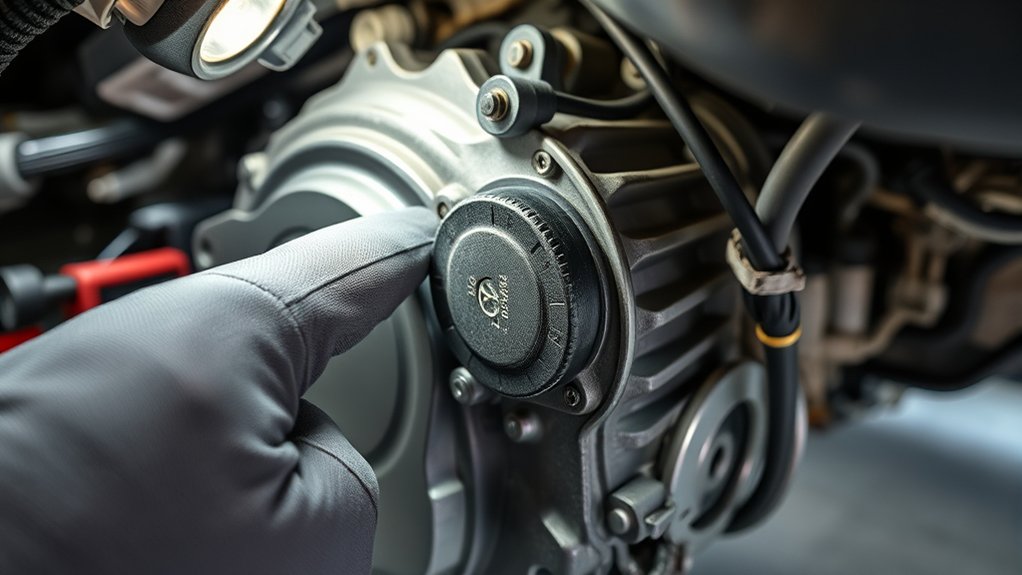
Finding the correct transmission identification for your Toyota Camry is not always as simple as checking one universal spot. Your car may have a transmission family code, assembly serial number, casting number, part number, and VIN-based build record. The safest method is to start with the full VIN, confirm the engine and model year, and inspect the transmission case only when physical verification is needed.
Quick Answer
Start with your Camry’s 17-character VIN and use Toyota’s official parts catalog, a Toyota dealer, or Toyota TIS to confirm the installed transmission. If you need a physical serial number or case code, locate it using the repair manual for your exact year, engine, and market because the position can vary.
Key Takeaways
- Use the full VIN before relying on a visual code or an online model-year chart.
- A transmission family code is different from a serial number, casting number, part number, or diagnostic trouble code.
- Some case markings may be beneath or near the air cleaner assembly, but that location is not universal for every Camry.
- Do not order a replacement transmission using only the model year and engine size.
- Use only the transmission fluid specification listed for your exact vehicle and transmission.
At a Glance
| Time Required | 5–20 minutes for VIN research and a basic visual check |
| Difficulty | Easy for VIN lookup; moderate if components must be removed for case access |
| Tools Needed | VIN, flashlight, phone camera, clean rag, and the correct Toyota service information |
| Cost | Usually free; professional repair-information access or dealer inspection may cost extra |
Where to Find the Toyota Camry Transmission Identification Code
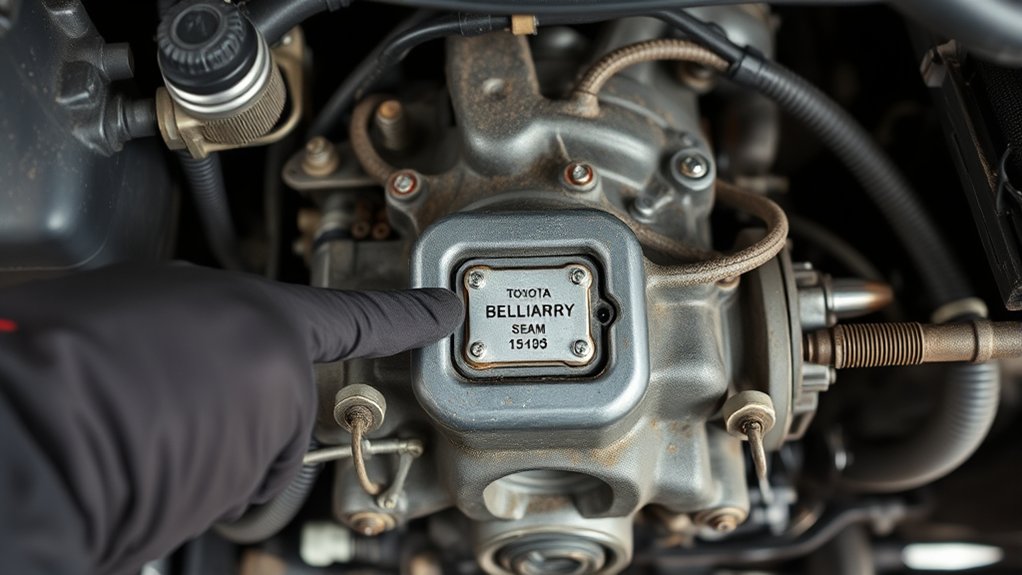
The best location depends on which identifier you need. For most owners, the safest starting point is not the transmission case. Begin with the VIN and use vehicle-specific Toyota data to identify the original drivetrain configuration.
1. Start With the Full VIN
Your Camry’s VIN is a 17-character vehicle identifier. You can usually find it:
- At the lower driver-side corner of the windshield
- On the driver-side doorjamb label
- On the registration or title
- On the insurance card
Enter the VIN in the Toyota Genuine Parts catalog to browse parts associated with the vehicle. You can also use the NHTSA VIN Decoder to confirm manufacturer-reported details such as model year, engine information, and assembly plant.
Note: A public VIN decoder may not display Toyota’s internal transmission family code. A Toyota parts department or Toyota TIS can use the full VIN to access more specific build and repair information.
2. Check the Vehicle Labels
Some Toyota vehicles and markets use a model or identification plate that includes engine, transmission, axle, or model information. Other Camrys may show only the VIN, production date, weight ratings, and tire information on the doorjamb certification label.
Do not assume that every driver-side label contains a field marked “TRANS/AXLE.” Read the complete label and compare it with the documentation for your exact vehicle.
3. Inspect the Transmission Case When Necessary
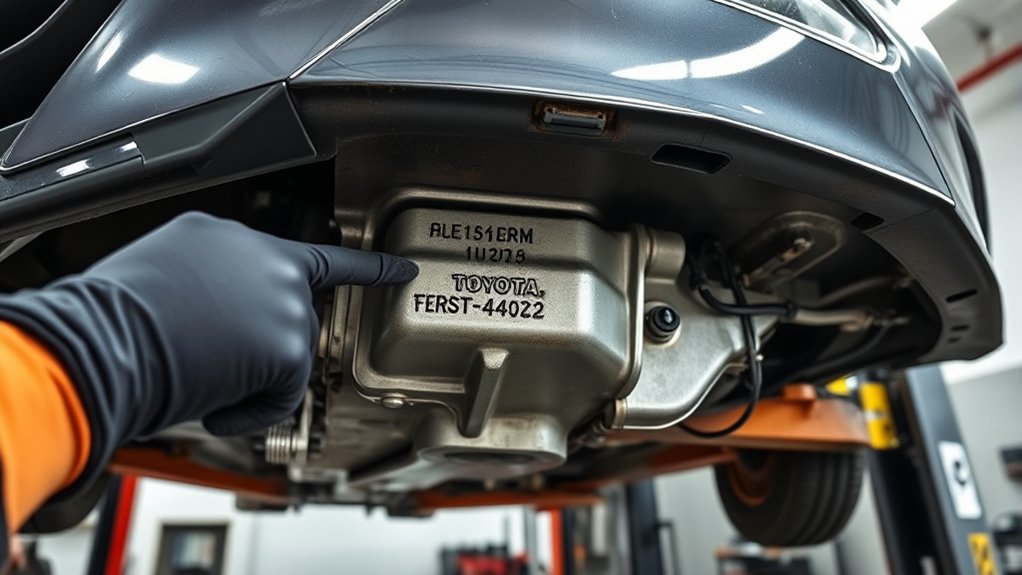
A transmission assembly may have a stamped serial number, engraved code, barcode label, or identification plate on its case. On some Camry configurations, the relevant area may be beneath or close to the air cleaner housing. On others, the marking may be positioned elsewhere on the transaxle case.
Use the repair manual for your exact year, engine, market, and drivetrain before removing any intake component. Toyota’s Technical Information System provides factory repair manuals and service information for North American vehicles.
Warning: Park on a level surface, apply the parking brake, switch the engine off, and allow hot components to cool. Keep your hands away from belts and electric cooling fans. On a Camry Hybrid, do not touch orange high-voltage cables or remove hybrid components.
Do Not Confuse These Identifiers
| Identifier | What It Tells You | Best Use |
|---|---|---|
| VIN | The vehicle’s identity and manufacturer-reported configuration | Starting a parts or service lookup |
| Transmission family code | The basic transmission or transaxle design | Repair procedures and major-component matching |
| Assembly serial number | The identity or production sequence of the installed assembly | Confirming a specific installed or replacement unit |
| Part number | A Toyota service or replacement component number | Ordering a complete unit or related component |
| Casting number | The design or mold used for one section of the housing | Supporting evidence only, not complete fitment proof |
| Diagnostic trouble code | A detected fault such as a sensor, solenoid, pressure, or ratio problem | Troubleshooting a warning light or operating problem |
Why the Correct Transmission Identification Matters
Correct identification helps you avoid ordering a transmission, valve body, sensor, seal, mount, or control component that does not match your Camry. It also directs a technician to the correct repair procedure and fluid specification.
Essential for Parts and Service
| Task | Why Identification Matters |
|---|---|
| Ordering parts | Connectors, control units, gear ratios, sensors, and housings may differ. |
| Selecting fluid | The required fluid must match the specific transmission application. |
| Using repair procedures | Fill temperatures, torque values, fluid levels, and diagnostic tests can differ. |
| Buying a used unit | The year and engine alone may not confirm electronic or mechanical compatibility. |
| Documenting a replacement | Records can show what was installed and why it was considered compatible. |
How It Supports Accurate Diagnostics
The transmission identification tells a technician which hardware and service procedure apply. It does not identify the fault by itself. Actual troubleshooting may require a scan tool, diagnostic trouble codes, fluid-level checks, electrical tests, pressure tests, or mechanical inspection.
For example, two transmissions may use similar housings but have different control software, solenoids, connectors, or final-drive ratios. Correct identification helps the technician select the right wiring diagram, test values, and repair instructions.
The transmission family code tells you what unit you have. A diagnostic trouble code tells you what fault the vehicle has detected.
How Model Year, Engine, and Production Details Affect the Code
Model year matters, but it is only one part of transmission identification. Engine choice, hybrid status, production date, assembly plant, destination market, trim, and midyear engineering changes can also affect the installed unit.
Major Camry Powertrain Differences
For U.S.-market 2012–2017 Camry models, the broad categories include six-speed automatic transaxles in gasoline models and an electronically controlled power-split transaxle in Camry Hybrid models. Common family-code examples in service and parts references may include U-series codes for gasoline models and a P-series designation for the hybrid transaxle.
| Powertrain | General Transmission Type | Why VIN Verification Is Still Needed |
|---|---|---|
| 2.5-liter gasoline four-cylinder | Six-speed automatic transaxle | Running changes, production details, electronics, and part supersessions may differ. |
| 3.5-liter gasoline V6 | Six-speed automatic transaxle designed for the V6 application | It is not interchangeable with the four-cylinder unit simply because both have six speeds. |
| Camry Hybrid | Hybrid power-split electronic transaxle, often described as an eCVT | Its design, electronics, service procedures, and safety requirements differ from a conventional automatic. |
Model-Specific and Market-Specific Differences
A Camry sold in another country may use a different engine or transmission from a U.S.-market car with the same model year. Production changes can also occur without a major exterior redesign.
Before buying a transmission or internal component, compare:
- The full VIN
- Model year and production date
- Engine code and displacement
- Gasoline or hybrid configuration
- Transmission family and assembly identification
- Connector locations and sensor configuration
- Final-drive or axle information when applicable
- Toyota part-number supersessions
Why Year-Only Identification Is Risky
A listing that says “fits 2012–2017 Camry” may cover several different powertrains. Even when the housing appears similar, internal ratios, electronics, mounting points, or calibration requirements can prevent proper operation.
Pro Tip: Give the seller your VIN and ask for the donor transmission’s family code, serial or assembly number, donor VIN, mileage, production date, and warranty terms. Keep those details with the repair invoice.
Why Accurate Identification Is Vital Before Repairs
Accurate transmission identification is most important when you are about to spend money or perform a procedure that depends on the exact unit. It helps reduce compatibility errors and prevents the use of a repair method intended for another transmission.
Confirm the transmission before:
- Ordering a complete replacement assembly
- Buying a valve body, torque converter, solenoid, sensor, seal, or control module
- Selecting transmission fluid
- Performing a fluid-level or refill procedure
- Using a wiring diagram or diagnostic flowchart
- Programming or replacing a transmission-related control unit
- Installing a used or rebuilt transmission
The code is a reference tool. It does not improve performance by itself, and repeatedly reading it is not a maintenance task.
How to Maintain Your Camry Transmission Effectively
Transmission maintenance should follow the schedule and procedures for your exact Camry. Use Toyota’s Manuals and Warranties portal to select the correct model year and review the owner’s manual and maintenance guide.
Use the Correct Fluid Specification
Toyota ATF WS and Toyota ATF T-IV are different fluid specifications. One should not be treated as a universal upgrade for the other. Use only the specification listed for your VIN, transmission, and market.
Many modern Camry automatic transaxles do not use a traditional owner-serviceable dipstick. Correct fluid-level checking may require the vehicle to be level, the fluid to be within a specified temperature range, and the proper fill and overflow procedure to be followed.
Warning: Adding the wrong fluid or setting the level incorrectly can cause poor shifting, overheating, aeration, leakage, or internal damage. Do not guess based on fluid color or a general compatibility claim.
Watch for Symptoms That Need Inspection
Arrange a professional inspection if you notice:
- Delayed engagement when selecting Drive or Reverse
- Harsh, slipping, flaring, or repeated shifting
- A transmission or check-engine warning light
- A fluid leak beneath the vehicle
- Burning odors or unusual whining, grinding, or humming
- Reduced-power or fail-safe operation
- New vibration during acceleration
These symptoms do not identify the failed part by themselves. A technician should inspect the vehicle, scan all relevant modules, check fluid condition and level where appropriate, and follow the correct Toyota diagnostic procedure.
Using Transmission Identification During Diagnostics
Begin diagnostics by recording the VIN, engine, transmission family, current symptoms, warning lights, and stored diagnostic trouble codes. The transmission identifier helps you select the correct technical information, but a scan tool is normally required to read electronic faults.
A useful diagnostic sequence is:
- Confirm the vehicle and transmission identification.
- Interview the driver and reproduce the symptom safely.
- Scan the engine, transmission, hybrid, ABS, and related control modules.
- Record current, pending, and history trouble codes before clearing anything.
- Check for relevant Toyota service bulletins or calibration updates.
- Inspect fluid leaks, wiring, connectors, mounts, and cooling components.
- Follow the model-specific diagnostic chart for the recorded codes and symptoms.
Do not replace a transmission solely because a trouble code contains the words “gear ratio,” “pressure,” or “solenoid.” Wiring faults, low fluid, control problems, damaged sensors, or other conditions can produce similar symptoms.
How to Use the Transmission Code for Repairs
Once you have confirmed the correct identifier, use it with the VIN to verify every repair part and procedure.
- Record the VIN and production date. Photograph the doorjamb label and windshield VIN.
- Confirm the engine and hybrid status. A four-cylinder gasoline, V6, and hybrid Camry do not use the same transmission design.
- Obtain the Toyota transmission identification. Use Toyota parts data, a dealer parts department, or Toyota TIS.
- Photograph the installed case marking. Clean the area gently and use a flashlight or phone camera rather than aggressive scraping.
- Compare the replacement unit. Check the family code, assembly number, connectors, mounts, sensors, final-drive information, and Toyota part number.
- Verify the fluid and installation procedure. Use the service information for the identified transmission.
- Document the repair. Keep the replacement unit’s identification, donor information, invoice, mileage, and warranty.
What to Do If the Code Is Unreadable
- Use a bright flashlight from several angles.
- Take close-up photographs and increase contrast on the phone.
- Remove loose dirt with a soft cloth and an approved cleaner.
- Do not grind, sand, or deeply scrape the housing.
- Ask a Toyota dealer or transmission specialist to identify the unit by VIN and physical features.
- If the transmission was replaced previously, obtain the repair invoice or donor information.
Do Not Buy a Transmission From a Casting Number Alone
A casting number may identify only one housing section. Several transmission versions can share similar castings while using different internal parts or electronics. Treat a casting number as supporting evidence, not final proof of interchangeability.
How Transmission Records Can Affect Resale Confidence
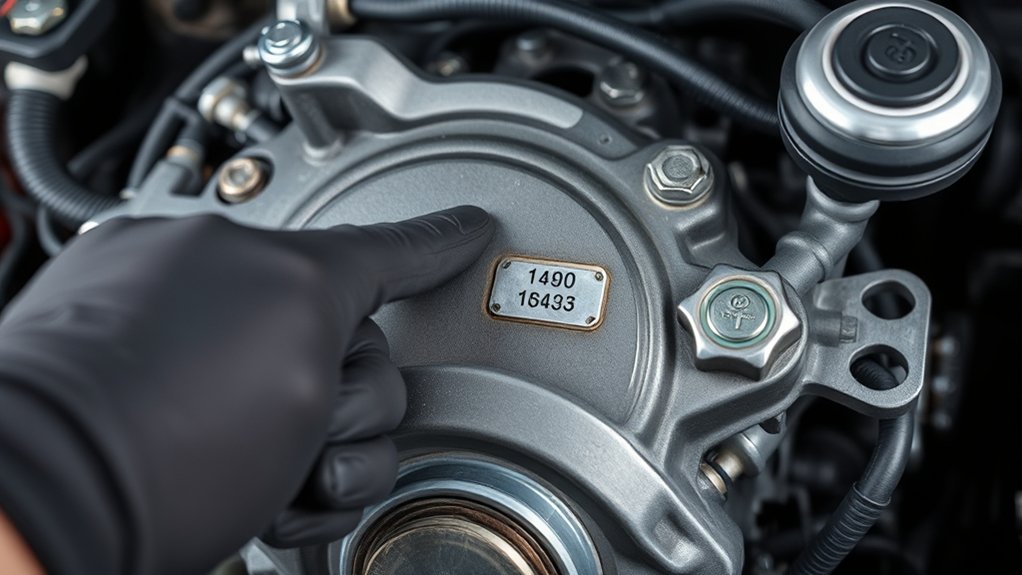
A transmission code does not automatically increase your Camry’s market value. However, clear documentation can help a buyer understand what work was completed and whether a replacement transmission was matched correctly.
Useful records include:
- The VIN and vehicle mileage at the time of repair
- The diagnosed problem and recorded trouble codes
- The transmission family or assembly identification
- The part number of the installed unit
- Whether the unit was new, remanufactured, rebuilt, or used
- The donor VIN and donor mileage for a used unit
- The installer’s invoice and warranty
- The fluid specification and related parts replaced
A missing or unreadable code is not proof that a transmission is defective. The concern is whether the installed unit can be verified as compatible and whether the repair is documented.
Tips for Proactive Transmission Care
- Keep the VIN, owner’s manual, maintenance guide, and repair invoices together.
- Use VIN-based Toyota data before ordering transmission-related parts.
- Follow the maintenance schedule for your driving conditions.
- Have leaks, warning lights, or shifting changes inspected promptly.
- Do not mix fluid specifications or use a universal fluid without verified approval for the application.
- Avoid towing or loading the vehicle beyond its published limits.
- Confirm that cooling-system and engine problems are repaired because overheating or poor engine operation can affect transmission behavior.
- Record the identification of any replacement transmission for future service.
Frequently Asked Questions
Where is the transmission code on a Toyota Camry?
Start with the VIN and Toyota’s vehicle-specific parts or repair data. A physical serial number or case marking may be on the transaxle housing, sometimes beneath or near intake components, but the exact position varies by year, engine, and transmission.
Can the VIN tell me which transmission my Camry has?
The VIN is the best starting point. Toyota parts systems, a Toyota dealer, or Toyota TIS can use it to identify the vehicle’s original configuration. Public VIN decoders may show the transmission type but may not display every internal Toyota family or assembly code.
How do I know whether I found the correct transmission number?
Compare the number with Toyota’s VIN-based service or parts data. Make sure you are reading a family code, serial number, or part label rather than a casting number. A dealer or transmission specialist can confirm an unclear marking.
What is the difference between Toyota ATF WS and ATF T-IV?
They are different Toyota fluid specifications intended for different applications. Do not select one because it is newer or described as thinner. Use the exact specification listed in the owner’s manual, maintenance information, or factory repair procedure for your VIN and transmission.
Where are the numbers located on the transmission itself?
They may be stamped, engraved, or printed on a label attached to the transmission case. The location can be on the upper, front, side, or bellhousing area and may be hidden by intake components. Use the correct Toyota repair manual before removing anything.
Can I buy a used Camry transmission using only the model year?
No. Confirm the VIN, engine, hybrid status, production details, transmission family, connectors, mounts, sensors, final-drive information, and part-number interchange. Ask for the donor VIN and assembly identification before purchasing.
Does a Camry Hybrid use a normal automatic transmission?
No. A Camry Hybrid uses a hybrid power-split transaxle that is commonly described as an electronic continuously variable transmission. Its design and service procedures differ from a conventional stepped automatic transmission.
Conclusion
The most reliable way to identify your Toyota Camry transmission is to begin with the full VIN and confirm the vehicle through Toyota’s parts or service information. Inspect a physical case marking only when you need to verify the installed assembly. Before ordering parts, compare the VIN, engine, transmission family, production details, connectors, and Toyota part information.
Do not rely on the model year, a casting number, or a general claim that every Camry code is beneath the air cleaner box. Careful identification helps you select compatible parts, use the correct fluid and repair procedure, and document any replacement transmission properly.
Sources
- Toyota Manuals and Warranties — vehicle-specific owner’s manuals, warranty information, and maintenance guides
- Toyota Technical Information System — factory repair manuals, service bulletins, wiring diagrams, and diagnostic information
- Toyota Genuine Parts — VIN-based vehicle and parts-fitment lookup
- NHTSA VIN Decoder — manufacturer-reported vehicle information associated with a VIN

