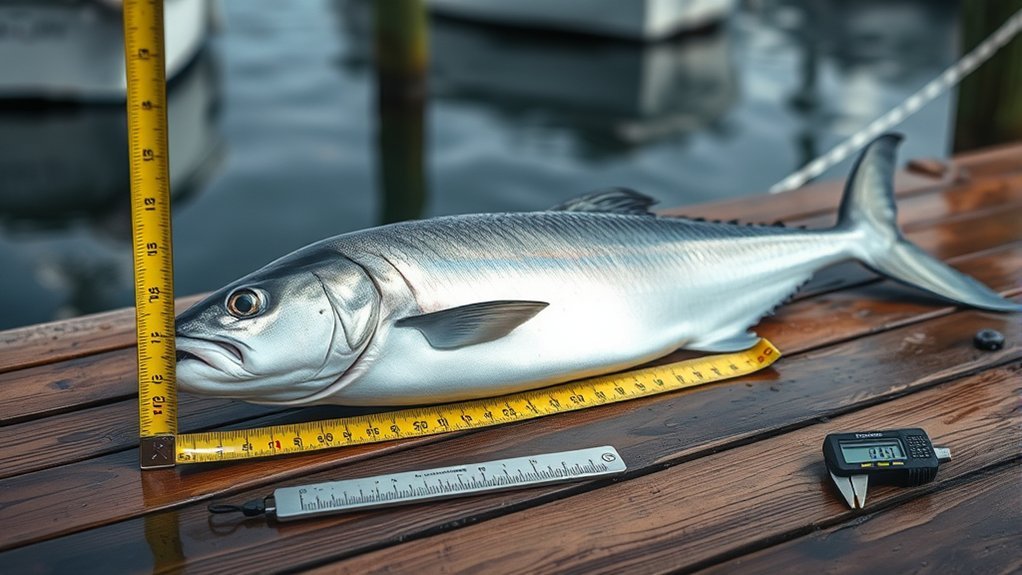
Measuring a fish correctly means using a straight-line measurement and the exact method required for that species and jurisdiction. Whether the fish is small or around three feet long, first check whether the rule calls for total length, fork length, or another standard. Keep the fish straight, use clearly defined anatomical endpoints, and avoid running a tape over the curve of its body.
Quick Answer
To measure fish length, first check the rule for the species and water. For total length, measure in a straight line from the foremost point of the head to the farthest tail tip, using the required tail position. For fork length, measure only to the center of the tail fork.
Key Takeaways
- Check the current regulation before measuring because legal methods vary by species and jurisdiction.
- Measure in a straight line; never run a flexible tape over the curve of the fish.
- Total length, fork length, and lower-jaw fork length use different anatomical endpoints and are not interchangeable.
- A rigid measuring board is convenient, but a ruler or flexible tape can also work when it is kept flat on a hard surface.
- For fish that will be released, wet the measuring surface and your hands, minimize handling, and return the fish to the water quickly.
At a Glance
| Time Required | Usually under 1 minute once the measuring tool is ready |
| Difficulty | Easy, but the correct legal measurement method must be known first |
| Tools Needed | Measuring board, ruler, or tape laid flat on a firm surface; current fishing regulations |
| Cost | No extra cost if you already have an accurate ruler, tape, or measuring board |
How to Measure Fish Length Correctly
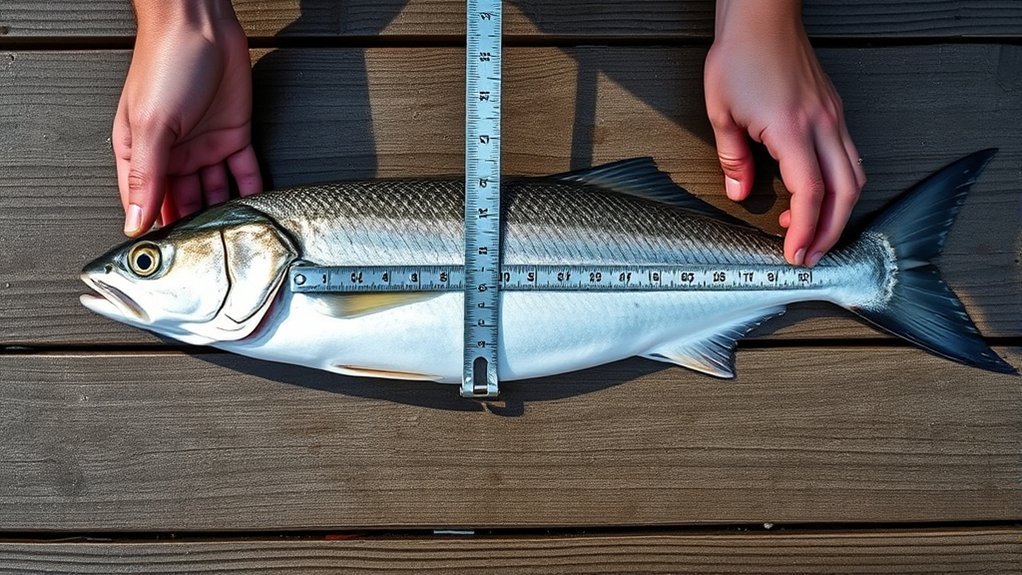
Accurate fish measurement starts with one question: which measurement does the regulation require? Do not assume that every species is measured from the nose to the farthest tail tip. Legal definitions can differ between species, states, countries, freshwater systems, and federal waters.
The Florida Fish and Wildlife Conservation Commission fish-measurement guide, for example, uses both total length and fork length for saltwater species. Federal Atlantic billfish rules use lower-jaw fork length for certain billfish.
[Amazon Products Picked for You]

Compact Folding Design: Easily folds for convenient storage and portability, making it perfect for tackle boxes and on-the-go fishing trips

Frabill | Trusted By Anglers Since 1938

1. BOAT & KAYAK READY — This 32-inch fish measuring board folds to 16 inches for easier storage in a kayak compartment, boat locker, backpack, or gear bag. Check your available space before packing
Step-by-Step Fish Measuring Method
- Check the regulation. Confirm the species and whether the rule requires total length, fork length, lower-jaw fork length, or another measurement.
- Prepare the measuring tool first. A rigid measuring board is convenient. A ruler or flexible tape can also work if it stays flat and straight.
- Position the fish straight. Lay the fish on its side against the measuring board or beside the flat measuring scale. Do not bend the body.
- Use the correct starting point. Depending on the rule, this may be the foremost point of the head, tip of the snout, tip of the jaw, or tip of the lower jaw.
- Close the mouth when the rule requires it. Florida’s total- and fork-length definitions, for example, specify a closed mouth.
- Use the correct tail endpoint. Total length usually reaches the farthest tail tip under the applicable definition, while fork length stops at the center of the fork.
- Read the measurement in a straight line. Never wrap or drape the tape over the curved body.
- Record the result immediately. If the fish will be released, return it to the water as quickly as possible.
Warning: Do not rely on a generic measuring method when deciding whether a fish is legal to keep. Check the current regulation for the exact species, location, season, and measurement definition before retaining the fish.
Should You Pinch or Compress the Tail?
Only use the tail position specified by the applicable measurement rule. For example, Florida FWC defines total length as the distance from the foremost point of the head, with the mouth closed, to the farthest tip of the tail while the tail is compressed or squeezed. Other jurisdictions may use their own wording, so the local definition controls.
A consistent tail position matters because spreading, pinching, or relaxing the tail can change the measured length by enough to matter near a legal minimum or slot limit.
Total Length vs. Fork Length for Fish
Total length and fork length measure different endpoints. They should never be substituted for one another when a regulation specifies one method.
| Method | Typical Endpoints | Examples |
|---|---|---|
| Total Length | Foremost head or snout point to the farthest tail tip, according to the applicable rule | Florida examples include many snappers, groupers, red drum, snook, and spotted seatrout |
| Fork Length | Tip of jaw or snout to the center of the fork in the tail | Florida examples include amberjacks, hogfish, pompano, cobia, and Spanish mackerel |
| Lower Jaw Fork Length | Tip of the lower jaw to the fork of the tail | Federal Atlantic billfish examples include sailfish, blue marlin, and white marlin |
| Standard Length | Snout to the end of the fleshy body before the tail fin | Common in scientific work; do not substitute it for a legal TL or FL requirement |
In Florida saltwater regulations, FWC lists snappers and groupers among species commonly measured by total length, while amberjacks and hogfish are among species measured by fork length. These are Florida examples, not universal classifications.
For federally regulated Atlantic billfish, NOAA Fisheries specifies lower-jaw fork length, measured in a straight line from the tip of the lower jaw to the fork of the tail.
A legal fish measurement is defined by its endpoints. A longer number obtained with the wrong method does not make the measurement valid.
What About Long or Ragged Tail Filaments?
Do not automatically ignore unusually long tail rays. Under Florida FWC’s total-length guidance, the ragged-edge tail filaments on species such as scamp, yellowmouth grouper, and black sea bass are included when measuring to the farthest tip of the tail. Other rules may define their endpoints differently, so check the regulation that applies where you are fishing.
Best Tools to Measure Fish Accurately
The most useful tool is one that lets you make a repeatable straight-line measurement. A rigid fish-measuring board or bump board is convenient because the fish can be aligned against a fixed end stop. A ruler or tape can also be accurate when it lies flat on a rigid surface.
A flexible measuring tape is not automatically more accurate. The key warning from FWC is that the tape must stay flat instead of following the fish’s body contour. Measuring over the curve can produce a longer reading than the true straight-line length.
Pro Tip: Wet the measuring board before placing a fish on it if you plan to release the fish. Have the ruler, camera, and release tools ready before lifting the fish from the water so the measurement takes only a few seconds.
[Amazon Products Picked for You]

Convenient Retractable Design: Features a built-in retractable mechanism for easy access and secure storage, perfect for on-the-go anglers

53-Inch Length: The 53-inch fish ruler is perfect for measuring a wide variety of fish, including larger species like bass, trout, and pike.

53in Fish Ruler Tape: Measuring 53 inches 7.87 inches, this fish ruler fits measuring various fish species-including large ones like bass, trout, and pike. A reliable tool for fishing enthusiasts who need accurate fish measurement
Measuring Large Fish or Fish That Will Be Released
There is no universal rule that fish over a particular length must be measured with a submerged tape. However, keeping a large or releasable fish in or alongside the water can reduce unnecessary handling when the local rules and measurement program allow that method.
NOAA Fisheries catch-and-release guidance recommends handling fish as little as possible, using wet hands, supporting the body, and minimizing air exposure. NOAA states that when a fish must be removed from the water, keeping air exposure below 60 seconds is ideal.
Nets with built-in measurement markings can be useful for a quick estimate, particularly when minimizing handling is the priority. However, do not assume that a measurement printed on a net satisfies a regulation requiring a specific straight-line method.
Can You Use a Phone App to Measure Fish?
Some fishing apps use photographs or augmented reality to estimate fish length. They can be convenient for personal records, but results may change with camera angle, distance, calibration, lens distortion, or fish position.
For a fish close to a legal minimum or maximum, use the physical measurement method required by the regulation rather than relying only on an app.
Common Fish Measuring Mistakes to Avoid
Small measuring errors can matter when a fish is close to a legal size limit. The most common problem is measuring over the body’s curve instead of taking a straight-line reading.
- Using the wrong measurement type: confirm whether the fish requires total length, fork length, lower-jaw fork length, or another method.
- Following the body curve: keep the ruler or tape straight and flat.
- Starting from the wrong point: check whether the rule begins at the snout, jaw, head, or lower jaw.
- Leaving the mouth open when the definition requires it closed: this can change the measured length.
- Using the wrong tail position: squeeze or pinch the tail only as required by the relevant definition.
- Measuring on an unstable surface: a moving or sagging tape makes the endpoint harder to read consistently.
- Ignoring unusual tail filaments: the regulation may specify whether they count.
- Relying on a photo or phone estimate near a legal limit: verify the fish using the legally required physical method.
Note: If a fish has a damaged tail, unusual anatomy, or another condition that makes the normal endpoint unclear, do not invent a different measuring method. Check the controlling fishing regulation or guidance from the responsible fisheries agency.
How to Handle a Fish Safely While Measuring
Accurate measurement should not come at the expense of a fish that will be released. Prepare the measuring board, dehooking tool, and camera before taking the fish out of the water.
- Wet your hands before handling the fish.
- Wet the measuring surface when possible.
- Support the fish horizontally rather than hanging it by the jaw.
- Avoid touching the eyes and gills.
- Keep handling and air exposure as short as possible.
- If practical and permitted, dehook and measure the fish while keeping it in the water.
- Release the fish promptly after measuring.
NOAA’s current catch-and-release recommendations emphasize minimal handling and state that less than 60 seconds of air exposure is ideal when removal from the water is necessary. Florida FWC likewise recommends preparing measuring equipment before removing a releasable fish from the water.
[Amazon Products Picked for You]

Aluminum Fish Ruler Gold

Easy to Store Design: The foldable fish measuring board is designed specifically for anglers in narrow spaces, and can measure fish up to 36 inches long when unfolded. After folding, the fish ruler is only 12 inches long and can be easily stored under the seat without occupying too much space. It is a perfect must have kayak accessories for fishing

12 inches when stowed, 36 inches when expanded
How Fish Length Rules Affect Legal Catches
Fishing regulations often connect minimum sizes, maximum sizes, or slot limits to one specific measurement method. Because total length and fork length use different endpoints, the same fish can produce different numbers under the two methods.
That does not mean an angler can choose the larger number. The only relevant number is the one obtained with the method named in the regulation.
Size limits are one of several tools fisheries managers use to control harvest and meet biological or management objectives. Rules can change as fisheries are reassessed, which is why an old chart, social-media post, or saved screenshot should not replace the current regulation.
Warning: Regulations can change by season, species, water body, state, federal management area, and even zone within the same state. Verify the current rule before keeping a fish, especially when its measurement is close to a minimum or slot boundary.
Frequently Asked Questions
How Do You Measure the Total Length of a Fish?
Use the total-length definition required by the applicable regulation. Under Florida FWC guidance, the fish lies on its side with its mouth closed, and total length is measured in a straight line from the foremost point of the head to the farthest tail tip with the tail compressed or squeezed.
What Is the 80/20 Rule in Fishing?
The fishing 80/20 rule is an informal application of the Pareto principle: anglers sometimes observe that a relatively small number of productive locations, times, or techniques account for a large share of their catches. It is a rule of thumb, not a fisheries regulation or a guarantee that exactly 80% of fish will come from 20% of locations.
How Do You Measure a Pompano?
The required method depends on the jurisdiction. In Florida, Florida pompano are regulated by fork length, not total length. Measure in a straight line from the tip of the jaw or snout, with the mouth closed, to the center of the fork in the tail. Current Florida recreational regulations list an 11-inch minimum fork length, but always check the current rule before fishing.
How Do You Calculate a Fish Length Measurement?
Fish length normally does not require a mathematical formula. Place the fish in the required position, identify the correct starting and ending anatomical points, and read the straight-line distance from an accurate ruler, tape, or measuring board.
Is Fork Length the Same as Total Length?
No. Fork length ends at the center of the tail fork, while total length extends to the tail endpoint specified by the governing definition, commonly the farthest tail tip. Because the endpoints differ, the two measurements should not be substituted for one another.
Should You Pinch a Fish’s Tail When Measuring It?
Pinch or compress the tail only when the measurement definition requires it. Florida FWC, for example, specifies a compressed or squeezed tail when taking total length. Check the rule that applies to your species and location rather than assuming the same tail position is required everywhere.
Sources
- Florida Fish and Wildlife Conservation Commission — Fish Measurement — definitions of total length, fork length, lower-jaw fork length, tail compression, and Florida species examples.
- Florida Fish and Wildlife Conservation Commission — Freshwater Fishing Tips — straight-line measuring technique, flexible-tape warning, and catch-and-release handling.
- Florida Fish and Wildlife Conservation Commission — Permit, Florida Pompano and African Pompano — current Florida pompano fork-length regulations.
- NOAA Fisheries — Recreational Atlantic Billfish Requirements — lower-jaw fork-length measurement and current federal billfish size requirements.
- NOAA Fisheries — Catch and Release Fishing Best Practices — wet-hand handling, body support, minimal handling, and air-exposure guidance.
Conclusion
Correct fish measurement starts with the regulation, not the ruler. Confirm whether the species requires total length, fork length, lower-jaw fork length, or another standard, then measure between the exact endpoints in a straight line. Keep flexible tapes flat, use the required tail position, and handle releasable fish quickly and carefully. When a legal size limit is involved, always verify the current local or federal rule before keeping the fish.
