·
Reviewed for accuracy
·
Last updated April 2026
·
4 min read
Catching your first salmon requires more than just throwing a line into the nearest river. Success comes down to understanding fish behavior, timing your trips, and using the right tackle. Master these fundamentals to build confidence and start landing fish on your own terms.
Quick Answer
To catch salmon as a beginner, fish during the peak summer runs between May and August using an 8-weight rod and a floating line. Focus your casts on deep river pools and seams where salmon rest. Keep your gear simple and practice your overhead casting before hitting the water.
Key Takeaways
- Target rivers during the peak summer months of May through August.
- Use a 13 to 14-foot 8-weight rod for maximum control and distance.
- Focus on deep pools, seams, and underwater structures to locate holding fish.
- Master the overhead and roll casts to adapt to different river environments.
What You Will Need
Before heading to the river, gather these required items. Preparation keeps you focused on fishing rather than fixing gear issues on the water.
- A valid state fishing license and salmon stamp.
- Medium-heavy 8-weight fishing rod.
- Polarized sunglasses to cut water glare.
- A large, rubber-mesh landing net.
- Sturdy wading boots.
Pro tip: Always check local fishing reports the night before your trip to verify river flow rates and current regulations.
1. Determine When and Where to Fish
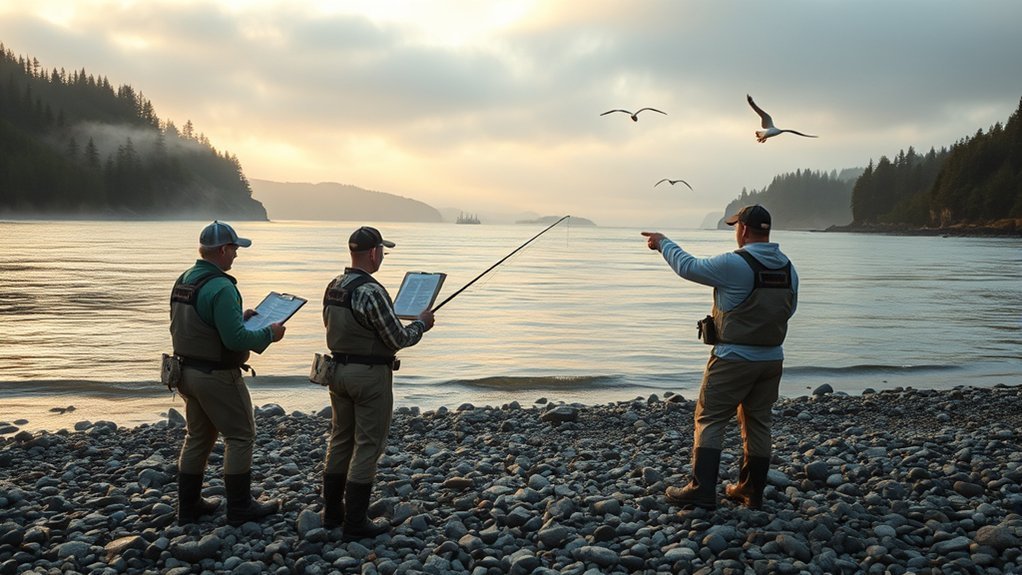
When you start out, timing and location matter more than expensive gear. Plan your first trips between May and August. Salmon remain highly active during this window, and the weather favors beginners.
You will find the best time varies by region. Spring and summer give you gentler water and clearer windows to learn.
Choose fishing spots wisely. Rivers produce excellent results during active runs. They offer deep pools, seams, and underwater structures like rocks and logs where salmon rest.
Choose spots where salmon hold: deep pools, seams, and underwater structure like rocks and logs during runs.
Lakes also produce fish. Work drop-offs and structure, especially during early morning or late evening when fish feed actively.
Study notable rivers such as the Kenai, Columbia, and Rogue to understand water flow. This knowledge makes successful fishing feel intentional.
Practice basic fishing techniques that match the habitat. Drift or troll lakes. Focus casts into river seams. Watch how fish behavior shifts with the current.
Start simple. Read the water. You will gain confidence and independence on every trip.
2. Gather Essential Tackle and Gear

Start with a simple, reliable setup. Fishing experts widely recommend a 13 to 14-foot rod rated for an 8-weight line. This setup gives beginners the casting distance and control salmon demand.
Assemble essential tackle that keeps your pack light. Pack a few trusted lures: spinners, spoons, and plugs. Spool a stout main line rated at 20 to 30 pounds for necessary strength. Bring poly leaders so you can quickly convert your floating line into a sink tip for deeper water.
Choose durable but uncomplicated fishing gear. Pack nippers, forceps, polarized sunglasses, and a large net for safe landings. Keep spare terminal tackle and comfortable boots in your vehicle.
Focus on mastering this compact kit rather than accumulating gear. A practical setup lets you move freely and learn the river.
3. Choose Lines, Leaders, and Flies
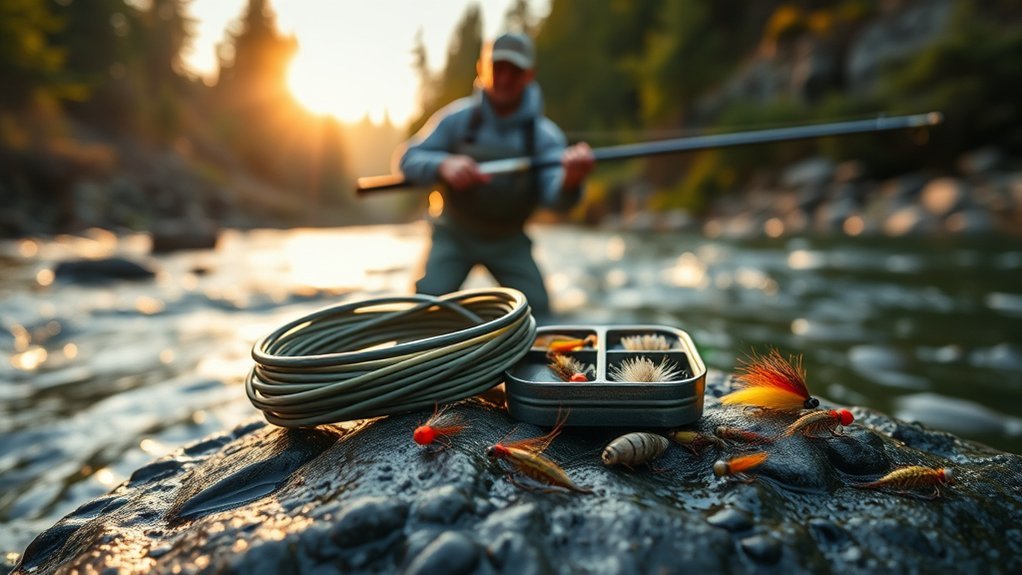
Different conditions require different setups. Getting your lines, leaders, and flies right makes the rest of your fishing day much easier.
Different conditions demand different setups. Get your lines, leaders, and flies right, and the day flows.
You need a floating line for late spring and summer. As you push into deeper runs, intermediate lines or poly leaders give you better control. Choose between full-belly lines and shooting-head systems. An entry-level option like the Snowbee XS-Plus Short Spey Floating Fly Line serves as a practical start.
Match a tapered leader to your line. Use Maxima monofilament in 12-pound or 15-pound test for strength and visibility. For flies, go bold. Salmon respond aggressively to larger patterns and bright egg imitations during runs.
- Drift a slow, bright egg pattern near the tail of a pool.
- Execute a full-belly Spey cast through a sweeping current.
- Add poly leaders to sink a floating setup.
- Use a tapered leader to turn over a bulky fly.
4. Master Core Casting Techniques

Casting forms the bridge between your setup and the fish. Getting comfortable with overhead, roll, and Spey casts makes every drift more effective. Learn these three core techniques to fish confidently.
The overhead cast on a single-handed rod acts as your foundation. Use smooth, controlled rod movements to deliver the line accurately. When trees block your backcast, the roll cast saves the day. You need no full backcast. Just use a quick sweep and a steady wrist.
For wide rivers, the spey cast on a double-handed rod provides long reaches with minimal effort. It builds a D-loop for power and control. Practice both single and double Spey variations to expand your range.
Keep practice sessions short and focused. Practice sharpens your timing, rhythm, and accuracy. Strong skills remove hesitation, letting you move quickly from setup to strike.
5. Find and Handle Salmon Safely
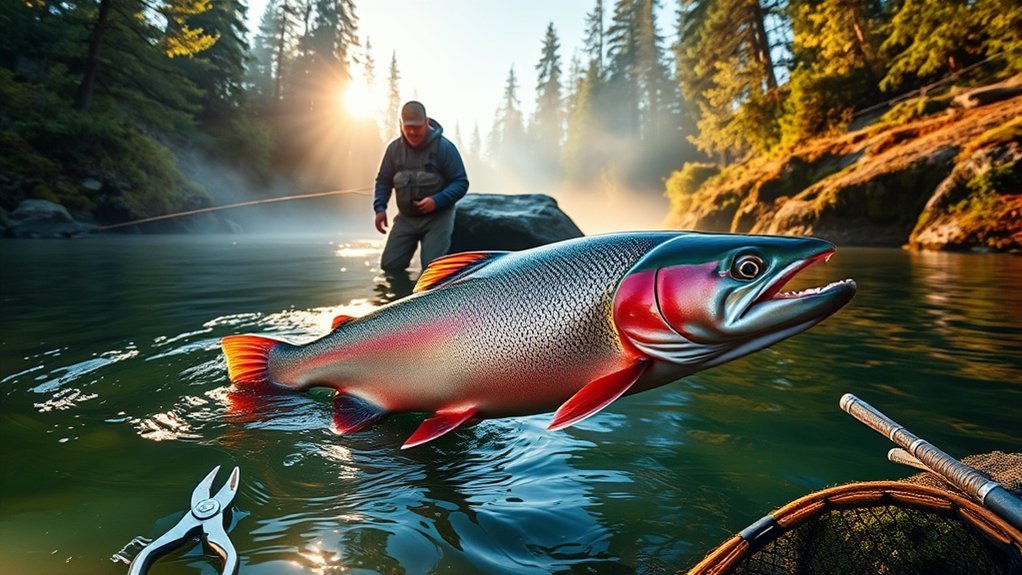
Where should you look first when scanning a river? Start with deep pools and seams. Look for areas where steady flow meets calm water.
Watch for visual cues of salmon behavior. Jumps, rolls, or surface swirls often betray nearby fish. Use a fish finder to locate depth and underwater structures that offer shelter during migration.
- Target the dark throat of a deep pool beneath a sunlit riffle.
- Fish the seam where fast current lips into slow water beside a boulder.
- Cast near a submerged log shadowed by eddies and bubbles.
- Watch the calm tailout where rolling fish surface at dusk.
Always respect local fishing regulations and your quarry. Review catch limits before every outing.
Warning: Never drag a salmon onto dry rocks or sand if you plan to release it, as this destroys their protective slime coat.
When you hook a salmon, use steady pressure. Minimize air time and unhook the fish carefully while it remains submerged. Support the fish upright in the current during release until it swims away strong.
Frequently Asked Questions
What is the best time of day to catch salmon?
Salmon feed most actively during low-light conditions. Focus your fishing efforts during the early morning hours just after sunrise, or in the late evening as the sun begins to set.
Do I need a double-handed rod for salmon fishing?
No, a standard single-handed rod works perfectly fine for beginners, especially on smaller rivers or lakes. However, a double-handed rod makes Spey casting much easier on wide, fast-flowing rivers.
What pound test line is best for salmon?
For most beginner salmon setups, use a 20 to 30-pound main line. Pair this with a slightly lighter 12 to 15-pound monofilament leader to ensure the leader breaks before your main line if you get snagged.
Conclusion
You now have the knowledge to select the right gear, find the best river spots, and execute basic casts. The true learning begins the moment you step into the water and start reading the currents. Pick a date this summer, grab your 8-weight rod, and head to a local river pool. Stay patient, practice your roll cast, and enjoy the process of hunting your first salmon.