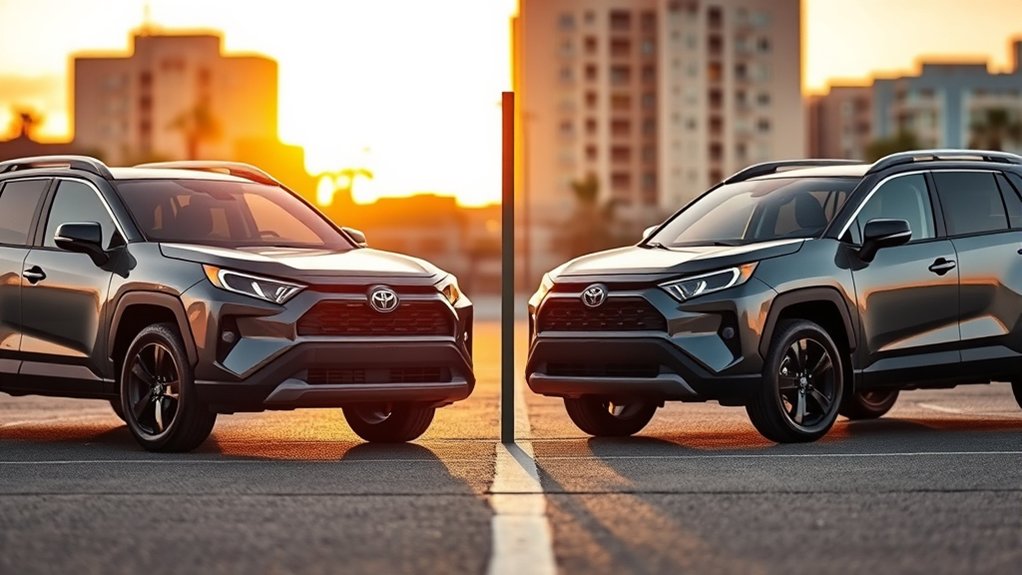
The MK4 RAV4 is approximately 1.8 inches lower than the MK3, with overall height decreasing from about 68.9 inches to 67.1 inches. That reduction lowers the center of gravity by roughly 1.5 inches, improving cornering stability and reducing body roll. The design also shifts from the MK3’s upright shape to a more streamlined profile. Interior compromises are modest, with about 1 inch less front headroom. Further comparison explains the effects on cargo space, trims, and buyer fit.
MK4 vs MK3 RAV4 Height Difference
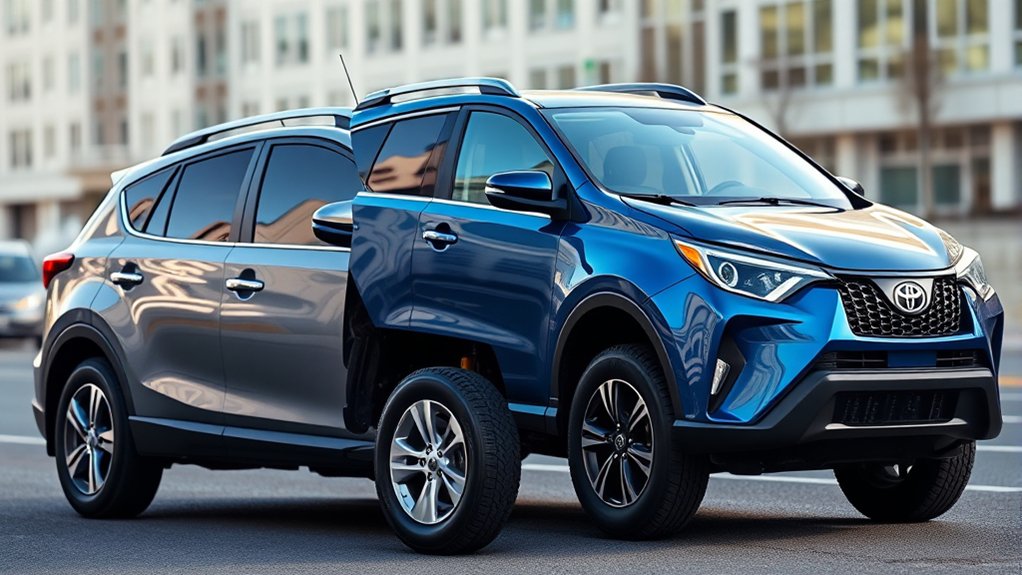
Although the dimensional change is modest, the MK4 RAV4 is approximately 1.8 inches lower than the MK3, with an overall height of about 67.1 inches versus 68.9 inches. This height difference is numerically small yet visually meaningful, establishing a cleaner silhouette and a more aerodynamic exterior package for the newer generation.
From a comparative design perspective, the MK4 RAV4 departs from the taller, more upright stance of the MK3 RAV4. The reduction does not indicate compromised practicality; instead, it reflects a more efficient spatial layout that preserves usable headroom through careful packaging.
The MK4 RAV4 exchanges the MK3’s upright height for a more efficiently packaged form that maintains practical interior usability.
For buyers seeking liberation from bulkier crossover proportions, the lower roofline communicates greater precision and modernity without abandoning utility. The MK3 RAV4 presents a more vertical profile, while the MK4 RAV4 appears more disciplined and intentionally streamlined.
In purely dimensional terms, the change is straightforward: the newer model sits 1.8 inches lower, and that measurement defines the core distinction.
How Lower Height Affects Handling
The MK4 RAV4’s lower overall height reduces its center of gravity, which directly limits body roll during lateral load transfer.
This geometric change improves cornering stability by helping the chassis maintain a more controlled and predictable attitude through turns.
As a result, the lower stance supports more precise handling responses than those typically associated with the taller MK3.
Reduced Body Roll
Lowering the MK4 RAV4 by approximately 1.5 inches relative to the MK3 reduces the vehicle’s center of gravity, which directly improves cornering stability and limits body roll.
This lower center of gravity decreases lateral weight transfer under directional load, producing reduced body roll and a more settled chassis response. For drivers seeking liberation from top-heavy dynamics, the effect is a vehicle that feels more disciplined and less evasive during rapid shifts.
The benefit is reinforced by a reported 10% gain in structural rigidity, allowing the chassis to resist torsional flex more effectively. Increased structural rigidity supports suspension accuracy, enabling tuning changes to work with fewer compromises.
The lower profile also improves aerodynamic efficiency, marginally reducing destabilizing airflow effects. Together, these factors create a more responsive, composed, and confidently controlled driving character overall.
Cornering Stability Gains
With body roll better contained, the MK4 RAV4’s reduced height also yields measurable gains in cornering stability. Being roughly 1.5 inches lower than the MK3, it presents less aerodynamic disturbance in fast directional changes, helping the chassis settle sooner and track more cleanly through bends.
That freer, more disciplined response gives drivers greater confidence when choosing a line through tightening curves.
The effect is reinforced by the MK4’s lower center of gravity and a reported 10 percent increase in structural rigidity. Together, these revisions limit chassis flex, preserve more consistent tire loading, and improve steering response under lateral load.
As a result, the vehicle reacts with greater precision, maintains traction more effectively, and delivers a more engaging, less constrained character when cornering at moderate to higher speeds overall.
Lower Center Of Gravity
Reducing overall height shifts the MK4 RAV4’s center of gravity closer to the road surface, directly improving transient stability and limiting weight transfer during cornering.
This lower center of gravity reduces body roll versus the MK3, allowing the chassis to settle faster and maintain more consistent tire loading through directional changes.
The reduced height also improves airflow management, trimming aerodynamic disturbance and sharpening handling dynamics at speed.
By lowering the center of mass, the MK4 achieves better weight distribution, stronger traction, and clearer steering feedback across mixed road conditions.
The result is a more responsive, sport-oriented platform that feels less constrained by SUV proportions.
For drivers seeking freedom from vague responses and excessive lean, this engineering change delivers measurable gains that matter more than an inflated price tag alone.
How Much Headroom Does the MK4 Lose?
How much headroom does the MK4 actually give up? Relative to the MK3, the MK4 RAV4 loses roughly 1 inch of front headroom, closely tracking its approximately 1.1 inch reduction in overall height. That dimensional change is not abstract; taller drivers will notice a slightly tighter seating environment, especially with upright posture or elevated seat adjustment.
The principal cause is the MK4’s more tapered roofline. By lowering the roof and sharpening the vehicle’s profile, Toyota improved aerodynamic efficiency and delivered a more streamlined silhouette.
The tradeoff is measurable but limited. Front occupants experience the clearest constraint, while rear headroom remains broadly adequate because the cabin packaging was managed intelligently.
In practical terms, the MK4 RAV4 does not sacrifice usability for style; it reallocates space with discipline. For buyers seeking liberation from bulkier crossover proportions, the lower roof delivers a sportier form without imposing a severe comfort penalty on most passengers overall.
MK4 vs MK3 Cargo Space Differences
A comparison of MK4 and MK3 cargo space begins with rear cargo dimensions, where the MK4 provides nearly 38 inches behind the second row while adopting a more flexible load area layout.
With the rear seats folded, the MK4 offers about 72 inches of load length, although overall seats-down capacity is slightly lower than the MK3’s 73.3 cubic feet.
Hybrid battery placement should also be considered, as it can influence floor height and usable volume despite the MK4’s practical packaging.
Rear Cargo Dimensions
Cargo practicality improves measurably in the MK4 RAV4, particularly in rear storage dimensions relative to the MK3. The rear cargo dimensions show nearly 38 inches behind the second row in the MK4, delivering freer loading access and better everyday utility than the MK3.
| Metric | MK4 | MK3 |
|---|---|---|
| Space behind second row | ~38 in | Slightly less |
| Seats-down total space | ~72 in | Smaller |
| Accessibility | Improved | More limited |
| Cargo efficiency | Higher | Lower |
This dimensional gain supports more adaptable use for luggage, tools, and recreational equipment without forcing compromises. Analytical comparison indicates the MK4 allocates cargo volume more efficiently, making it the more storage-liberating platform. One caveat remains: GR Sport versions may surrender a small amount of trunk capacity because of battery packaging.
Seats-Down Load Length
One of the clearest functional advantages in the MK4 RAV4 appears when the rear seats are folded, with load length extending to approximately 72 inches and thereby exceeding the shorter MK3 configuration. This increased seats-down load length materially improves cargo space efficiency, allowing longer objects to be carried with fewer compromises.
It gives users greater freedom from the packing limitations imposed by the earlier platform.
The MK4 RAV4 also delivers nearly 38 inches of usable space behind the second row, reinforcing its redesigned cargo area as more practical in daily operation.
By comparison, the MK3 provides adequate but more restrictive dimensions, especially when larger or awkwardly shaped items are involved.
Hybrid Battery Impact
Although the MK4 RAV4 retains strong everyday utility, its hybrid battery introduces a modest packaging compromise relative to the MK3 by slightly reducing available trunk volume in some configurations. This affects cargo space most noticeably when maximum versatility is required, since the MK3 lacks hybrid components that occupy underfloor volume and preserve a more generous load area.
With seats folded, the MK4 provides approximately 72 inches of load length, while usable space behind the second row remains nearly 38 inches, sustaining practical daily function.
However, hybrid battery placement influences the overall design by contributing to a slightly lower profile, which can alter loading geometry and marginally limit certain storage arrangements.
For buyers seeking efficiency without surrendering core usefulness, the MK4 presents a disciplined tradeoff rather than a substantial functional loss overall.
Do Some MK4 Trims Sit Higher?
Why do some MK4 RAV4 trims appear to sit higher than others? Although the generation has a lower overall height than the MK3, trim-specific hardware alters perceived and measured ride height. Certain versions, especially the Limited, may use slightly elevated suspension calibrations to expand rough-surface capability.
This does not overturn the platform’s generally lower stance, but it does create visible variation within the MK4 range.
Wheel diameter also matters. Larger factory wheels can raise static ride height modestly, increasing the gap between body and road.
In addition, some MK4 configurations offer adaptive suspension, allowing adjustable ride height according to operating conditions. That flexibility gives drivers more control over ground clearance without changing the vehicle’s core architecture.
The tapered roofline further complicates visual judgment: it makes the body seem lower even when a specific trim stands slightly taller at the chassis.
As a result, appearance and actual measurement do not always align perfectly in practice.
Who Should Choose the Lower MK4 RAV4?
Buyers who prioritize on-road efficiency and everyday usability are the strongest candidates for the lower MK4 RAV4. At roughly 1.5 inches shorter than the MK3, it presents measurable aerodynamic and stability advantages, particularly at highway speeds.
That dimensional reduction also supports a sportier driving experience through slightly improved handling response and a more planted feel in routine cornering.
The lower profile will also appeal to drivers seeking freedom from cumbersome urban maneuvering. In dense city settings, the MK4’s reduced height can simplify parking, improve clearance awareness, and make tight-space navigation less stressful.
Passengers benefit as well, since the lower step-in height enables easier access, an important factor for families, older occupants, or anyone with mobility concerns.
Aesthetic preferences matter too: the MK4’s stance reads as more contemporary and streamlined. Accordingly, the lower MK4 best suits drivers who value modern design, daily convenience, and composed road behavior over a taller, more upright SUV presentation.
Frequently Asked Questions
How High Does a RAV4 Sit off the Ground?
A RAV4 typically sits about 6.1 to 6.3 inches off the ground. Its ground clearance features, suspension design, and off road capability reflect an analytically balanced configuration, enabling liberated drivers to prioritize stability, efficiency, and access.
What Year Is RAV4 to Stay Away From?
One might “liberate” oneself from 2001–2003, 2006, and 2013–2015 RAV4s; these years concentrate RAV4 reliability concerns and Engine performance issues. Analytically, 2009–2012 and later refreshed examples are generally considered among the Best model years.
How High Does a RAV4 Seat off the Ground?
A RAV4 seat typically sits about 24–28 inches off the ground, varying by trim. Its RAV4 ground clearance supports an elevated RAV4 seating position, enhancing RAV4 driver visibility and enabling confident, unrestricted ingress, egress, and road command.
How Tall Is a RAV4 in Feet?
A RAV4 stands approximately 5.7 to 5.9 feet tall, depending on generation. Such RAV4 dimensions inform technical RAV4 comparisons, while key RAV4 features reveal how height influences aerodynamics, cabin perception, and independent driving preference.
Conclusion
Overall, the MK4 RAV4 stands modestly closer to the ground than the MK3, typically by about 25–30 mm, depending on trim and market specification. That slight downward revision brings a quieter promise: improved on-road composure, marginal aerodynamic benefit, and a more car-like stance. The trade-off is discreet rather than severe, with only a small reduction in vertical generosity and negligible practical compromise. In technical terms, the MK4’s lower profile reflects refinement, not meaningful sacrifice.

