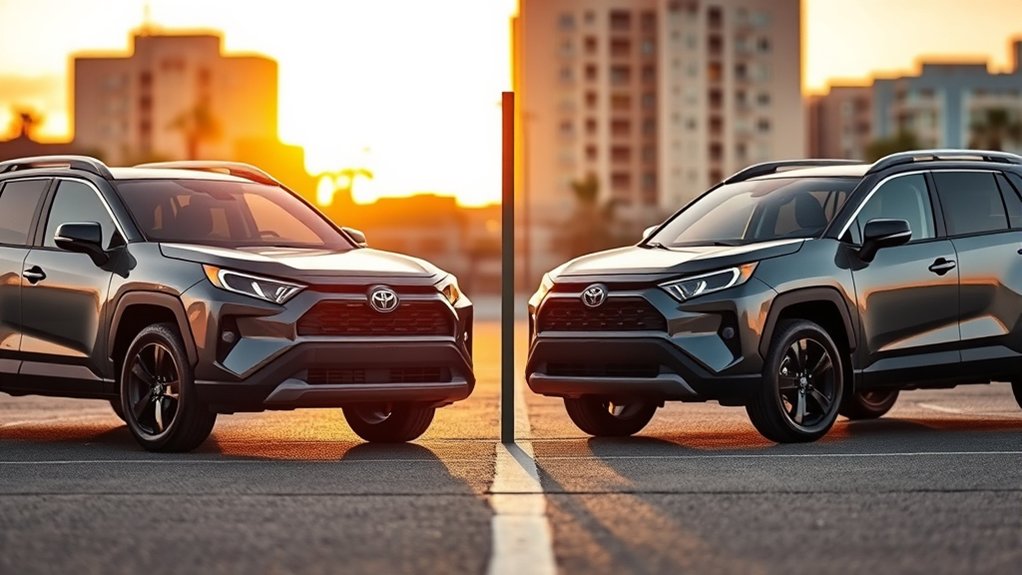
The MK4 vs MK3 RAV4 height difference is smaller than the two SUVs’ styling suggests. Toyota gave the fourth-generation RAV4 a lower, more streamlined roofline, but the exact difference depends on whether you include roof rails. Comparing the 2012 MK3 with the 2013 MK4 also reveals changes in ground clearance, passenger headroom, cargo space, and everyday usability.
Quick Answer
The 2013 MK4 Toyota RAV4 is 0.9 inch lower than the 2012 MK3 without roof rails: 65.4 versus 66.3 inches. With roof rails, the difference is about 1.6 inches: 67.1 versus 68.7 inches. The MK4 also has less ground clearance and slightly less headroom, although its cargo space remains competitive.
MK4 vs MK3 RAV4 Height Difference
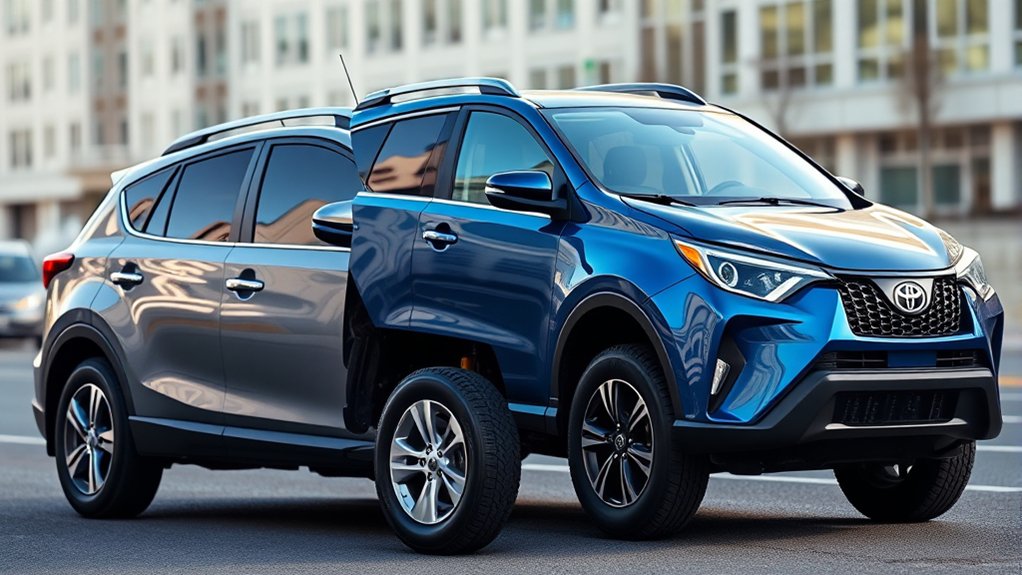
The fourth-generation Toyota RAV4 has a lower overall height than the third generation. The difference is 0.9 inch without roof rails or approximately 1.6 inches with roof rails when comparing representative 2012 and 2013 North American specifications.
These figures refer to vehicle height, not ground clearance. Roof rails affect the highest point of the SUV without necessarily changing how high its body sits above the road.
According to Toyota’s 2012 RAV4 specifications and the 2013 RAV4 launch specifications, the main measurements are:
| Measurement | MK3 RAV4 (2012) | MK4 RAV4 (2013) |
|---|---|---|
| Height without roof rails | 66.3 inches | 65.4 inches |
| Height with roof rails | 68.7 inches | 67.1 inches |
| Ground clearance | 7.5 inches | 6.3 inches |
| Front headroom without moonroof | 40.8 inches | 39.8 inches |
| Wheelbase | 104.7 inches | 104.7 inches |
The MK4 looks noticeably different despite retaining the same wheelbase. Its sloping roof, revised body proportions, and sculpted panels create a sportier appearance than the MK3’s upright design.
The important distinction is that overall vehicle height, roof-rail height, and ground clearance are different measurements. Compare like-for-like specifications before deciding which RAV4 is lower.
For garage clearance, include roof rails, crossbars, and roof-mounted accessories. A roof rack or cargo box can make either vehicle substantially taller than its published factory height.
These measurements apply to representative North American vehicles. Toyota sold different body configurations and equipment packages in other markets, so dimensions can vary.
How Lower Height Affects Handling
The MK4 RAV4’s lower roofline contributes to its more streamlined appearance, while its revised suspension and steering help shape its driving behavior. However, overall vehicle height alone cannot establish an exact reduction in the center of gravity.
Handling depends on several factors, including suspension tuning, vehicle weight, tire grip, track width, and how the vehicle distributes its mass.
Reduced Body Roll
A lower center of gravity can reduce a vehicle’s tendency to lean during cornering. This effect occurs because the vehicle’s mass sits closer to the road, reducing the leverage that creates body roll.
The MK4’s shorter exterior profile is consistent with a more road-focused design, but roof-height measurements do not prove that its center of gravity fell by the same amount.
Toyota also revised the MK4’s suspension characteristics. Updated spring and shock-absorber tuning helped create a more controlled driving response.
Body roll can still vary with tire condition, passenger load, road surface, and suspension wear. A well-maintained MK3 may feel more composed than an MK4 with worn shocks or unsuitable tires.
Cornering Stability Gains
The MK4 RAV4 introduced changes intended to improve cornering stability and steering response. These included revised chassis components and a more advanced all-wheel-drive control system on equipped models.
Its Dynamic Torque Control AWD system can adjust power delivery between the front and rear wheels as driving conditions change. In Sport mode, the system can also respond to steering inputs to help manage cornering behavior.
The MK4’s body structure uses high-strength steel and reinforcement around important chassis areas. These changes support more consistent steering and suspension behavior.
The lower roof and aerodynamic improvements may also help manage airflow at higher speeds. Still, a precise handling improvement cannot be calculated from exterior height alone.
For everyday driving, expect differences in steering feel and suspension response rather than a dramatic change caused solely by the lower roof.
Lower Center Of Gravity
The center of gravity is the point where a vehicle’s mass is effectively balanced. Its position affects how the SUV responds during turning, braking, and sudden steering movements.
Lowering heavy components can improve vehicle stability. Simply changing the shape of the roof, however, does not guarantee an equal reduction in the center of gravity.
The MK4’s overall design reflects Toyota’s effort to deliver more car-like handling while retaining useful SUV space.
Other changes, including improved steering control, suspension calibration, and available AWD technology, also contribute to its driving character.
Neither the roof-height difference nor a general claim of improved rigidity should be treated as a measured center-of-gravity reduction.
How Much Headroom Does the MK4 Lose?
The MK4 RAV4 loses approximately 1 inch of front headroom compared with the MK3 when comparing versions without a moonroof. Front headroom decreases from 40.8 inches in the 2012 model to 39.8 inches in the 2013 model.
Rear headroom also decreases, from approximately 39.7 inches to 38.9 inches. That represents a reduction of about 0.8 inch.
These changes reflect the MK4’s lower roof profile and redesigned interior packaging.
The difference may be noticeable if you’re tall, especially when you sit upright or prefer a higher driver-seat position.
Moonroof-equipped models require a separate comparison. The 2012 RAV4 lists about 39.5 inches of front headroom with a moonroof, while the 2013 model lists approximately 38.9 inches.
That means the headroom difference is not identical across every configuration.
The MK4 also gained some space in other directions. Front legroom increased from approximately 41.8 inches to 42.6 inches, partly offsetting the reduction in vertical space.
Seat adjustment matters as much as the published number. Lowering the driver seat may provide sufficient clearance even when the roof is closer to your head.
If you’re choosing between these generations, sit in both vehicles with the seat adjusted to your normal driving position. Check the space above your head and around the door opening.
MK4 vs MK3 Cargo Space Differences
The MK4 RAV4 has a lower roofline but does not suffer a major cargo-space reduction. In fact, Toyota increased the space available behind the rear seats while keeping maximum folded-seat capacity broadly similar.
The redesigned rear cargo area and roof-hinged liftgate also improve everyday access compared with the MK3’s traditional side-opening rear door.
Rear Cargo Dimensions
The MK4 provides approximately 38.4 cubic feet of cargo space behind the second row. For comparison, representative 2012 MK3 specifications list approximately 35.9 cubic feet in Toyota Canada’s five-seat configuration.
Published figures can differ slightly by market and measurement convention. The following comparison uses Toyota Canada’s 2012 and 2013 specifications.
| Metric | MK4 | MK3 |
|---|---|---|
| Cargo behind second row | 38.4 cu. ft. | 35.9 cu. ft. |
| Cargo behind front seats | 73.3 cu. ft. | 73.2 cu. ft. |
| Rear cargo access | Roof-hinged liftgate | Side-hinged rear door |
| Spare tire position | Under cargo floor | Usually mounted on rear door |
The difference is more noticeable when the rear seats remain upright. The MK4 offers additional space for groceries, luggage, and everyday equipment.
The roof-hinged liftgate is another major improvement. It opens upward rather than swinging to the side, which can be more convenient when loading items in narrow parking areas.
However, the liftgate needs enough overhead clearance. This matters when opening it inside a low garage.
The MK3’s rear-mounted spare tire also changes its exterior loading arrangement. Some MK3 versions were available without the externally mounted spare, so check the specific vehicle.
Seats-Down Load Length
With the second-row seats folded, the MK4 provides a long cargo floor suitable for luggage and recreational equipment. Approximate load-length estimates around 72 inches are sometimes used, but this is not a universal factory measurement for every MK4 configuration.
The available length depends on how far the front seats are positioned, how the rear seatbacks fold, and where the cargo measurement begins.
The MK3 also provides generous seats-down storage. Its total folded-seat volume is very close to that of the MK4, so the newer model does not offer a dramatic increase in maximum cargo capacity.
The distinction is mainly in the shape and accessibility of the space.
If you transport long objects, measure the flat usable distance from the closed liftgate to the back of the front seats.
Also measure the narrowest point between the wheel wells and the height of the rear opening. These measurements can matter more than total cubic feet.
Hybrid Battery Impact
The fourth-generation RAV4 gained a hybrid option for the 2016 model year. Hybrid components affect cargo packaging, resulting in less measured cargo volume than comparable gasoline-powered MK4 versions.
According to Toyota’s 2016 RAV4 Hybrid information, the gasoline and hybrid versions have the following cargo capacities:
- Gasoline MK4: Approximately 38.4 cubic feet behind the rear seats and 73.4 cubic feet with the rear seats folded.
- Hybrid MK4: Approximately 35.6 cubic feet behind the rear seats and 70.6 cubic feet with the rear seats folded.
The hybrid therefore gives up approximately 2.8 cubic feet in both configurations.
This is a relatively modest difference for many everyday uses, but it may matter if you regularly carry large boxes, camping equipment, or bulky luggage.
Hybrid battery packaging does not mean that every MK4 sits lower than another. Exterior height and cargo volume should be evaluated separately.
The MK3 did not offer a conventional production RAV4 Hybrid, making this an important difference between the generations.
Do Some MK4 Trims Sit Higher?
Some MK4 RAV4 trims appear taller because of roof rails, wheels, and exterior styling. That does not necessarily mean their suspension provides greater ground clearance.
The original North American MK4 lineup included LE, XLE, and Limited grades. Later models added other configurations, including SE and Hybrid versions.
For the 2013 model, Toyota specified 17-inch wheels for LE and XLE versions and 18-inch wheels for the Limited.
However, larger wheel diameter does not automatically raise an SUV. Tire sidewall height can change to keep the overall tire diameter close to the original specification.
Roof rails have a more direct effect on published overall height.
For example, the original MK4 measurement rises from 65.4 inches without rails to 67.1 inches with rails.
This is primarily a difference in the vehicle’s highest point, not proof of a taller suspension.
Similarly, standard MK4 Limited models should not be assumed to have a factory height-adjustable suspension. The model’s published specifications do not establish the adaptive ride-height feature claimed in some descriptions.
Later trim names from different markets can also create confusion. GR Sport branding should not be treated as a standard feature of the original 2013 North American lineup.
For an accurate comparison, match the model year, market, tire specification, and roof equipment.
If a used RAV4 appears unusually high or low, inspect it for aftermarket suspension parts, nonstandard tires, or altered ride height.
Who Should Choose the Lower MK4 RAV4?
The MK4 RAV4 is an appealing choice if you prefer modern styling, convenient cargo access, and a more road-focused driving experience. Its lower roofline makes the exterior look sleeker without severely reducing practical interior space.
Its advantages are particularly relevant for regular commuting, city driving, and family transportation.
Consider the MK4 if you value:
- Modern exterior design: The lower roof and sculpted body create a more streamlined appearance.
- Convenient cargo loading: The upward-opening liftgate is easier to use in many parking situations.
- Useful rear storage: The gasoline model provides more cargo space behind the second row than the representative MK3.
- Updated handling systems: Revised steering, suspension tuning, and available AWD technology support a more controlled road feel.
- Hybrid availability: Later MK4 models offer a gasoline-electric powertrain for buyers who prioritize fuel efficiency.
The MK3 still has several advantages worth considering.
Its taller cabin provides more headroom, and its greater ground clearance may be useful on uneven roads or rough driveways.
The MK3 also offered an optional third-row seat in some North American configurations. The original 2013 MK4 was designed with two rows and seating for five.
Buyers who need occasional seven-passenger seating should check whether a specific MK3 has the factory third-row option. The extra seats reduce available cargo space when in use.
The taller MK3 may also suit drivers who prefer a more upright SUV design and greater clearance beneath the vehicle.
According to Toyota’s RAV4 generation history, the MK3 and MK4 reflect different stages in the vehicle’s development, with the fourth generation emphasizing updated AWD technology and more contemporary packaging.
Before buying either generation, compare the exact vehicles rather than relying on their generation labels alone.
Check the roof height, seat adjustment, tire condition, suspension, maintenance history, and cargo opening. These details may have a greater effect on everyday comfort than the difference in exterior height.
Frequently Asked Questions
How High Does a RAV4 Sit off the Ground?
The 2012 MK3 RAV4 has approximately 7.5 inches of ground clearance, while the 2013 MK4 has approximately 6.3 inches. This makes the MK4 about 1.2 inches lower at its minimum ground-clearance point. Ground clearance varies across other RAV4 generations, and aftermarket suspension or tire changes can affect the actual measurement.
What Year Is RAV4 to Stay Away From?
No single RAV4 model year should automatically be avoided without considering its condition and maintenance history. Some older models have documented reliability concerns, but individual vehicles can differ substantially. For a used RAV4, review recalls, service records, and common problems for its engine and transmission before arranging a professional inspection.
How High Does a RAV4 Seat Sit off the Ground?
A RAV4’s seat height above the ground depends on the generation, suspension, tires, and seat adjustment. A general estimate of 24–28 inches should not be treated as a universal factory specification. If entry height matters, measure from the ground to the front edge of the seat cushion with the seat adjusted to your normal position.
How Tall Is a RAV4 in Feet?
The 2013 MK4 RAV4 is approximately 5 feet 5.4 inches tall without roof rails and 5 feet 7.1 inches with them. The 2012 MK3 measures approximately 5 feet 6.3 inches without rails and 5 feet 8.7 inches with rails. Other years and generations can have different heights, particularly with roof accessories installed.
Is the MK4 RAV4 Lower Than the MK3 in Ground Clearance?
Yes. The representative 2013 MK4 has 6.3 inches of ground clearance compared with 7.5 inches for the 2012 MK3. This 1.2-inch reduction is different from the exterior roof-height difference. It may matter when driving over deep ruts, uneven entrances, or obstacles beneath the vehicle.
Does the MK4 RAV4 Have Less Cargo Space Than the MK3?
No, not in the original gasoline comparison. The MK4 provides slightly more space behind the rear seats while maintaining almost the same maximum folded-seat cargo capacity. However, the later MK4 Hybrid has less cargo volume than the gasoline MK4 because of its different powertrain packaging.
Conclusion
The MK4 RAV4 is lower than the MK3, but the difference depends on what you measure. The roof sits approximately 0.9 inch lower without roof rails, while ground clearance decreases by about 1.2 inches in the representative 2012-to-2013 comparison.
The MK4 delivers a more modern design, useful cargo space, and updated driving technology. The MK3 retains advantages in headroom and ground clearance.
For the best choice, compare the exact trims, check their physical dimensions, and inspect their mechanical condition. Used-vehicle buyers can also use the NHTSA vehicle recall lookup to identify outstanding safety recalls by VIN.
Sources
- Toyota Canada — 2012 RAV4 Specifications: Original MK3 exterior height, headroom, ground clearance, and cargo dimensions.
- Toyota Canada — 2013 RAV4 Launch Specifications: MK4 exterior dimensions, interior measurements, cargo capacity, styling, and chassis features.
- Toyota Europe — RAV4 Generation History: Third- and fourth-generation development, model history, and hybrid introduction.
- Toyota USA — 2016 RAV4 and RAV4 Hybrid: Gasoline and hybrid cargo capacities, available powertrains, and model features.
- National Highway Traffic Safety Administration — Vehicle Recalls: Official recall information and VIN-based safety recall lookup.