
No. Toyota does not sell a new battery-electric RAV4 in the United States for the 2026 model year. The current RAV4 is offered as a conventional hybrid or plug-in hybrid, not as a battery-electric vehicle. If you want a fully electric Toyota SUV, the Toyota bZ is the closest RAV4-size alternative, while the smaller Toyota C-HR is another BEV option. Toyota discontinued the most recent RAV4 EV after the 2014 model year.
Last updated: September 19, 2026. U.S.-market model availability, ranges, charging specifications, warranties, and federal clean-vehicle credit rules were rechecked against current Toyota and U.S. government sources. Details can vary by grade, location, and production date.
Quick Answer
No new all-electric RAV4 is available in Toyota’s 2026 U.S. lineup. Buyers can choose a RAV4 Hybrid or RAV4 Plug-in Hybrid. The Toyota bZ is the closest current battery-electric alternative, and Toyota has not published a U.S. release date for a new battery-electric RAV4 as of September 19, 2026.
Key Takeaways
- The 2026 RAV4 is available as a hybrid or plug-in hybrid, not as a battery-electric vehicle.
- The former bZ4X is now called the Toyota bZ and offers up to 314 miles of manufacturer-estimated range in certain configurations.
- The 2026 RAV4 Plug-in Hybrid produces 324 horsepower, and the SE is rated for up to 54 miles of EPA-estimated all-electric range.
- The 2026 Toyota C-HR is another fully electric option, with standard all-wheel drive and up to 287 miles of EPA-estimated range.
- Federal consumer clean-vehicle purchase credits are unavailable for vehicles acquired after September 30, 2025, although regional programs may still apply.
Does Toyota Make an Electric RAV4 Right Now?
No. Toyota’s current U.S. RAV4 lineup does not include a battery-electric vehicle, or BEV. According to Toyota’s 2026 RAV4 announcement, the model is offered with two electrified powertrains:
- RAV4 Hybrid: A gasoline engine and electric motors work together. The battery charges through regenerative braking and the engine, so the vehicle does not plug in.
- RAV4 Plug-in Hybrid: A larger battery can be charged from an external power source. The 2026 SE is EPA-rated for up to 54 miles of all-electric driving before the vehicle continues as a gasoline-electric hybrid.
A fully electric vehicle uses no gasoline engine. For that type of powertrain, Toyota currently directs U.S. shoppers toward models such as the Toyota bZ and Toyota C-HR.
Note: Toyota has not announced a U.S. release date for a new battery-electric RAV4 as of September 19, 2026. Toyota’s published 2026 RAV4 lineup remains Hybrid and Plug-in Hybrid only, so future-model rumors should not be treated as confirmed U.S. product plans.
Toyota’s RAV4 EV History
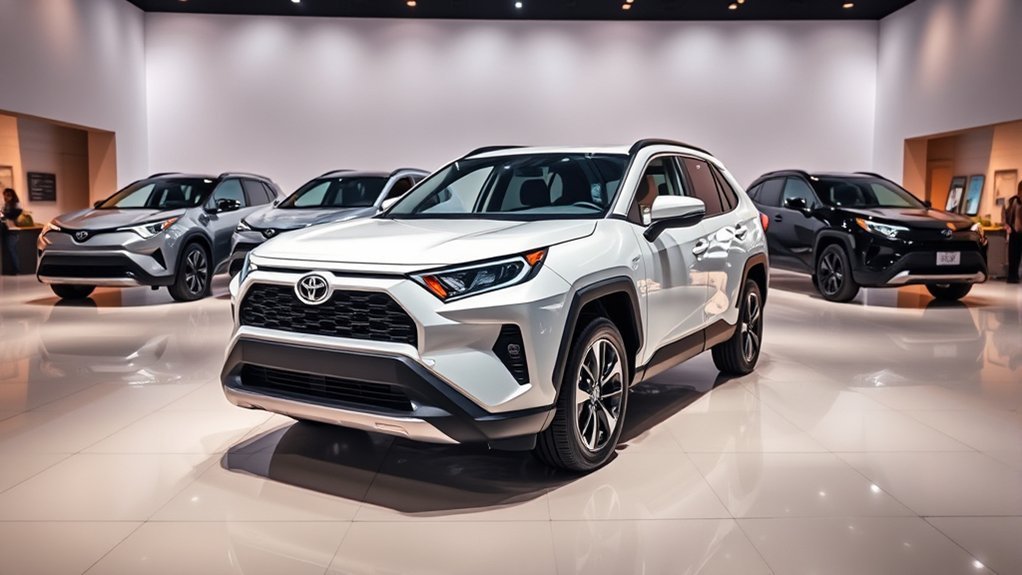
Toyota has built an electric RAV4 before. In fact, two RAV4 EV generations appeared long before the current Toyota bZ.
First-Generation RAV4 EV
The first RAV4 EV was offered through limited fleet and retail programs between 1997 and 2003. It was a battery-electric vehicle rather than a hybrid and carried an EPA-rated range of approximately 95 miles. Toyota later reported that 1,484 first-generation RAV4 EVs were sold or leased in the United States from model years 1998 through 2003.
This early model demonstrated that an electric compact SUV was possible, but limited battery technology, charging infrastructure, production volume, and availability kept it from becoming a mainstream vehicle.
Second-Generation RAV4 EV
Toyota produced a second RAV4 EV from 2012 through 2014 in collaboration with Tesla. It combined a RAV4 body with a Tesla-supplied battery and electric drive system and carried an EPA-rated range of 103 miles. Toyota planned approximately 2,600 sales through 2014, with availability focused on selected California markets.
Production and sales were limited, primarily to California. Toyota discontinued the model after the 2014 model year, so every RAV4 EV on the used market is now more than a decade old.
Toyota has sold electric RAV4s before, but neither historical generation is part of the company’s current new-vehicle lineup.
Should You Buy a Used RAV4 EV?
A used RAV4 EV may appeal to an enthusiast or a driver with modest daily mileage, but it should not be evaluated like a current EV. Before purchasing one:
- Arrange an independent inspection by a technician familiar with high-voltage electric vehicles.
- Request a battery-health assessment and test the vehicle after a full charge.
- Confirm the actual charging equipment, charging speed, and cable compatibility. For 2012–2014 RAV4 EVs, Toyota specified 120-volt Level 1 and 240-volt Level 2 AC charging, with SAE J1772 for public charging; do not assume a factory DC fast-charging port.
- Check whether qualified service facilities and model-specific parts are available nearby.
- Review the remaining real-world range in cold weather, at highway speeds, and with climate control operating.
- Confirm that the vehicle’s range comfortably exceeds the buyer’s routine mileage with a practical reserve.
Warning: A dashboard range estimate is not a complete battery-health test. Battery condition, service support, and parts availability can have a major effect on the ownership risk of an older, low-volume EV.
Toyota bZ: The Closest Current All-Electric Alternative
The vehicle previously sold in the United States as the bZ4X was renamed the Toyota bZ for the 2026 model year. It is Toyota’s closest current battery-electric alternative to a RAV4.
Toyota’s 2026 bZ specifications include:
- Starting MSRP: $34,900 before dealer processing and handling charges
- Maximum range: Up to 314 manufacturer-estimated miles in the XLE FWD Plus configuration
- Front-wheel-drive output: Up to 221 horsepower, depending on battery and configuration
- All-wheel-drive output: 338 horsepower
- Charging connector: North American Charging System, or NACS
- Onboard charger: 11-kW onboard AC charger; supports Level 1 and Level 2 charging
- Safety suite: Toyota Safety Sense 3.0
Range depends heavily on the selected battery, drivetrain, and grade. Toyota lists lower estimates for several other bZ configurations, so shoppers should verify the specification for the exact vehicle rather than relying on the maximum advertised number. Toyota announced the 2027 bZ on August 4, 2026 and described it as unchanged from the prior model year, so the 2026 bZ remains a useful current reference for shoppers comparing Toyota’s battery-electric SUV with the 2026 RAV4.
How Does the Toyota bZ Compare With Past RAV4 EV Models?
The current Toyota bZ provides considerably more range, power, charging capability, and driver-assistance technology than either historical RAV4 EV generation.
| Model | Model Years | Published Maximum Range | Current Status |
|---|---|---|---|
| First-generation RAV4 EV | 1997–2003 | Approximately 95 EPA-rated miles | Discontinued |
| Second-generation RAV4 EV | 2012–2014 | 103 EPA-rated miles | Discontinued |
| Toyota bZ | 2026 | Up to 314 manufacturer-estimated miles, depending on configuration | 2026 model; 2027 bZ announced unchanged |
Published range is only a standardized estimate. Temperature, speed, elevation, wind, tire pressure, passenger and cargo weight, cabin heating, air conditioning, and battery condition can all change the distance achieved in actual use.
RAV4 Hybrid vs. Plug-in Hybrid vs. Electric: Key Differences
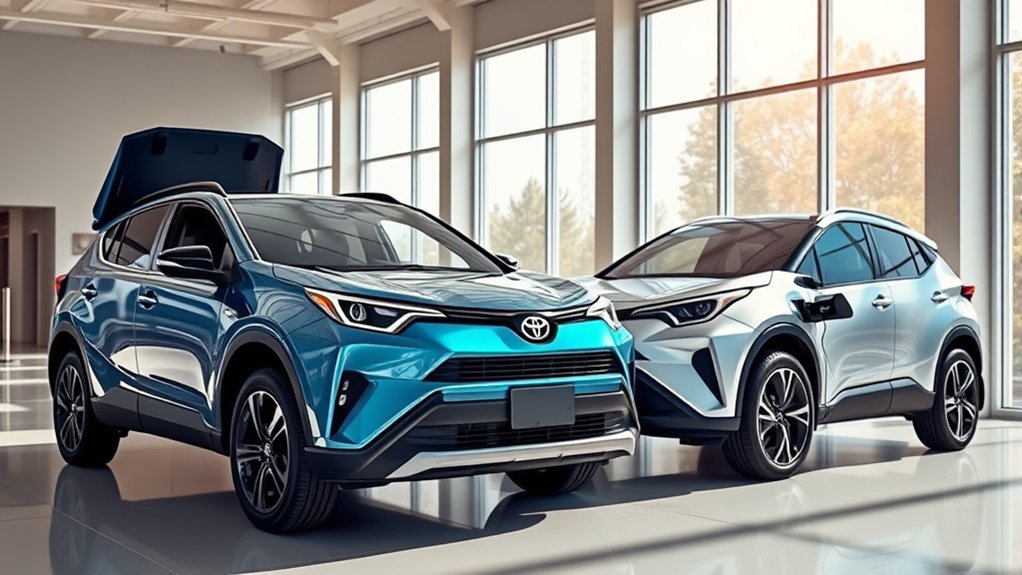
The term “electrified” can describe a hybrid, plug-in hybrid, or fully electric vehicle, but these powertrains work differently.
| 2026 Model | Powertrain | External Charging | Published Electric Range | System Output | Best Suited To |
|---|---|---|---|---|---|
| RAV4 Hybrid | Hybrid electric vehicle | No | No rated plug-in EV range | 226 hp FWD or 236 hp AWD | Drivers who want gasoline convenience with improved efficiency |
| RAV4 Plug-in Hybrid | Plug-in hybrid electric vehicle | Yes | Up to 54 EPA-estimated miles on SE | 324 hp | Electric commuting with gasoline backup for longer travel |
| Toyota bZ | Battery-electric vehicle | Required | Up to 314 manufacturer-estimated miles, depending on configuration | Up to 221 hp FWD or 338 hp AWD | Drivers ready for fully electric ownership and routine charging |
| Toyota C-HR | Battery-electric vehicle | Required | 287 EPA-estimated miles for SE; 273 miles for XSE | 338 hp AWD | Drivers seeking a smaller, sportier electric crossover |
Caution: Do not compare a BEV’s electric range directly with a hybrid’s total gasoline-assisted driving range. Electric range measures how far an EV can travel before recharging, while a hybrid can refuel quickly and continue operating on gasoline.
What’s New in Toyota’s Electric SUV Lineup for 2026?
2026 Toyota bZ
The Toyota bZ replaced the bZ4X name for 2026 and received substantial updates. Depending on configuration, changes include increased range, stronger power output, an NACS charging port, battery preconditioning, an 11-kW onboard charger, and revised interior and exterior features. Toyota’s August 4, 2026 announcement says the 2027 bZ is unchanged from the prior model year.
The maximum 314-mile estimate applies only to a particular front-wheel-drive configuration. Other bZ grades have lower published estimates, including versions with all-wheel drive.
2026 Toyota C-HR
The fully electric 2026 Toyota C-HR uses standard all-wheel drive and produces 338 horsepower. Toyota lists an EPA-estimated range of 287 miles for the SE and 273 miles for the XSE.
The C-HR has an NACS charging port and can charge from 10% to 80% in approximately 30 minutes under Toyota’s stated ideal DC fast-charging conditions. Its $37,000 starting MSRP excludes dealer processing and handling charges.
Charging a Toyota EV or Plug-in Hybrid
Charging convenience is one of the most important differences between a hybrid, plug-in hybrid, and fully electric vehicle.
Level 1 Charging
Level 1 charging uses a conventional household outlet. It is the slowest option, but it may be sufficient for a plug-in hybrid or a driver who adds only a small number of miles each day.
Level 2 Charging
Level 2 charging commonly uses a 240-volt home charger or a public AC charging station. It is much faster than a standard household outlet and is the usual home-charging solution for a battery-electric vehicle.
DC Fast Charging
DC fast charging is designed for faster charging during longer trips. Actual speed depends on the vehicle, charger, battery temperature, battery state of charge, weather, and station output. Charging normally slows as the battery approaches a high state of charge.
The current Toyota bZ and C-HR use NACS charging ports. Toyota states that supported configurations can complete a 10%-to-80% DC fast-charge session in approximately 30 minutes under ideal conditions.
Charging equipment differs within the 2026 RAV4 Plug-in Hybrid lineup. Toyota lists DC fast-charging capability for the XSE and Woodland grades, while the SE and GR Sport use J1772 Level 1 and Level 2 charging. Confirm the equipment fitted to the exact vehicle before purchase.
Pro Tip: Before buying a BEV, obtain an estimate for installing a suitable home charger and confirm the charging stations available along routes you travel regularly. Reliable home charging usually has a greater effect on day-to-day convenience than the maximum advertised DC fast-charging rate.
What Reduces Real-World Electric Range?
- Cold or extremely hot weather
- High sustained highway speeds
- Strong headwinds or steep elevation changes
- Cabin heating and air-conditioning use
- Heavy passenger, cargo, or accessory loads
- Low tire pressure or less-efficient replacement tires
- Frequent hard acceleration
- Battery aging and condition
Plan road trips with a practical reserve instead of assuming the vehicle will achieve its maximum published range in every condition.
How to Choose the Right Toyota Electrified Vehicle
The best choice depends on where you drive, how often you can charge, and how much flexibility you need.
- Measure your normal mileage. Review a typical week rather than relying on one unusually long or short trip.
- Confirm home-charging access. Apartment residents and renters should verify permission, parking access, electrical capacity, and billing arrangements.
- Map regular long-distance routes. Check charging-station reliability and spacing before selecting a BEV.
- Account for seasonal range loss. Use a conservative range estimate if you regularly drive in very cold or hot weather.
- Compare the exact grades. Range, drivetrain, charging capability, wheels, equipment, and price can vary substantially within one model.
- Price the complete ownership package. Include insurance, home-charger installation, electricity, public charging, registration, tires, and expected maintenance.
- Take a realistic test drive. Check seating, visibility, cargo space, ride quality, controls, and charging-port placement.
The RAV4 Hybrid fits drivers who prioritize easy refueling and long-distance flexibility over electric-only driving. The RAV4 Plug-in Hybrid fits drivers whose daily trips often stay within its EV range but who still value gasoline backup. The bZ or C-HR fits drivers with reliable charging who want routine driving without gasoline.
Benefits and Trade-Offs of Driving a Toyota Electric Vehicle
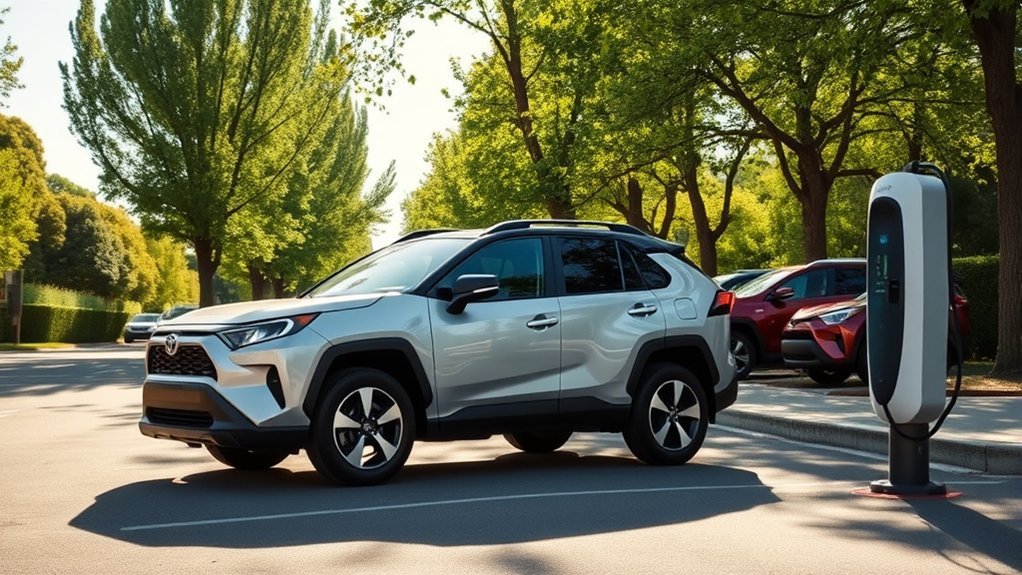
Environmental Impact
A battery-electric vehicle produces no tailpipe emissions while driving. Its total environmental impact still depends on electricity generation, battery and vehicle manufacturing, vehicle lifespan, and eventual recycling.
A plug-in hybrid can complete some trips without tailpipe emissions when operating in electric mode. Once its gasoline engine runs, it produces tailpipe emissions like other combustion vehicles. Charging the PHEV regularly is therefore important if reducing gasoline use is a primary goal.
Ownership Costs
EV owners can avoid oil changes and several other gasoline-engine maintenance items. Electricity may also cost less per mile than gasoline, particularly when a vehicle is charged at home during a favorable utility rate period.
However, no single full-charge cost applies nationwide. Estimate home-charging cost with this basic calculation:
Energy added in kilowatt-hours × electricity price per kilowatt-hour, plus charging losses.
For example, the amount shown on an electricity bill may be higher than the energy stored in the battery because some power is lost during charging. Public fast-charging prices can also be substantially higher than residential electricity rates.
Insurance, tire wear, registration fees, home-charger installation, public-charging use, and depreciation should be included in a complete ownership comparison.
Safety and Warranty
The 2026 Toyota bZ and C-HR include Toyota Safety Sense 3.0. The redesigned 2026 RAV4 introduces Toyota Safety Sense 4.0. Feature operation and availability can still vary by model and grade, so drivers should review the owner’s manual and understand that assistance systems do not replace attentive driving.
Toyota’s published materials for the current bZ and C-HR include eight-year or 100,000-mile coverage for specified electric-vehicle components and the traction battery. Warranty terms, exclusions, state-specific provisions, and coverage for other electrified models can differ. Review the warranty guide for the exact vehicle and model year before purchase.
Government Incentives and Purchase Checks
The federal New Clean Vehicle Credit, Previously-Owned Clean Vehicle Credit, and Qualified Commercial Clean Vehicle Credit are not available for vehicles acquired after September 30, 2025, according to the Internal Revenue Service. A vehicle acquired by the deadline may still require a separate eligibility review if delivery occurred later.
That federal change does not necessarily eliminate every incentive. Depending on location and program funding, buyers may find:
- State or local purchase and lease programs
- Utility rebates for vehicles or home chargers
- Reduced charging rates during off-peak hours
- Manufacturer or dealer incentives
- State, local, utility, manufacturer, or fleet programs that may apply to qualifying business or commercial use
Programs can expire, pause, or change without much notice. Verify eligibility directly with the administering agency, utility, manufacturer, or other program sponsor before relying on an incentive in a purchase budget. A dealer advertisement alone is not proof of tax eligibility.
Where to Find Current Toyota Electric-Vehicle Information
Use model-specific manufacturer pages and government resources instead of relying on older summaries or search-result snippets.
| Resource | Best Use |
|---|---|
| Toyota 2026 bZ information | Official range, output, charging, price, safety, and warranty information |
| Toyota 2026 C-HR information | Official C-HR range, performance, charging, price, and warranty information |
| Toyota 2026 RAV4 information | Official RAV4 Hybrid and Plug-in Hybrid powertrain details |
| FuelEconomy.gov | EPA fuel-economy, electric-range, energy-use, and comparison information |
| U.S. Department of Energy Alternative Fuels Data Center | Charging levels, connector information, and infrastructure guidance |
| Internal Revenue Service | Current federal clean-vehicle tax information and effective dates |
Related Guides
Frequently Asked Questions
Has Toyota announced a release date for a new electric RAV4?
No U.S. release date has been announced as of September 19, 2026. Toyota’s published 2026 RAV4 lineup consists of hybrid and plug-in-hybrid models, not a battery-electric RAV4.
Is the RAV4 Plug-in Hybrid fully electric?
No. The 2026 SE is EPA-rated for up to 54 miles of all-electric driving, but every RAV4 Plug-in Hybrid also has a gasoline engine. After the usable EV charge is depleted, it can continue operating as a hybrid.
Which Toyota EV is closest to the RAV4?
The Toyota bZ is the closest current battery-electric alternative in general size and purpose. The Toyota C-HR is another fully electric choice, but it has a smaller and sportier crossover design.
How far can the 2026 Toyota bZ travel on a charge?
Toyota lists up to 314 manufacturer-estimated miles for the XLE FWD Plus configuration. Other grades and drivetrains have lower estimates, and actual range varies with driving and environmental conditions.
What charging options are available for current Toyota electric vehicles?
The Toyota bZ and C-HR support Level 1, Level 2, and compatible DC fast charging through an NACS port. RAV4 Plug-in Hybrid charging capability varies by grade, so buyers should verify the exact vehicle’s equipment.
What battery warranty does a current Toyota EV include?
Toyota’s published materials for the 2026 bZ and C-HR list eight years or 100,000 miles of coverage for specified electric-vehicle components and the traction battery. Consult the applicable warranty guide for terms, exclusions, and state-specific provisions.
Are government incentives available for a Toyota electric vehicle?
Federal New, Previously-Owned, and Qualified Commercial Clean Vehicle Credits are unavailable for vehicles acquired after September 30, 2025. State, local, utility, manufacturer, or fleet programs may still be available, but eligibility and funding vary.
Is an older Toyota RAV4 EV still practical?
It may work for limited local driving, but every RAV4 EV is now an older, low-volume vehicle. Battery condition, remaining real-world range, charging speed, qualified service access, and replacement-parts availability should be investigated before purchase.
Conclusion
Toyota has produced an electric RAV4 in the past, but no new battery-electric RAV4 is available in the company’s 2026 U.S. lineup. The RAV4 Hybrid provides gasoline convenience and improved efficiency, while the RAV4 Plug-in Hybrid adds meaningful electric commuting range with gasoline backup. Drivers seeking a fully electric Toyota SUV should compare the current bZ and C-HR, paying close attention to grade-specific range, charging access, total ownership cost, and daily driving needs.
Sources
- Toyota: 2026 RAV4 Plug-in Hybrid — current EPA-estimated EV range, output, pricing, and grade information
- Toyota: 2026 Toyota RAV4 — Hybrid and Plug-in Hybrid powertrains, charging hardware, and grade details
- Toyota: 2026 Toyota bZ — model-name change, pricing, range, performance, charging, safety, and warranty information
- Toyota: 2027 Toyota bZ — confirms the 2027 bZ remains unchanged from the prior model year
- Toyota: 2026 Toyota C-HR — range, output, charging, pricing, safety, and warranty information
- Toyota: First-generation RAV4 EV history — U.S. program dates, sales volume, and historical range
- Toyota: 2012 RAV4 EV — 103-mile EPA range, charging, California sales plan, and production volume
- U.S. Department of Energy and Environmental Protection Agency: FuelEconomy.gov — official fuel-economy, electric-range, energy-use, and comparison information
- U.S. Department of Energy Alternative Fuels Data Center — charging levels, connectors, and electric-vehicle infrastructure guidance
- Internal Revenue Service: Clean Vehicle Tax Credits — current federal new, used, and commercial clean-vehicle credit termination rules
