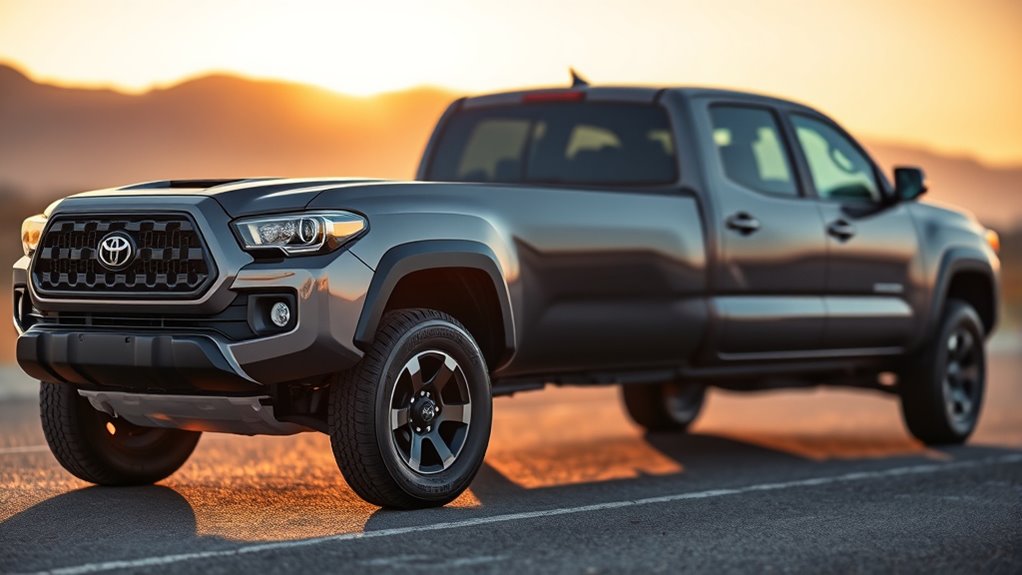
For 2026, the Toyota Tacoma XtraCab uses a 126.0-inch wheelbase, while the Double Cab stretches to 131.9 inches. The shorter XtraCab favors maneuverability, lighter weight, and a two-seat, six-foot-bed layout. The Double Cab improves stability, passenger room, and bed flexibility with five-seat short- or long-bed options. Trim access also differs, with Limited and TRD Pro limited to Double Cab short-bed models. Each setup serves a distinct use case, as the details ahead show.
Key Takeaways
- The 2026 Tacoma XtraCab has a 126.0-inch wheelbase, making it more maneuverable than the Double Cab.
- The Double Cab uses a 131.9-inch wheelbase, improving highway stability and trailer-sway resistance.
- XtraCab seats two and comes only with a six-foot bed, while the Double Cab seats five with short- or long-bed options.
- XtraCab trims include SR, SR5, and TRD Off-Road; Double Cab adds PreRunner, TRD Sport, Limited, and TRD Pro.
- Tacoma pricing starts at $33,740 and reaches $65,945, with up to 6,500 pounds of towing when properly equipped.
Tacoma XtraCab vs Double Cab
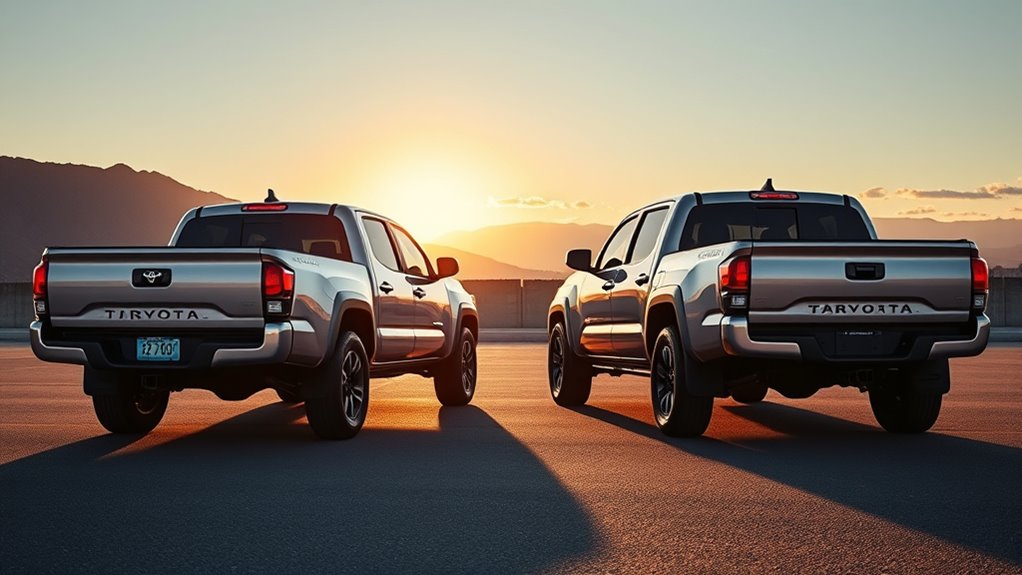
The Tacoma lineup separates into two distinct cab configurations with different priorities: the 2026 XtraCab uses a two-door, two-seat layout and is offered only with a long bed, making it the more cargo-focused choice, while the Double Cab adds four doors and five seats and can be paired with either short or long bed configurations for greater versatility.
The XtraCab suits buyers prioritizing utility, because its reduced cabin footprint supports a larger rear load area and a simpler interior layout. The Double Cab, by contrast, expands occupant capacity, serving family use and multi-passenger travel without abandoning truck capability.
The XtraCab prioritizes utility, while the Double Cab adds passenger space for family and multi-passenger travel.
Both bodies are available on SR, SR5, and TRD Off-Road trims, allowing access to different equipment levels and trail-oriented hardware. For buyers seeking more autonomy in how the truck is configured, the XtraCab emphasizes function, while the Double Cab broadens comfort and use-case flexibility.
Higher trims, including Limited and TRD Pro, are Double Cab only.
Tacoma Cab and Bed Options for 2026
For 2026, the Tacoma lineup offers two distinct cab-and-bed combinations built around different priorities: the XtraCab uses a two-door, two-seat layout and is paired only with a six-foot long bed, while the Double Cab adds four doors and five seats and can be ordered with either a five-foot short bed or a six-foot bed.
This structure gives buyers a clean choice between cargo focus and passenger capacity.
- XtraCab: maximum bed length, reduced cabin volume.
- Double Cab: broader interior access, flexible bed options.
- Short bed: standard on crew-cab trucks, optimized for urban maneuverability.
- Long bed: suited to larger payloads and freer load management.
Limited and TRD Pro models remain Double Cab short-bed variants, reflecting a premium, people-first configuration.
How Each Tacoma Cab Drives
The XtraCab emphasizes a utility-oriented driving character, with its compact dimensions and longer bed favoring cargo capacity and tighter-space maneuverability.
The Double Cab is tuned toward passenger comfort, and its longer wheelbase contributes to greater on-road stability and a smoother ride.
Although both versions use the same powertrain lineup, the Double Cab’s added mass can slightly reduce fuel efficiency relative to the lighter XtraCab.
XtraCab Utility Feel
XtraCab Tacoma models lean toward utility-focused driving, pairing two-seat practicality with a longer bed option that suits cargo transport and work duties.
In this XtraCab setup, the driving character is purposeful, with the shorter body aiding maneuverability in tight sites. The Double Cab, by contrast, broadens cabin access and passenger capacity, but the XtraCab remains the cleaner tool for stripped-down utility.
- Longer bed capacity supports freer load management.
- Two-seat layout reduces interior complexity.
- Leaf-spring rear hardware prioritizes payload duty.
- Shorter length can improve agility on constrained routes.
This configuration serves operators who value function over accommodation, preserving a direct, work-ready feel.
Double Cab Ride
Double Cab Tacoma models prioritize ride stability and passenger comfort, using a longer wheelbase to smooth out rough pavement and uneven terrain more effectively than the XtraCab.
The Double Cab’s chassis tuning supports controlled body motion, making daily commuting and trail travel feel composed. Its maximum towing capacity of 6,500 pounds adds utility without demanding a harsh ride, preserving a civil driving character under load.
Inside, spacious seating for up to five occupants gives families and work crews room to travel without constraint. Higher trims add a 14-inch touchscreen, improving interface access and connectivity.
The body design also supports short and long bed configurations, allowing cargo flexibility while maintaining passenger space. This balance suits drivers seeking practical capability with less compromise.
Wheelbase And Maneuvering
Wheelbase length plays a major role in how each Tacoma cab feels on the road and in tight spaces. The XtraCab, or B Max, uses a 126.0-inch wheelbase, giving it stronger maneuverability, quicker rotation, and easier parking in crowded corridors.
The Double Cab stretches to about 131.9 inches, trading agility for highway stability, towing control, and cabin space for liberated passenger movement.
- Shorter wheelbase supports sharper turns.
- Longer wheelbase improves straight-line composure.
- Lighter XtraCab mass can sharpen acceleration.
- Double Cab better resists trailer sway.
For drivers seeking freedom in urban traffic, the XtraCab feels more responsive.
The Double Cab suits those prioritizing comfort, load confidence, and steady handling under heavier demands.
Which Tacoma Trim Works With Each Cab
Cab selection on the 2026 Toyota Tacoma depends on trim, with the XtraCab reserved for long-bed configurations and the Double Cab offered with both short- and long-bed setups. This structure makes the Tacoma lineup trim-specific rather than universal.
SR and SR5 can be ordered with either cab, giving buyers a choice between cargo-focused packaging and greater cabin volume. The TRD Off-Road also accepts both cab styles, preserving trail capability while allowing broader configuration freedom.
By contrast, the PreRunner and TRD Sport are offered in Double Cab form, pairing sport-oriented hardware with extra seating space. The Limited and TRD Pro are restricted to Double Cab, short-bed models, reflecting their top-spec positioning and standard equipment layout.
In practical terms, cab eligibility determines the available bed length and interior capacity before any other specification is chosen.
Which Tacoma Cab Fits Your Daily Needs
Cab size and layout determine passenger capacity, door access, and interior flexibility, with the XtraCab configured for two occupants and the Double Cab configured for up to five.
Bed length then modifies the utility balance, as the XtraCab is limited to a long bed while the Double Cab can pair with short or long bed setups.
In practice, the selected cab and bed combination directly affects daily usability for cargo hauling, passenger transport, and overall access.
Cab Size And Layouts
The 2026 Toyota Tacoma is offered in two distinct cab layouts, each designed around different daily-use priorities: the XtraCab, with two doors and seating for two, and the Double Cab, with four doors and room for up to five occupants.
These cab configurations define access, passenger volume, and trim availability with clear functional separation. The XtraCab emphasizes utility and straightforward entry, while the Double Cab supports broader human transport needs.
- XtraCab: two-seat, two-door layout.
- Double Cab: four-door, five-passenger layout.
- Double Cab: standard short-bed pairing.
- Limited and TRD Pro: Double Cab only.
For liberated buyers, the choice is practical: select XtraCab for work-focused autonomy or Double Cab for shared mobility and daily versatility.
Bed Length Versus Space
Bed length becomes the primary differentiator once passenger capacity is established: the 2026 Toyota Tacoma’s XtraCab is limited to a long bed of roughly 6.1 feet, while the Double Cab is offered with a standard short bed of about 5.0 feet and, in some configurations, a longer cargo box.
The XtraCab favors hauling capacity and a simpler layout, while the Double Cab expands passenger space for up to five occupants. For daily use, the short-bed Double Cab supports easier parking, tighter turning environments, and freer urban movement.
The long-bed configuration suits users who need greater load volume for tools, gear, or recreational equipment. Limited and TRD Pro trims remain Double Cab short-bed models, reinforcing a compact, capable balance between comfort and utility.
Tacoma Wheelbase, Cargo Space, and Seating
Wheelbase plays a major role in how the 2026 Toyota Tacoma balances passenger space, cargo utility, and overall versatility. The XtraCab uses a 127.4-inch wheelbase, while the Double Cab stretches to 140.6 inches, changing how each layout serves independent work and travel.
XtraCab prioritizes cargo space and utility, seating up to two occupants with a configuration suited to focused hauling. Double Cab expands seating to five and improves headroom and comfort, supporting broader movement and less confinement.
- XtraCab: shorter wheelbase, longer bed emphasis.
- Double Cab: longer wheelbase, short or long bed options.
- Cargo capacity: XtraCab reaches about 1,705 pounds.
- Seating: Double Cab increases passenger accommodation and interior ease.
This structure gives buyers a clear framework for choosing autonomy in utility or openness in cabin space.
Tacoma Price, MPG, and Powertrain Options
Pricing, efficiency, and powertrain selection define the Tacoma’s value proposition across its lineup, with the 2026 model ranging from $33,740 for the base SR to $65,945 for the TRD Pro, destination included. The tacoma price ladder reflects equipment and driveline choices, while mpg figures remain competitive for a midsize truck built for autonomy and utility. Standard power comes from a turbocharged 2.4-liter four-cylinder, rated at 228 hp in SR trim and 278 hp in higher trims; the hybrid i-FORCE MAX raises output to 326 hp and 465 lb-ft.
| Metric | Figure |
|---|---|
| Base MSRP | $33,740 |
| Max MSRP | $65,945 |
| Hybrid MPG | 23 combined |
Rear-drive models return 20 city / 24 highway / 22 combined mpg. XtraCab and Double Cab configurations broaden powertrain options, and the properly equipped truck can tow 6,500 pounds. That range supports practical use without surrendering mechanical freedom.
Frequently Asked Questions
Which 2026 Toyota Tacoma Model Is the Best?
The Double Cab TRD Pro appears best overall, balancing performance comparison, towing capacity, and off road capabilities with premium hardware. The XtraCab suits utility-focused users better, but the Double Cab maximizes versatility, comfort, and capability.
Is 2026 Tacoma Better Than 2025?
Yes, the 2026 Tacoma appears gently brighter: 2026 performance upgrades, 2026 interior features, and 2026 safety enhancements make it the stronger package. It offers more power, a larger screen, better safety, and improved towing.
What Is the Wheelbase of a 2026 Toyota Tacoma?
The 2026 Toyota Tacoma has a wheelbase measurement of 126.0 inches for the XtraCab and 131.9 inches for the Double Cab, shaping Tacoma performance and off road capabilities through stability, ride quality, and maneuverability.
Which Tacomas to Stay Away From?
He should avoid the base SR for weak interior features, the TRD Off-Road if towing and engine reliability matter most, and the heavy Limited if efficiency is critical; XtraCab limits versatility, despite strong off road capabilities.
Conclusion
In the 2026 Tacoma lineup, the XtraCab and Double Cab serve clearly different priorities. The XtraCab emphasizes a shorter wheelbase, better maneuverability, and maximum bed utility, while the Double Cab adds rear-seat space and everyday versatility. Trim availability, payload, and passenger needs ultimately determine the best fit. For buyers comparing cab layouts, the choice can feel almost monumental, because it directly shapes ride, space, and practicality across nearly every Tacoma configuration.

