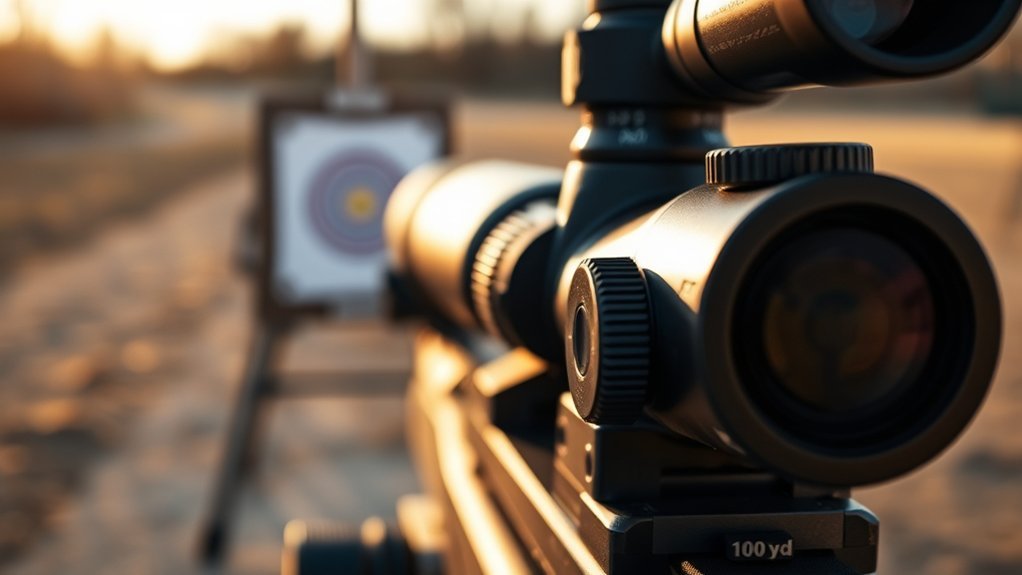
A scope factory-set for 100-yard parallax can shift apparent point of aim by roughly 1 to 2 inches at 30 yards. In high-magnification setups or with larger eye-position changes, the error can increase to several inches. The effect occurs because the reticle and target image no longer share the same focal plane at the shorter distance. With a consistent cheek weld, practical error is often limited to about 1 to 2 MOA. Further detail shows how to test and minimize this shift.
How Much Shift Does 100-Yard Parallax Cause at 30 Yards?
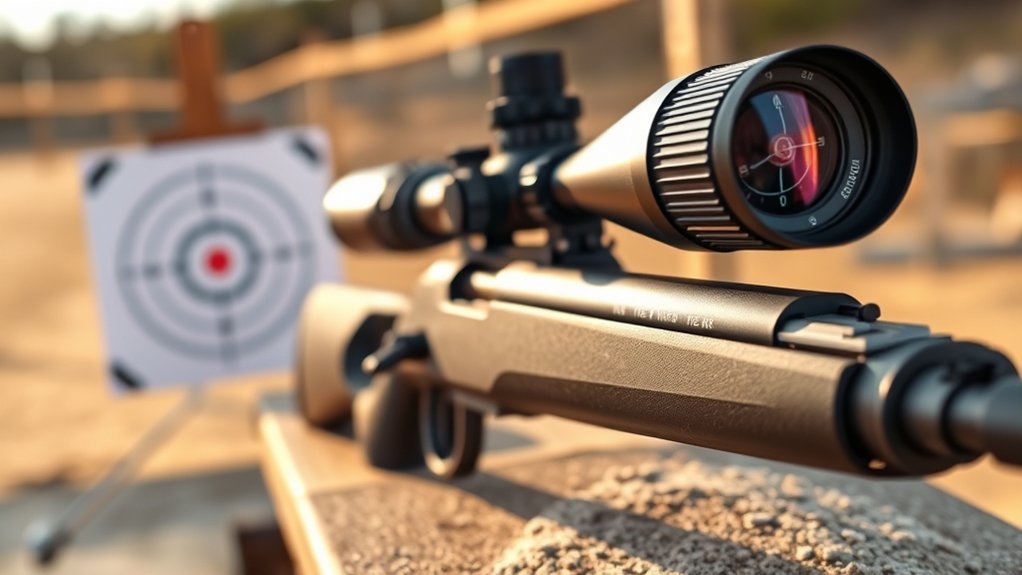
At 30 yards, a riflescope factory-set for 100-yard parallax can produce a meaningful point-of-aim shift because the target image and reticle are no longer optically coincident at that shorter distance.
In practical terms, the displacement can reach 1-2 inches at 30 yards from minor eye-position changes, and several inches in unfavorable combinations of magnification, scope geometry, and shooter inconsistency. That magnitude is operationally significant.
The effect becomes more consequential as magnification rises, since apparent reticle movement across the target is easier to induce and harder to ignore.
As magnification increases, parallax error grows more operationally significant, making reticle drift easier to provoke and less tolerable in practice.
For users seeking liberation from avoidable error, this means the nominal zero does not guarantee true alignment at shorter distances. A scope lacking parallax adjustment may consequently compromise effective range and produce an unexpected point of impact shift well beyond acceptable tolerance.
Systematic verification at 30 yards is the corrective measure: establish eye position discipline, test for reticle movement, and apply parallax adjustment whenever available to restore repeatable precision under field conditions.
Why Scope Parallax Looks Worse at 30 Yards
The reason parallax appears markedly worse at 30 yards is geometric: most riflescopes are factory-focused to place the reticle and target image in the same optical plane at roughly 100 yards.
So reducing target distance to 30 yards increases the separation between those planes and amplifies visible reticle displacement with any lateral eye movement.
At 30 yards, the optical system consequently becomes less forgiving, and the reticle can seem to drift or float across the target despite the rifle remaining stationary.
This apparent motion is not freedom from mechanical limits, but evidence of greater image-plane mismatch.
Higher magnification intensifies the effect by enlarging both the target and the visible displacement, making small alignment errors proportionally more obvious.
Scopes lacking parallax adjustment are especially vulnerable because their fixed 100-yard setting cannot reconcile the closer focal distance.
The result is increased dispersion and a less stable point of aim, particularly when precision expectations are high.
This explains confusion.
How Eye Position Changes Your Point of Aim
Because parallax links apparent reticle position to the shooter’s pupil location, even millimeter-scale lateral eye movement can shift the point of aim when the reticle and target image are not on the same focal plane.
At 30 yards, this geometric mismatch becomes more consequential, especially under higher magnification, where the reticle can seem to drift or float across the target as eye position changes.
The practical implication is straightforward: inconsistent head placement produces inconsistent aiming references. A stable cheek weld constrains pupil location, reducing angular error and tightening correspondence between indicated aim and actual point-of-impact.
Without adequate parallax adjustment, small deviations in eye alignment can account for a substantial share of unexplained misses at close range. In effect, disciplined eye position liberates the shooter from a hidden optical variable, allowing the scope to report target location more faithfully.
Precision at 30 yards consequently depends not only on mechanical zero, but also on repeatable ocular alignment behind the optic.
How to Test Scope Parallax at 30 Yards
A practical test at 30 yards isolates whether observed point-of-aim variation comes from eye-position inconsistency or residual scope parallax. The procedure begins with a stable rifle, a sharply defined target at 30 yards, and the scope’s parallax adjustment left at 100 yards, the common factory baseline for many parallax scopes.
The shooter then maintains the rifle motionless and shifts the eye slightly within the exit pupil while monitoring reticle-to-target relationship. Any visible reticle drift across the target plane indicates measurable parallax error.
At 30 yards, even small apparent movement can translate into meaningful dispersion and reduced independence from inconsistent cheek weld. To verify proper parallax adjustment, the observer incrementally refines the parallax adjustment knob and repeats the head-shift test.
The endpoint is reached when the reticle appears locked to the target with no floating or lateral displacement. Regular confirmation remains essential whenever distance changes, because improper adjustment predictably enlarges groups and compromises precise, self-directed shot placement.
How to Adjust Parallax for a 30-Yard Shot
For a 30-yard shot, the scope’s parallax adjustment should first be set to the 30-yard index rather than a 100-yard setting, where reticle-to-target misalignment can become significant.
The shooter then maintains a consistent cheek weld and makes small lateral and vertical eye shifts to detect any apparent reticle movement against the target.
Adjustment is fine-tuned until that movement is reduced to effectively zero, indicating correct eye alignment and minimal parallax error at 30 yards.
Set Approximate Distance
When the target is at 30 yards, a scope left at its common 100-yard parallax setting can produce a noticeable point-of-aim shift from small changes in eye position.
To regain control, the shooter should begin parallax adjustment by setting the side-focus or objective ring near the 25- or 30-yard mark. This initial estimate places the optical focal plane much closer to the actual target distance, reducing reticle drift as head position varies.
To adjust parallax efficiently, the operator should verify the scope is truly intended for 30 yards rather than relying on factory 100-yard defaults.
At higher magnification, residual error becomes more pronounced, so temporarily lowering power can reduce apparent shift.
Regular pre-shot confirmation of approximate distance settings supports freer, more precise shot placement under field conditions and enhances confidence.
Fine-Tune Eye Alignment
How should eye alignment be verified after the parallax control is set near 30 yards? The shooter should fine-tune eye alignment by confirming that the reticle stays visually fixed on the target during slight lateral and vertical head movement. Any apparent drift indicates incomplete parallax adjustment and possible point-of-impact error at 30 yards, sometimes several inches with a 100-yard setting.
- Set the knob precisely to 30 yards.
- Establish a repeatable cheek weld.
- Move the eye a few millimeters in each direction.
- Refine until reticle movement becomes negligible.
This method quantifies freedom from optical bias. A stable cheek weld limits geometric inconsistency, while repeated observation validates the correction.
On higher magnification scopes, this verification should precede every close-range shot, since parallax sensitivity increases as distance decreases considerably.
How Magnification Affects Parallax Error
Although parallax exists at any power setting, its practical effect on point of aim is typically minor at magnifications of 10x or less and becomes progressively more pronounced above 10x. At 30 yards, this means lower-power magnification scopes generally show limited apparent reticle displacement, even if the scope has fixed parallax calibrated at 100 yards. Small eye-position deviations still exist, but their geometric impact remains comparatively constrained.
Beyond 10x, the optical system reveals parallax error with greater sensitivity. The shooter sees more target detail, yet also more reticle movement as head position shifts off axis. With fixed parallax set for 100 yards, that movement can become significant at 30 yards because the target image and reticle plane are not optically coincident.
The result is measurable point-of-aim migration rather than mere visual nuisance. In practical terms, increased power amplifies the consequences of imperfect alignment, making a parallax adjustment knob increasingly valuable for independent, controlled precision.
When a Fixed 100-Yard Parallax Scope Still Works
A fixed 100-yard parallax scope generally remains functional at 30 yards because the resulting point-of-aim shift is typically limited to about 0.25 to 0.5 MOA under normal eye-placement error.
That margin stays small enough for practical hunting accuracy inside 100 yards, but only if cheek weld and ocular alignment are kept consistent from shot to shot.
In this scenario, close-range performance depends less on the parallax setting itself than on how effectively eye position is controlled.
Close-Range Error Limits
When a scope is factory-set for 100-yard parallax, use at 30 yards typically produces only a small point-of-aim deviation, commonly on the order of 1-2 MOA under ordinary head-position error. This means practical accuracy usually remains acceptable without immediate adjustment, giving shooters more freedom in ordinary field use.
At 30 yards, parallax is constrained by the short target distance, so reticle displacement is modest unless magnification is high or group-size demands are strict.
- Typical close-range error stays near 1-2 MOA.
- Practical shooting usually shows negligible impact.
- Precision grouping may reveal slight shift.
- Zero confirmation remains the disciplined safeguard.
For most non-precision applications, a fixed 100-yard setting still works efficiently. Serious users seeking tighter dispersion should verify zero after range changes and quantify any residual offset empirically.
Eye Position Matters
Because a fixed 100-yard parallax setting is optimized for a different focal distance, eye position becomes a primary error source at 30 yards: even small deviations in cheek weld can shift the reticle relative to the target and produce measurable point-of-impact change.
At 30 yards, parallax error increases because the target image and reticle are not coincident on the same optical plane. If eye alignment drifts laterally or vertically, the apparent aiming point moves despite the rifle remaining stationary. This can create horizontal and vertical displacement in point of impact, often enlarging groups beyond expected dispersion.
A disciplined, repeatable cheek weld reduces this optical freedom and constrains error. Consequently, a fixed 100-yard scope can still function adequately at closer distance when head placement is consistent, but it cannot forgive careless alignment or unstable shooting geometry.
Practical Hunting Accuracy
Practical field use often shows that a fixed 100-yard parallax scope remains sufficiently accurate at 30 yards, provided eye position is repeatable. For most hunting applications, resulting error remains small enough to preserve practical accuracy and decisive shot placement under field pressure.
- At 30 yards, parallax shift from a 100-yard setting is commonly about 1-2 MOA.
- On small game, that margin is usually acceptable for rapid engagements.
- On deer-sized targets, the effect is typically inconsequential within critical-zone dimensions.
- Consistent cheek weld and centered eye alignment sharply reduce point-of-impact deviation.
This reality gives hunters equipment freedom without demanding constant optical adjustment. A fixed-parallax optic still performs effectively across common hunting distances, so long as the shooter understands limitations, maintains alignment discipline, and matches expected precision to target size and conditions.
How to Reduce Parallax Error in the Field
Reduce parallax error in the field by setting the scope’s parallax adjustment to the actual target distance; for a 30-yard shot, the dial should be set to 30 yards. This parallax adjustment is the primary control for minimizing apparent reticle shift in rifle scopes, and it directly reduces point-of-aim displacement at short range.
A consistent cheek weld further stabilizes eye position behind the optic, limiting lateral or vertical movement that magnifies residual parallax. The shooter should verify alignment by moving the head slightly while maintaining target focus; if the reticle appears to drift across the target, the setting requires correction.
Repetition at multiple known distances builds practical sensitivity to how parallax alters impact, especially near 30 yards where small optical errors become proportionally significant. High-quality rifle scopes, particularly models with side-focus systems, provide finer adjustment resolution and superior optical design.
Such equipment helps the user reduce parallax error and operate with greater independence, precision, and field confidence overall.
Frequently Asked Questions
What Does 100 Yard Parallax Mean?
A 100-yard parallax setting means reticle-target alignment is error-free at 100 yards. This Parallax explanation indicates fixed optical calibration; Parallax adjustment is unnecessary there, while Parallax effects can increase at other distances, depending on eye position.
At What Distance Does Parallax Matter?
Parallax matters most beyond roughly 150 yards, where Parallax error increases measurable distance impact, especially at higher magnification. Inside 100 yards, effects are usually negligible; proper scope adjustment further minimizes deviation, preserving shooter autonomy and precision.
Is Sighting in at 25 Yards the Same as 100?
No; like Plato’s cave, equivalence is illusion. A 25-yard sighting distance rarely matches a 100-yard zero because scope alignment and trajectory differ. Target consistency requires quantified verification, as parallax and ballistic offset can shift impact measurably.
How Much Does Parallax Affect Accuracy?
Parallax can reduce accuracy by roughly 0.25–1.0 inches at 30 yards, depending on magnification and eye position. This parallax explanation highlights accuracy implications; disciplined eye alignment and correct scope adjustments materially liberate precision and consistency.
Conclusion
At 30 yards, a scope fixed at 100-yard parallax can shift apparent point of aim by a measurable margin when the eye drifts off-center, with error increasing as magnification rises and head position loosens. The effect is small in geometry yet sharp in practice, like a narrow beam bending across a short corridor. Careful cheek weld, centered sight picture, and parallax adjustment compress that error envelope, keeping reticle and target aligned as a single, rigid axis.
