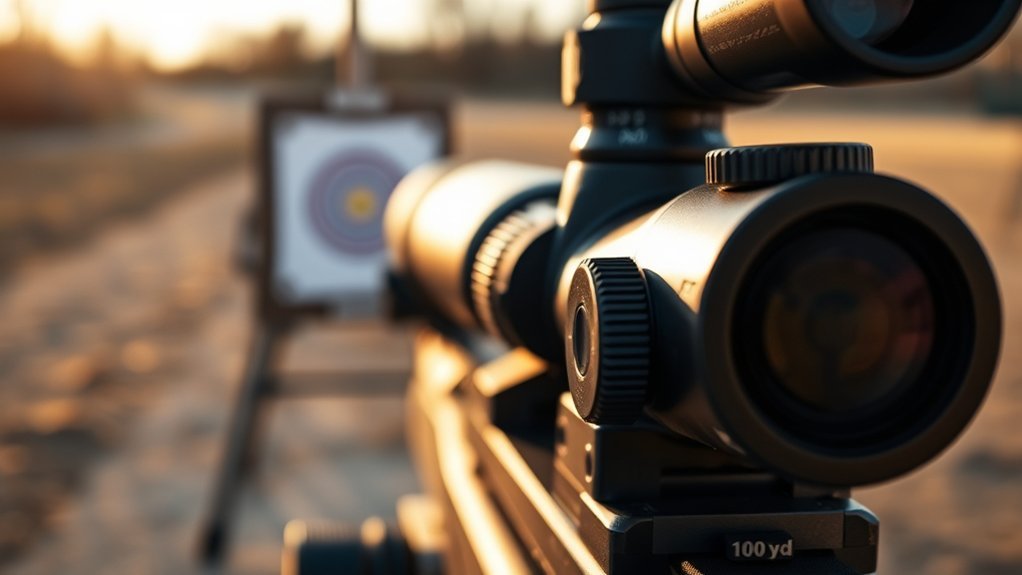
A riflescope with 100-yard parallax at 30 yards can show apparent reticle movement when your eye shifts behind the scope. The amount depends on the optic, magnification, and eye position. There is no reliable inch value that applies to every rifle and scope combination.
Understanding the difference between optical parallax and actual point-of-impact change helps you identify the problem without confusing it with an incorrect zero.
Quick Answer
A scope set for 100-yard parallax can show noticeable reticle drift at 30 yards, but there is no universal 1- or 2-inch error. Actual displacement depends on the scope and how far your eye moves off-center. One MOA equals approximately 0.31 inch at 30 yards. A stationary-rifle head-movement test reveals the actual error.
Key Takeaways
- Parallax makes the reticle appear to move across the target when your eye changes position.
- A consistent cheek weld reduces error, even when the scope has fixed parallax.
- Higher magnification makes close-range focusing problems and reticle movement easier to notice.
- Side-focus markings are starting points, not guaranteed measurements of target distance.
- Parallax correction and rifle zero are separate adjustments.
How Much Shift Does 100-Yard Parallax Cause at 30 Yards?
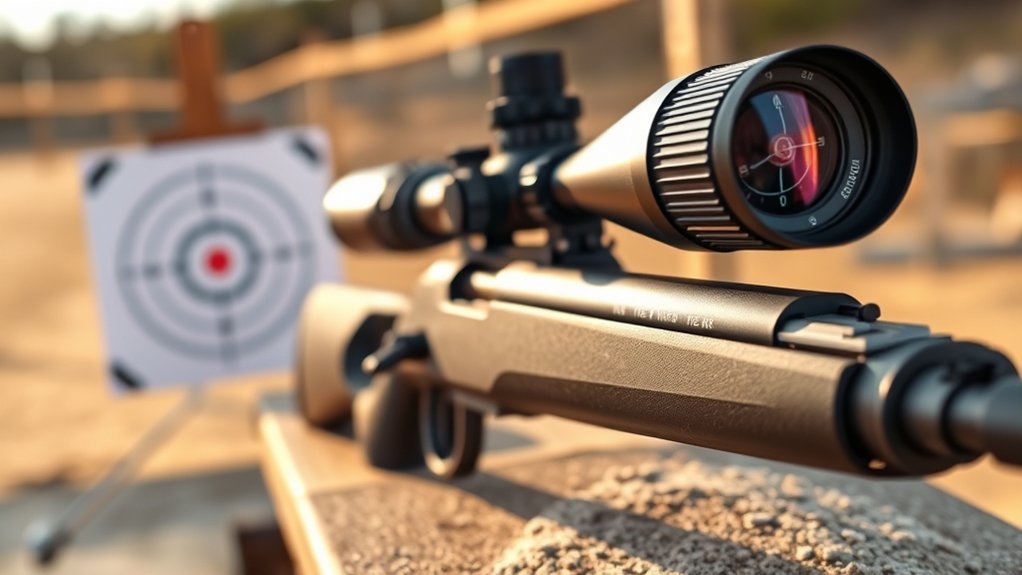
A scope factory-set for 100-yard parallax can produce apparent point-of-aim movement at 30 yards. However, the distance mismatch alone does not establish how many inches the reticle will move.
The actual error depends on the scope’s optical design, objective lens, eye position, and focus setting. A centered eye may show little practical error, while an off-center eye can reveal greater movement.
For a useful comparison, convert angular error into inches at the target distance.
According to Leupold’s optical terminology, one minute of angle (MOA) equals approximately 1.047 inches at 100 yards. At 30 yards, that angle covers about 0.314 inch.
| Angular displacement | Approximate displacement at 30 yards |
|---|---|
| 0.5 MOA | 0.16 inch |
| 1 MOA | 0.31 inch |
| 2 MOA | 0.63 inch |
These figures illustrate angular measurement. They are not guaranteed parallax errors for a particular scope.
For perspective, one inch of displacement at 30 yards represents approximately 3.2 MOA. Two inches represents about 6.4 MOA.
That is why claims of 1–2 inches and 1–2 MOA should not be treated as interchangeable.
The useful answer is the movement observed through your actual scope, with the rifle held stationary at the intended distance.
Why Scope Parallax Looks Worse at 30 Yards
Parallax occurs when the target image and reticle do not appear in the same optical plane. Moving your eye then changes their apparent alignment, even though the rifle has not moved.
A scope corrected for 100 yards is designed to minimize that effect at its specified distance. At 30 yards, the closer target may appear out of focus, and the reticle can seem to float across it.
Bushnell’s parallax guidance explains that the visible movement comes from the mismatch between the target image and the reticle.
The problem becomes apparent when your eye shifts vertically or horizontally behind the eyepiece.
Fixed-parallax scopes are not automatically unsuitable for closer distances. Their limitations depend on the particular optical system and the precision required.
For example, Bushnell specifies a fixed 100-yard parallax calibration for its R7 1-8×24 riflescope. Other scopes use different fixed distances.
The factory calibration is therefore a model-specific specification, not a universal setting for every riflescope.
How Eye Position Changes Your Point of Aim
Your eye position controls how you see the reticle against the target. When parallax exists, moving your eye away from its original position can change the apparent aiming point.
Imagine looking at a nearby object against a distant wall. When you move your head, the object appears to shift against the background.
A similar effect occurs inside a riflescope when the target image and reticle are not optically aligned.
A consistent cheek weld helps keep your eye in the same position. Centering your eye behind the eyepiece also provides a repeatable sight picture.
However, proper eye position does not physically eliminate parallax. It limits the variation caused by viewing the scope from different positions.
You should also distinguish parallax from an ordinary eye-relief problem.
- Parallax: The reticle appears to move relative to the target when your eye moves.
- Eye relief: The distance between your eye and the eyepiece affects whether you see the full image.
- Scope shadow: Dark areas around the sight picture indicate that your eye is not positioned correctly within the viewing area.
Correcting your viewing position helps produce a consistent reference, but the head-movement test remains necessary to check residual parallax.
How to Test Scope Parallax at 30 Yards
You can test parallax at 30 yards without firing a shot. The test requires a stable rifle, a clearly visible target, and careful observation of reticle movement.
Keep the rifle stationary throughout the procedure. Otherwise, you may mistake actual rifle movement for an optical problem.
Warning: Before conducting a stationary parallax test, unload the firearm and verify that its chamber and magazine are empty. Keep the muzzle pointed in a safe direction and your finger away from the trigger. Follow the NSSF firearm safety rules throughout the procedure.
- Secure the rifle. Place it in a stable rest so the scope remains pointed at a safe, clearly defined target.
- Set the target distance. Position the target at 30 yards and select a clearly visible reference point.
- Establish the starting setting. If your scope has parallax adjustment, begin near its 100-yard marking to observe the original mismatch.
- Move your eye slightly. Shift your head horizontally and vertically while keeping the rifle completely still.
- Watch the reticle. Determine whether the crosshair moves against the target.
- Adjust and repeat. If the scope supports parallax correction at 30 yards, refine the adjustment until the apparent movement becomes negligible.
The test succeeds when the reticle remains visually stationary against the target despite small changes in eye position.
If the reticle continues to move, the scope may need further adjustment or may not support parallax correction at that distance.
A fixed-parallax scope has no external control for removing this mismatch. You can still use the test to understand its behavior.
How to Adjust Parallax for a 30-Yard Shot
For a 30-yard target, begin with the scope’s parallax control near the actual distance, provided its adjustment range includes 30 yards.
Then refine the setting by observing the reticle while moving your eye slightly. The correct setting is the one that minimizes apparent movement, not necessarily the one printed on the dial.
Set Approximate Distance
Start by checking whether your scope has a side-focus knob or adjustable objective.
If it does, turn the control toward the closest available marking to 30 yards. Some scopes have numbered distance scales, while others use reference marks without exact yardage labels.
Manufacturer markings are approximate. Vortex’s focusing instructions recommend using them as a guide and checking the final setting through observed reticle movement.
Do not assume every adjustable scope can reach 30 yards.
For example, Leupold lists a 30-yard minimum parallax-free distance for its VX-4HD 4-16×50 side-focus model. Other designs have different limits.
If your scope reaches its closest setting before the target becomes properly focused, do not force the control beyond its mechanical stop.
Fine-Tune Eye Alignment
After selecting the approximate distance, confirm that the reticle remains stable against the target.
- Set your normal viewing position behind the scope.
- Focus your eye on the target and observe the reticle.
- Move your eye slightly without moving the rifle.
- Adjust the parallax control until visible reticle movement is minimized.
- Return to your normal eye position and confirm the result.
If the target is clear but the reticle remains blurry, check the eyepiece diopter rather than continuing to change the parallax setting.
These controls serve different purposes. The diopter focuses the reticle for your vision, while the side-focus or adjustable-objective control focuses the target image and corrects parallax.
Leupold’s riflescope support instructions explain the correct order: establish a sharp reticle first, then use the objective or side-focus adjustment to address target focus and parallax.
Once the diopter is set correctly for your eyesight, it generally does not need adjustment for every change in target distance.
How Magnification Affects Parallax Error
Higher magnification makes parallax more noticeable because it enlarges the target image and apparent reticle movement. It can also make a poorly focused close-range image harder to use.
However, magnification does not necessarily increase the underlying geometric parallax by the same proportion.
The NRA’s explanation of optical parallax distinguishes theoretical parallax from the practical difficulty of aiming through a magnified, out-of-focus image.
A scope set for a distant target may show an increasingly blurry image as magnification rises at 30 yards.
Lowering magnification can make the image easier to view and may make residual movement less distracting. It does not automatically remove the optical mismatch.
There is also no universal magnification threshold at which parallax suddenly becomes a problem.
A fixed 100-yard scope can show measurable parallax below 10x, while a properly adjusted high-magnification scope can minimize it at a supported target distance.
Use the same stationary-rifle test at your intended magnification to judge the actual result.
When a Fixed 100-Yard Parallax Scope Still Works
A fixed 100-yard parallax scope can still be usable at 30 yards. Its practical suitability depends on the amount of observed reticle movement, your eye-position consistency, and the accuracy required.
Because the scope lacks a separate parallax adjustment, you cannot dial away the mismatch. You can reduce its practical effect through consistent positioning and range verification.
Close-Range Error Limits
There is no reliable fixed MOA limit for every 100-yard parallax scope used at 30 yards.
A scope showing little reticle movement may produce limited practical error. Another scope may show a larger apparent shift under different viewing conditions.
The angular conversion remains useful when evaluating your result:
- One MOA represents about 0.31 inch at 30 yards.
- Two MOA represents about 0.63 inch.
- One inch of displacement represents approximately 3.2 MOA.
These measurements help explain observed movement without assuming that every scope produces the same error.
Remember that parallax correction is not the same as zero adjustment. The parallax control addresses optical alignment; the elevation and windage turrets adjust the aiming system’s zero.
Eye Position Matters
Consistent eye position becomes especially useful when a fixed-parallax scope is used outside its intended distance.
Keep your cheek placement repeatable and your eye centered behind the optic. Avoid changing your head position from one sight picture to the next.
This reduces one source of variation without requiring an adjustable scope.
However, a consistent cheek weld cannot correct every optical limitation. If reticle movement remains excessive for your intended use, the scope’s fixed-distance calibration may be unsuitable for that application.
Practical Hunting Accuracy
For hunting, a fixed-parallax scope may provide adequate close-range performance when its observed error is small and eye position remains consistent.
Whether that performance is acceptable depends on the target, conditions, and required precision. It should not be assumed from the scope’s factory parallax distance alone.
Small targets leave less room for aiming variation. Larger targets do not remove the need to account for reticle movement, rifle zero, and other sources of error.
Check your actual rifle and scope combination at the distances you expect to encounter. If the sight picture is unclear or the aiming reference is uncertain, do not rely on a generic estimate of parallax error.
How to Reduce Parallax Error in the Field
The most practical way to reduce parallax error is to match the optical adjustment to the target distance whenever your scope permits it.
When using fixed parallax, consistent eye position becomes particularly important. The following checks help keep your aiming reference repeatable.
- Know your scope: Identify its factory parallax setting and minimum focusing distance.
- Use the correct control: Adjust side focus or the objective for target distance, not the eyepiece diopter.
- Keep your eye centered: Establish a consistent cheek weld and full sight picture.
- Check the reticle: Look for movement against the target when your eye changes position.
- Reduce magnification when useful: A lower setting may make a close target easier to view.
- Confirm your zero separately: Do not mistake an optical focus adjustment for a ballistic correction.
At multiple known distances, the same observation method helps you understand where your particular scope performs comfortably and where its limitations become noticeable.
If a scope cannot focus at your intended distance, a model designed for closer-range parallax correction may be more appropriate.
For persistent or unusual optical problems, consult the manufacturer or a qualified optics technician.
Frequently Asked Questions
What Does 100-Yard Parallax Mean?
A 100-yard parallax setting means the scope is designed to minimize apparent reticle movement at 100 yards. At other distances, the target image and reticle may no longer share the same optical plane. The amount of resulting error depends on the optic and eye position.
At What Distance Does Parallax Matter?
Parallax can matter at any distance where the target image and reticle are not optically aligned. A scope calibrated for 100 yards can show error at 30 yards or at longer distances. There is no universal distance beyond which parallax suddenly becomes important.
Is Sighting In at 25 Yards the Same as 100?
No. A 25-yard zero does not automatically produce a 100-yard zero. Bullet trajectory and the relationship between the sight line and bore line affect impact at different distances. Parallax is a separate optical issue, so actual point of impact must be verified at the intended distance.
How Much Does Parallax Affect Accuracy?
There is no universal accuracy penalty because parallax varies with scope design, target distance, and eye position. At 30 yards, one MOA corresponds to about 0.31 inch. A stationary-rifle head-movement test helps establish the actual apparent aiming error for your scope.
Does Adjusting Parallax Change Your Rifle’s Zero?
Parallax adjustment is not intended to change the rifle’s mechanical zero. It changes how the target image aligns with the reticle. Your apparent aiming point can change when existing parallax is corrected, so confirm actual point of impact separately rather than treating the focus control as an elevation or windage adjustment.
Conclusion
A scope with fixed 100-yard parallax can show apparent aiming error at 30 yards, but the amount cannot be predicted from the factory setting alone.
Use a stationary-rifle test to observe the actual reticle movement. Keep your eye position consistent, adjust parallax when your scope supports it, and confirm your rifle’s zero separately.
Sources
- Leupold — Glossary: MOA measurements and optical terminology.
- Bushnell — Adjusting Parallax: Explanation of reticle movement and the adjustment procedure.
- Bushnell — R7 1-8×24 Riflescope: Example of a fixed 100-yard parallax specification.
- NSSF — Rules of Safe Gun Handling: Firearm safety precautions.
- Vortex Optics — FAQs: Reticle focus, side-focus adjustments, and parallax testing.
- Leupold — Riflescope Support: Diopter setup and target-focus guidance.
- Leupold — VX-4HD 4-16×50 Specifications: Example of a 30-yard minimum parallax-free distance.
- NRA Shooting Illustrated — Understanding Optical Parallax: Optical geometry and magnification effects.
