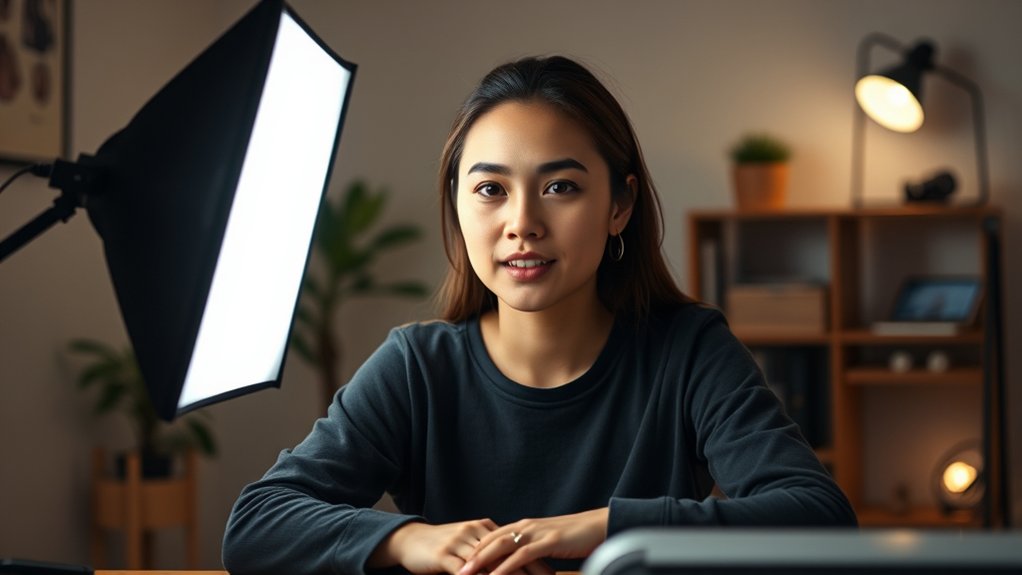
A 39-inch octabox is generally a strong choice for close talking head videos because its larger surface creates softer, more even facial light and smoother shadow shifts. In small rooms, placing it about 3 to 4 feet from the subject keeps the light flattering while limiting spill. A 24-inch softbox works better when space is extremely tight and directionality matters more. Positioning the light 45 degrees off-axis and slightly high improves shape, with more setup guidance below.
Which Softbox Is Best for Talking Head Videos?
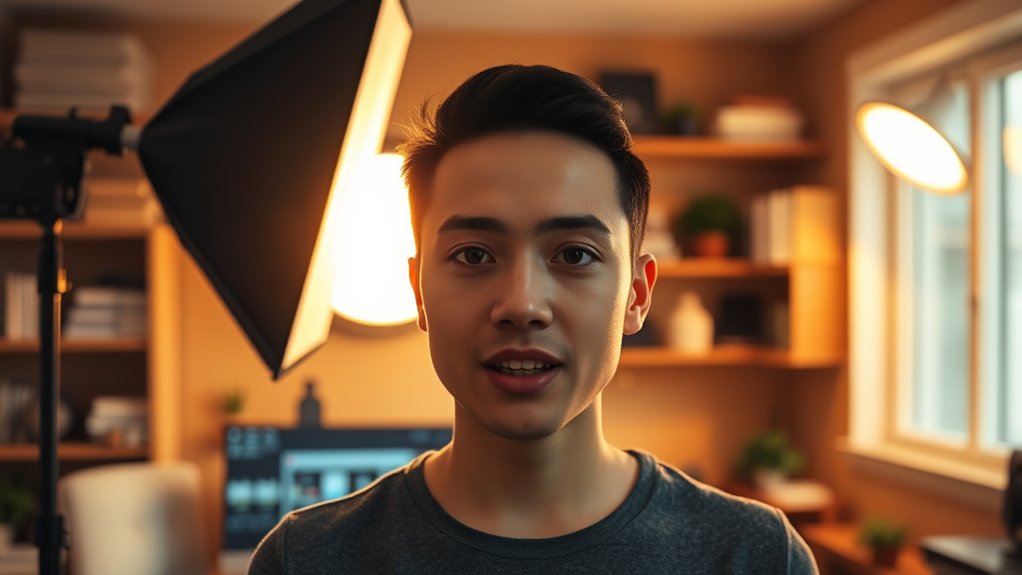
When selecting a softbox for talking head videos, a 39-inch model is often regarded as the most practical choice because its larger surface area produces softer, more even facial illumination and minimizes harsh shadows.
For close framing, that size balances wraparound softness with controllable spill, allowing the subject’s features to appear natural rather than flattened. This gives creators more freedom to shape a clean, self-directed visual identity.
A frequently cited option is the Elinchrom Rotalux 39 Octobox, valued for versatile output and a natural-light character suited to interviews and tutorials.
A deeper softbox design further improves directional control, keeping illumination even and efficient.
For tighter setups, the Godox 120cm softbox remains compact while still delivering flattering diffusion for close-ups.
Models with adjustable diffusers add practical control over softness and intensity, enabling precise tuning for skin texture, contrast, and catchlights without forcing the subject under aggressive, constraining light.
What Makes a Softbox Work in Small Rooms?
In small rooms, softbox performance depends on controlled diffusion, manageable size, and precise placement. Effective diffusion is critical because confined spaces exaggerate hard edges and shadow contrast. A well-designed softbox softens changes across the face, producing flattering light for talking head framing without flooding walls or ceilings.
Compact dimensions also matter, since a smaller fixture maintains directionality and keeps the setup physically practical. Control features further determine whether a softbox can liberate a creator from inconsistent room conditions. Adjustable brightness helps balance exposure without pushing light into the background, while variable color temperature supports cleaner matching with daylight or interior bulbs.
Placement typically works best at roughly 3 to 4 feet from the subject, where softness remains intact and spill stays restrained. In restricted spaces, collapsible construction adds another advantage: faster setup, easier storage, and more freedom to build a repeatable lighting arrangement that delivers professional results without requiring a dedicated studio room.
Is a 39-Inch or 24-Inch Softbox Better?
A 39-inch softbox offers a larger apparent light source, which increases diffusion and produces softer shadows at typical talking-head distances.
A 24-inch softbox is easier to place in small rooms and tighter setups, but its smaller surface area usually creates slightly firmer shadow edges and less even wrap.
The better choice depends on the balance between available space and the need for close-range softness, with 39-inch models generally favoring a more polished on-camera look.
Light Size Tradeoffs
Size determines the tradeoff: a 39-inch softbox creates a larger apparent light source, which diffuses light more effectively, softens facial shadows, and generally produces a more flattering look for talking head videos, especially in close-up framing.
In practical lighting terms, that larger modifier offers broader facial fill and better shadow control, making it suitable for creators seeking a freer, more polished image.
A 24-inch softbox trades some softness for efficiency. Its smaller footprint fits tight rooms, travels easily, and speeds setup for mobile production.
It can also sit nearer the subject without dominating the frame or blasting the scene with excessive intensity. By comparison, a 39-inch unit often benefits from more working distance and more dedicated space.
The decision depends less on absolute quality than on room constraints, placement flexibility, and production mobility.
Close-Range Softness
At close working distances, the comparison shifts from general coverage to apparent source size relative to the subject and the need for spill control. A 24-inch softbox usually suits talking heads better, especially in a 6ft x 6ft office, because it keeps illumination disciplined while preserving balanced exposure. A 39-inch softbox produces broader wrap and gentler diffusion, but that freedom can flood walls and flatten contrast in tight rooms.
| Size | Strength | Best Use |
|---|---|---|
| 24-inch | Control | Small rooms |
| 39-inch | Softer wrap | Looser setups |
| Placement | Changes softness | Fine-tuning |
When placed closer, either softbox softens shadows and flatters facial texture. The decision thus rests on intent: the 24-inch for focused authority and spatial liberation, the 39-inch for a softer ambient look where spill is acceptable.
What Softbox Setup Works Best in a 6×6 Office?
In a 6×6 office, a compact key light such as a 39-inch octabox or 24-inch mat softbox typically provides sufficient wrap for talking head framing without consuming critical floor space.
Placement is usually most effective when the fixture is mounted on a C-stand or ceiling pole to keep the light close while maintaining a clean shooting area.
Window light control also becomes necessary in this setup, since unmanaged daylight can shift exposure and color balance across the face and background.
Compact Key Light
A compact office demands a key light that controls spill while still producing soft, flattering output. In a 6×6 room, a 24-inch softbox often gives the cleanest balance of diffusion, direction, and placement freedom. For creators seeking visual liberation, the Elinchrom Rotalux 39 Octobox expands softness without turning the space into clutter. LED panels such as the Godox F600bi add precise brightness and color control while remaining compact.
| Light | Strength | Best Use |
|---|---|---|
| 24-inch softbox | Tight footprint | Primary key |
| Rotalux 39 Octobox | Softer shadows | Flattering closeups |
| Godox F600bi | Bi-color flexibility | Small-room consistency |
A C-stand or ceiling pole preserves floor space. Adding hair and background lights completes a practical three-point structure, improving depth, subject separation, and on-camera polish in tighter shooting conditions.
Window Light Control
Most 6×6 offices benefit from a 24-inch octabox with a front diffusion panel when window light needs tighter control for talking head videos.
This compact softbox diffuses harsh sunlight, softens facial contrast, and reduces glare that can trap the frame in an unpolished look. It gives the subject cleaner separation and a calmer tonal range on camera.
For balance, the softbox is typically placed at a 45-degree angle opposite the window, countering direct spill and restoring exposure control.
In brighter rooms, a stronger key such as the Godox F600bi or Amaran F22x Mat can overpower daylight and hold consistency through shifting conditions.
An adjustable, portable softbox setup supports fast repositioning, giving creators more freedom to shape light precisely inside a restrictive office footprint without sacrificing image quality.
How Do You Place a Softbox for Flattering Light?
Proper softbox placement starts with angle and height: the light is typically set about 45 degrees to one side of the subject and slightly above eye level, so it shapes the face with controlled shadows while keeping the illumination natural. This arrangement defines facial structure without introducing harsh shifts, allowing the subject to appear clear, dimensional, and visually unconfined on camera.
Set the softbox 45 degrees off-axis and slightly high to sculpt the face with natural, controlled dimension.
A diffusion panel should remain installed to broaden the source and smooth skin rendition, reducing texture emphasis while preserving detail.
Distance also matters: moving the softbox closer increases softness and wrap, while pulling it back lowers intensity and spreads illumination more evenly. Small adjustments often produce significant changes in contrast across the cheeks, jawline, and eye sockets.
Background exposure should be balanced against the key light so the subject does not separate too aggressively or fall into an artificial-looking setup. The goal is controlled, flattering light that supports presence, autonomy, and visual ease.
Should You Use a Softbox or Ring Light?
When comparing a softbox with a ring light for talking head videos, the distinction lies primarily in light quality and facial rendering. Softboxes diffuse output through a front panel, producing broader, softer illumination that preserves skin texture while reducing harsh shadows. This makes them better for presenters seeking a natural, liberated on-camera presence rather than a stylized social-media look.
They also reduce glare on teleprompter glass, which helps maintain clean eye lines during scripted delivery.
Ring lights emit direct, symmetrical light from the lens axis, so setup is fast and compact. That convenience serves beginners, mobile creators, and tight spaces. However, the frontal pattern can flatten cheekbones, minimize depth, and introduce circular reflections in eyes or glasses.
For longer recordings, softboxes generally remain the more professional tool, though they demand greater setup time and physical room. The better choice depends on workflow, environment, and whether speed or dimensional lighting matters more for the intended presentation style.
Frequently Asked Questions
How to Light a Talking Head Video?
Light a talking head video by applying Lighting Techniques: place a large softbox 45 degrees off-axis as key, close for softness; overpower windows; add hair and background lights. This setup gives the speaker visual freedom.
What Is the Best Softbox Lighting for Video?
Best results come from a 36-inch octagonal softbox, casting cloudlike, even illumination across the face. Softbox Materials affect diffusion quality; Bowens-mount compatibility expands freedom. Budget users may prefer Neewer, while Godox 80cm remains consistently practical.
What Is the Best Aperture for a Talking Head Video?
The best aperture for talking head video is generally f/2.8 to f/5.6; Lens Choice influences results. Wider settings isolate subjects and boost exposure, while narrower settings preserve facial sharpness, background detail, and lighting consistency across takes.
What Size Softbox Is Best for Taking Headshots?
A 24-inch softbox is generally best for headshots, balancing softness, control, and space efficiency. Softbox Materials affect diffusion quality and durability. Positioned three to five feet away, it delivers practical, liberating illumination with dimensional facial modeling.
Conclusion
For close talking head videos, the best softbox is the one that fits the room without choking the light. In a 6×6 office, a 24-inch softbox often lands the cleanest balance of softness, control, and placement flexibility. Set slightly above eye level and 30 to 45 degrees off-axis, it wraps the face like a quiet window at dusk, smoothing contrast while preserving shape. Compared with a ring light, it carves depth instead of flattening the frame.
