Last updated: September 22, 2026
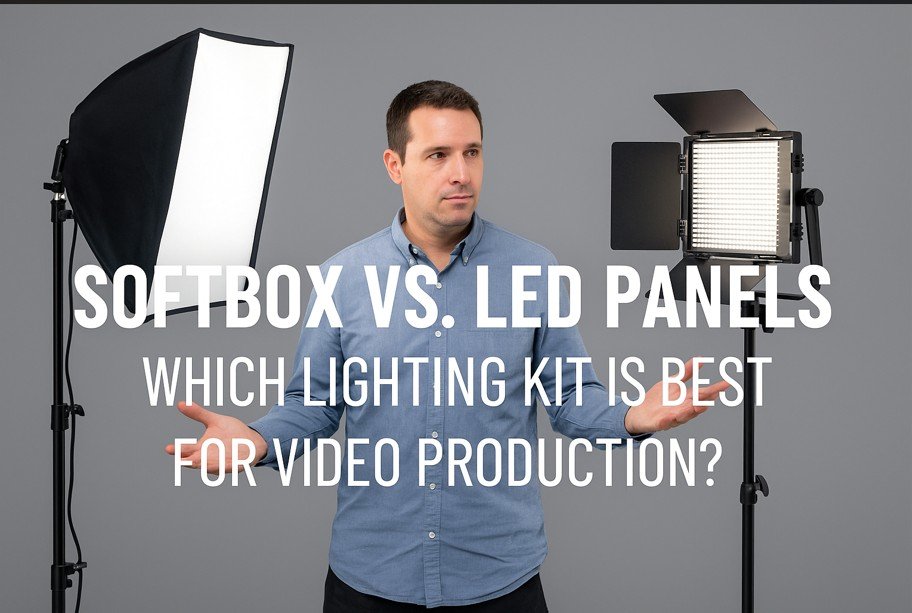
A softbox and an LED panel are not technically the same type of tool. A softbox is a light modifier that spreads and diffuses light from a compatible fixture, while an LED panel is a light fixture. In practical buying terms, creators often compare a bulb or COB light used with a softbox against a slim flat LED panel.
For talking-head videos and controlled home studios, a large diffused source is often the easiest way to create soft shadow transitions. For small rooms, travel, livestreaming, or frequent setup changes, a slim dimmable LED panel can be easier to place and control. You can also combine the two approaches by using an LED fixture with a compatible softbox or diffuser.
If you’re already using a 3 light studio lighting kit or planning to buy one, compare the actual fixture, modifier, controls, output, color quality, power options, and physical size rather than choosing by the words “softbox” or “LED” alone. You can also compare 3-light studio lighting kit options.
Quick Answer
For video, choose based on the light you need rather than treating softboxes and LED panels as opposite technologies. A large softbox is useful when you want a broad, diffused key light and have room for a modifier and stand. A slim LED panel is useful when compact size, fast dimming, battery operation, or quick color-temperature changes matter. A diffused LED panel or an LED COB fixture with a softbox can combine soft light with modern LED control.
Key Takeaways
- A softbox is a modifier; an LED panel is a fixture, so the comparison is not strictly LED versus non-LED.
- Light softness depends heavily on the apparent size of the illuminated source, its diffusion, and its distance from the subject.
- LED panels are often convenient in tight spaces because many models put dimming and color-temperature controls directly on a slim fixture.
- A softbox can be paired with a modern LED fixture when you want both electronic control and a larger diffused source.
- For video, also compare output, color quality, flicker performance, fan noise, power options, mounting, and setup footprint.
What Is a Softbox?
A softbox is a light modifier. It surrounds or mounts in front of a compatible light source and uses reflective material plus one or more diffusion layers to create a broader illuminated surface.
The larger that illuminated surface appears from the subject’s position, the softer the transition between light and shadow generally becomes. Adobe’s video-lighting guidance similarly notes that a larger source produces softer lighting. See Adobe’s basic lighting guidance for video.
Good For:
-
Talking head videos
-
Portraits and interviews
-
Product shots where broad reflections are useful
-
Indoor video content
-
Home studio setups
-
Creating a large key or fill source
Common Features:
-
Reflective interior and front diffusion fabric
-
Available in many sizes and shapes
-
May attach to LED COB lights, other continuous fixtures, or compatible lamp heads
-
Some models include multiple diffusion strengths
-
Optional grids can help reduce spill and make the soft source more directional
-
Usually becomes softer relative to the subject when the illuminated surface is made larger or positioned closer
Important distinction: The softbox itself normally does not determine dimming range, color temperature, RGB effects, app control, or maximum output. Those properties come mainly from the fixture placed behind or inside it.
What Is an LED Panel?
An LED panel is a flat continuous-light fixture built from LEDs arranged across or behind an illuminated surface. Depending on the model, a panel may be daylight-only, bi-color, tunable white, or full-color RGB/RGBWW.
Many creator-focused LED panels include onboard dimming, adjustable color temperature, battery support, remote control, or app control. Those features are convenient for YouTubers, streamers, vloggers, and crews that need to change a setup quickly.
Good For:
-
YouTube, Instagram, and TikTok content
-
Live streaming
-
On-location shoots
-
Creative videos that need tunable or colored light
-
Small rooms and desk setups
-
Creators who frequently reposition lights
Common Features on Many Models:
-
Electronic brightness control
-
Adjustable color temperature on bi-color or tunable-white models
-
App or remote support on some fixtures
-
Slim physical design
-
Battery and/or AC power on some models
-
RGB or lighting effects on selected panels
Softbox vs LED Panel for Video: Main Differences
At a Glance
| Factor | Softbox Setup | LED Panel |
| What it is | A modifier plus a compatible light fixture | A complete flat LED fixture |
| Softness | Often very soft when the modifier is large and close to the subject | Ranges from hard to soft depending on panel area and diffusion |
| Controls | Depends on the fixture behind the softbox | Many models offer onboard dimming, CCT, RGB, remote, or app controls |
| Physical footprint | Usually needs more depth and space around the stand | Usually easier to fit against walls, desks, or tight sets |
| Portability | Varies; collapsible modifiers travel well but still add setup pieces | Slim panels are often quicker to move and mount |
| Output | Depends on the fixture; diffusion reduces some output | Model-specific; compare photometrics at the same distance |
| Best fit | Controlled interviews, portraits, tutorials, product work, fixed studios | Small rooms, streaming, mobile shoots, fast changes, background effects |
Which Gives Softer Light?
A softbox is designed to turn a relatively small source into a larger illuminated surface. When that surface is large relative to the subject and positioned reasonably close, it generally creates gentler shadow transitions across faces and products.
An LED panel is not automatically harsh. A small bare panel may create harder-edged shadows, while a larger panel with built-in diffusion or an added diffuser can look much softer. The important variables are the size of the glowing surface, diffusion, distance, and placement.
Aputure’s LS 60 Softbox, for example, is specifically designed to increase the illuminated area of an LED point-source fixture, illustrating why “LED” and “softbox” are not competing light technologies. See the Aputure LS 60 Softbox specifications.
Bottom line: If softness is the goal, compare the apparent source size and diffusion rather than choosing by fixture label alone.
For face-to-camera video, make the source large enough to create the shadow quality you want, then place and angle it so the face still has useful shape.
Which Is Brighter and Easier to Dim?
Neither category automatically wins on maximum brightness. A small LED panel may produce less usable output than a powerful LED COB fixture inside a softbox, while a high-output panel may outperform a basic bulb-based softbox kit. Compare manufacturer photometrics at the same distance instead of relying on wattage or the fixture’s physical size alone.
Where LED panels are often convenient is control access. Many modern panels put dimming and color-temperature controls directly on the fixture and may also support remotes or apps. A softbox does not prevent those controls—the result depends on the light mounted behind it.
Remember that diffusion has an output cost. Aputure softboxes, for example, are offered with diffusion fabrics rated at different stop losses, and Aputure’s published photometric tables show lower measured output when stronger diffusion is used. Exact loss varies by modifier and material. See Aputure’s F21c photometric data.
Which Is Easier to Set Up?
A slim panel can be fast to deploy: mount it, supply power, set its angle, and adjust output. That is useful for livestreams, quick social videos, interviews with limited setup time, and solo creators who need to make changes from behind the camera.
A traditional softbox may require unfolding or assembling the modifier, attaching diffusion, mounting it to the fixture, and positioning a stand. Quick-release and pop-open softboxes can reduce that setup time, so portability varies substantially by design.
Bottom line: A bare or built-in-diffusion LED panel usually involves fewer physical pieces. A softbox setup takes more room but may be worth the extra setup when a larger source is central to the look.
Pro Tip: Mark your light-stand position on the floor with removable tape once you find a setup you like. This makes repeated shoots faster and more consistent.
Which Is More Portable?
A large assembled softbox occupies more volume around the subject than a slim LED panel. Even collapsible modifiers require a fixture, stand, and enough room for the modifier itself, so they are often more comfortable in a dedicated filming space.
Flat panels and flexible LED mats can be easier to pack or position against a wall, beside a monitor, or in a shallow room. Battery-capable panels also reduce dependence on nearby AC outlets during location work.
Bottom line: If travel weight, fast repositioning, or a shallow physical footprint is the priority, a compact panel generally has the practical advantage. If the modifier stays assembled in a studio, portability matters much less.
Which Gives You More Control?
A softbox controls the shape and quality of the light. Its size and diffusion affect softness, while an optional fabric grid can reduce spill. The electronic controls still come from the fixture used with it.
An LED panel may provide direct electronic control over intensity and, depending on the model, color temperature, hue, saturation, effects, or wireless control. A panel can also accept additional diffusion or a dedicated softbox if the manufacturer supports one.
This distinction matters because you do not necessarily have to choose between soft light and electronic control. An LED-based softbox setup can provide both.
Which Works Better in a Small Room?
A slim LED panel is often easier to place in a cramped room because it needs less depth. It can fit beside a monitor, close to a wall, or near a desk where a large modifier would enter the camera frame or block a walkway.
A compact softbox can still work in a small room if you have enough stand clearance. Placing a larger diffused source fairly close to a talking-head subject can produce soft light without requiring the fixture to run at maximum output.
Room conditions also affect color. A bi-color or tunable-white LED fixture can make matching another controlled source easier, but changing Kelvin does not automatically correct mixed lighting. Window daylight and warm household lamps can still create different colors on opposite sides of a subject.
Warning: Keep stands stable, route cables away from walkways, and follow the fixture and stand manufacturers’ load limits. Large modifiers increase wind resistance and can make a stand easier to tip.
What Should You Check for Color Accuracy?
Color temperature and color accuracy are different. Kelvin or CCT describes whether the light is warmer or cooler, while color-rendering measurements attempt to describe how faithfully colors are reproduced.
For camera work, compare the manufacturer’s published color-quality data rather than assuming that a large Kelvin range means accurate skin or product colors. CRI is commonly published, while TLCI was developed specifically around television-lighting performance. The European Broadcasting Union explains that TLCI was created to help broadcasters assess modern lighting, including LEDs. See the EBU overview of TLCI-2012.
Also check whether the light stays consistent as you dim it or change CCT, and watch for unwanted green or magenta shifts in the actual camera image.
What Else Matters for Video Lighting?
Output at a known distance: Compare lux or foot-candle measurements taken at the same distance and with comparable accessories. Wattage alone does not tell you how much useful light reaches the subject.
Flicker: A video light should behave cleanly at the frame rates and shutter settings you intend to use. If the manufacturer publishes high-speed or flicker-performance information, check it before buying for slow motion or demanding video work.
Fan noise: Powerful fixtures may use active cooling. If the light will sit close to a microphone, listen for fan noise or check the manufacturer’s operating modes.
Power: Decide whether you need AC power only, internal batteries, removable batteries, or another DC option. Location work can make power compatibility more important than RGB effects.
Mounting and modifiers: A fixture with a useful modifier ecosystem can be easier to adapt later than a closed system with few compatible accessories.
Physical dimensions: Check the assembled depth of the light, stand footprint, modifier diameter, and clearance around doors and furniture—not just the packed dimensions.
How Should You Compare Budget and Value?
Do not assume that every softbox setup is cheaper or every LED panel is more expensive. Compare the price of the complete working setup you actually need.
-
Light fixture
-
Softbox or other diffusion if required
-
Grid or spill-control accessories
-
Light stand or mounting hardware
-
AC adapter, extension cable, or batteries
-
Remote-control accessories if needed
-
Cases or protection for location work
A low-cost softbox kit can be practical for a fixed room, while a compact panel can save time and floor space. A separate LED COB fixture plus a standard modifier may cost more initially but can provide a more expandable system. The useful comparison is total setup cost versus the features and flexibility you actually use.
What About Long-Term Use?
Long-term value depends more on construction and serviceability than on whether the front of the light is a panel or a softbox.
With a separate fixture-and-softbox system, the modifier, fixture, stand, and diffusion can often be replaced independently. Integrated LED panels package more of the system into one body, which is convenient but makes repairability model-specific.
Before buying, consider warranty, availability of replacement power supplies, batteries, diffusion fabrics, mounting parts, and whether the modifier mount gives you room to change fixtures later.
Which One Should You Use?
Choose a Softbox-Based Setup If:
-
You want a large, diffused source for faces or products
-
You have enough room for a stand and modifier
-
Your lighting position stays mostly fixed
-
You want control over diffusion and spill
-
You already own a compatible continuous LED fixture
-
You want a modifier system that can be changed independently of the light
Choose an LED Panel If:
-
You need a shallow, compact fixture
-
You frequently move between locations
-
You want quick onboard dimming
-
You need adjustable CCT or RGB features available on the selected model
-
You film at a desk or in a small room
-
You want fast setup and teardown
-
You need a battery-capable light for location work
Which Lighting Setup Fits Different Types of Video?
For YouTube talking-head videos:
Use a reasonably large, diffused key source. That can be a softbox on an LED fixture or a sufficiently large diffused panel. Position and apparent source size matter more than the label.
For livestreaming:
A compact panel can be convenient beside a monitor or desk because it uses little depth and can often be dimmed without moving the stand.
For product videos:
Softboxes are useful when you want broad controlled reflections across glossy surfaces. Panels are useful when you need compact placement or several independently adjustable sources. The product’s shape and reflectivity should determine the setup.
For TikTok, Instagram, and short videos:
A compact panel is convenient when you frequently move the camera or filming location. Add diffusion when the bare source produces harder shadows than you want.
For home studios:
If the setup can stay assembled, a softbox-based key light can provide a repeatable broad source. If the room serves multiple purposes, a slim panel may be easier to put away.
For travel or client shoots:
Compare packed weight, battery support, stand size, setup time, and modifier assembly. A compact panel often reduces the number of separate components.
Can You Use a Softbox With an LED Light?
Yes. This is a common modern video-lighting setup. Many continuous LED point-source fixtures use a modifier mount that accepts compatible softboxes, and some LED panels have dedicated snap-on softboxes or diffusion accessories.
A softbox changes the size, diffusion, and spread of the light; the LED fixture still provides the brightness, dimming behavior, color temperature, RGB functions, power system, and electronic controls.
Examples of LED-based soft-light configurations include:
-
COB LED fixtures with compatible softboxes
-
LED panels with dedicated snap-on softboxes
-
Flexible LED mats with diffusion frames
-
RGB LED fixtures used behind diffusion
-
LED fixtures with softboxes and fabric grids for spill control
This combination is often the most useful way to think about an upgrade: choose a capable fixture first, then choose the modifier needed for the look and room.
Do You Need a 3-Light Setup?
No. Three-point lighting—a key light, fill light, and back or hair light—is a classic structure, but it is not mandatory for good video.
Start with one well-positioned key light. If facial shadows are deeper than you want, add a reflector or weaker fill. Add a back or background light only when the shot needs more separation or visual depth.
If you want to compare complete multi-light systems, see these 3-light studio lighting kit options.
Frequently Asked Questions
Is a softbox better than an LED panel for video?
Neither is automatically better. A softbox is a modifier, while an LED panel is a fixture. Choose a large diffused source when softness is the priority and a compact panel when space, fast adjustment, or portability matters more. You can also use an LED fixture with a softbox.
Do LED panels need diffusion?
Not always. A large panel with effective built-in diffusion may already produce the shadow quality you want. A small or bare panel may benefit from extra diffusion when its shadows or reflections look too hard.
Does a softbox reduce brightness?
Yes, diffusion normally reduces some of the light reaching the subject. The amount depends on the material and modifier. You can compensate by increasing fixture output, moving the source closer, adjusting camera exposure, or using lighter diffusion when appropriate.
What matters most for soft video lighting?
The apparent size of the illuminated source relative to the subject is one of the biggest factors. A larger source or a source moved closer generally creates softer shadow transitions, while a smaller or more distant source tends to look harder.
Do I need three lights for YouTube videos?
No. One well-positioned key light can be enough for many talking-head videos. Add fill, background, or backlighting only when you need to control shadow depth or create more separation.
Final Thoughts
The useful choice is not simply “softbox or LED.” Decide first what the shot needs, then choose the fixture and modifier combination that delivers it.
-
Choose a large diffused source when flattering, soft shadow transitions matter most.
-
Choose a compact LED panel when room size, fast setup, electronic controls, or mobility matter most.
-
Use an LED fixture with a softbox when you want modern control plus a larger diffused source.
Before buying, compare source size, photometric output, diffusion, color quality, flicker behavior, fan noise, CCT/RGB controls, power options, stand footprint, and modifier compatibility. Those factors tell you far more about how a video light will perform than the product category alone.


1 thought on “Softbox vs. LED Panels: Which Lighting Kit Is Best for Video Production?”