You rely on LiPo chargers to keep your FPV batteries healthy, safe, and ready to fly. Choosing the right charger reduces the risk of cell damage, shortens turnaround time between sorties, and extends pack life so you spend more time flying and less time troubleshooting.
This guide gives you concise, expert-backed recommendations so you can match charger capabilities to your flying style, whether you value raw power, portability, or a wallet-friendly option.
Top Picks
|
Category |
Product |
Score |
|---|---|---|
|
🏆 Best Overall |
95/100 |
|
|
🚀 Most Powerful |
93/100 |
|
|
🔋 Best Portable |
88/100 |
|
|
⭐ Most Reliable |
90/100 |
|
|
🔰 Best for Tiny Whoops |
87/100 |
|
|
💼 Best Beginner Friendly |
84/100 |
|
|
🎯 Best Midrange Dual |
82/100 |
|
|
💰 Best Budget Reviver |
78/100 |
How We Selected
You need a charger that balances safety, speed, and compatibility, so we prioritized models with reliable balancing, clear cell monitoring, and proven safety protections. We weighed maximum output and simultaneous-port charging for pilots who run many packs, portability and detachable power options for field use, and intuitive UI for quick setup.
Price and real-world user feedback were used to separate solid budget options from premium tools, and we favored products with a track record of firmware updates, good build quality, and widely available connectors.
HOTA D6 Pro
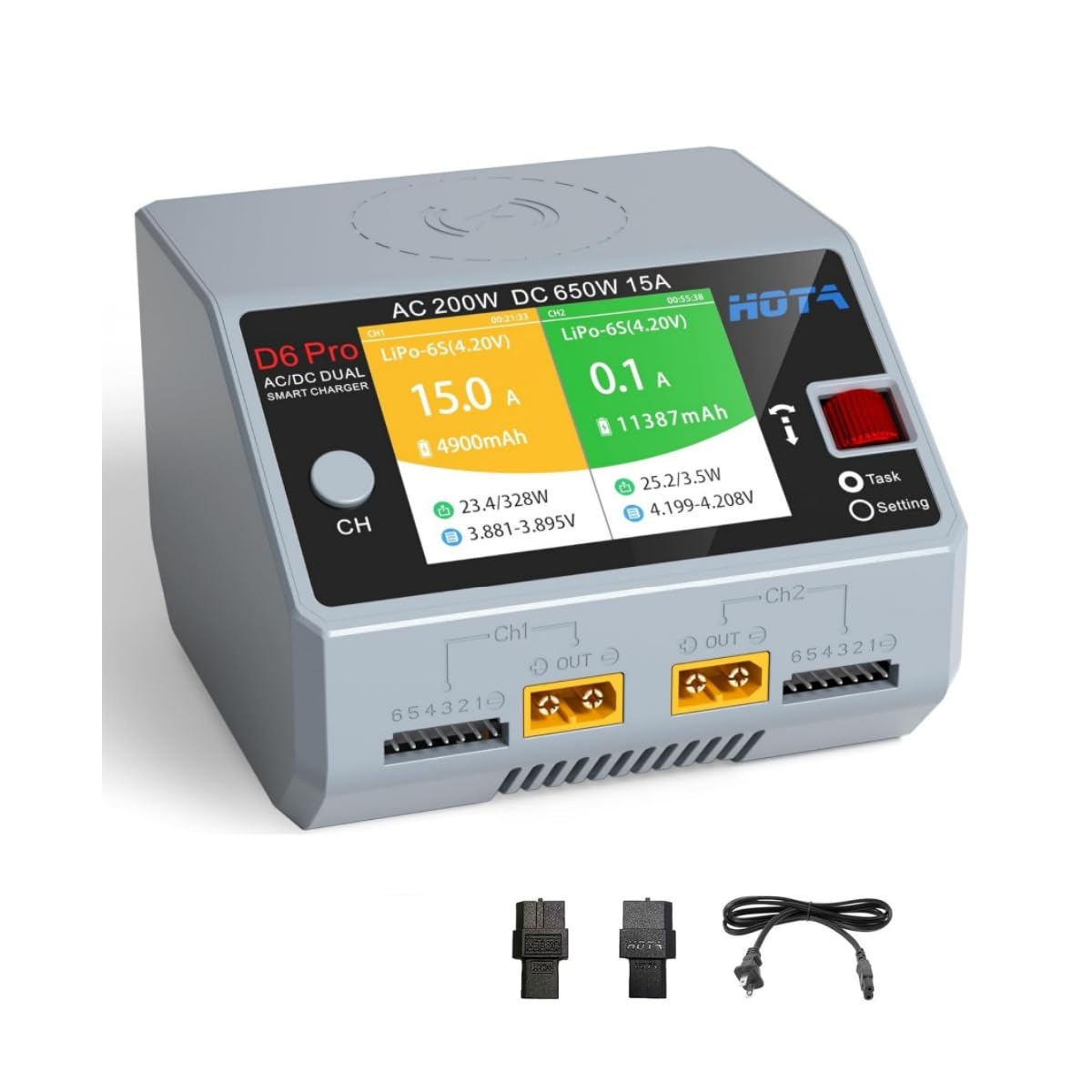
You get a dual‑channel charger that lets you top up two packs at once without juggling adapters or extra gear. The D6 Pro packs 15A per channel and supports a wide range of chemistries, so it works for race packs and bench repairs alike. It’s compact enough to live on your bench but powerful enough to cut turnaround times on busy flying days. If you want something that handles everyday charging and occasional field work with minimal fuss, this is a solid choice.
What People Say
You’ll see a lot of praise for how straightforward the menu and setup are, and many users appreciate the fast, balanced charging for 1–6S packs. Reviewers often note it works well with smart batteries and that the dual ports are a real time saver. The most common gripe is that the printed instructions are thin, so you might look up a quick tutorial video to get the most out of it.
Overall Sentiment: Positive

Situational Benefits
|
Situation |
How It Helps |
|---|---|
|
Weekend Race Day |
You can charge two race packs at once and get them back on the bench quicker, reducing downtime between heats. |
|
Field Sessions |
The compact size and AC/DC support mean you can power it from a car or a field power pack and keep flying without hauling a full lab setup. |
|
Battery Maintenance |
You can balance and storage‑charge tired packs to extend their usable life and diagnose cells with consistent readings. |
Ease Of Use
|
Feature |
Ease Level |
|---|---|
|
Initial Setup |
Easy |
|
Menu Navigation |
Moderate |
|
Balancing and Monitoring |
Easy |
|
Field Power Options |
Easy |
Versatility
You can work with 1–6S LiPo/LiHv and multiple other chemistries, use AC or DC sources, and attach common connectors, so it covers hobbyists who fly everything from tiny quads to 5‑inch racers.
Safety Features
Built‑in balance charging, cell monitoring, and standard protection routines guard against overcharge and reverse polarity. The charger’s status readouts help you verify each cell while charging.
Durability
The charger feels solid and reasonably compact; users report reliable day‑to‑day performance and a one‑year warranty as basic protection against defects.
Problem Solving
This unit addresses common pain points: it reduces queue time by charging two packs, corrects imbalance between cells, and works with smart packs so you don’t need multiple specialized chargers.
Key Benefits
- Dual high‑current channels so you can charge two packs simultaneously
- 15A capability for faster turnaround between flights
- Balances individual cells and supports many battery chemistries
- Compact, sturdy design suitable for bench and field use
- Clear status feedback that helps you monitor charge progress
Rating: 4.6 (total: 106+)
Gens Ace D300

You get a no‑nonsense dual‑channel charger built around raw power and practicality. The D300 is designed to move a lot of energy quickly, so on busy flying days you can turn packs around fast.
It handles AC and higher‑power DC sources, gives clear monitoring of charge status, and fits well on a bench or in a pit box when you need serious output. If your priority is speed and reliability for multiple packs, this is a tool that pulls its weight without being needlessly complicated.
What People Say
Customers commonly highlight the D300’s fast charging and dependable dual‑port performance, saying it makes managing multiple packs less of a hassle. People also point to the clear readouts and sturdy build as perks, while a few note the absence of a formal warranty and recommend checking setup guides if you want to squeeze out advanced features.
Overall Sentiment: Positive

Situations
|
Situation |
How It Helps |
|---|---|
|
Race Weekend |
Charge two race packs at high amperage to keep you on the track longer and eliminate long waits between heats. |
|
Field Trips |
AC/DC flexibility lets you use available power at the pit area or a vehicle battery, so you don’t need a full workshop setup. |
|
Batch Maintenance |
Fast, precise charging and monitoring make balancing and storage cycles quicker when you’re prepping many packs. |
Ease Of Use
|
Feature |
Ease Level |
|---|---|
|
Initial Setup |
Moderate |
|
Menu Navigation |
Moderate |
|
Monitoring Readouts |
Easy |
|
AC/DC Switching |
Easy |
Versatility
The D300 supports dual ports, high output and both AC and DC inputs, making it flexible for small‑field setups and heavy bench use where you need fast charging across multiple pack types.
Safety
Built‑in balance charging and standard protection routines combined with CE/FCC certification provide baseline safety; the clear status display helps you verify each cell during charging.
Durability
The unit has a solid, workmanlike build and feels suitable for frequent use; note that the manufacturer lists no warranty, so treat it as a reliable tool but keep receipts and documentation.
Solves
This charger solves common pain points by reducing turnaround time with dual high‑current ports, simplifying pack monitoring with clear displays, and offering AC/DC power options for on‑site charging.
Key Benefits
- High total output for quick charge cycles
- Dual independent ports to charge two packs at once
- Clear monitoring and smart charge controls
- CE and FCC compliance for basic regulatory assurance
- Robust AC and DC input options for field flexibility
Rating: 4.6 (total: 342+)
ISDT 608AC

You get a compact charger that punches above its size. The 608AC auto detects packs, shows individual cell voltages on a color display, and balances cells while charging or putting batteries into storage.
The detachable power supply and DC input make it practical for field use, so you can plug into a car or a power bank and keep flying. For everyday bench charging it’s simple and precise, and for on‑site sessions it’s flexible and light enough to carry.
If you want a reliable, portable tool that covers most hobby needs without a steep learning curve, this one is worth considering.
What People Say
Users consistently praise the 608AC for its compact size and clear display, which makes monitoring cell voltages straightforward. Many call out the detachable power supply and DC capability as a field‑ready feature, and reviewers note solid build quality and intuitive controls.
A few mention they’d like extra buttons for faster navigation, but overall people appreciate how much functionality ISDT packs into a small unit.
Overall Sentiment: Positive
Situational Benefits
|
Situation |
How It Helps |
|---|---|
|
Field Charging |
You can run the charger from a car or a power bank thanks to the detachable supply, so you don’t need to carry a big power station. |
|
Routine Maintenance |
The per‑cell readout and auto balance mode let you storage‑charge and level cells quickly, which helps prolong pack life. |
|
Traveling To Events |
Its lightweight footprint and simple connectors make it easy to fit in a pit bag without adding bulk. |
Ease Of Use
|
Feature |
Ease Level |
|---|---|
|
Initial Setup |
Easy |
|
Scroll Wheel Control |
Easy |
|
Menu Navigation |
Moderate |
|
Field Power Switching |
Easy |
Versatility
Supports multiple chemistries and 1–6S packs, offers both AC and DC power options, and includes discharge and storage modes, making it useful across bench work and field sessions.
Safety Features
Auto balancing, per‑cell monitoring, and standard protection routines reduce overcharge risk and help you verify cell health during every cycle.
Durability
The unit is lightweight but well‑built; owners report reliable performance over repeated use and appreciate the solid construction for travel and fieldwork.
Problem Solving
This charger addresses common hobby pain points by offering portable power options, clear cell diagnostics, and balanced charging to revive or maintain packs efficiently.
Key Benefits
- Detachable power supply for easy AC or DC operation
- Color display that shows per‑cell voltages and charging stats
- Auto detection and balancing for safer, healthier packs
- Compact, lightweight body that’s easy to transport
- Wide charge range suitable for 1–6S batteries and multiple chemistries
Rating: 4.4 (total: 109+)
Venom Pro Duo

You get a dependable dual‑channel charger that’s built for everyday use and heavier sessions alike. It charges two packs simultaneously while giving clear feedback on status via the LCD, so you can manage multiple batteries without guesswork.
The unit supports a wide range of chemistries and connectors, making it useful for bench work, race prep, or keeping family RC gear ready. If you need a straightforward, durable charger that handles most hobby workflows, this is a reliable pick.
What People Say
Buyers frequently praise the Pro Duo for its reliability and the convenience of charging two batteries at once, which cuts wait time during busy flying sessions. People note the clear display and straightforward controls make it approachable, and many appreciate the solid build quality that stands up to regular use. A few users mention connector compatibility and adapting plugs, but overall the impression is that it’s a workhorse charger.
Overall Sentiment: Positive

Situations
|
Situation |
How It Helps |
|---|---|
|
Race Day |
Charge two race packs in parallel so you can cycle through batteries quickly between heats and stay on the track longer. |
|
Family RC Use |
Supports many chemistries and common connectors, letting you manage different packs without swapping chargers for each toy. |
|
Workshop Maintenance |
Balance charging and clear readouts help you diagnose and revive slightly unbalanced packs during routine maintenance. |
Ease Of Use
|
Feature |
Ease Level |
|---|---|
|
Initial Setup |
Easy |
|
LCD Readouts |
Easy |
|
Dual Port Management |
Easy |
|
Connector Adaptation |
Moderate |
Versatility
Handles 1–6S packs across many chemistries, two independent channels, and multiple connector types, so it fits bench work, pit boxes and household RC setups.
Safety
Includes balance charging, cell monitoring and standard protection routines to reduce overcharge and short‑circuit risks while showing per‑pack status on the LCD.
Durability
Users report long service life and robust construction; the unit behaves like a tool built for frequent use and transport in a pit bag.
Problem Solving
Solves common headaches by reducing charger wait time with two ports, simplifying pack monitoring with a clear display, and supporting multiple battery types so you don’t need separate chargers.
Key Benefits
- Two independent charging ports for simultaneous packs
- Clear LCD status readout for easy monitoring
- Compatible with many battery chemistries and common connectors
- Sturdy construction and user‑friendly controls
- Balance charging to keep cells healthy
Rating: 4.6 (total: 881+)
HTRC Dual 10A
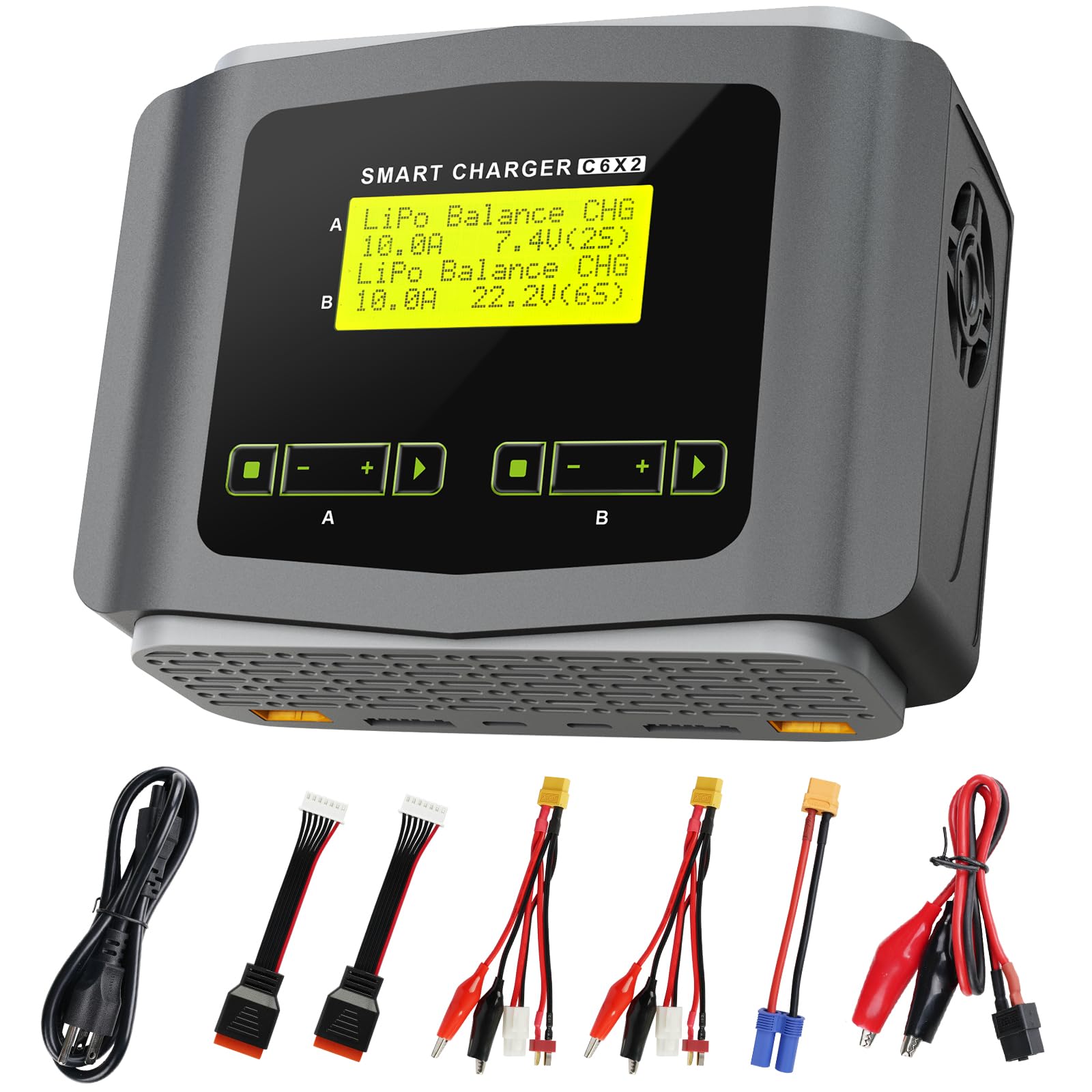
You get a straightforward dual‑channel charger that balances speed and practicality. It charges two packs at once at up to 10A per channel, offers a large display for clear status, and accepts a range of common connectors so you can work with most hobby packs without swapping gear. It’s roomy enough for bench use and compact enough to toss in a pit bag, making it useful for routine maintenance, prepping batteries before a session, or turning packs around between flights.
What People Say
Buyers often highlight the clear display and the convenience of charging two packs at once, which makes busy flying days less stressful. People also appreciate broad connector support and reliable balance charging, though some mention a slight learning curve with advanced settings.
Overall the consensus is that it’s a capable, workmanlike unit that handles day‑to‑day hobby needs well.
Overall Sentiment: Positive

Situations
|
Situation |
How It Helps |
|---|---|
|
Track Or Race Day |
Charge two race packs simultaneously so you can cycle through batteries faster and stay on the course longer. |
|
Family RC Sessions |
Supports many chemistries and connectors so you can keep different models ready without juggling multiple chargers. |
|
Routine Maintenance |
Large screen and balance modes help you spot and correct cell imbalances during storage or conditioning cycles. |
Ease Of Use
|
Feature |
Ease Level |
|---|---|
|
Initial Setup |
Moderate |
|
Display Readouts |
Easy |
|
Dual Port Management |
Easy |
|
Advanced Settings |
Moderate |
Versatility
Works with 1–6S packs across LiPo, LiHV, Li‑ion, NiMH and other chemistries and accepts XT60/EC5 and common connectors, making it suitable for varied hobby setups.
Safety
Includes balance charging, cell monitoring, and standard protection routines to reduce overcharge and short‑circuit risks while showing clear status on the screen.
Durability
Built for regular use with a solid chassis and a two‑year warranty, users report dependable day‑to‑day performance and resilience in typical hobby environments.
Problem Solving
Reduces charger bottlenecks with two channels, simplifies pack health checks via a large display, and handles multiple connector types so you can manage mixed fleets without extra adapters.
Key Benefits
- Two independent 10A channels to reduce wait time
- Large screen for easy monitoring of charge status
- Supports multiple chemistries and common connectors
- Balance charging and storage modes to protect pack health
- Two‑year warranty adds basic ownership confidence
Rating: 4.5 (total: 1365+)
Aorika SAIL6
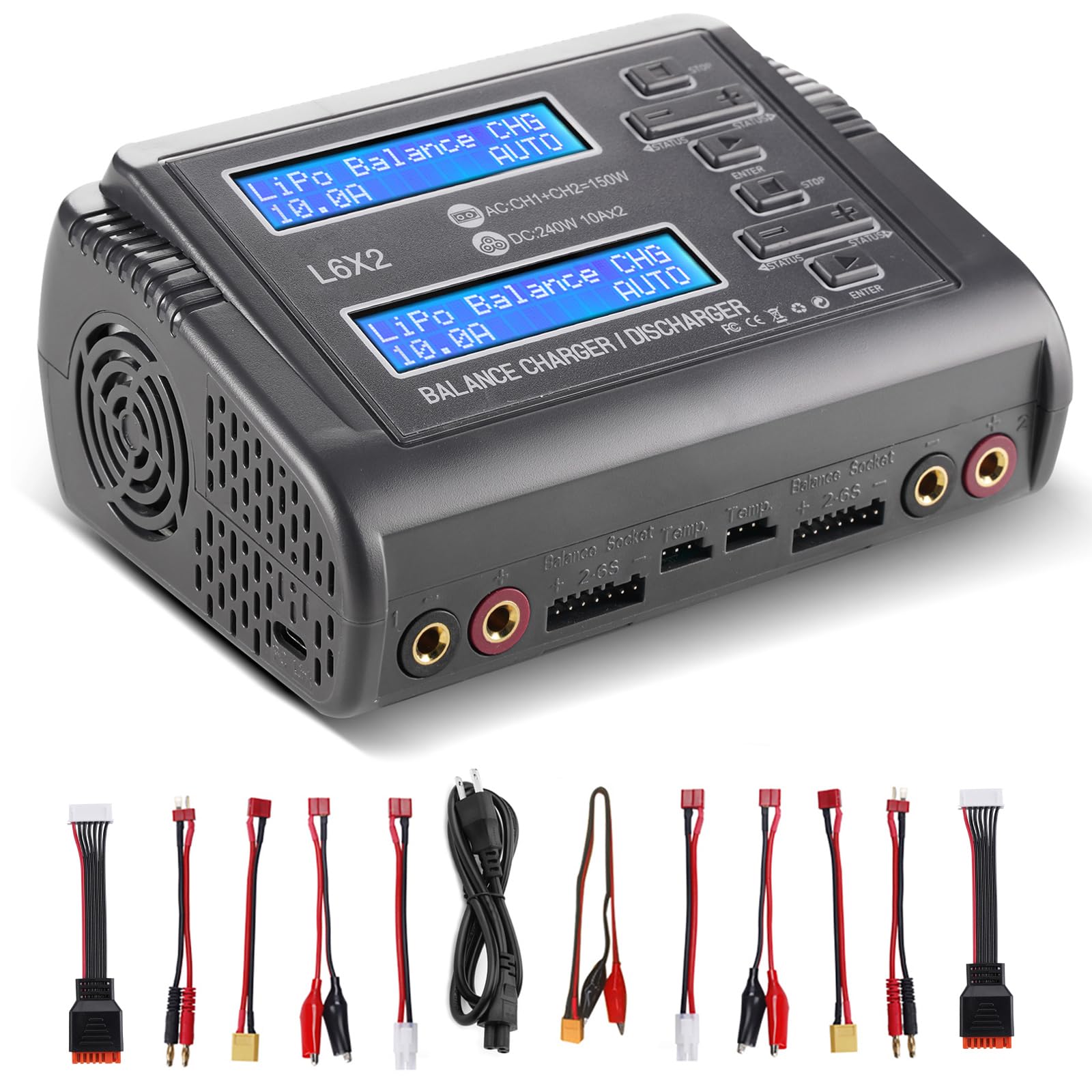
You get a compact dual‑channel charger that covers most hobby needs without overcomplicating things. It charges two packs at once, offers balance and storage modes, and accepts common connectors so you can work across RC cars and drones. The unit’s size makes it easy to tuck into a pit bag for event days, while the display and settings let you handle routine maintenance and diagnostics at your bench.
If you want a versatile everyday charger that won’t take up much space, this one is a practical pick.
What People Say
Users frequently mention the charger’s compact size and the convenience of charging two batteries at once. Many appreciate the clear display and reliable balance charging, and several say it handles a range of battery types well. A common note is that advanced settings can be a bit fiddly at first, so a short learning period or a quick video guide helps.
Overall Sentiment: Positive
Situations
|
Situation |
How It Helps |
|---|---|
|
Weekend Flying |
You can top off two packs between flights and get back in the air faster without swapping chargers. |
|
Home Maintenance |
Balance and storage modes make it easy to keep cells healthy during routine conditioning and long‑term storage. |
|
Family RC Time |
Supports multiple connector types so you can charge different toys without hunting for adapters. |
Ease Of Use
|
Feature |
Ease Level |
|---|---|
|
Initial Setup |
Moderate |
|
Display Readouts |
Easy |
|
Dual Port Operation |
Easy |
|
Advanced Settings |
Moderate |
Versatility
You can handle 1–6S LiPo/LiHV and several other chemistries, use common connectors, and switch between balance, charge and storage modes, so it adapts to bench work and casual field use.
Safety
Includes balance charging, cell monitoring and standard protection routines to reduce overcharge, reverse polarity and short‑circuit risks while showing status on the display.
Durability
You’ll find it feels solid for routine use; owners report dependable performance and the two‑year warranty provides added peace of mind for regular hobby wear and tear.
Problem Solving
This charger cuts down queue time with two channels, simplifies pack checks via clear readouts, and supports mixed fleets so you don’t need multiple chargers for different toys.
Key Benefits
- Two independent 10A channels to charge dual packs
- Balance and storage modes to protect pack health
- Compact design that fits a pit bag or small bench
- Wide connector compatibility including XT60 and Tamiya
- Clear display for easy status monitoring
Rating: 4.3 (total: 371+)
Tenergy Charger

You get a versatile, no‑nonsense charger that’s aimed at hobbyists who need broad connector support and reliable balance charging. It auto handles common chemistries, offers clear readouts, and the variety of connector options means you can charge packs from different models without swapping gear.
The included LiPo bag and CE/FCC compliance make it practical for everyday bench work and family RC sessions, while the eight connector options simplify managing multiple small packs. If you want a flexible charger that makes life easier when you’re juggling different batteries, this one fits the bill.
What People Say
Users often highlight the charger’s connector flexibility and the convenience of working with so many plug types right out of the box. People appreciate that it handles multiple chemistries and that the balance and storage modes help maintain pack health. A few mention there’s a short learning curve for advanced settings, but most find it approachable for routine charging.
Overall Sentiment: Positive

Situations
|
Situation |
How It Helps |
|---|---|
|
Family RC Sessions |
You can keep different toys ready since the charger supports many connector types and common battery chemistries. |
|
Hobby Bench Work |
Balance and storage modes let you condition and store packs safely while monitoring per‑cell health during maintenance. |
|
Field Prep |
Compact size and broad connector support make it easy to pack spare leads and adapters for event days. |
Ease Of Use
|
Feature |
Ease Level |
|---|---|
|
Initial Setup |
Easy |
|
Connector Selection |
Easy |
|
Menu And Modes |
Moderate |
|
Balance/Storage Use |
Easy |
Versatility
Handles 1–6S packs across multiple chemistries and provides a broad set of connector options, making it suitable for mixed hobby fleets and varied charging scenarios.
Safety
Balance charging, storage mode and an included LiPo safety bag help reduce overcharge risks and provide a safer routine for handling and storing packs.
Durability
Built to be compact and practical, users report dependable everyday performance and the unit’s components feel suitable for regular hobby use.
Problem Solving
Solves the headache of juggling connectors and small packs by providing wide compatibility and balanced charging modes so you can maintain and use mixed batteries with less fuss.
Key Benefits
- Supports 1–6S packs across LiPo, LiFe, NiMH and NiCd
- Includes a wide range of connector adapters for common plugs
- Balance charging and storage modes to protect pack health
- Compact profile and an included LiPo bag for safer handling
- Multiple port options make it useful for mixed fleets
Rating: 4.6 (total: 410+)
HTRC C150
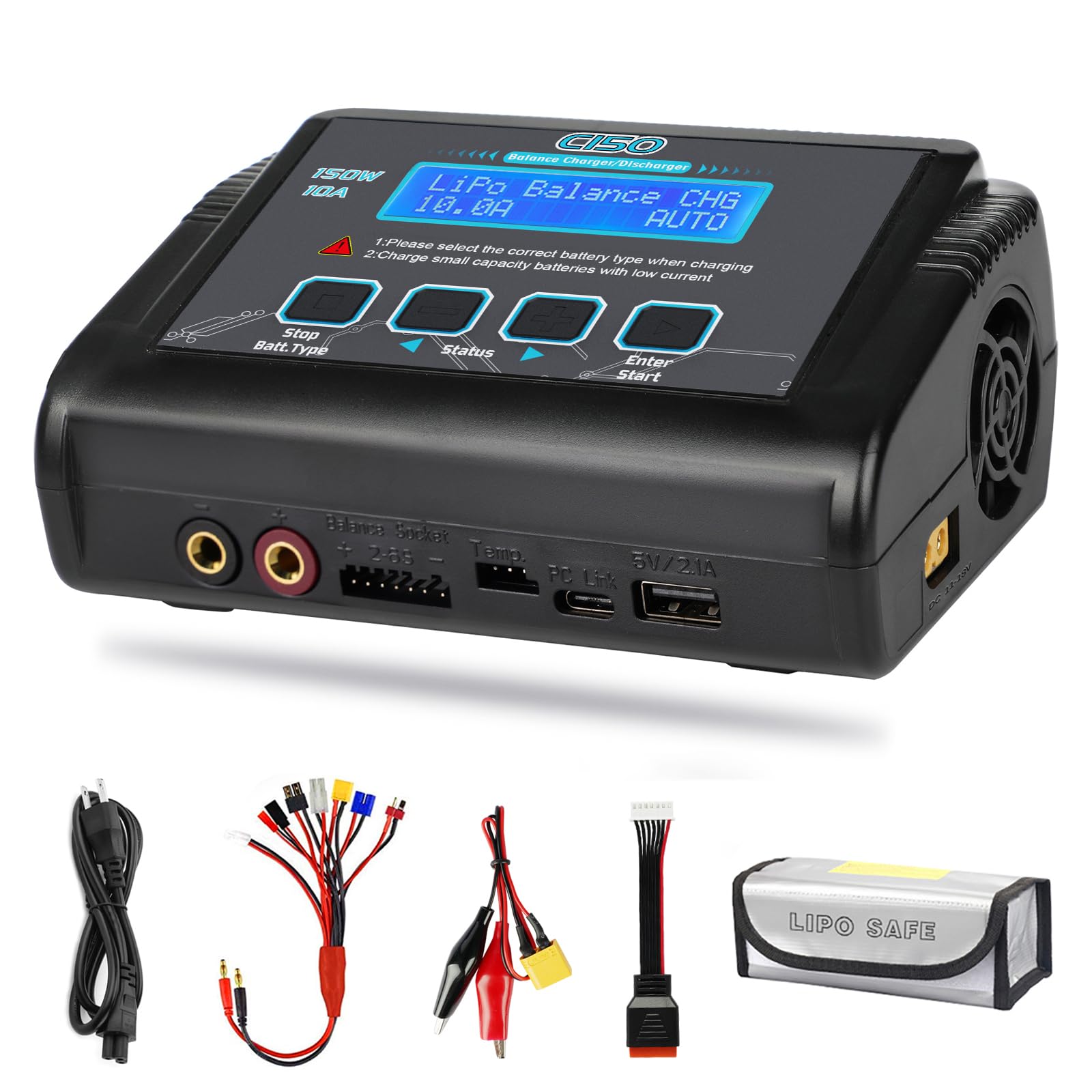
You get a capable single‑port charger that focuses on reliable balance charging and flexible maintenance options. The C150 handles both charge and discharge cycles, offers a clear display for monitoring cell voltages and supports a variety of connectors for common hobby packs.
It’s especially useful if you value a dedicated bench charger that can also put batteries into proper storage state. Expect a workhorse that’s good for routine conditioning, preparing packs before a session, and diagnosing slightly tired cells.
What People Say
Users commonly praise the charger’s balance and storage functions, noting that the per‑cell readouts make it easy to verify health during cycles. Many appreciate the thorough feature set for a single‑port unit and say it handles routine charging and conditioning well.
The most frequent downsides mentioned are a somewhat noisy fan during operation and a short learning curve with the menu.
Overall Sentiment: Positive
Situations
|
Situation |
How It Helps |
|---|---|
|
Routine Bench Maintenance |
You can balance and storage‑charge packs to prolong life and spot cell issues with the clear display before they become problems. |
|
Pre‑Flight Prep |
Use the charger to top off and verify cell balance so your packs are consistent and ready for reliable performance on flying days. |
|
Battery Conditioning |
The discharge and storage modes let you cycle and condition packs that have been sitting, which helps restore usable life. |
Ease Of Use
|
Feature |
Ease Level |
|---|---|
|
Initial Setup |
Moderate |
|
Display Readouts |
Easy |
|
Menu Navigation |
Moderate |
|
Storage/Discharge Modes |
Easy |
Versatility
Covers 1–6S LiPo/LiHV and multiple other chemistries, with adapters for common connectors and both charge and discharge features, making it useful for a wide range of RC tasks.
Safety
Balance charging, cell monitoring and standard protection routines minimize overcharge and short‑circuit risk while the clear readouts help you verify correct operation throughout the cycle.
Durability
Built with a serviceable chassis and active cooling; users report consistent performance over repeated cycles, though the fan can be audible under load.
Problem Solving
Addresses common hobby needs by providing reliable balance charging, storage capabilities to maintain packs, and clear diagnostics to spot weak cells before they fail in the field.
Key Benefits
- 150W power and up to 10A current for fast, controlled charging
- Storage and discharge modes to maintain pack health
- Clear display for per‑cell monitoring and status
- Wide adapter support for many RC connector types
- Solid single‑port focus for bench reliability
Rating: 4.3 (total: 365+)
Hilldow B6
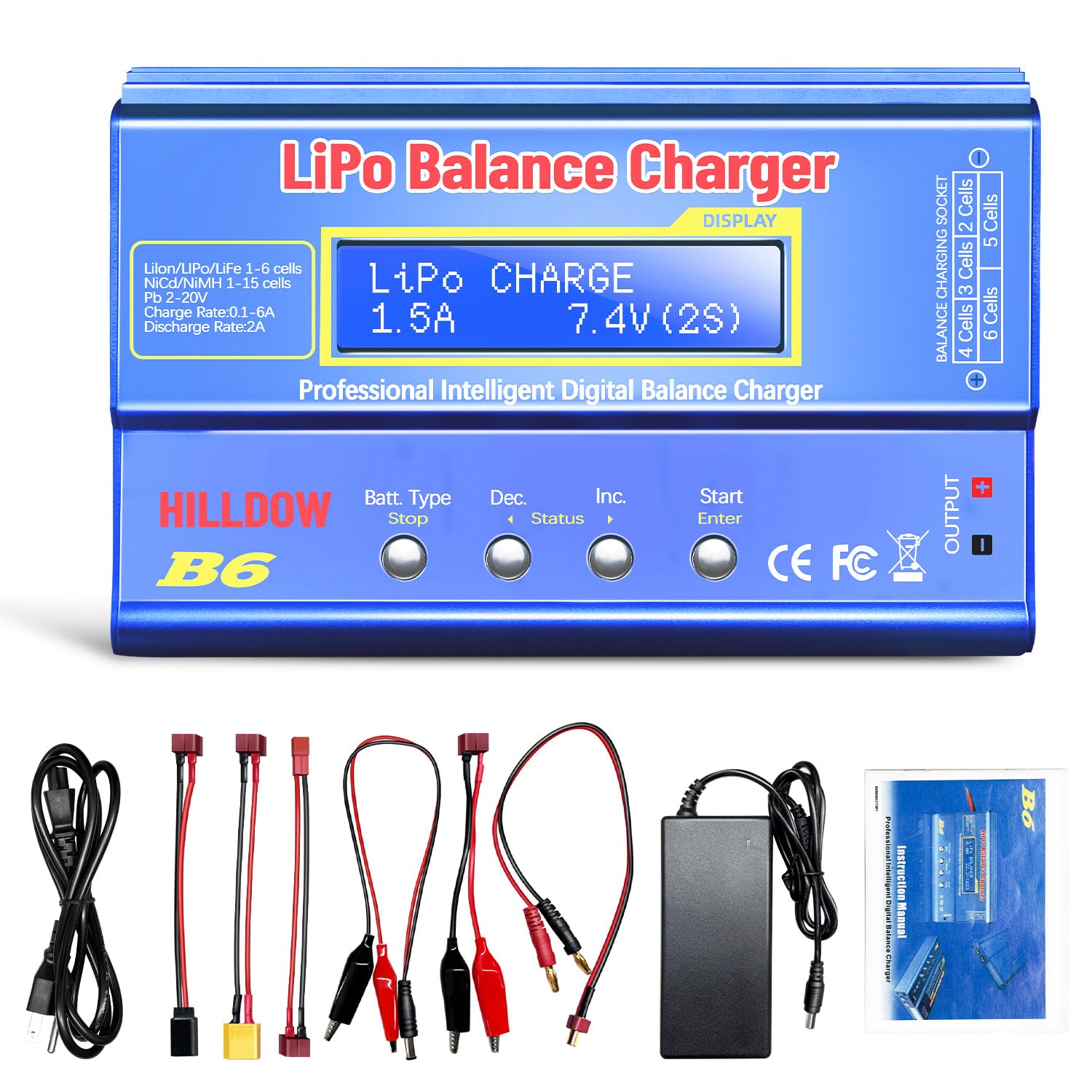
You get a compact, no‑nonsense charger that’s great for reviving and balancing individual cells. It’s the sort of tool you keep on the bench for maintenance tasks, restoring unbalanced packs, and routine conditioning before a flying session.
The B6’s small footprint makes it easy to move between the garage and the pit table, and it gives you the core features you need without a bulky control panel. If you want an affordable mini charger that handles common repair and balancing chores, this is a practical choice.
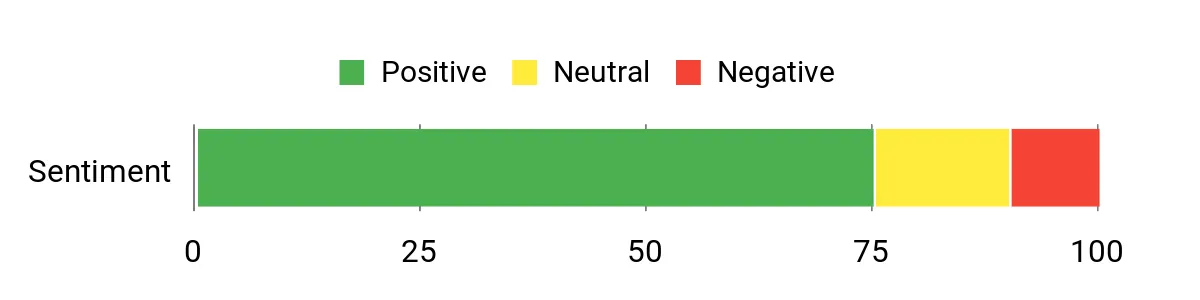
What People Say
People commonly praise the B6 for bringing tired or unbalanced packs back into usable condition and for being easy to swap between connections. Reviewers appreciate the compact size and straightforward operation for everyday tasks, while a few point out that careful setup is needed to avoid charging mistakes and that reading the menus takes a short learning period.
Overall Sentiment: Positive
Situations
|
Situation |
How It Helps |
|---|---|
|
Battery Revival |
Bring low or unbalanced cells back to life with controlled charging and balancing so packs last longer and you avoid premature replacements. |
|
Routine Maintenance |
Use storage and balance modes to prepare packs for longer storage or to level cells before a flying session. |
|
Small Bench Work |
Its compact footprint and simple hookups make it handy for quick diagnostics and repairs without taking up much space. |
Ease Of Use
|
Feature |
Ease Level |
|---|---|
|
Initial Setup |
Moderate |
|
Display And Controls |
Easy |
|
Balancing Operation |
Easy |
|
Advanced Options |
Moderate |
Versatility
Handles multiple chemistries and cell counts and offers charge, discharge and storage modes, making it suitable for hobbyists juggling different packs and repair tasks.
Safety Features
Includes balance charging and standard protection routines; careful selection of settings is still important to avoid misuse with nonstandard packs.
Durability
Compact but sturdy for regular bench use; users report consistent performance when operated within recommended settings and with proper care.
Problem Solving
Helps you diagnose and correct cell imbalances, revive marginal packs, and maintain batteries for reliable performance during flying sessions.
Key Benefits
- Portable mini form factor that fits a small bench or pit bag
- Balance and discharge modes useful for pack maintenance
- Supports 1–6S LiPo/Li‑ion and common NiMH/NiCd packs
- Straightforward connectors (XT60/JST/T) for easy hookups
- Included power supply simplifies out‑of‑the‑box use
Rating: 4.3 (total: 300+)
VIFLY WhoopStor

You can charge or storage‑cycle up to six 1S packs at once and keep an eye on each cell with the color display. The independent bays are hot‑swappable so you can pull a finished pack and drop a fresh one without stopping the whole run.
Multiple power inputs — USB‑C, DC and XT60 — mean you can use whatever you have in the pit box, and the storage function helps protect tiny whoop batteries between flights. If you fly a pile of 1S packs, this saves time and clears up a lot of charger juggling.
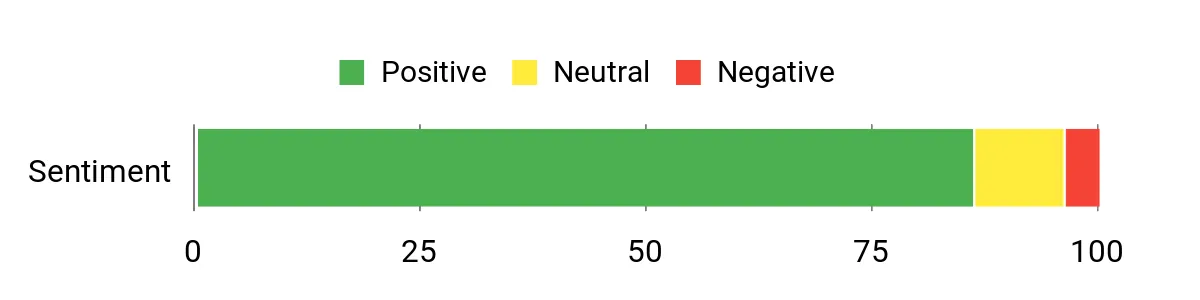
What People Say
Users commonly praise the convenience of six independent bays and the storage function for keeping 1S packs healthy. Many highlight the clear live voltage readouts and the ability to hot‑swap packs as major time‑savers during busy sessions. A few mention fan or coil noise on some units and remind buyers that this is optimized for 1S cells rather than larger packs.
Overall Sentiment: Positive
Situations
|
Situation |
How It Helps |
|---|---|
|
Multiple Whoop Packs |
You can charge six tiny packs at once and pull finished ones as needed, which keeps you flying without a long single‑charger queue. |
|
Field Days |
USB‑C, DC and XT60 inputs let you use whatever power source is available in the pit area so you don’t need a full bench setup. |
|
Storage Maintenance |
Set storage targets per bay to bring batteries to safe long‑term voltages and avoid leaving packs at full charge for extended periods. |
Ease Of Use
|
Feature |
Ease Level |
|---|---|
|
Initial Setup |
Easy |
|
Hot‑Swap Bays |
Easy |
|
Menu And Display |
Moderate |
|
Power Input Choices |
Easy |
Versatility
Designed specifically for 1S packs with support for standard and HV 1S, multiple connector types and several power inputs, so it excels for tiny whoops but isn’t a multi‑cell all‑purpose charger.
Safety
Per‑bay monitoring, storage target settings and independent circuits reduce the risk of overcharging individual cells; built‑in protections handle common faults during charge and discharge cycles.
Durability
The unit is compact and feels solid for frequent travel; owners report dependable performance over many cycles, though some note audible noise similar to a small laptop under load.
Problem Solving
This charger tackles the headache of serial charging by allowing parallel, independent charging and storage, cutting swap time and keeping 1S fleets healthier with per‑bay control.
Key Benefits
- Six independent bays for simultaneous charging and discharging
- Per‑bay voltage readouts and storage targets for healthier packs
- Hot‑swappable design reduces downtime between flights
- Multiple power inputs (USB‑C, DC, XT60) for field use
- Compact footprint made for whoop pilots and tight pit bags
Rating: 4.6 (total: 680+)
FAQ
How Do I Choose The Right Charger
Start by matching the charger’s capabilities to how you fly: consider the number of ports if you cycle many packs, the per‑channel amperage for turnaround speed, and the cell range (for example 1–6S) so it supports your packs. Look for clear per‑cell monitoring, reliable balance charging, and the power input types you’ll use in the field (AC, DC, USB‑C).
A practical tip is to size charge current to the pack’s capacity rather than maxing the charger; a 1,500 mAh pack charged at 1C needs about 1.5 A, so a charger with flexible current settings is more useful than one with only a fixed high output.
Are LiPo Chargers Safe And What Should You Do To Minimize Risk
Chargers with balance and cell monitoring greatly reduce risk, but you still need good habits: always use the correct chemistry and cell count, inspect packs and leads for damage, and place batteries on a nonflammable surface or in a LiPo bag while charging. Use the charger’s storage mode for long‑term storage, avoid leaving packs unattended for extended periods, and keep firmware and connectors in good condition so protections work as intended.
Can One Charger Handle Different Battery Types And Multiple Packs
Many modern chargers support LiPo, LiHV, LiFe and common Ni chemistries, but you must explicitly select the correct chemistry and cell count for each charge. Charging multiple packs at once is fine when channels are independent or when parallel charging is only done with identical packs (same cell count, capacity and state of charge); avoid mixing chemistries or cell counts together and check whether the charger shares common ground before using parallel adapters.
When in doubt, charge packs separately or use a multi‑bay unit with independent circuits and per‑cell monitoring to keep things safe and predictable.
Preferred Features
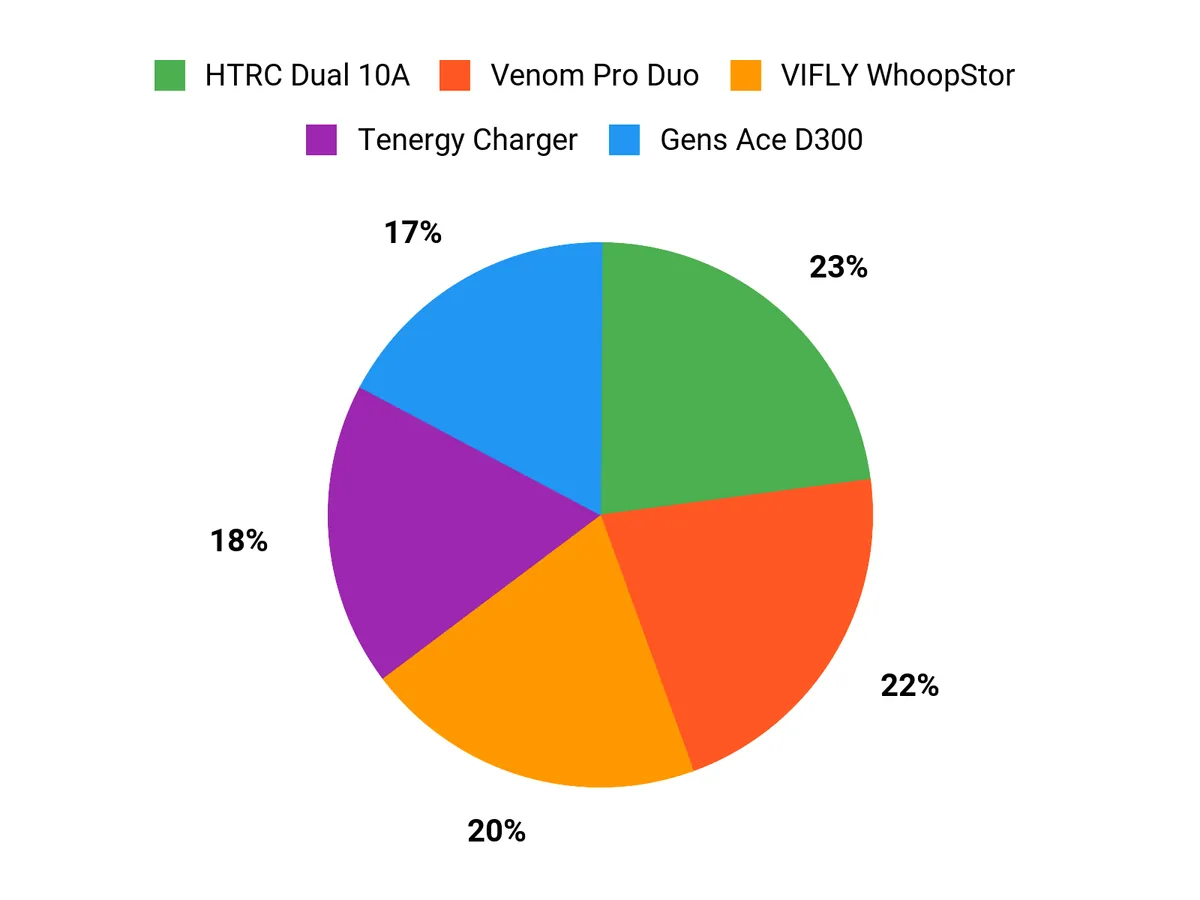
You’ll usually choose based on whether you need raw power and dual‑channel throughput for fast turnarounds or a compact, field‑ready unit with detachable power and clear per‑cell readouts. If you race or cycle many packs you’ll favor the high amperage and simultaneous ports of the HOTA D6 Pro or Gens Ace D300; if you want portability and easy on‑site operation you’ll lean toward the ISDT 608AC for its detachable supply and intuitive display.
Wrapping Up
You want a charger that fits how you fly and how many batteries you cycle. The HOTA D6 Pro is the best all-around choice if you need dual channels, high amperage, and solid build quality.
If your priority is raw output for fast turnarounds the Gens Ace IMARS D300 delivers industry-leading wattage. For field work and portability the ISDT 608AC stands out with its detachable supply and compact footprint. Venom Power remains a dependable option for longevity and straightforward dual charging.
If you fly tiny whoops, the VIFLY WhoopStor saves time with six independent bays and handy storage functions. For newcomers, the Tenergy unit keeps connectors and workflows simple while the HTRC Dual 10A is a balanced midrange performer. If you need an inexpensive tool to revive or balance packs, the Hilldow B6 offers core functionality at a low price. Match the charger to your pack count, whether you prioritize speed, portability, or value, and you will get more reliable battery life and less downtime between flights.
| Product Name | Image | Rating | Input Voltage | Current Rating | Compatible Devices |
|---|---|---|---|---|---|
| HOTA D6 Pro Dual Channel RC Battery Charger |
|
4.6/5 (106 reviews) | 180 volts AC | 15 A | RC cars, boats, drones, LiH/LiF/Lilon/Lixx, NiZn/Nicd/NiMH, Smart Battery, Lead Acid |
| Gens Ace Lipo Charger IMARS D300 |
|
4.6/5 (342 reviews) | 240 volts AC | 16 A | Various RC batteries |
| ISDT Lipo Battery Balance Charger 608AC |
|
4.4/5 (109 reviews) | 110V~220V AC | 8 A | RC cars, planes, drones |
| Venom Power Pro Duo LiPo Battery Charger |
|
4.6/5 (881 reviews) | 120 volts AC | 7 A | RC cars, drones, LiPo, LiHV, Li-Ion, and Pb batteries |
| HTRC LiPo Battery Charger Dual 10A Fast |
|
4.5/5 (1,365 reviews) | 120 volts AC | 10 A | LiPo, LiHV, Li-ion, NiCD, NiMH, Pb batteries |
| Aorika LiPo Battery Charger Dual 10A |
|
4.3/5 (371 reviews) | 11 volts DC | 20 A | RC cars, RC drones |
| Tenergy 1S-6S Digital Battery Pack Charger |
|
4.6/5 (410 reviews) | 240 volts AC | 5 A | Battery-powered devices with compatible connectors (Tamiya, Mini Tamiya, JST, etc.) |
| HTRC 150W 10A RC Balance Charger |
|
4.3/5 (365 reviews) | 240 volts AC | 10 A | RC cars, drones, LiPo, Li-ion, LiFePO4, LiHV, NiMH, NiCd, PB batteries |
| Hilldow B6 Mini Lipo Balance Charger |
|
4.3/5 (300 reviews) | 110 volts AC | 6 A | Li-Po/Li-ion (1-6 cells), Li-Fe, NiMH (1-15 cells), NiCd (1-15 cells) |
| VIFLY WhoopStor V3 6 Ports 1S LiPo Battery Storage Charger |
|
4.6/5 (680 reviews) | 12 volts DC | 1.3 A | 1S LiPo batteries for whoop drones |
This Roundup is reader-supported. When you click through links we may earn a referral commission on qualifying purchases.
