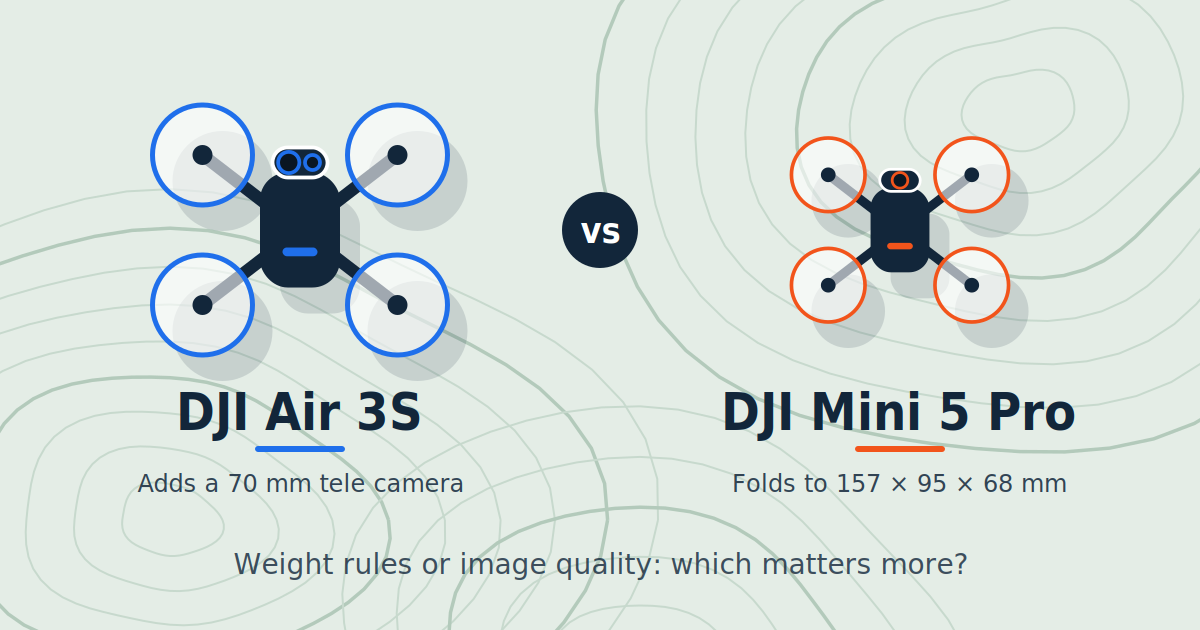
Trying to choose between the DJI Air 3S and the DJI Mini 5 Pro? In this DJI Air 3S vs DJI Mini 5 Pro matchup, both drones carry a 1-inch main sensor and forward LiDAR, so the choice comes down to lenses and weight.
Neither wins outright. Choose the DJI Air 3S for a second, 70 mm tele camera in a larger 724 g airframe. Choose the DJI Mini 5 Pro for a much smaller, lighter kit, though the Plus batteries in the linked combo lift it to about 295 g.
We compared both on DJI’s published specs, the exact kits the links sell, and owner and reviewer trends.
DJI Air 3S vs DJI Mini 5 Pro Compared
| Compare |
 Best for dual-camera shots
Premium
|
 Best for travel
Mid-range
|
|---|---|---|
| Best for | Creators who want a second, tele camera and can carry a larger drone | Travelers who want the smallest, lightest kit with a 1-inch sensor |
| Cameras | 1-inch 50 MP wide (24 mm) plus 48 MP tele (70 mm)Better | 1-inch 50 MP wide (24 mm), digital zoom only |
| Weight | 724 g | About 295 g with this combo’s Plus batteries (249.9 g ±4 g with the standard battery)Better |
| Folded size | 214 × 101 × 89 mm | 157 × 95 × 68 mmBetter |
| Rated flight time | Up to 45 min per battery | Up to 52 min per Plus battery (36 min with the standard battery) |
| Our score | 95/100 | 90/100 |
DJI Air 3S vs DJI Mini 5 Pro: Quick Verdict
DJI Air 3S
Bottom line: The DJI Air 3S gives you a second, 70 mm camera, at the cost of size and weight. Choose it when framing options matter more than portability.
- Cameras: 1-inch 50 MP wide (24 mm) plus 48 MP tele (70 mm), two framings without swapping gear
- Video: 4K up to 120 fps with 10-bit D-Log M and HLG, room for heavy color grading
- Weight: 724 g, above the 250 g registration line
- Max flight time: Up to 45 minutes per battery (DJI rating), room for several takes
- Obstacle sensing: Omnidirectional vision plus forward LiDAR, helps in low light
The Air 3S pairs its 1-inch wide camera with a 70 mm medium tele camera, so you can shoot a wide establishing shot and a compressed close-up without changing hardware. Both cameras record 4K up to 120 fps and support 10-bit D-Log M and HLG.
Forward LiDAR joins the omnidirectional vision system to help the aircraft see obstacles in low light, and ActiveTrack 360° handles subject tracking. The Fly More Combo (RC 2) adds a screen controller, three batteries, a charging hub, an ND filter set and a shoulder bag for cityscapes, landscapes, weddings and client work.
The trade-off is size. At 724 g it sits above the 250 g line that triggers registration in the US and many other countries, and it packs larger than the Mini 5 Pro.
- Second 70 mm tele camera for tighter framing
- 1-inch main sensor with 10-bit D-Log M and HLG
- Forward LiDAR plus omnidirectional sensing for low-light flights
- Fly More Combo (RC 2) adds a screen controller, three batteries and ND filters
- Rated for up to 45 minutes per battery
- At 724 g it is well above the 250 g registration line
- Larger folded size than the DJI Mini 5 Pro
- Real flights run about 30 to 35 minutes per battery
DJI Mini 5 Pro
Bottom line: The DJI Mini 5 Pro puts a 1-inch main sensor in a much smaller, lighter body, but the Plus batteries in this combo add weight. Choose it when you travel a lot.
- Cameras: 1-inch 50 MP wide (24 mm) with digital zoom, one lens so tighter framing means cropping
- Video: 4K up to 120 fps with 10-bit D-Log M and HLG, room for heavy color grading
- Weight: About 295 g with this combo’s Plus batteries (249.9 g ±4 g with the standard battery), so check local weight rules
- Max flight time: Up to 52 minutes per Plus battery, or 36 with the standard battery (DJI ratings), the longer rating adds weight
- Obstacle sensing: Omnidirectional vision plus forward LiDAR, helps in low light
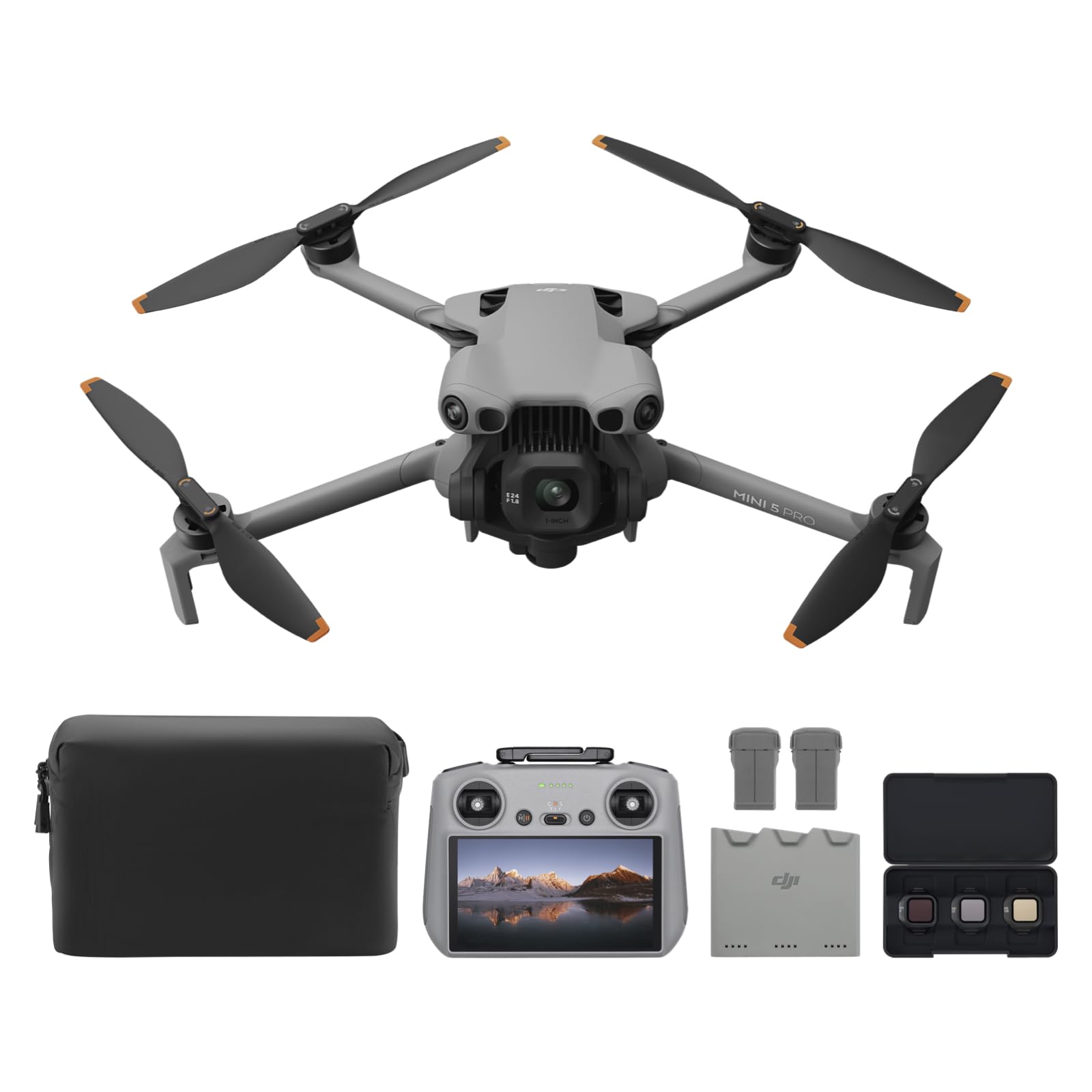
The Mini 5 Pro fits a 1-inch, 50 MP main camera into a body that folds to 157 × 95 × 68 mm. It records 4K up to 120 fps with 10-bit D-Log M and HLG, and its gimbal rotates 225° for true vertical video.
Forward LiDAR and omnidirectional vision help it see obstacles in low light, and ActiveTrack 360° handles subject tracking. The Fly More Combo Plus (RC 2) includes a screen controller, three Plus batteries, a charging hub and ND filters.
Read the weight line carefully. DJI lists 249.9 g ±4 g with the standard battery, but the Plus batteries in this combo raise takeoff weight to roughly 295 g, so the rules for drones over 250 g apply.
- 1-inch 50 MP main camera in a body that folds to 157 × 95 × 68 mm
- 4K up to 120 fps with 10-bit D-Log M and HLG
- Forward LiDAR plus omnidirectional sensing for low-light flights
- 225° gimbal rotation for true vertical video
- Fly More Combo Plus adds a screen controller, three Plus batteries and ND filters
- Plus batteries raise takeoff weight to about 295 g, above the 250 g line
- One 24 mm-equivalent camera with digital zoom only
- Standard-battery flights run about 20 to 25 minutes in testing
DJI Air 3S vs DJI Mini 5 Pro: Head-to-Head Breakdown
The core trade-off is simple: the DJI Air 3S adds a tele camera, while the DJI Mini 5 Pro delivers the same 1-inch main sensor in a far lighter kit. The higher price tier of the DJI Air 3S buys the second lens and the larger airframe, not a different main sensor.
Camera System
Both drones use a 1-inch, 50 MP main sensor behind an f/1.8 lens, so their wide-angle camera specs match. The DJI Air 3S adds an f/2.8 tele camera with a 48 MP sensor, which lets you frame distant subjects without cropping the image. The DJI Mini 5 Pro relies on digital zoom, which does crop.
Video Modes
Your grading workflow is the same on either drone, and the DJI Air 3S offers those modes on both of its cameras. For vertical clips, the DJI Mini 5 Pro’s gimbal rotates 225°, while the DJI Air 3S offers a 2.7K vertical mode.
Weight and Portability
With the standard battery, DJI lists the DJI Mini 5 Pro at 249.9 g ±4 g, right at the 250 g line, so weigh your own unit if the threshold matters. With the Plus batteries in this combo, both drones fall under the FAA’s registration rule for drones over 250 g, but the DJI Mini 5 Pro is still less than half the weight.
Flight Time
DJI rates the DJI Air 3S at up to 45 minutes and the DJI Mini 5 Pro at up to 52 minutes with Plus batteries, but it tested them at different speeds (32.4 kph and 25.2 kph), so the numbers are not like for like. In testing, the DJI Air 3S lands around 30 to 35 minutes and the DJI Mini 5 Pro’s standard battery about 20 to 25 minutes.
Obstacle Sensing
The DJI Air 3S lists a longer sideways measurement range (0.5 to 30 m against 0.5 to 12 m), a small on-paper edge. Both list 12 m/s wind resistance and O4-class transmission rated to 20 km under the FCC standard.
Value for Money
The DJI Mini 5 Pro sits in a lower price tier and delivers the same 1-inch main sensor, video modes and LiDAR sensing as the DJI Air 3S. The DJI Air 3S adds the tele camera and a larger airframe. Both combos include a screen controller, three batteries, a charging hub and ND filters, and Amazon prices change often, so check both listings.
DJI Air 3S or DJI Mini 5 Pro: Which Should You Buy?
- Weddings, events and client work that need a tele shot: get the DJI Air 3S.
- Landscape and cityscape shoots with wide and tight framing: get the DJI Air 3S.
- Packing light for travel: get the DJI Mini 5 Pro.
- Vertical video for reels and shorts: get the DJI Mini 5 Pro.
How We Compared
- Manufacturer specs: DJI’s published specification sheets, matched to the exact Fly More Combo each link sells.
- Like for like: We compared cameras, video modes, weight, folded size, rated flight time and sensing on the same variant, and show both values where DJI’s test methods differ.
- Owner and reviewer trends: Real-world flight time, image quality and stability points that appear in at least two independent sources outside Amazon.
- Rules and safety: Weight against the 250 g registration line, plus a check of recall notices for both models.
Customer Preferences
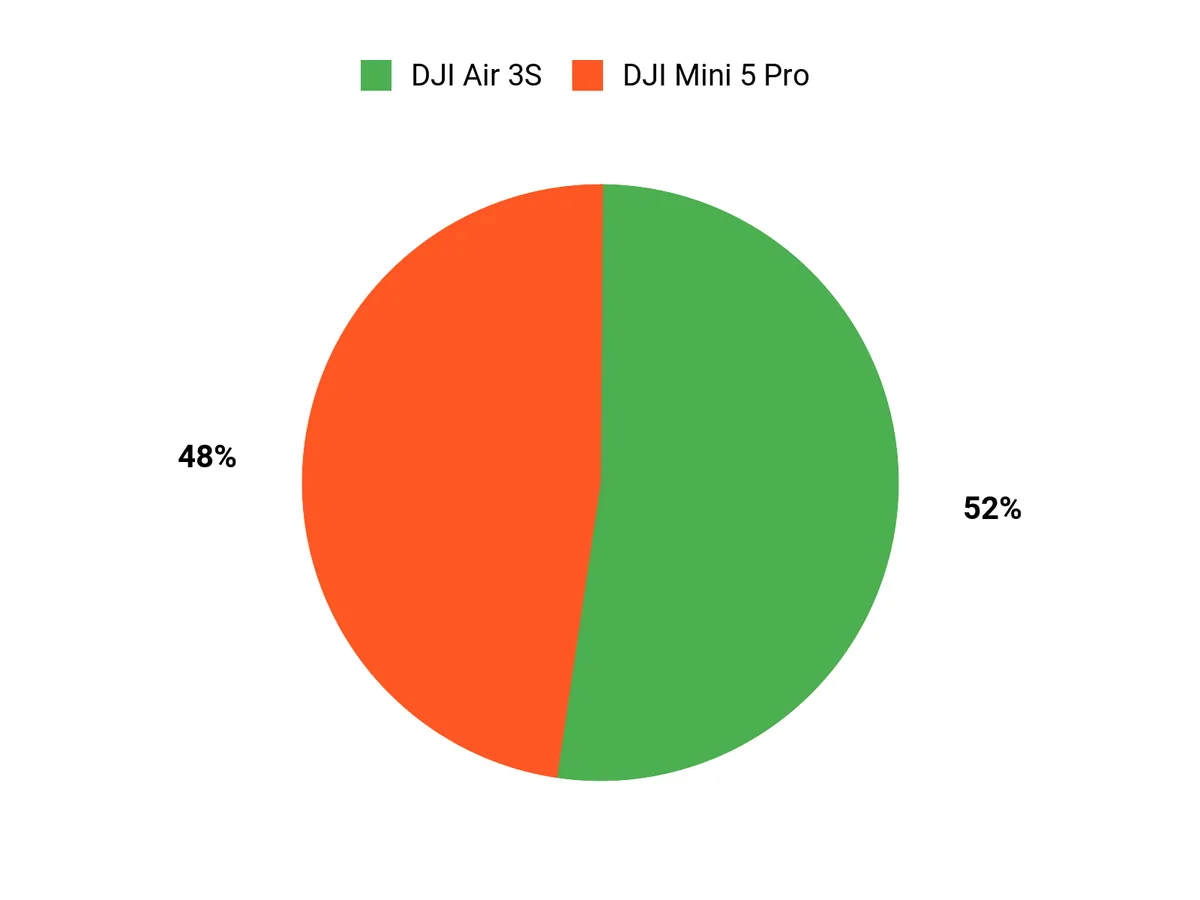
Buyers in this class usually weigh camera flexibility against portability. If a tele lens matters most, the DJI Air 3S fits. If a small, light kit matters most, the DJI Mini 5 Pro fits.
How to Choose a Camera Drone
Weight and Registration Rules
Many countries use 250 g as the line for registration and extra operating rules. In the US, the FAA requires registration for drones over 250 g, recreational flights with lighter drones are exempt, and commercial flights need registration at any weight. DJI lists the DJI Mini 5 Pro at 249.9 g ±4 g with its standard battery, so weigh your own unit. With the Plus batteries in the linked combo it moves above the line, as does the 724 g DJI Air 3S. If low weight matters most, the DJI Mini 5 Pro is the lighter of the two.
Camera and Lens Setup
A 1-inch sensor generally gathers more light than the smaller sensors in cheaper drones, which helps in dim scenes. A second, tele lens matters if you shoot events, portraits or distant subjects, while a single wide lens is enough for most landscapes and travel clips. The DJI Air 3S is the only one of the two with a tele camera.
Flight Time and Batteries
Rated flight times come from ideal test conditions, so plan around what testers report: about 30 to 35 minutes for the DJI Air 3S and 20 to 25 minutes for the DJI Mini 5 Pro’s standard battery. Carry spare batteries for anything longer than a short outing. Both combos in this comparison include three batteries.
Obstacle Sensing and Safety
Omnidirectional sensing helps the aircraft avoid obstacles, and LiDAR adds distance measurement in low light, but neither replaces watching the drone yourself. DJI advises extra caution in complex environments. Both the DJI Air 3S and the DJI Mini 5 Pro combine vision sensing with forward LiDAR.
Mistakes to Avoid When Buying a Camera Drone
- Trusting the sub-250 g label: Check the weight with the exact battery that comes in the box.
- Buying on the rated flight time: Use real-world figures from testers instead.
- Ignoring the combo contents: Confirm the listing names the kit you want, including controller, batteries and filters.
- Skipping local rules: Check registration and Remote ID rules for every country you plan to fly in.
- Paying for a lens you will not use: Choose a tele camera only if you frame distant subjects.
FAQs
Which Drone Should You Choose: the DJI Air 3S or the DJI Mini 5 Pro?
Choose the DJI Air 3S if you want a second, 70 mm tele camera, and the DJI Mini 5 Pro if you want the smaller, lighter kit. Both share a 1-inch main sensor, 4K up to 120 fps and forward LiDAR, so your choice depends on lenses, weight and how much you carry.
Will Weight Rules Affect Where You Can Fly?
Yes, weight decides which registration and operating rules apply. Many regulators use a 250 g threshold, and in the US the FAA requires registration for drones over that weight. Both drones in this comparison sit above it in the linked combos. Check the rules in each country you plan to fly in, and carry proof of registration when you travel.
How Much Does Image Quality Matter For Real-World Use?
It matters most when you grade footage, shoot high-contrast scenes or deliver to clients. Both drones use a 1-inch, 50 MP main sensor behind an f/1.8, 24 mm-equivalent lens, so their wide-angle camera specs match. The DJI Air 3S adds a 70 mm tele camera for tighter framing, which matters more for events and portraits than for travel clips.
What Is the Main Difference Between the DJI Air 3S and DJI Mini 5 Pro?
The main difference is the second camera and the weight. The DJI Air 3S adds a 70 mm tele camera and weighs 724 g, while the DJI Mini 5 Pro has one wide camera and weighs about 295 g in the linked combo. Their main sensors, video modes and forward LiDAR are otherwise closely matched.
Does the DJI Mini 5 Pro Stay Under 250 Grams?
Only with its standard battery, and only just. DJI lists 249.9 g with a ±4 g tolerance, and testers have weighed production units at 252 to 253 g. The Plus batteries in the Fly More Combo Plus raise takeoff weight to about 295 g, so treat this combo as a drone over 250 g.
Do the DJI Air 3S and DJI Mini 5 Pro Share Batteries or Chargers?
No, each drone uses its own batteries. DJI’s charging hub for the Air 3S lists only Air 3 and Air 3S batteries as compatible, and the Mini 5 Pro hub lists only Mini 5 Pro batteries, standard and Plus. Both combos include a hub for their own drone, so you won’t need to buy one separately.
Is It Legal to Buy and Fly These Drones in the US?
Yes, as of this update. Both models were FCC-authorized before the December 2025 Covered List action, and drones you already own can keep flying. A July 2026 FCC proposal would end imports and marketing of previously authorized drones with LiDAR, which both models carry. It is a proposal, not a final rule, so check the FCC’s latest notices.
How Long Do the Batteries Really Last?
Less than the ratings suggest. Testers report about 30 to 35 minutes per battery on the DJI Air 3S against DJI’s 45-minute rating, and about 20 to 25 minutes on the DJI Mini 5 Pro’s standard battery against 36. DJI rates the Plus batteries in the Mini 5 Pro combo at up to 52 minutes, at the cost of extra weight.
Final Verdict: DJI Air 3S vs DJI Mini 5 Pro
There is no single winner in the DJI Air 3S vs DJI Mini 5 Pro matchup. Both share a 1-inch main sensor, 4K up to 120 fps and forward LiDAR, so pick the DJI Air 3S for the tele camera or the DJI Mini 5 Pro for the smaller, lighter kit. Keep in mind that the Plus batteries in the linked Mini 5 Pro combo put it above 250 g.
