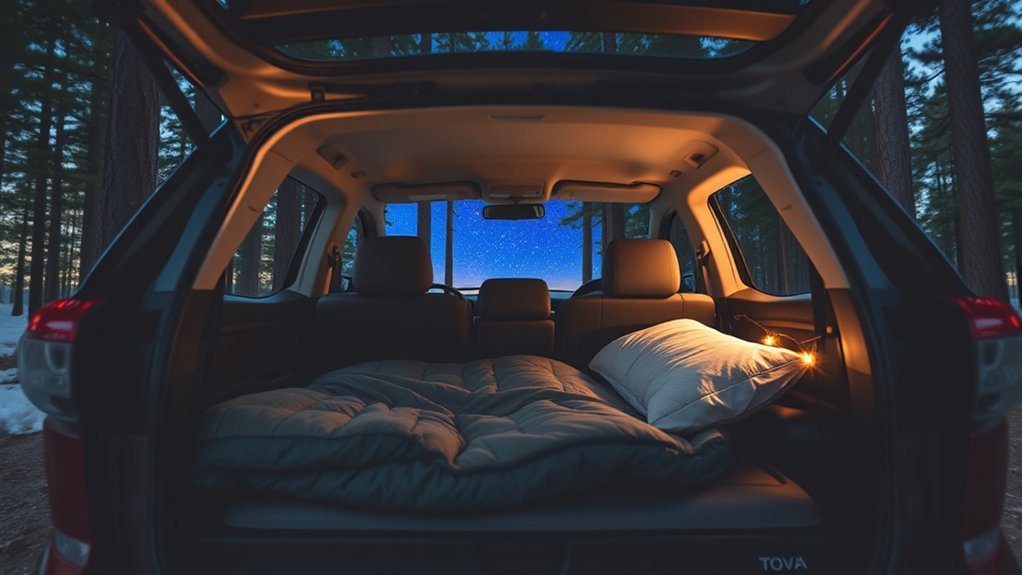
A Toyota RAV4 can work well as a compact car-camping shelter when you match the setup to your exact model, body size, weather, and gear. The folded cargo area is generally most practical for one person, although some pairs can make it work. Comfort depends less on a published cargo-volume figure and more on usable length, width, floor levelness, ventilation, and careful packing.
Quick Answer
Yes. Most five-door Toyota RAV4s can work for one or two car campers, but comfort depends on model year, your height, and how level the folded cargo floor is. Measure your vehicle before buying a mattress, level gaps safely, ventilate the cabin, and never sleep with the engine or a fuel-burning stove running.
Key Takeaways
- Measure your RAV4’s usable cargo length, narrowest width, wheel-well width, and floor slope before choosing a mattress.
- One adult usually has more room for gear and movement. Two adults should complete a test setup before relying on the vehicle overnight.
- A supportive pad, level parking space, window coverings, and cross-ventilation make a larger difference than trim-level luxuries.
- Never run the engine for overnight heat or cooling, and never operate a fuel-burning stove, heater, lantern, or grill inside the vehicle.
- Check local camping rules, weather, vehicle recalls, roof-load limits, and your exact model-year owner’s manual before leaving.
At a Glance
| Time Required | About 30–60 minutes for the first measurement and test setup |
| Difficulty | Easy to moderate, depending on floor leveling and gear organization |
| Tools Needed | Tape measure, phone level, sleeping pad or mattress, window covers, ventilation screens, and storage bins |
| Cost | About $0 with gear you own, or roughly $40–$250 for a pad, screens, covers, and organizers |
Are Toyota RAV4s Comfortable for Sleeping During Car Camping?
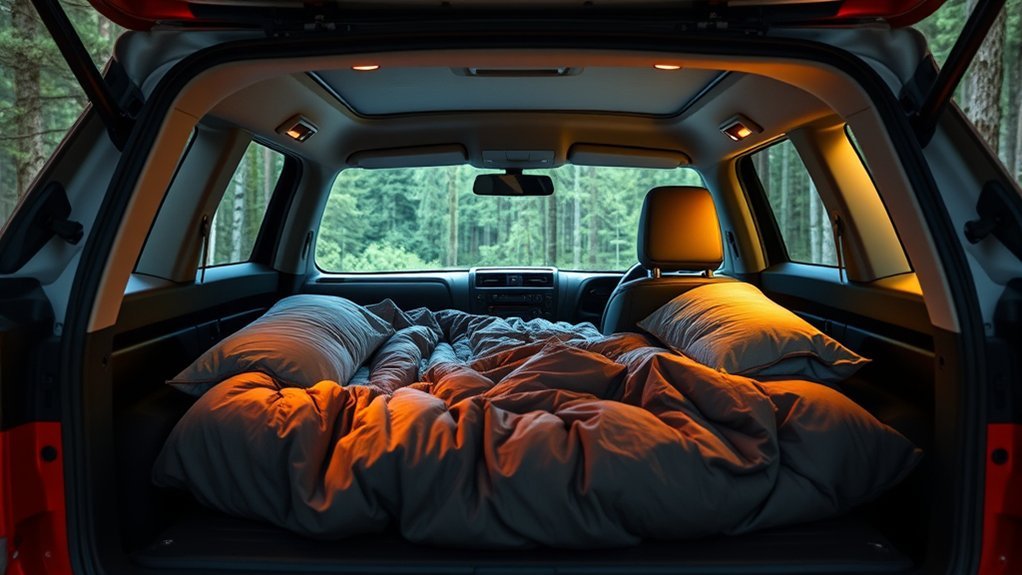
A Toyota RAV4 can provide a protected sleeping space for short trips, especially for a solo camper. It blocks wind, rain, and insects more effectively than sleeping in the open, while its compact size remains easy to drive and park.
That does not mean every RAV4 creates a long, wide, or perfectly level bed. Comfort changes with the model year, body style, seat design, front-seat position, mattress thickness, and the amount of gear stored inside.
A taller camper may need to sleep diagonally or move the front passenger seat forward. Two adults may have enough length but still find the available shoulder and hip width restrictive. A thick mattress can also reduce headroom and make it harder to sit up.
Measure Your RAV4 Before Buying a Mattress
Published cargo volume does not tell you whether your body or mattress will fit. Volume includes height, while sleeping comfort depends mainly on a usable two-dimensional floor.
- Move the front seats into safe overnight positions. Do not push a seat so far forward that it presses against the dashboard, controls, or steering wheel.
- Fold the rear seatbacks according to the owner’s manual. Remove or reposition head restraints only as the manual permits.
- Measure usable length. Measure from the closed hatch to the nearest front-seat obstruction on both sides.
- Measure the narrowest floor width. Check between the wheel wells as well as the wider area above them.
- Check floor height changes. Measure any step, hinge gap, or slope between the cargo floor and folded seatbacks.
- Check vertical clearance. Allow room for the mattress, your body, bedding, and safe movement without contacting the roof.
- Test the hatch. Confirm that it closes without pressing on the mattress, bedding, or stored gear.
Pro Tip: Mark your measured cargo outline on the floor at home with painter’s tape. Place your mattress and bedding inside the outline, then lie down with your camping partner before buying additional equipment.
A test layout reveals problems that product labels cannot, including shoulder crowding, insufficient footroom, limited headroom, and a mattress that is too wide to pass through the hatch.
Assessing Sleeping Space Across RAV4 Generations
RAV4 dimensions and rear-seat arrangements have changed considerably since the model’s introduction. Even vehicles from the same generation may differ by market, body style, trim, spare-tire placement, cargo-floor design, and installed accessories.
Toyota’s official model history notes that the first short-body RAV4 had limited rear-passenger and luggage room. A longer four-door version followed, and later generations became progressively more family-oriented. You should still treat the generation as a starting point rather than a guaranteed mattress specification.
Generational Space Comparisons
| Generation | General Sleeping-Space Considerations |
|---|---|
| First generation, 1994–2000 | The short two-door body is especially limited. The longer four-door model offers more useful space, but both require careful measurement and a compact sleep system. |
| Second generation, 2001–2005 | The body became longer and wider. Rear-seat folding and removal arrangements vary, so inspect the exact vehicle rather than relying on a generation-wide number. |
| Third generation, 2006–2012 | The larger body generally gives campers more usable length and gear room. Seatback angle, cargo-floor shape, and the side-hinged rear door on many models affect setup. |
| Fourth generation, 2013–2018 | The liftgate and more conventional cargo layout can simplify loading. Check for a slope or height change where the rear seatbacks meet the cargo floor. |
| Fifth generation, 2019–2025 | The wide, practical cargo area works well for many solo campers. Couples should test shoulder width, mattress placement, and gear storage before a trip. |
| Sixth generation, 2026 onward | Toyota describes a redesigned rear seatback that folds flat to maximize cargo space. Measure the complete sleeping surface because a folded seatback does not automatically guarantee a level bed for every camper. |
Sleeping Configuration Variances
Two RAV4s with similar exterior dimensions can provide different sleeping experiences. Check these variables before choosing a mattress or building a platform:
| Variable | Why It Matters |
|---|---|
| Body style and model year | They determine the basic cargo length, hatch design, and rear-seat arrangement. |
| Front-seat position | Moving a seat forward can add sleeping length but may create a gap that needs safe support. |
| Wheel-well width | This is often the narrowest area and may prevent a full-width mattress from lying flat. |
| Seatback slope or step | A small height difference can cause sliding, hip pressure, or lower-back discomfort. |
| Mattress thickness | More cushioning can improve pressure relief but reduces headroom and storage space. |
| Camper height and build | Usable length and shoulder room matter more than total cargo volume. |
User Experiences: What Usually Affects Sleeping Comfort?
Campers commonly reach different conclusions about the RAV4 because they are not testing identical vehicles, bodies, mattresses, or weather conditions. A setup that feels comfortable to a shorter solo traveler may feel cramped to two taller adults.
The most common comfort problems are not simply a lack of cargo volume. They include a sloped floor, pressure from a mattress seam, cold air beneath an uninsulated bed, condensation on the windows, insufficient ventilation, and gear occupying the foot area.
The best predictor of a comfortable RAV4 sleep setup is not a published cargo number. It is a full test night with your actual mattress, bedding, gear, window covers, and ventilation plan.
Before a long trip, complete at least one test setup at home. Lie down in your normal sleeping position, close the hatch, check your exit route, and remain inside long enough to notice pressure points and moisture buildup. Do not run the engine during the test.
Pros and Cons of Car Camping in a Toyota RAV4
The RAV4 balances fuel use, everyday drivability, enclosed shelter, and moderate cargo room. It is easier to maneuver than a large van or full-size SUV, but the compact footprint creates limits that become more noticeable with two sleepers or bulky equipment.
Sleeping Space Limitations
The main limitation is usable floor area. Taller campers may need to sleep diagonally, while two people can quickly use the full width between the wheel wells. A thick double mattress may leave little room for clothing, a cooler, water, shoes, or emergency equipment.
The folded seatbacks may also create a slope or step. Sleeping with your head lower than your feet can feel uncomfortable, while an unsupported gap may damage a mattress or cause a platform to shift.
Choose a level parking space first. If additional leveling is needed inside, use a stable, broad support that cannot collapse, slide, interfere with seat hardware, or block an exit. Avoid loose stacks of boxes or hard objects that could become projectiles while driving.
Fuel Efficiency Benefits
A compact crossover can use less fuel than many larger camping vehicles. However, fuel economy varies by generation, powertrain, grade, drivetrain, speed, temperature, tire pressure, elevation, roof equipment, and cargo weight.
The 2026 U.S. RAV4 lineup uses hybrid or plug-in-hybrid powertrains, depending on grade. Toyota publishes different estimates for individual configurations, so check the current window label, official specifications, or FuelEconomy.gov for the exact vehicle rather than applying one MPG figure to every RAV4.
A roof box or rooftop tent can increase aerodynamic drag. Heavy equipment can also affect efficiency and handling, so pack only what you need and remain within every vehicle and rack limit.
Versatile Cargo Capacity
With the rear seatbacks folded, a RAV4 can carry bedding, compact cooking equipment, clothing, and other camping essentials. The enclosed cargo area also keeps equipment out of rain during travel.
The tradeoff is that the same floor must often serve as both storage and sleeping space. A solo camper can usually move more gear to the unused side. Two campers may need a roof box, hitch-mounted cargo solution, tent, or outdoor storage plan.
| Advantages | Limitations |
|---|---|
| Enclosed protection from wind, light rain, and insects | Limited length, shoulder room, and headroom |
| Smaller and easier to park than a van | Sleeping and storage compete for the same floor |
| Practical for solo trips and short overnights | Condensation builds quickly without ventilation |
| Can remain useful as an everyday vehicle | Not an insulated shelter for extreme heat or cold |
Modifying Your RAV4 for Camping Comfort
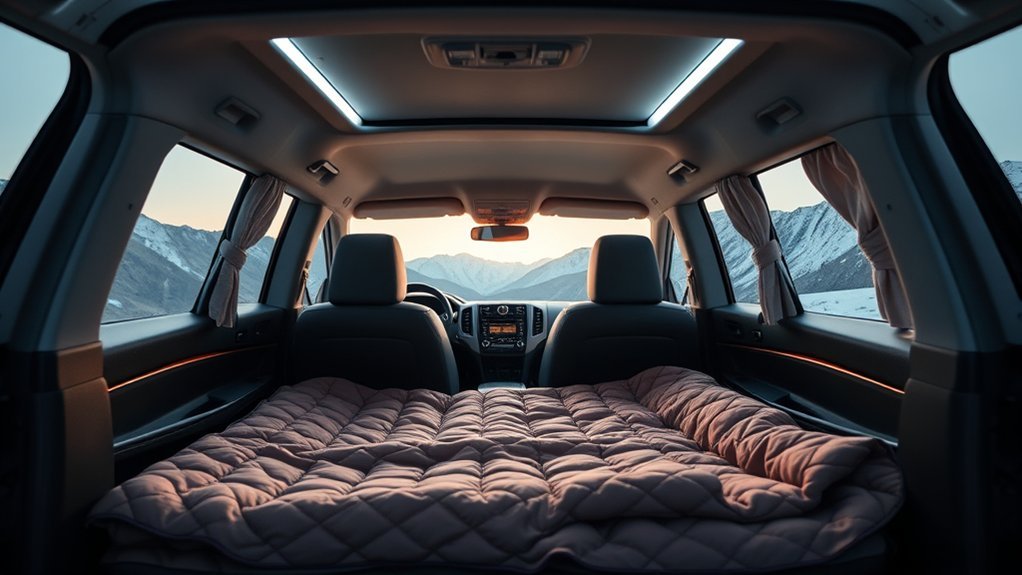
You do not need a permanent conversion for occasional car camping. A reversible setup is usually easier to install, safer to remove, and more practical when the RAV4 still carries passengers.
- Park on a legal, level, stable surface. Set the parking brake and avoid drainage channels, soft shoulders, falling branches, flood-prone areas, and obstructed roads.
- Move the front seats forward only as needed. Store the keys where you can reach them without accidentally pressing the alarm, hatch, or start button.
- Fold the rear seatbacks correctly. Follow the instructions for your model year and confirm that belts, buckles, and cargo are not trapped.
- Bridge only verified gaps. Use a stable platform or support panel designed to carry the expected load. Round or pad sharp edges that could puncture a mattress.
- Add insulation and cushioning. A closed-cell pad beneath an inflatable pad can reduce heat loss and protect against a cold cargo floor.
- Set up ventilation. Open two windows slightly on opposite sides and use fitted insect screens where conditions allow.
- Install removable window covers. Keep the driver’s area and at least one exit easy to uncover and operate.
- Move loose equipment. Store hard or heavy items low and securely so they cannot fall onto sleepers or shift during an emergency exit.
Note: Folding the seatbacks is different from removing the rear seats. Seat removal may involve wiring, restraint components, fasteners, warning lights, and model-specific procedures. Do not remove seats unless your exact owner or repair information permits it and the work is completed correctly.
A custom platform can create a level surface and storage below, but it must not exceed payload limits, interfere with seat latches, block access to emergency equipment, or become dangerous during a sudden stop. Secure removable components before driving.
| Modification | Potential Benefit | What to Check |
|---|---|---|
| Folding seatbacks | Creates the basic sleeping area | Manual procedure, belt position, slope, and gaps |
| Inflatable or self-inflating pad | Adds cushioning and some insulation | Measured length, width, thickness, and valve access |
| Removable leveling panel | Reduces a step or unsupported gap | Load capacity, stability, secure storage, and sharp edges |
| Window screens and covers | Improves airflow, insect control, and privacy | Weather, security, visibility, and emergency removal |
| Cargo organizers | Keeps small items accessible | Weight, secure placement, and exit clearance |
Choosing the Right RAV4 Trim for Your Camping Adventures
For sleeping comfort, the exact cargo-floor measurements matter more than leather, wheel size, or exterior styling. Compare vehicles with the rear seatbacks folded and the front seats in the positions you will use overnight.
For used vehicles, trim names and equipment vary by model year. Older LE and XLE models may provide everything a basic sleeper needs, while Adventure, TRD Off-Road, Woodland, Hybrid, and Prime variants can add traction, ground clearance, powertrain differences, outlets, roof equipment, or other features depending on the year.
For the 2026 U.S. model year, Toyota lists seven grades across three design groups:
- Core: LE, XLE Premium, and Limited
- Rugged: Woodland
- Sport: SE, XSE, and GR SPORT
The 2026 lineup uses hybrid or plug-in-hybrid powertrains, depending on grade. The Woodland has camping-friendly equipment such as raised roof rails with crossbars and an available rear cargo-area power outlet, but those features do not automatically make its sleeping floor longer or prove compatibility with a rooftop tent.
Before choosing a trim, compare:
- Usable floor length and width with the seatbacks folded
- Floor slope and hatch clearance
- Payload and roof-load information
- AWD needs for the roads you will legally travel
- Ground clearance and tire suitability
- Accessory-power availability
- Spare-tire and cargo-floor arrangement
- Your purchase, fuel, maintenance, and insurance costs
Use Toyota’s official owner’s-manual portal to confirm instructions and limits for the exact model year. Do not transfer a specification from a different generation or similarly named trim.
Must-Have Gear for a Good Night’s Sleep in Your RAV4
A compact setup works best when every item has a clear purpose. Prioritize a supportive sleep surface, weather-appropriate insulation, ventilation, privacy, water, lighting, and emergency equipment before convenience accessories.
Comfortable Sleeping Mattress Options
No universal “RAV4 mattress size” fits every model. Choose from these options after measuring your vehicle:
- Closed-cell foam pad: Durable, inexpensive, and resistant to punctures. It provides insulation but less pressure relief.
- Self-inflating pad: Balances cushioning, insulation, and compact storage. Narrow individual pads can fit around wheel-well restrictions more easily than one large mattress.
- Inflatable SUV mattress: Can cover more of the cargo area and may include shaped sections. Confirm every listed dimension rather than relying only on vehicle-fit marketing.
- Folding foam mattress: Supportive and quick to deploy but bulky when stored.
- Custom-cut foam: Can match an irregular cargo outline but must remain thin enough for useful headroom and easy removal.
Two separate pads often give couples more flexibility than one wide mattress. Each person can choose a preferred firmness, and one pad can move around a wheel well or storage bin.
Inflate an air mattress only to the pressure recommended by its manufacturer. Temperature changes can alter firmness, and overinflation can stress seams. Keep repair patches accessible.
Essential Sleeping Accessories
- Temperature-appropriate sleeping bag or quilt: Choose equipment for the expected overnight low, wind, humidity, and your personal cold tolerance.
- Insulated sleeping pad: Bedding above you does not prevent heat loss into a cold vehicle floor.
- Compact pillow: Use one that does not consume valuable headroom.
- Window screens: Fitted mesh helps provide airflow while reducing insect entry.
- Removable window covers: Use non-damaging covers that can be removed quickly from inside.
- Rechargeable fan: A small fan can improve air movement but cannot make unsafe heat conditions safe.
- Headlamp: Hands-free light is useful during setup and emergencies.
- First-aid kit: Match the contents to the destination, group, weather, and distance from help.
- Water and emergency food: Carry more than you expect to use when traveling remotely.
- Portable carbon-monoxide alarm: This can provide an additional warning layer but never makes idling or indoor fuel use safe.
Smart Storage Solutions
Storage should preserve the full sleep surface while keeping emergency items reachable. Soft-sided bags can fit into irregular spaces and are less painful to contact during the night than hard containers.
- Keep shoes in a washable tray near the hatch or a designated door.
- Store frequently used items in one labeled bag.
- Keep keys, a headlamp, phone, and glasses within reach.
- Place water where it cannot leak onto bedding or electronics.
- Keep heavy objects low and secured while driving.
- Do not block doors, the hatch release, or the route to the driver’s seat.
- Move food and scented products into storage appropriate for local wildlife rules.
A roof box may free interior space, but it adds weight and aerodynamic drag. Confirm the vehicle, rail, crossbar, box, and total-load limits before installation.
Maximizing Storage Space for Car Camping in Your RAV4
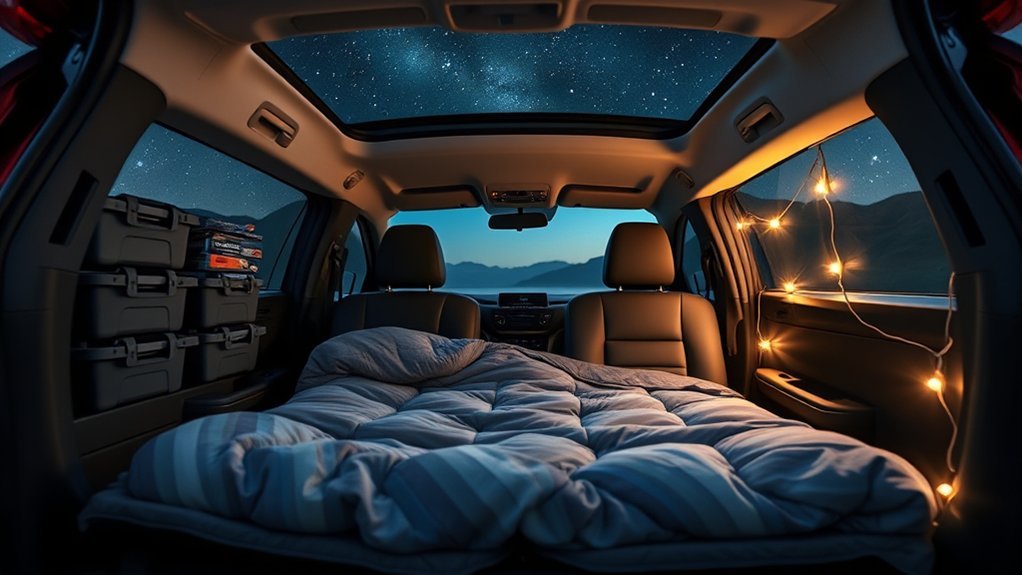
Pack the vehicle in two stages: a safe driving configuration and an overnight sleeping configuration. Nothing should remain loose where it could strike an occupant during hard braking.
- Use shallow bins beneath a verified platform. Label them so you do not need to unload the entire vehicle.
- Keep bedding together. A single bedding bag speeds setup and protects clean items from shoes and cooking equipment.
- Use the front footwells after parking. Lightweight bags can move forward overnight, provided they do not interfere with pedals or the driver’s controls.
- Pack vertically during travel. Reconfigure only after reaching the campsite and setting the parking brake.
- Separate wet gear. Store damp clothing and footwear away from bedding to reduce interior moisture.
- Limit duplicate equipment. Compact cookware, nesting containers, and multipurpose clothing preserve valuable space.
- Keep safety gear accessible. Do not bury medication, water, a fire extinguisher, first-aid supplies, or emergency communication equipment.
Removing rear seats may create more room in selected models, but it is not a routine camping step. Follow model-specific service information and consider professional assistance when wiring, sensors, restraint components, or warning systems are involved.
Ventilation, Condensation, and Temperature Control
People release moisture through breathing and perspiration. In a small closed cabin, that moisture condenses on cold glass and trim. Wet clothing, shoes, towels, and cooking equipment add more humidity.
To reduce condensation:
- Open two windows slightly on opposite sides to create cross-ventilation.
- Use fitted mesh screens when insects are present.
- Use rain guards only if they are securely installed and do not interfere with safe window operation.
- Dry wet gear outside the sleeping area when possible.
- Run a rechargeable fan to circulate air without operating the vehicle.
- Wipe heavy condensation with an absorbent cloth in the morning.
- Avoid breathing directly into the side of a sleeping bag or under tightly sealed bedding.
Window cracking reduces moisture but does not eliminate carbon-monoxide hazards, make fuel-burning equipment safe indoors, or guarantee a safe temperature.
Warning: Never sleep with the engine running, and never use a gas stove, charcoal grill, fuel-burning heater, lantern, or generator inside the RAV4 or another enclosed or partly enclosed sleeping space. Carbon monoxide has no color or smell and can incapacitate sleeping occupants before they notice symptoms. If anyone develops headache, dizziness, weakness, nausea, chest pain, or confusion, move to fresh air and seek emergency help.
Do not treat the RAV4 as a climate-controlled hotel room. Leave or use a suitable alternative shelter when overnight heat, cold, storms, smoke, flooding, or wind exceed your equipment and experience.
During cold-weather trips, use a properly rated sleep system, dry base layers, insulated pads, and an emergency plan. Keep snow, mud, leaves, and other debris away from the exhaust before driving, and never idle for warmth while sleeping.
During hot weather, shade and ventilation may not keep the cabin safe. Vehicle interiors can become dangerously hot. Do not remain in the vehicle when conditions exceed what you can manage safely, and never leave children, dependent adults, or animals unattended.
Cooking Tips and Staying Comfortable While Camping in Your RAV4
Cook outside in a permitted area on a stable, nonflammable surface. Keep fuel-burning equipment away from the vehicle’s open doors, windows, hatch, vents, dry vegetation, tents, and other combustible materials.
Follow the stove manufacturer’s clearance and fuel instructions. Check local fire restrictions before lighting any stove or fire, and keep appropriate extinguishing equipment nearby. Never bring a stove into the vehicle because of rain, wind, cold, or insects.
A compact food system may include:
- A fuel-efficient outdoor camp stove approved for the location
- A reusable plate, bowl, cup, and utensils
- A stable preparation surface
- A cooler or insulated container suited to the trip
- Clean water for drinking and food preparation
- Soap and a method for collecting food scraps and wastewater
- Sealed storage that meets local wildlife requirements
Keep raw foods separated from ready-to-eat foods and maintain safe temperatures. Pack out leftovers, spilled food, wrappers, and other waste. The National Park Service recommends learning local regulations, preparing for hazards, using durable established sites, and packing out food and trash.
Foldable chairs and a sunshade can make meals more comfortable, but secure them before driving. Do not attach a shade, tarp, or line where it could damage the vehicle, obstruct traffic, or create a trip hazard.
Safety, Security, and Pre-Trip Checklist
Car camping combines vehicle, campsite, weather, and personal-safety risks. Complete this checklist before each trip:
- Confirm that sleeping in a vehicle is allowed at the selected site.
- Check campground, park, forest, municipal, and private-property rules.
- Review the weather forecast, overnight low, heat, wind, storms, smoke, and flood risk.
- Tell a trusted person where you are going and when you expect to return.
- Download maps and essential information for areas without service.
- Check tires, fluids, lights, brakes, battery condition, wipers, and fuel or charge level.
- Search the VIN at NHTSA’s recall website and address safety recalls.
- Park legally on stable ground and set the parking brake.
- Keep at least one exit unobstructed and operable from inside.
- Learn how the doors, locks, hatch, alarm, and interior releases behave before bedtime.
- Keep keys, a phone, light, shoes, and essential medication within reach.
- Keep windows ventilated without creating an unnecessary security risk.
- Store food, trash, and scented items according to local wildlife guidance.
- Do not leave the vehicle in accessory mode until the 12-volt battery is depleted.
- Never rely on idling for overnight heating, cooling, or battery charging.
Choose a campsite that allows a quick departure. Avoid parking where another vehicle, locked gate, rising water, snowbank, or fallen branch could trap you.
Roof Tents and Roof Cargo
A rooftop tent may be possible on some RAV4 configurations, but compatibility is not automatic. Factory side rails alone may not support a tent, and a rack’s driving limit is different from the load it may support while parked.
Before installation, obtain written specifications for:
- The exact RAV4 model year, roof type, and factory roof-load limit
- The compatible rack towers, rails, and crossbars
- The rack’s dynamic load limit while driving
- The rack and vehicle’s permitted static load while parked
- The rooftop tent’s weight and mounting requirements
- The combined weight of the tent, occupants, bedding, ladder, and accessories
- Required crossbar spacing and installation torque
Use the lowest applicable limit in the complete system. Do not assume that an aftermarket component increases the vehicle roof’s permitted load. Recheck fasteners as instructed by the rack and tent manufacturers, and account for the change in height, crosswind response, center of gravity, parking clearance, and fuel use.
Is the RAV4 Right for Your Car-Camping Needs?
The RAV4 is a practical option when you want an everyday compact SUV that can also provide enclosed shelter for occasional overnight trips.
It is most likely to suit:
- A solo camper who packs compactly
- Two smaller campers who have completed a successful test setup
- Short trips in moderate weather
- Established campsites with legal vehicle access
- Travelers who prefer simple, reversible equipment
A ground tent, larger SUV, van, or other shelter may be better when:
- You cannot lie down without bending or pressing against the interior
- Two people lack sufficient shoulder or gear space
- You need to stand or change clothing indoors
- You are traveling with children, animals, or several passengers
- The weather requires more ventilation, insulation, or living space
- Your equipment prevents an unobstructed exit
- You plan extended trips rather than occasional overnight stays
The right decision comes from testing your exact vehicle rather than relying on a general cargo figure. Build the complete setup at home, spend time inside with the hatch closed and engine off, and correct problems before reaching a remote campsite.
Frequently Asked Questions
Can the RAV4 accommodate two adults comfortably for sleeping?
Some pairs can sleep in a RAV4, but comfort is not guaranteed. It depends on both adults’ height and build, the model year, narrowest cargo width, mattress thickness, and gear placement. Measure the vehicle and complete a full two-person test setup before relying on it for a trip.
What is the best sleeping arrangement for RAV4 car camping?
Park level, move the front seats only as far as needed, fold the rear seatbacks correctly, bridge any verified gap with a stable support, and use a measured insulated pad. Keep two windows slightly open on opposite sides, secure loose gear, and maintain a clear exit.
How does the RAV4 perform in cold weather while camping?
The cabin blocks wind and precipitation, but it is not an insulated winter shelter. Use a temperature-appropriate sleeping bag, an insulated pad, dry clothing, ventilation, weather monitoring, and an emergency plan. Never run the engine or a fuel-burning heater while sleeping.
What safety precautions matter when sleeping inside a RAV4?
Camp only where overnight vehicle use is permitted, park on stable ground, set the parking brake, keep an exit clear, ventilate the cabin, store keys and a light within reach, secure food, monitor weather, and check the VIN for recalls. Never idle overnight or use fuel-burning equipment inside.
Can I fit a roof tent on a Toyota RAV4?
Possibly, but you must verify the exact model year, roof type, vehicle limit, compatible rack, crossbar spacing, dynamic driving limit, parked static limit, and rooftop-tent requirements. Include the tent, occupants, bedding, ladder, and accessories in the total load. Factory rails alone do not prove compatibility.
What size mattress fits in a Toyota RAV4?
No single mattress size fits every RAV4. Measure usable length on both sides, the narrowest width between wheel wells, the wider area above them, floor height changes, and hatch clearance. Compare those measurements with the mattress’s actual inflated or unfolded dimensions.
Can I leave the engine or climate control running while I sleep?
Do not plan to sleep with the engine running. Exhaust leaks, blocked tailpipes, airflow changes, nearby vehicles, and other conditions can expose occupants to carbon monoxide. Window cracking and a portable alarm do not make idling safe. Use weather-appropriate bedding or leave for safer shelter.
How can I reduce condensation inside the RAV4?
Create cross-ventilation by opening two opposite windows slightly, use fitted insect screens, circulate air with a rechargeable fan, and keep wet gear away from bedding. Wipe moisture from the glass in the morning. Do not seal the cabin tightly for warmth.
Conclusion
Sleeping in a Toyota RAV4 can be comfortable enough for a solo camper or a carefully prepared pair, but the result depends on the exact vehicle and setup. Measure the cargo floor instead of trusting a universal mattress claim, correct slopes with secure supports, use suitable bedding, organize gear, and test everything before traveling.
Safety remains more important than convenience. Ventilate the cabin, keep an exit open, follow local camping rules, prepare for changing weather, and never run the engine or fuel-burning equipment while sleeping. With those limits understood, the RAV4 can serve as a practical, compact base for occasional car-camping trips.
Sources
- Toyota USA Newsroom: 2026 RAV4 — current generation, powertrains, grade lineup, rear-seat design, and manufacturer estimates
- Toyota Owner’s Manuals and Warranty Information — model-year-specific operation, equipment, warnings, and limits
- Toyota RAV4 Model History — body-style and generational development
- CDC: Carbon Monoxide Poisoning Basics — carbon-monoxide symptoms, vehicle exhaust risks, and portable-stove precautions
- NHTSA Recall Lookup — VIN-based unrepaired safety-recall checks
- National Park Service: Leave No Trace Seven Principles — campsite planning, regulations, weather preparation, food, and waste practices
