
Your vehicle can serve as a convenient mobile power source for laptops, phones, cameras, chargers, and other low-wattage electronics. The key is choosing a 12V power inverter that matches both your devices and the electrical limits of your vehicle’s accessory outlet.
This guide compares three compact car power inverters with different strengths: the Energizer EN100 for light-duty portability, the DEWALT DXAEPI140 for USB-C charging and mountable installation, and the BESTEK 300W for higher rated output and multiple AC connections.
Affiliate Disclosure:. As an Amazon Associate I earn from qualifying purchases. This page contains Amazon affiliate links. If you make a qualifying purchase through one of these links, we may earn a commission.
Quick Verdict
Best Compact Choice — Energizer EN100: A good match for phones, tablets, cameras, and lighter laptop charging when you want a small 100W inverter that stores easily.
Best for USB-C and Mounting — DEWALT 140W: Useful if you want 25W USB-C, 15W USB-A, a 120V AC outlet, quiet fan-free operation, and hardware for mounting the inverter in a vehicle.
Best for Higher Output — BESTEK 300W: Offers the highest inverter rating of these three along with two AC outlets and two USB ports, although your vehicle’s 12V outlet rating may limit how much of that capacity you can actually use.
Top Picks
|
Category |
Product |
Continuous Output |
|---|---|---|
|
🏆 Best Compact Choice |
100W |
|
|
💼 Best for USB-C & Mounting |
140W |
|
|
⚡ Best for Higher Output |
300W rated |
Selection Criteria
The most important consideration is whether an inverter can safely support the devices you plan to connect. We compared continuous wattage, surge capacity where verified, AC and USB connections, waveform type, cooling design, portability, and vehicle-friendly installation.
All three retained models use modified-sine-wave AC output. That is commonly suitable for many chargers and general electronics, but it should not automatically be assumed compatible with sensitive audio equipment, certain motors, medical equipment, or devices whose manufacturers specify pure-sine-wave power.
We also considered practical differences that affect daily use. A small inverter can be more convenient than a higher-powered model when you only need charging, while extra AC outlets and higher capacity may matter more for camping or mobile work.
Before You Buy: Check Your Vehicle’s 12V Outlet
Important: The inverter’s advertised wattage is not the only limit. Your vehicle’s 12V accessory outlet, wiring, and fuse must also be able to supply the required current.
Electrical input is roughly calculated as volts × amps, and an inverter also loses some energy during conversion. That means a vehicle outlet protected by a relatively low-amperage fuse can limit usable AC output well below the inverter’s maximum rating.
Check your vehicle owner’s manual or the rating printed near the accessory socket before connecting a high load. Never install a larger fuse simply to run a higher-powered inverter through wiring that was not designed for it.
Energizer EN100

The Energizer EN100 is the light-duty option in this comparison. It converts 12V DC vehicle power to 120V AC and is rated for 100W continuous output with a 200W peak. You get one standard AC outlet plus two USB charging ports sharing 2.1A.
Its main advantage is simplicity. The compact direct-plug design has no separate power cable to manage, and the adjustable head makes it easier to position in different vehicle interiors. Energizer lists the unit at about 8 ounces.
Who Should Buy This?
Choose the EN100 if most of your needs involve phones, tablets, cameras, small chargers, and compatible low-wattage laptop adapters. It is particularly useful when storage space matters and you do not need multiple AC outlets.
Buyer Considerations
The EN100 is a modified-sine-wave inverter, so check device requirements before connecting sensitive electronics. It also uses a thermal fan; it should not be described as a completely fanless inverter even though Energizer markets its operation as ultra quiet.

The sentiment graphic above comes from the original article dataset. Its methodology and review-snapshot date were not provided, so it should not be treated as a current live Amazon review measurement.
Situational Benefits
|
Situation |
How It Helps |
|---|---|
|
Road Trips |
Provides an AC outlet and USB charging without carrying a large inverter. |
|
Light Camping |
Useful for compatible low-wattage electronics, phone charging, and small chargers when vehicle power is available. |
|
Daily Commute |
The compact direct-plug format is easy to store and quickly connect when you need AC or USB power. |
Safety and Compatibility
Energizer identifies the EN100 as ETL approved and conforming to UL Standard 458. Use it only within both the inverter’s rating and your vehicle outlet’s electrical limit. Keep ventilation openings clear and stop using the inverter if the plug, socket, or inverter becomes unusually hot.
Key Benefits
- 100W continuous and 200W peak rating
- One 120V AC outlet
- Two USB charging ports with 2.1A shared output
- Compact direct-plug design with an adjustable head
- Modified-sine-wave output for compatible devices
Check Product Details on Amazon
DEWALT 140W

The DEWALT DXAEPI140 sits between the Energizer and BESTEK in power capacity. It is rated for 140W continuous output and provides one 120V AC outlet along with a 25W USB-C port and a 15W USB-A port.
The biggest advantages are its modern USB connections and installation flexibility. DEWALT includes mounting hardware for a more secure vehicle installation, and the inverter uses a fan-free design for silent operation during normal use.
Who Should Buy This?
This is a strong fit for drivers who regularly charge a laptop, phone, tablet, or other compatible electronics and want USB-C charging without carrying separate adapters. The mounting kit also makes sense for a work truck or vehicle where the inverter will stay in place.
Buyer Considerations
At 140W, this remains a compact accessory-socket inverter rather than a replacement for a high-capacity hardwired system. High-draw heating appliances and larger power tools can easily exceed its capability.

The sentiment graphic above comes from the original article dataset. Its methodology and review-snapshot date were not provided, so it should not be treated as a current live Amazon review measurement.
Situational Benefits
|
Situation |
How It Helps |
|---|---|
|
Daily Work Vehicle |
The included installation hardware lets you secure the inverter instead of leaving it loose in the cabin. |
|
Road Trips |
USB-C, USB-A, and AC connections give passengers several ways to charge compatible electronics. |
|
Laptop Charging |
The 140W AC rating provides more headroom than a basic 100W inverter when the laptop charger stays within the inverter and vehicle-socket limits. |
Safety and Battery Protection
DEWALT lists integrated low-voltage protection with automatic shutoff when vehicle-battery voltage becomes too low. That is helpful protection, but it is still better to avoid extended high-load use with the engine off when preserving enough battery charge to restart the vehicle matters.
Practicality
The inverter plugs into a 12V DC accessory outlet and weighs about 16 ounces. Its single AC outlet is supplemented by dedicated 25W USB-C and 15W USB-A charging ports, reducing the need for separate USB wall chargers.
Key Benefits
- 140W continuous AC output
- One 120V AC outlet
- 25W USB-C plus 15W USB-A charging
- Fan-free silent-running design
- Automatic low-voltage shutoff
- Includes hardware for mounting in a vehicle
Check Product Details on Amazon
BESTEK 300W
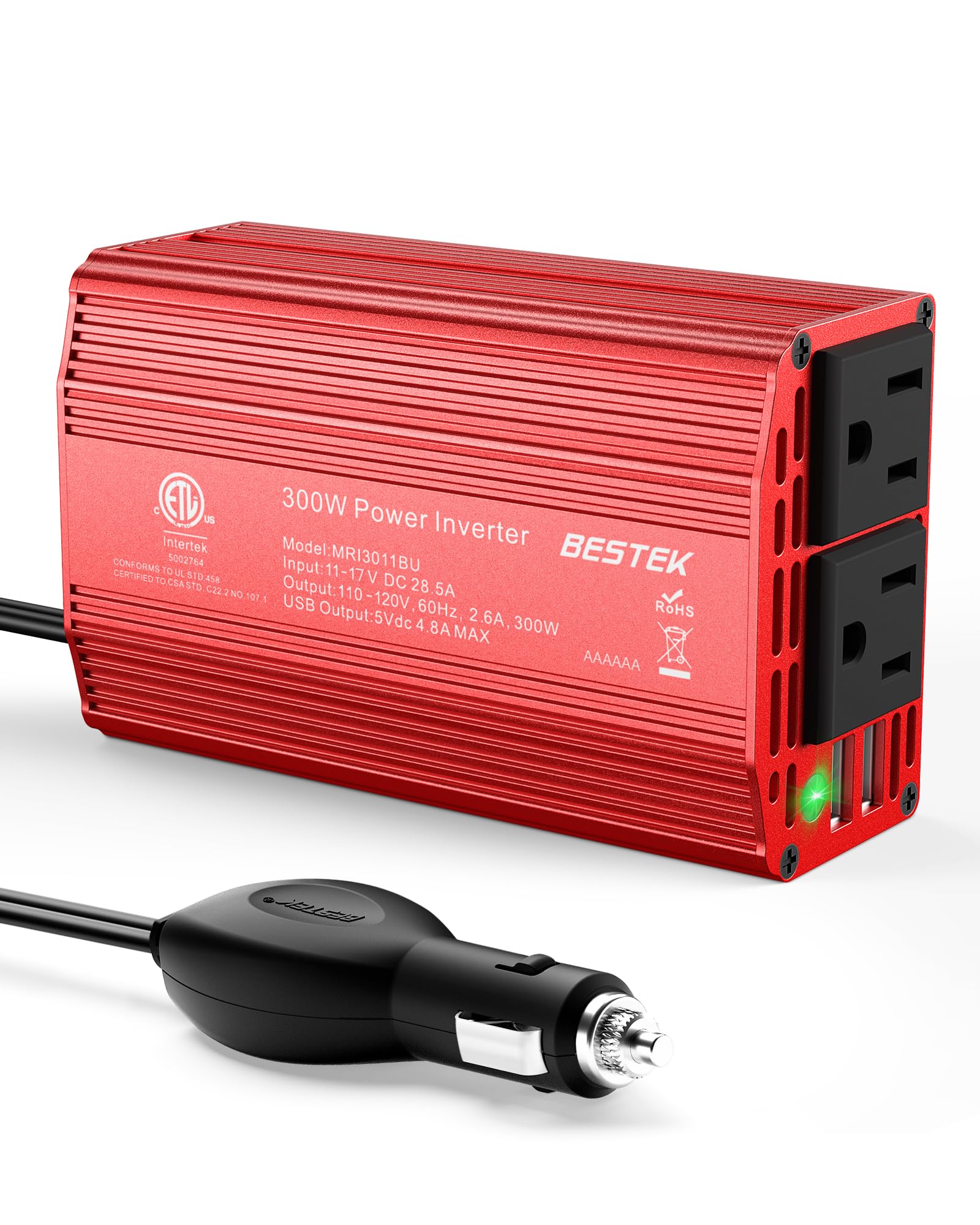
The BESTEK is the highest-rated inverter in this three-product comparison, with a stated 300W continuous output and 700W instantaneous peak. It provides two 110V AC outlets plus two USB charging ports, giving it more connection flexibility than the smaller models.
Its aluminum housing, 32-inch 12V power lead, and temperature-responsive cooling fan make it convenient for road trips, camping, and mobile charging. The fan increases speed as temperature or load rises rather than running at maximum speed all the time.
Who Should Buy This?
Choose the BESTEK when you need two AC outlets or expect to connect several compatible devices. It offers more inverter capacity than the EN100 or DEWALT model, but that extra rating is useful only when your vehicle’s 12V circuit can safely support the required input current.
Buyer Considerations
Do not assume that plugging a 300W inverter into any cigarette-lighter socket automatically makes 300W available. Check the accessory-outlet wattage or fuse rating in your vehicle owner’s manual and keep the total connected load within the lower of the vehicle-circuit limit or inverter limit.

The sentiment graphic above comes from the original article dataset. Its methodology and review-snapshot date were not provided, so it should not be treated as a current live Amazon review measurement.
Situational Benefits
|
Situation |
How It Helps |
|---|---|
|
Camping |
Two AC outlets and two USB ports can support several compatible low-wattage devices when the vehicle circuit has adequate capacity. |
|
Road Trips |
Provides multiple charging connections for laptops, tablets, cameras, and phones without relying on several separate 12V adapters. |
|
Mobile Work |
The higher inverter rating can accommodate compatible chargers that exceed the capacity of smaller 100W-class inverters, subject to the vehicle outlet limit. |
Safety Features
The current product information describes protection against overheating, under-voltage, over-voltage, and short circuits, along with an internal fuse. These protections do not replace the need to observe your vehicle’s accessory-outlet rating and keep the inverter ventilated.
Practicality
Two AC receptacles are more useful than a single outlet when several travelers need power. The dual USB ports handle compatible USB devices without occupying either AC receptacle.
Energy and Waveform Considerations
This is a modified-sine-wave inverter. Many ordinary switching power supplies and chargers can operate on modified sine wave, but some equipment may run hotter, buzz, malfunction, or specifically require pure sine power. Check the device manufacturer’s requirements when compatibility is uncertain.
Key Benefits
- 300W continuous and 700W instantaneous rating
- Two AC outlets plus two USB charging ports
- 32-inch 12V power lead for easier positioning
- Durable aluminum housing
- Temperature and load-responsive cooling fan
- Modified-sine-wave output for compatible devices
Check Product Details on Amazon
Which Car Power Inverter Should You Choose?
|
If You Need… |
Best Match |
|---|---|
|
The smallest option for basic charging |
Energizer EN100 |
|
USB-C charging and a mountable design |
DEWALT 140W |
|
Two AC outlets and the highest inverter rating |
BESTEK 300W |
FAQ
How Do I Choose the Right Inverter Wattage?
Check the running wattage of every device you intend to power and also consider startup or surge requirements. Your inverter must support the load, but your vehicle’s 12V outlet must also provide enough input power. Leave reasonable headroom instead of continuously operating either the inverter or vehicle circuit at its maximum rating.
Can I Use These Inverters With Sensitive Electronics?
All three products in this comparison use modified-sine-wave output. Many ordinary chargers can work with that waveform, but equipment specifically requiring pure sine wave should use a suitable pure-sine inverter instead. For medical devices or other critical equipment, follow the equipment manufacturer’s approved power requirements rather than assuming compatibility.
Will Using an Inverter Drain My Car Battery?
Yes. An inverter draws energy from the vehicle electrical system, and extended operation with the engine off can discharge the starter battery. Low-voltage shutdown can reduce the risk on models that provide it, but it should not be treated as permission to run large loads indefinitely with the engine stopped.
Can a 300W Inverter Deliver the Full 300W From Every Cigarette-Lighter Socket?
No. The practical limit depends on the vehicle’s accessory-outlet wiring and fuse rating. A 300W rating describes the inverter’s capacity under suitable input conditions; it does not override the electrical limit of the socket supplying it. Check the vehicle owner’s manual before connecting higher loads.
What Is the Difference Between Continuous and Peak Wattage?
Continuous wattage is the power an inverter is designed to supply during normal operation. Peak or surge wattage is a short-duration capacity intended to handle brief startup demand. A device with a motor or compressor can require substantially more power at startup than while running.
Customer Preferences
The best choice depends more on your electrical load than on brand alone. The Energizer EN100 prioritizes small size and light-duty charging. The DEWALT adds USB-C, silent fan-free operation, low-voltage shutoff, and mounting hardware. The BESTEK provides the highest inverter rating and two AC outlets, but its real usable output can be constrained by the vehicle’s accessory circuit.
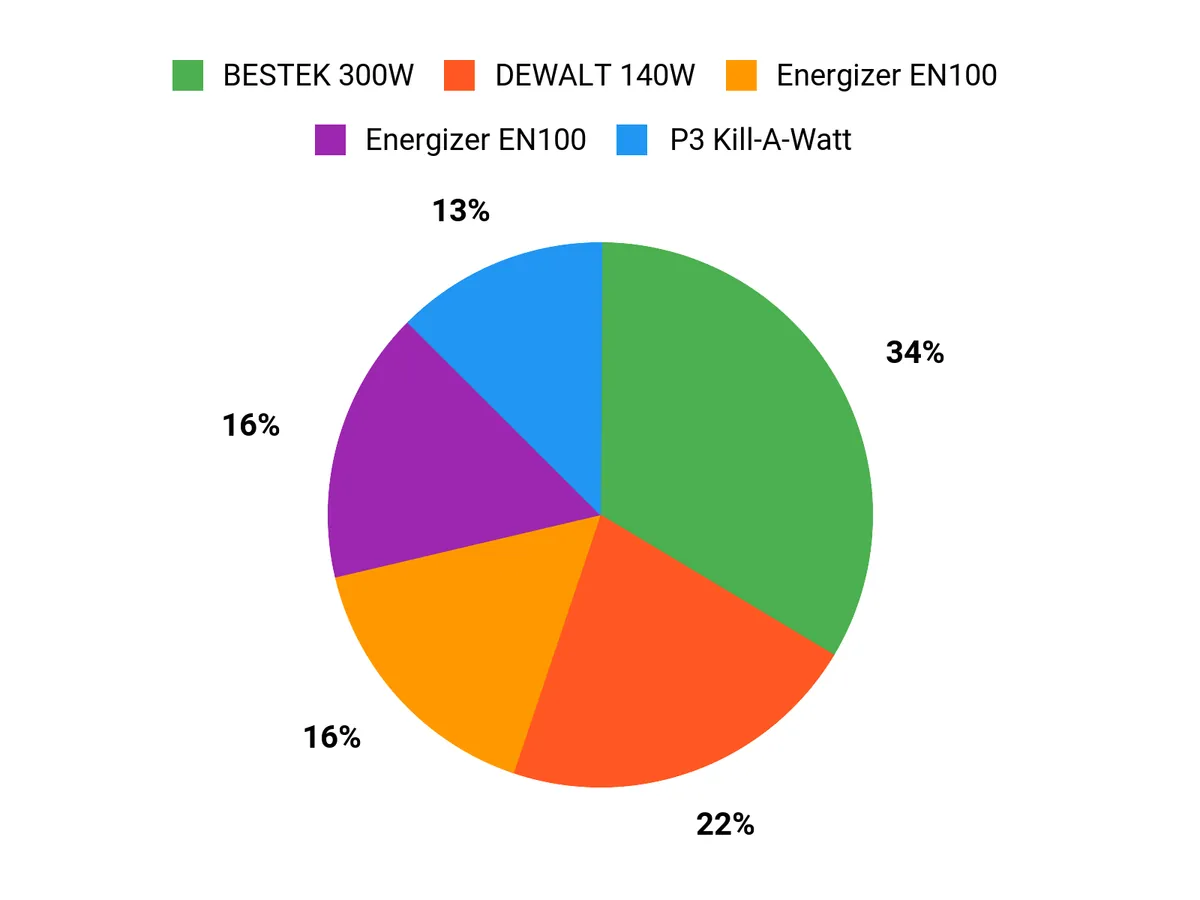
This preference graphic is retained from the original article dataset. Because its collection method and date were not supplied, use the product specifications and your own power requirements as the primary decision factors.
Wrapping Up
The Energizer EN100 makes the most sense when portability and basic charging are the priority. Its 100W continuous rating, one AC outlet, and two shared USB ports are sufficient for many everyday low-wattage electronics without carrying a larger inverter.
The DEWALT DXAEPI140 is the more feature-focused compact option, particularly if you value dedicated 25W USB-C charging, 15W USB-A, low-voltage shutdown, silent fan-free operation, and the ability to mount the inverter securely inside a vehicle.
The BESTEK 300W offers the most inverter capacity and the most AC connectivity of these three, with two AC outlets plus dual USB ports. Its advantage is greatest when your vehicle’s 12V circuit can safely supply the required current.
Whichever model you choose, check both device wattage and vehicle-outlet limits, keep the inverter ventilated, and use a pure-sine-wave inverter instead when the equipment manufacturer requires one.
| Energizer 100W Power Inverter | DEWALT DXAEPI140 Power Inverter | BESTEK Power Inverter 300W | |
|---|---|---|---|
|
|
|
|
|
| Continuous Output | 100W | 140W | 300W rated |
| Peak Output | 200W | 280W listed | 700W instantaneous |
| AC Outlets | 1 | 1 | 2 |
| USB Connections | 2 USB ports, 2.1A shared | 25W USB-C + 15W USB-A | 2 USB ports |
| Waveform | Modified sine wave | Modified sine wave | Modified sine wave |
| Cooling / Noise | Thermal fan; marketed as ultra quiet | Fan-free silent design | Temperature/load-responsive fan |
| Best For | Compact everyday charging | USB-C and mounted vehicle use | Higher-capacity multi-device use |
| Check Amazon Details | Check Amazon Details | Check Amazon Details |
This roundup is reader-supported. When you click through qualifying affiliate links, we may earn a referral commission.