Updated on 2026-03-16
Affiliate disclosure:. As an Amazon Associate I earn from qualifying purchases. This roundup is reader-supported. If you buy through Amazon links, we may earn a commission at no extra cost to you.
Key takeaways
- Best overall: DJI Air 3S Fly More Combo — long flight time, dual cameras with a 1″ CMOS sensor, and nightscape-capable omnidirectional sensing.
- Best lightweight: DJI Mini 4 Pro — stays under 249 g, packs 360° sensing, and still shoots 4K HDR.
- Best zoom setup: DJI Mavic 3 Pro — three cameras (wide, medium tele, and tele) let you confirm details from a safe standoff.
- Best long bundle: Bwine F7GB2 Pro — 3-battery kit with GPS flight modes for extended grid sweeps.
- Best value: Potensic ATOM — stabilized 4K with a 3-battery kit at a lower price point (fly carefully near trees since it lacks obstacle sensors).
Quick note: “Max” range and flight time are lab numbers. Wind, cold, and thick woods can cut them significantly.
Top picks
| Category | Product | Score |
|---|---|---|
| 🏆 Best Overall | DJI Air 3S Fly More Combo (RC 2) | 94/100 |
| 🎯 Best for Beginners | DJI Mini 4 Pro (DJI RC 2) | 90/100 |
| 🔎 Best Performance / Zoom | DJI Mavic 3 Pro (DJI RC) | 92/100 |
| 🚀 Best Battery Bundle | Bwine F7GB2 Pro (3 batteries) | 88/100 |
| 💰 Best Value | Potensic ATOM 3-Axis Gimbal 4K | 86/100 |
How we picked these drones
- Time in the air: longer flights (or more spare batteries) mean more ground covered per trip.
- Camera you can use: clear video, useful zoom or telephoto reach, and workable low-light performance.
- Safe flying: obstacle sensing helps a lot in timber and along tree lines.
- Field workflow: a bright controller screen and fast battery swaps save time when daylight is short.
DJI Air 3S Fly More Combo (RC 2)

Best for: the widest range of recovery trips, from open fields to mixed woods.
Why it’s a good pick: The Air 3S pairs a 1″ CMOS wide-angle camera with a 70mm medium tele camera, both shooting 4K/60fps HDR. It has omnidirectional sensing plus a forward-facing LiDAR sensor that works at night, making it one of the safest options for flying near timber in low light.
Downside: No thermal camera for true heat-signature tracking at night.
- Listed flight time: up to 45 min per battery. The Fly More Combo includes 3 batteries.
- Listed range: up to 20 km (FCC; varies by region and conditions).
- Sensing: omnidirectional vision sensors plus forward-facing LiDAR.
- Bundle: RC 2 screen controller, 3 batteries, charging hub, ND filters, and shoulder bag.
Pick this if you want the strongest all-around package for wooded and open recovery flights.
DJI Mini 4 Pro (DJI RC 2)

Best for: beginners, hikers, and anyone who wants a compact drone that’s easy to carry deep into the field.
Why it’s a good pick: At under 249 g (with the standard battery), the Mini 4 Pro is regulation-friendly in most areas. It still packs omnidirectional obstacle sensing, a 1/1.3″ sensor shooting 4K/60fps HDR, and up to 20 km of transmission range.
Downside: Very light drones can feel less stable in strong wind gusts.
- Listed flight time: up to 34 min (standard battery); up to 45 min with the Battery Plus (sold separately, pushes weight over 249 g).
- Listed range: up to 20 km (FCC; varies by region and conditions).
- Sensing: omnidirectional vision sensing with APAS.
- Controller: RC 2 with a built-in 5.5″ screen, easier than a phone in bright sun.
Pick this if portability is your top priority and you still want full obstacle sensing.
DJI Mavic 3 Pro (DJI RC)

Best for: buyers who want the most camera flexibility for scouting from a distance.
Why it’s a good pick: Three cameras give you a Hasselblad wide-angle (24mm), a 70mm medium tele, and a 166mm tele. That range of focal lengths lets you spot and confirm details without flying close, which is useful when you don’t want to spook other wildlife or risk a crash.
Downside: Higher cost and more bulk than Air or Mini models.
- Listed flight time: up to 43 min.
- Listed range: up to 15 km (FCC; varies by region and conditions).
- Sensing: omnidirectional obstacle sensing with APAS 5.0.
- Camera: triple-camera system covering wide-angle to 7x optical zoom.
Pick this if you want the most lens reach and are willing to pay more for it.
DJI Mini 3 Pro (DJI RC)

Best for: shoppers who want DJI’s small-drone quality for less money than a Mini 4 Pro.
Why it’s a good pick: A stabilized 4K/60fps camera with a 1/1.3″ sensor and tri-directional sensing in a very portable kit. It shares the under-249 g weight class (standard battery) with the newer Mini 4 Pro but costs less.
Downside: Older sensing (tri-directional instead of omnidirectional) and lacks some newer features found on the Mini 4 Pro.
- Listed flight time: up to 34 min.
- Weight: under 249 g with the standard battery (the Battery Plus adds weight above 249 g).
- Sensing: tri-directional (forward, backward, and downward).
Bwine F7GIM Pro

Best for: budget shoppers who want long total flight time, a gimbal, and GPS search modes.
Why it’s a good pick: The F7GIM features a 3-axis brushless gimbal, GPS tools (waypoints, follow, orbit), and a two-battery bundle. A TOF sensor assists with low-altitude stability, and a Night Mode helps with dusk flights. It also has a built-in FAA Remote ID module.
Downside: At 357 g, it requires FAA registration. Expect more variation in real-world performance than premium DJI models.
- Listed total time: up to 70 min with 2 batteries.
- Listed range: up to 10,000 ft.
- Camera: 6K photos, 4K/30fps video with 3-axis brushless gimbal.
- Remote ID: built-in FAA Remote ID module included.
Bwine F7GB2 Pro (3 batteries)

Best for: long daytime grid sweeps on a tighter budget.
Why it’s a good pick: Three batteries help you keep searching without long charging breaks. The 3-axis gimbal and 4K camera deliver steady footage, and GPS modes like waypoints and follow make it easier to run repeatable passes. Built-in FAA Remote ID means no extra module needed.
Downside: No obstacle avoidance sensors, so it’s not the best choice for tight woods.
- Listed total time: up to 75 min with 3 batteries.
- Listed range: up to 10,000 ft.
- Camera: 3-axis gimbal with 4K camera and 5x digital zoom.
- Remote ID: built-in FAA Remote ID module included.
Pick this if you want the longest time in the air for open-field scanning without spending DJI money.
Potensic ATOM 3-Axis Gimbal 4K

Best for: open-area scanning and value-focused buyers.
Why it’s a good pick: Stabilized 4K/30fps video on a 3-axis gimbal with a Sony CMOS sensor, a three-battery kit, and a fast-charging hub that tops off all three batteries in about 1.5 hours. At under 249 g, it’s regulation-friendly in most areas.
Downside: No obstacle-avoidance sensors. Keep extra clearance near branches and tree lines.
- Listed total time: up to 96 min with 3 batteries (32 min each).
- Listed range: up to 6 km.
- Weight: under 249 g.
Pick this if you want the lowest entry price for a stabilized 4K drone with multiple batteries.
Ruko F11PRO 2

Best for: a well-built kit with a 3-axis gimbal and long total battery time.
Why it’s a good pick: Two batteries, GPS return-to-home, smart flight modes (follow, orbit, waypoints), and a 3-axis gimbal camera are a useful combo for daylight recovery flights. Night Mode helps extend your window at dusk.
Downside: No obstacle avoidance sensors. At 357 g, it requires FAA registration. Real-world range in woods will be shorter than listed specs.
- Listed total time: up to 70 min with 2 batteries.
- Listed range: up to 10,000 ft.
- Camera: 3-axis gimbal, 6K photos, 4K/30fps video.
- Remote ID: built-in FAA Remote ID module included.
Ruko F11GIM2 (64-min)
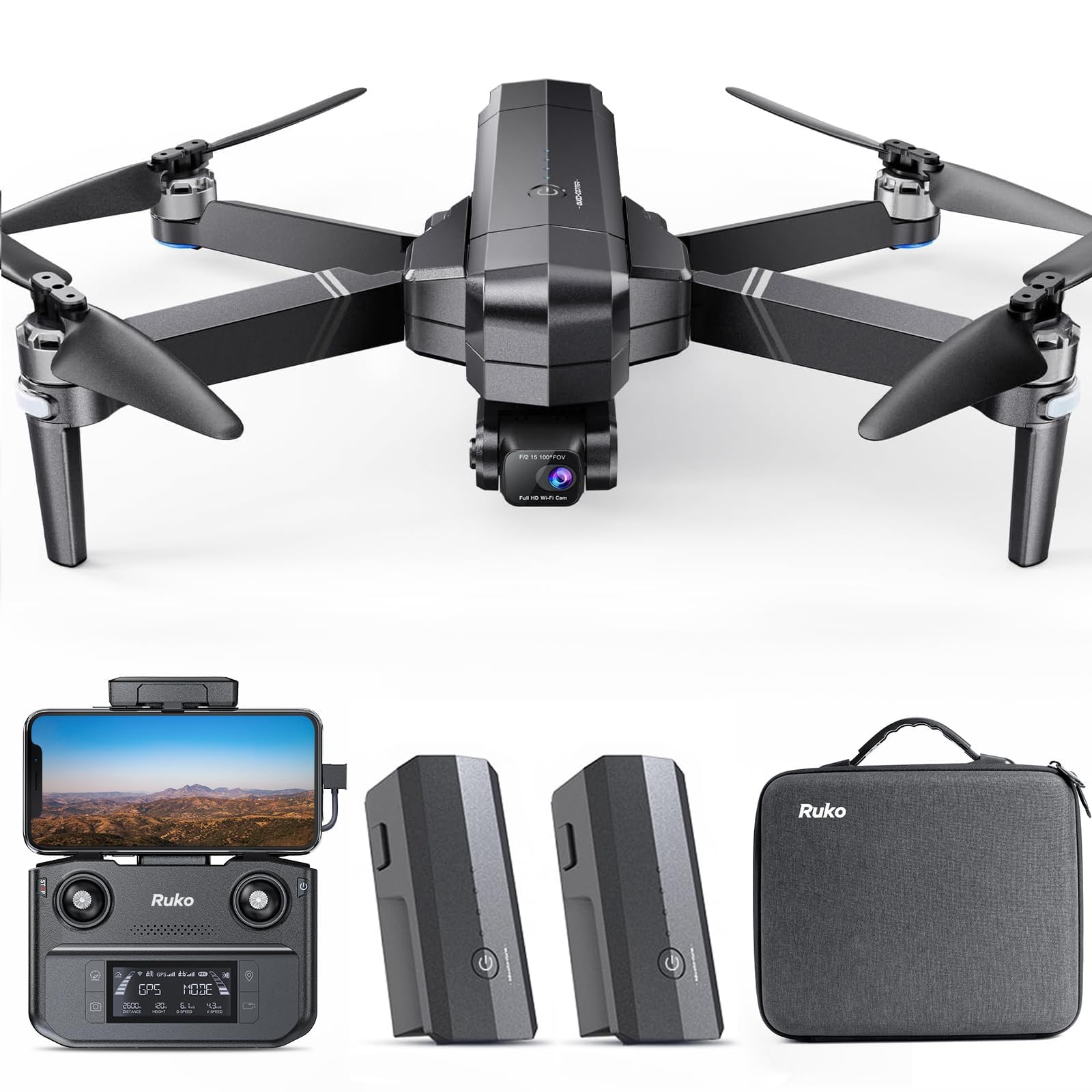
Best for: daytime sweeps when you want simple GPS control and steady video at a lower price.
Why it’s a good pick: Two batteries and GPS tools (waypoints, follow, orbit) help you run repeatable search passes. The 2-axis gimbal combined with electronic image stabilization keeps video smooth.
Downside: No obstacle avoidance sensors. Plan your flight path and keep plenty of clearance from trees. At 559 g, this is the heaviest drone on the list.
- Listed total time: up to 64 min with 2 batteries.
- Listed range: up to 5 km.
- Remote ID: built-in FAA Remote ID module included.
Comparison
| Product | Standout for recovery | Battery approach | Obstacle sensing |
|---|---|---|---|
| DJI Air 3S | Dual cameras + 1″ sensor + night-capable sensing | 3 batteries in Fly More kit | Omnidirectional + forward LiDAR |
| DJI Mini 4 Pro | Sub-249 g with full 360° sensing | Swap batteries as needed | Omnidirectional vision |
| DJI Mavic 3 Pro | Best lens flexibility (wide to 7x optical) | Higher-end battery system | Omnidirectional |
| Bwine F7GB2 Pro | Longest 3-battery bundle | 3 batteries in the box | None — fly higher, plan corridors |
| Potensic ATOM | Best value kit under 249 g | 3 batteries + fast-charge hub | None — keep extra clearance |
FAQ
Can drones help you locate wounded deer safely and legally?
Yes, if you use them responsibly. Rules vary a lot by state and country. Some places restrict drone use for hunting-related activity, so check your local regulations before flying. Never use a drone to chase or harass wildlife. You’ll also need to follow aviation rules, including staying within visual line of sight and registering your drone if it weighs over 250 g. The FAA’s drone page has current registration and Remote ID requirements.
What features matter most for deer recovery?
Focus on usable flight time (enough to cover your search area on one battery or a quick swap), a stable live video feed so you can actually see what’s on the ground, and camera reach — a telephoto or medium tele lens lets you inspect from a safe distance. In wooded areas, obstacle sensing can prevent expensive crashes. For night recovery, a true thermal drone is the real upgrade, but those cost significantly more.
How should you fly for an effective search?
Start high to get your bearings and identify likely routes. Then run a slow, overlapping grid over the area. Mark spots on your map as you go. Swap batteries early rather than pushing to empty. In timber, fly higher than the tree canopy and keep a safe buffer from branches, especially if your drone lacks obstacle sensors.
Wrapping up
Match the drone to your terrain. For the best overall mix of flight time, sensing, and camera options, go with the DJI Air 3S Fly More Combo. If you want a small, regulation-friendly pack and still want 360° sensing, the DJI Mini 4 Pro is the easy choice. For the most camera reach, step up to the DJI Mavic 3 Pro.
Whatever you choose, bring spare batteries, practice slow grid sweeps before you need them, and follow local wildlife and drone rules.