Every underwater drone listing promises 4K. Almost none of them tell you the two things that decide whether you get usable footage: how long it stays down, and how much light it throws.
Our top pick of the best underwater drones is the QYSEA FIFISH V6 Expert M200, with up to six hours of dive time and 6,000 lumens of LED. On a smaller budget, the CHASING Gladius Mini S reaches the same 100 m depth.
Every pick here was checked against manufacturer spec sheets, owner feedback from outside Amazon, and current safety recall records.
Underwater Drones Compared
| Product | Best for | Max depth | Runtime | Camera & lights |
|---|---|---|---|---|
|
Premium
|
Long, dark survey days | 100 m (330 ft) | Up to 6 hours | 4K UHD, 166°, 6,000 lm |
|
Premium
|
Current and hull inspection | 100 m (330 ft) | Up to 4 hours | 4K UHD + EIS, 4,000 lm |
|
Mid-range
|
Filming on a smaller budget | 100 m (330 ft) | Up to 4 hours | 4K UHD + EIS, 2,400 lm |
|
Premium
|
Retrieval and salvage | 100 m (330 ft) | Up to 6 hours | 4K UHD, 166°, 6,000 lm |
|
Budget
|
First-timers and snorkel spots | 15 m (49 ft) | About 1 hour | 1080p, f/1.6, 500 lm |
Best Underwater Drones: Our Top Picks
1. QYSEA FIFISH V6 Expert M200
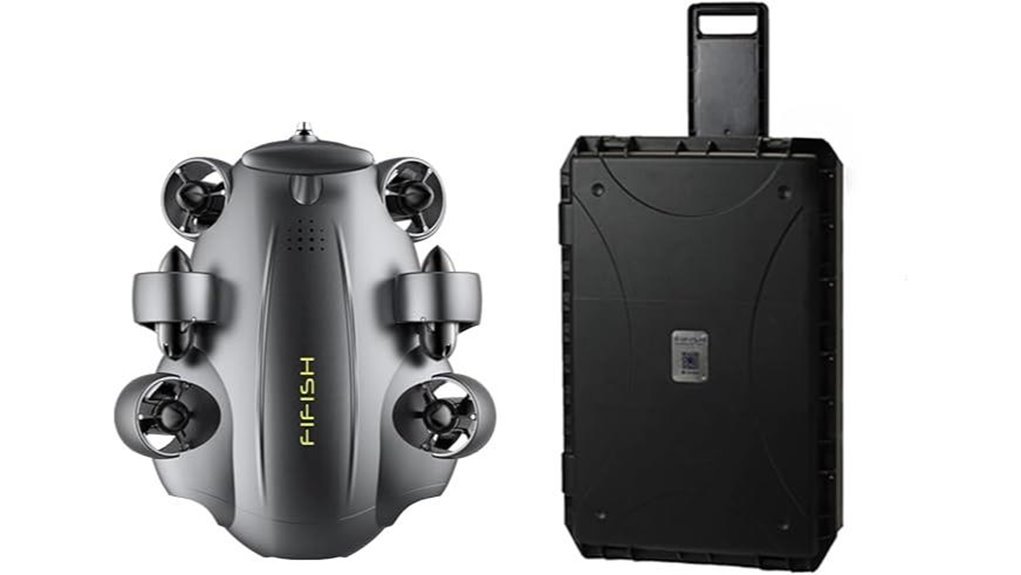
Bottom line: The QYSEA FIFISH V6 Expert M200 is the drone to buy when the dive is long, deep and dark. It suits divers, surveyors and film crews who need six hours of runtime and light they can actually work by.
- Max depth: 100 m (330 ft), enough for wrecks, walls and hull surveys
- Camera: 4K UHD, 166° lens, 12MP stills, frames a whole hull panel
- Lighting: two 3,000-lumen LEDs, the brightest set in this list
- Runtime: up to 6 hours, one charge covers a full working day
- Reach: 200 m (660 ft) tether reel, work a site without repositioning
Six degrees of freedom is the headline. The V6 Expert rolls, pitches and yaws a full 360°, so you can film a propeller from underneath or hold the camera flat against a hull. Posture Lock holds the angle you set to within a fraction of a degree, and Depth Lock holds the depth while you frame the shot.
The Q-Interface is what turns it from a camera into a tool. More than 20 add-ons clip on: 2D imaging sonar for turbid water, a laser scaler, a compass ruler, water and mud samplers, pH and turbidity sensors. A 128 GB card ships in the slot and pulls straight out for transfer.
This is the M200 package, which means the industrial case and the 200 m reel, with no robotic arm. If you want the arm, that is pick 4 below on a shorter reel. Charging is quick either way, reaching roughly 90% in an hour, so a lunch break buys you the afternoon.
- Up to six hours of runtime, and about 90% charge in an hour
- Two 3,000-lumen LEDs light water other drones cannot film in
- Full 360° omnidirectional movement with posture and depth lock
- Q-Interface takes sonar, samplers, measuring tools and a robotic arm
- 200 m tether reel and a 128 GB card included
- At 4.6 kg plus the industrial case, it is a two-bag kit
- Three control modes and VR head tracking take real practice
- The robotic arm is a separate package, not included here
2. CHASING M2 S
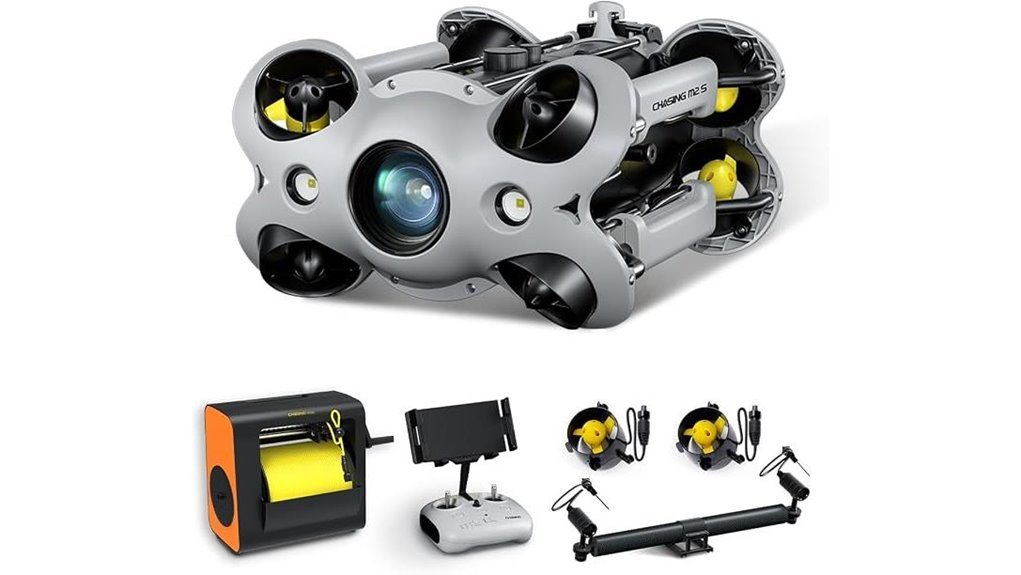
Bottom line: The CHASING M2 S is the pick when the water will not sit still. Eight vectored thrusters and the NeptuneX flight controller hold a heading against wave and tide, which is what hull, dock and pipeline inspection actually demands.
- Max depth: 100 m (330 ft), covers hulls, piers and most inland sites
- Camera: 4K UHD with EIS, 1/2.3-inch Sony CMOS, steady while fighting current
- Lighting: two 2,000-lumen LEDs, three levels for close-up work
- Runtime: up to 4 hours, swap a spare pack to keep going
- Reach: 200 m radius, extendable to 400 m with longer tether
The eight thrusters sit in a symmetrical vector layout, with translation and rotation controlled separately. In practice that means the M2 S stops sliding off a weld seam every time a wave rolls past. Chasing’s Kalman depth fusion damps the vertical surge that normally shoves a small ROV up and down.
The third-generation anti-stuck C-Motor 3.0 uses magnetic protection to keep grit out of the drive and to slow electrochemical corrosion, which is the failure that ends most cheap ROVs working near the bottom. The body weighs about 4.5 kg, so one person can carry, launch and recover it without help.
The battery is swappable rather than sealed in. A 97.68Wh pack is standard and runs up to four hours; a 200Wh pack is sold separately for longer jobs. Accessories include a grabber arm, laser scaler, distance-lock sonar, floodlights and a GoPro mount, and the 64 GB card takes up to 512 GB.
- Eight vectored thrusters hold position in waves and moving water
- Swappable battery, with a larger pack available for long jobs
- Anti-stuck C-Motor 3.0 resists sand, grit and corrosion
- 200 m working radius, extendable to 400 m
- Compact enough for one person to launch and recover
- Four hours on the standard battery; the bigger pack costs extra
- The 100 m depth limit rules out deep offshore work
- Bolt-on accessories add drag and cut runtime noticeably
3. CHASING Gladius Mini S
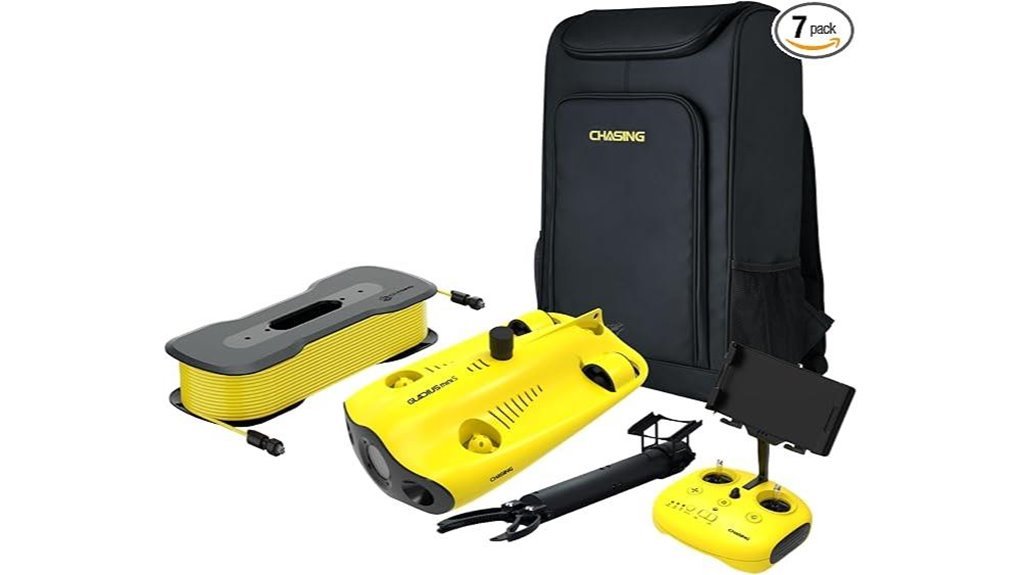
Bottom line: The CHASING Gladius Mini S reaches the same 100 m as the professional ROVs here for considerably less. It suits divers, boat owners and content creators who want 4K and a four-hour day without a professional budget.
- Max depth: 100 m (330 ft), matches ROVs costing far more
- Camera: 4K/30fps with EIS, 12MP stills, 150° view, smooth without a gimbal
- Lighting: two 1,200-lumen LEDs, enough for reef and hull work
- Runtime: up to 4 hours calm, about 1 hour flat out
- Reach: 200 m tether in this bundle, survey a hull end to end
Two 4,800mAh batteries give a real four-hour day in calm water. Reviewers who surveyed a full boat hull and then went looking at a reef still had charge in reserve. Push it to its 4-knot top speed with both lights at full brightness and that drops to roughly an hour, which is the honest trade.
The tether plugs straight into the controller instead of leaning on Wi-Fi, which was the original Gladius Mini’s weak point. Anti-stuck motors sit recessed in the aluminum body, so silt and sand are far less likely to jam a propeller when you are working close to the bottom.
This listing is the 200M FlashPack: drone, controller, 64 GB card, grabber claw and backpack. At 2.7 kg it travels on your back, and one-touch depth lock parks it at a set depth so you can concentrate on the shot rather than on holding station.
- Genuine four-hour runtime in calm water from dual 4,800mAh batteries
- 100 m depth rating for far less than the professional ROVs here
- Wired controller link removes the Wi-Fi dropouts of the older Mini
- Recessed anti-stuck motors cope with silt and sand
- Bundle includes grabber claw, 64 GB card and backpack
- 6 lb with tether and case, so not a pocket drone
- Runtime falls to about an hour at full speed and full brightness
- Image quality drops off fast once the water turns murky
4. QYSEA FIFISH V6 Expert M100A
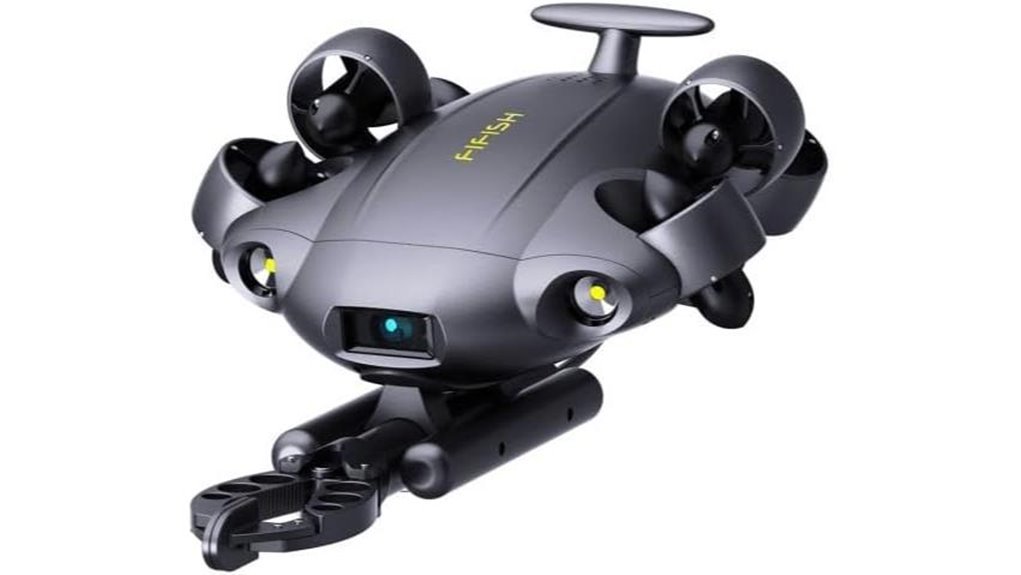
Bottom line: The QYSEA FIFISH V6 Expert M100A is the same ROV as our top pick, sold with the robotic arm and industrial case already in the box. Choose this one when the job is retrieval rather than filming.
- Max depth: 100 m (330 ft), the same rating as the M200 package
- Camera: 4K UHD, 166° lens, 12MP stills, wide enough for close inspection
- Lighting: two 3,000-lumen LEDs, works in turbid and night water
- Runtime: up to 6 hours, about 90% charge in an hour
- Reach: 100 m (330 ft) tether reel, half the M200’s reel
The two-finger arm clamps with 100N of force, opens to 120 mm and is neutrally buoyant, so reaching for something does not upset the drone’s trim. It grips firmly enough to tow an object back on the tether, which is how people recover lost anchors, dropped tools and sample material.
Everything else matches the M200: the 14,400mAh battery, 360° movement, Q-Steady 2.0 stabilization, corrosion-protected Q-Motors, a pull-out SD slot with a 128 GB card, and the Q-Interface that accepts sonar, samplers and measuring tools alongside the arm.
The trade-off is reach. This package ships with a 100 m reel instead of 200 m, so you work closer to your launch point. For most retrieval work, under a dock, alongside a hull or in a reservoir, that is rarely the limiting factor.
- Robotic arm and industrial case included, nothing extra to buy
- 100N clamping force with a neutrally buoyant 120 mm jaw
- 14,400mAh battery runs up to six hours and fast-charges
- Two 3,000-lumen LEDs and a 166° 4K camera for close inspection
- Q-Interface still accepts sonar, samplers and measuring tools
- 100 m tether reel, half the reach of the M200 package
- Usually the most expensive configuration on this list
- Arm plus industrial case make it the bulkiest kit here
5. CHASING Dory
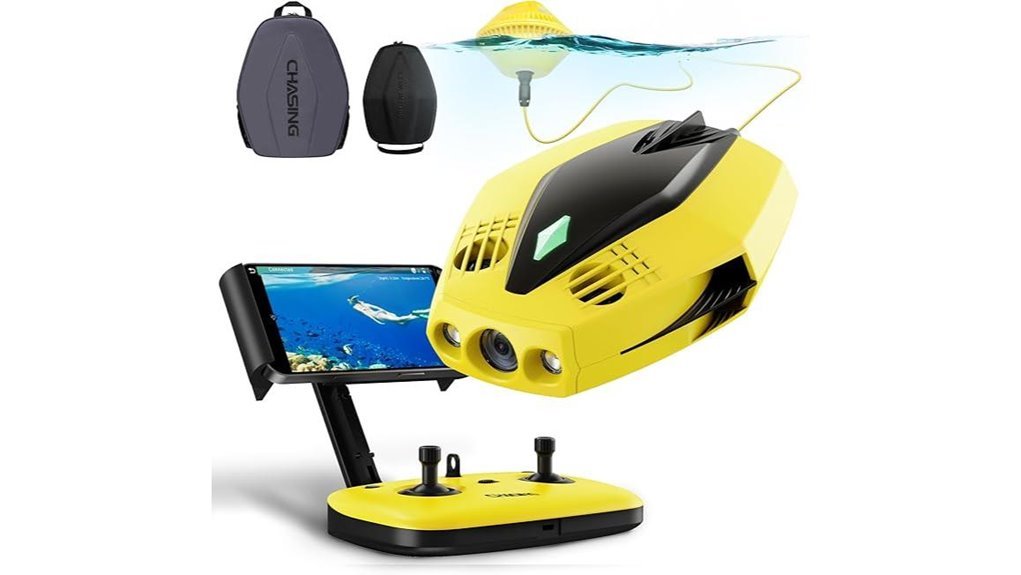
Bottom line: The CHASING Dory is the cheapest way to find out whether you actually want an underwater drone. At 2.4 lb it lives in a backpack, and most people have the app figured out inside a quarter of an hour.
- Max depth: 15 m (49 ft), snorkel depth, docks and shallow reef
- Camera: 1080p/30fps, f/1.6 lens, 2MP stills, bright for its class
- Lighting: two 250-lumen LEDs, gentle enough not to scatter fish
- Runtime: about 1 hour, so plan one session per charge
- Reach: 15 m tether to a floating Wi-Fi buoy
There is no reel and no base station. The drone plugs into a floating Wi-Fi buoy, the buoy talks to your phone, and the CHASING GO2 app handles the rest: dive, tilt 45° up or down, lock the depth, record, and push footage straight to social. This particular set adds a Bluetooth remote and a carry backpack.
Dual Play mode splits the controls across two devices, so one person drives while the other shoots. On a boat with family aboard, that is the feature people actually end up using, along with the 19 filters and one-tap sharing in the app.
Its limits are honest ones. Fifteen metres of depth and fifteen metres of tether keep you around docks, coves and the top of a reef, and the buoy’s Wi-Fi only carries about 50 ft to your phone. Chasing itself recommends calm water rather than surge or swift current.
- 2.4 lb and smaller than a sheet of paper, so it fits any bag
- App control with tilt lock and depth lock, no piloting experience needed
- f/1.6 lens and twin 250-lumen lights hold up in weak light
- Dual Play mode lets two people share driving and filming
- This set adds a Bluetooth remote and a backpack
- The 15 m depth ceiling rules out wrecks and deep hull work
- About an hour of runtime, and it needs a wall socket to recharge
- Drifts in current, and Chasing advises calm water only
QYSEA FIFISH V6 Expert M200 vs CHASING Gladius Mini S: Is the Upgrade Worth It?
Both dive to 100 m and both shoot 4K, so the spec sheets look closer than the drones actually are. What the extra money buys on the V6 Expert is light, endurance and the ability to bolt real tools onto it.
- Lighting: 6,000 lumens against 2,400, which often decides whether murky water is filmable at all.
- Runtime: six hours against four, plus roughly 90% recharge inside an hour.
- Movement: full 360° roll and pitch with posture lock, against a five-thruster layout that holds course but not attitude.
- Tools: the Q-Interface takes sonar, samplers and a robotic arm; the Mini S takes a claw and an action cam.
Which Underwater Drone Should You Buy?
- Longest day in the water: get the QYSEA FIFISH V6 Expert M200.
- Hull, dock and pipeline inspection in current: get the CHASING M2 S.
- Best all-round filming for the money: get the CHASING Gladius Mini S.
- Picking things up off the bottom: get the QYSEA FIFISH V6 Expert M100A.
- Your first underwater drone, or travelling light: get the CHASING Dory.
How We Chose
- Depth against tether: we treated the depth rating and the tether reel as separate limits, because the shorter of the two is what actually stops you.
- Usable light: lumens matter more than megapixels below about 10 m, so we compared LED output and aperture before camera resolution.
- Real runtime: we used calm-water figures and the manufacturer’s full-speed figures, not the headline number alone.
- Sources: manufacturer spec sheets and manuals first, then owner feedback trends across non-Amazon retailers and enthusiast sites, cross-checked against current CPSC and manufacturer recall notices.
- What we did not do: invent test results. Where a figure could not be confirmed against a primary source, we left it out.
How to Choose an Underwater Drone for Diving, Fishing and Filming
Camera, battery and depth rating decide most of it. Maneuverability, tether reach and tool support decide the rest, and they are the ones buyers usually discover too late.
Camera Quality Matters Most
Aim for 4K if you plan to publish the footage, and 1080p only if the camera is there to help you see. Electronic image stabilization matters more than it sounds: without it, footage shot while the drone corrects for current is hard to watch. A wide aperture lets in more light, which is why the 1080p CHASING Dory still performs respectably at snorkel depth with its f/1.6 lens. Sensor size is the other quiet factor; the 1/2.3-inch Sony sensors in the CHASING ROVs hold detail better than the smaller sensors in cheaper units. Colour-restoration processing then puts back the reds that water strips out in the first few metres.
Battery Life Comparison
Runtime sets the length of your working day. The QYSEA FIFISH V6 Expert M200 leads here with a 14,400mAh (155.52Wh) pack rated up to six hours, charging to roughly 90% in an hour. The CHASING M2 S gives up to four hours on its 97.68Wh battery, with a 200Wh pack sold separately and a battery bay designed for swapping. The Gladius Mini S matches four hours on two 4,800mAh cells in calm water. The Dory offers about an hour. Treat every figure as a calm-water best case: speed, lights and bolt-on accessories all pull it down sharply.
Depth Capabilities Overview
Match the depth rating to where you actually go. A 100 m (330 ft) rating covers wreck dives, reef walls, commercial hulls and almost all inland water, and it is what four of the five picks here offer. A 15 m (49 ft) rating covers snorkel depth, docks, marinas and the top of a reef, which is genuinely enough for many buyers. Deeper ratings demand thicker housings, stronger seals and more power, which is why they cost more and weigh more. Pressure also drains batteries faster, so a drone worked near its limit will not hit its headline runtime.
Maneuverability And Stability
Thruster count and layout decide whether you get the shot or chase it. Vectored layouts, like the eight thrusters on the CHASING M2 S, control translation and rotation separately, so the drone holds a heading while a wave passes. Six degrees of freedom, as on the FIFISH V6 Expert, adds full 360° roll and pitch, letting you film straight up under a hull. Depth lock and posture lock are worth looking for on any model: they park the drone so you can concentrate on framing. Anti-stuck motors, recessed or magnetically protected, keep sand out of the drive near the bottom.
Tool And Accessory Support
If the drone is going to work rather than sightsee, check what bolts on. QYSEA’s Q-Interface carries more than 20 attachments, including imaging sonar, laser scalers, water and mud samplers, and the 100N two-finger arm that comes packaged with the QYSEA FIFISH V6 Expert M100A. CHASING’s ROVs take a grabber arm, laser scaler, distance-lock sonar, floodlights and GoPro mounts. Two practical points: accessories add drag and cut runtime, sometimes by half, and storage matters too. Removable cards that go up to 128 GB or 512 GB save you exporting over a cable on a wet boat.
Lighting And Visibility
Water absorbs light fast, so onboard LEDs do more for footage than extra megapixels. The spread across these picks is wide: 500 lumens on the Dory, 2,400 on the Gladius Mini S, 4,000 on the M2 S and 6,000 on the FIFISH V6 Expert. Below roughly 10 m, or in anything silty, the brighter units are the difference between usable video and a green blur. Dimmable lights matter too, because full brightness close to a surface bounces glare straight back at the lens, and gentler output disturbs marine life less on reef work.
Portability And Design
Weight decides where you can realistically launch. The Dory is 2.4 lb and fits in a daypack. The Gladius Mini S is 2.7 kg plus tether, backpack-portable but a deliberate trip. The FIFISH V6 Expert is 4.6 kg before you add the industrial case and a 200 m reel, which is a two-person carry over rough ground. A streamlined hull with recessed or shrouded propellers also survives knocks against pilings and rocks, and matters as much as the case. Check what carrying gear is included: an EPP box, an industrial wheeled case or a backpack changes the real-world cost.
Connectivity And Controls
Control method separates the consumer units from the working ones. Phone-and-buoy systems like the Dory’s are the simplest to learn, but the buoy’s Wi-Fi reaches only about 50 ft and drifts in chop. Dedicated controllers that connect to the drone through the tether, as on the Gladius Mini S and M2 S, remove dropouts entirely and add HDMI output and live streaming. Look for depth lock on any model you consider, plus a data port or removable card for getting footage off. VR head tracking, offered on the FIFISH V6 Expert, is genuinely useful for inspection but takes practice.
Tether Length and Real Working Range
The tether, not the depth rating, is usually what stops you. A 100 m drone on a 100 m reel cannot be at 100 m depth and 50 m away at the same time, because the cable has to cover both. The M200 package ships a 200 m reel for that reason; the M100A ships 100 m. The CHASING M2 S runs a 200 m radius as standard and extends to 400 m with a longer cable. Tether drag also costs thrust and battery, so pay out only what you need, and budget for a reel if you are working from a boat.
Mistakes to Avoid When Buying an Underwater Drone
- Buying on depth rating alone: check the tether length in the package, since that is your true working range.
- Trusting the headline runtime: those figures assume calm water and low power, so halve them for real filming days.
- Ignoring lighting: a 4K camera with weak LEDs produces worse footage than a 1080p camera with strong ones.
- Buying two versions of the same drone: package names like M100, M100A, M200 and M200A describe the same ROV with different cases, reels and arms.
- Forgetting the accessories cost: claws, sonar, longer tethers, spare batteries and reels are almost always sold separately.
FAQs
Are Underwater Drones Allowed in Marine Protected Areas or National Parks?
Usually not without a permit. Most marine protected areas and national parks restrict or ban remotely operated vehicles, and rules differ between individual parks, reserves and countries rather than following one national standard. Check the managing authority’s regulations before you travel, and apply for a research or filming permit if you need one. Fines for operating without permission can be substantial.
How Do You Ensure Data Privacy When Recording Underwater Footage?
Treat the footage like any other camera data. Store recordings on encrypted drives, restrict who can access the card or exports, and avoid uploading raw files to public platforms before reviewing them. If you are filming near marinas, private moorings or commercial infrastructure, check local privacy and surveillance rules first, and remove any incidental footage of people or restricted sites before sharing.
Can Underwater Drones Be Used for Scientific Research or Marine Biology Projects?
Yes, and increasingly they are. Consumer and prosumer ROVs collect video, stills, depth and temperature data from places divers cannot safely or repeatedly reach. Models with sampling tools go further: the FIFISH V6 Expert accepts water and mud samplers plus pH, salinity, turbidity and dissolved-oxygen sensors. For survey work, look for measurement tools and stable positioning rather than the best camera.
Why Do Underwater Drones Use a Tether Instead of Wireless Control?
Because radio and Wi-Fi barely travel through water. A physical tether is the only reliable way to carry live HD video up and control signals down, which is why every ROV here uses one. The Dory gets around it by floating a Wi-Fi buoy on the surface, tethered to the drone. The tether is also your recovery line if the battery dies.
Can You Use an Underwater Drone in Saltwater?
Yes, all five picks here are built for it, but saltwater demands aftercare. Rinse the drone, tether and connectors in fresh water after every dive, dry the ports fully, and check O-rings before the next one. Corrosion-resistant motor designs, like QYSEA’s Q-Motor and CHASING’s magnetically protected C-Motor 3.0, slow the damage but do not replace rinsing.
Which Underwater Drone Is Best for Fishing?
It depends on the water. For scouting structure around docks, shallow flats and calm lakes, the CHASING Dory is the easiest and lightest option, and its 250-lumen lights are gentle enough not to scatter fish. For deeper marks, offshore structure or anywhere with current, the Gladius Mini S gives you 100 m of depth and a four-hour session.
What Are the Maintenance Requirements for Long-Term Underwater Drone Storage?
Rinse and dry it thoroughly, then store it somewhere cool and out of direct sunlight. QYSEA advises charging FIFISH batteries to around 50 to 60% for long storage and running a charge-and-discharge cycle every three months. Check seals and O-rings before the drone goes away and again before it goes back in, and coil the tether loosely rather than under tension.
How Do Underwater Drones Perform in Extremely Cold or Icy Waters?
Battery capacity drops noticeably and runtime falls with it. Most of these drones list an operating range starting around -10°C, so check your model’s rating before an ice dive. Keep batteries warm until launch, expect shorter sessions than the specification suggests, and take extra care with tether handling and recovery, since cold hands and a cut-through ice hole are an unforgiving combination.
Final Verdict
The best underwater drones separate on light and endurance, not on the resolution printed in the listing title. On that test the FIFISH V6 Expert M200 wins clearly, with six hours of runtime and 6,000 lumens on a 200 m reel.
If the budget will not stretch that far, the CHASING Gladius Mini S reaches the same 100 m for considerably less, and the QYSEA FIFISH V6 Expert M100A is the one to buy if you need the robotic arm in the box.
