
Yes, a properly equipped 2026 Toyota RAV4 can tow some lightweight pop-up campers. However, your safe limit depends on the RAV4’s exact grade and drivetrain, the camper’s fully loaded weight, tongue weight, and the remaining payload available for passengers and cargo. You should never choose a camper from its advertised dry weight alone.
Quick Answer
Yes. Toyota lists a 3,500-pound towing capacity for the 2026 RAV4 XLE Premium AWD, Woodland, and SE AWD. The LE AWD is rated at 1,750 pounds. Confirm your exact vehicle’s limit, then compare it with the camper’s loaded weight, tongue weight, payload needs, and equipment requirements.
Key Takeaways
- The 3,500-pound rating does not apply to every 2026 RAV4 configuration.
- Use the camper’s actual loaded weight or GVWR, not dry weight alone.
- Tongue weight, passengers, luggage, accessories, and hitch equipment all consume the RAV4’s payload.
- The Woodland includes a 2-inch receiver and wiring harness; equipment on other grades must be verified.
- Your exact owner’s manual, vehicle labels, hitch ratings, and local towing laws take priority over general guidance.
Understanding the 2026 Toyota RAV4’s Towing Capacity
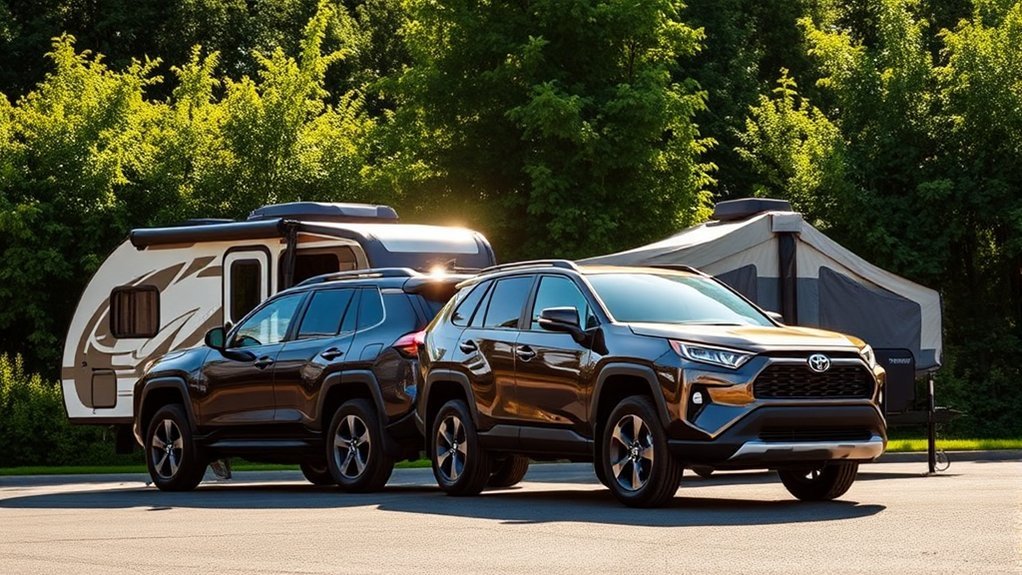
The 2026 RAV4 does not have one towing limit for every model. According to Toyota’s U.S. specifications for the 2026 RAV4, the rating changes with the grade and drivetrain.
| 2026 RAV4 configuration | Toyota-listed towing capacity | What to know |
| LE AWD | 1,750 pounds | Suitable only for especially light campers after accounting for cargo, payload, and tongue weight. |
| XLE Premium AWD | 3,500 pounds | Toyota explicitly identifies the AWD configuration with this rating. |
| Woodland HEV or PHEV AWD | 3,500 pounds | Includes a standard 2-inch rear receiver and wiring harness. |
| SE AWD, HEV or PHEV | 3,500 pounds | The rating applies to the AWD configuration, not automatically to SE FWD. |
| Other grades or drivetrains | Verify before towing | Use the exact owner’s manual, vehicle certification labels, and installed equipment ratings. Do not apply another grade’s rating. |
A towing-capacity number is a maximum rating under defined conditions. It does not mean every camper at that weight will be a suitable match. Trailer shape, tongue load, passenger weight, cargo, hitch equipment, road grade, temperature, and braking requirements also affect your setup.
Warning: Never assume a RAV4 can tow 3,500 pounds because it has AWD. Confirm the exact grade, drivetrain, tow rating, payload label, hitch rating, and trailer requirements before connecting a camper.
Recommended Pop-Up Campers for RAV4 Owners
Lightweight campers from lines such as the Forest River Rockwood Freedom, Aliner Ranger 12, and older Jayco Jay Series may include configurations that fit within some RAV4 towing limits. However, those names alone do not establish compatibility.
Each product line can contain several floorplans with different frames, appliances, batteries, water tanks, air conditioners, storage options, and gross weight ratings. Model-year changes can also alter the specifications.
How to Compare Lightweight Pop-Up Options
Before selecting a camper, find the specification label or manufacturer documentation for the exact floorplan and model year. Record these figures:
- Unloaded or dry weight: The camper’s approximate weight before personal cargo and, depending on the manufacturer’s method, some fluids or dealer-installed equipment.
- Cargo-carrying capacity: The amount of additional weight the camper is designed to carry.
- GVWR: The maximum permitted weight of the fully loaded camper.
- Hitch or tongue weight: The downward load the trailer places on the RAV4’s hitch.
A camper with a low advertised dry weight can become unsuitable after you add propane, a battery, water, food, bedding, cookware, chairs, bicycles, and other camping supplies. When actual loaded weight is unknown, using the camper’s GVWR provides a more conservative first screening.
Camper Compatibility Checklist
A pop-up camper is a reasonable candidate only when all of the following conditions are met:
- Its actual loaded trailer weight remains below the RAV4’s verified towing limit.
- Its tongue weight remains within the RAV4, hitch, ball mount, and trailer-coupler limits.
- The tongue weight, occupants, cargo, and installed accessories remain within the RAV4’s payload.
- The combined vehicle and trailer weight remains within any applicable gross combined weight rating.
- The hitch, ball, wiring, safety chains, trailer brakes, and breakaway equipment are compatible.
- The setup complies with the laws where you register and operate it.
Pro Tip: Weigh the camper as you will actually travel, with its battery, propane, water, food, equipment, and normal cargo aboard. A public vehicle scale gives you more useful information than a brochure’s dry-weight figure.
Features That Can Make Towing Easier
The Woodland grade is the clearest factory-oriented towing choice because Toyota equips it with a 2-inch rear receiver and wiring harness. Other grades may require compatible towing equipment that is approved and installed correctly.
AWD can improve traction during acceleration on loose, wet, or slippery surfaces. However, AWD does not shorten every stopping distance, increase the published tow rating, or correct an overloaded trailer.
Useful towing equipment may include properly adjusted mirrors, a suitable wiring connector, trailer brakes, a compatible brake controller where required, safety chains, and a breakaway system. The exact equipment depends on the camper and local regulations.
Weight Considerations for Towing
Safe towing requires more than comparing one camper number with one vehicle number. You need to check the limits for the trailer, tow vehicle, hitch components, axles, tires, and complete combination.
Trailer Weight Terms You Should Know
| Term | Meaning | Why it matters |
| UVW or dry weight | The camper’s unloaded starting weight under the manufacturer’s stated method. | It normally does not represent your ready-to-camp weight. |
| Cargo-carrying capacity | The permitted weight of cargo, fluids, and added equipment. | Exceeding it can overload the camper even when the RAV4 remains below its tow rating. |
| Trailer GVWR | The maximum permitted weight of the fully loaded camper. | It is a safer screening figure when you do not know the actual loaded weight. |
| Actual loaded trailer weight | The camper’s measured weight in travel-ready condition. | This is the figure you compare with the verified towing limit. |
| Tongue weight | The downward load placed on the hitch. | It affects stability and uses part of the RAV4’s payload capacity. |
| Vehicle payload | The permitted combined load of occupants, cargo, tongue weight, and added equipment. | You can exceed payload before reaching the maximum trailer rating. |
| GCWR | The maximum permitted combined weight of the loaded RAV4 and loaded trailer, when specified. | It protects the complete vehicle-and-trailer combination from overloading. |
Tongue Weight and Trailer Stability
Conventional bumper-pull trailers are commonly loaded with roughly 10% to 15% of their total weight on the tongue. However, that general range does not override the limits in your RAV4 manual, hitch labels, ball-mount rating, coupler rating, or camper instructions.
For example, a camper that weighs 2,400 pounds when loaded could place approximately 240 to 360 pounds on the hitch within that general range. That tongue load then counts against the RAV4’s available payload along with the driver, passengers, luggage, accessories, and hitch equipment.
Too little tongue weight can contribute to instability and sway. Excessive tongue weight can overload the rear axle, hitch, tires, or vehicle payload. Load the camper according to its manufacturer’s instructions and verify the result rather than relying on an estimate.
Check Payload and Combined Weight
Find the payload information on the RAV4’s driver-door or door-jamb label. Begin with the vehicle-specific figure and subtract the weight of:
- The driver and every passenger
- Cabin and cargo-area luggage
- Roof-mounted equipment and cargo
- Aftermarket accessories
- Hitch and towing hardware
- The camper’s actual tongue weight
The remaining amount must stay at or above zero, and you must also respect axle, tire, hitch, trailer, and combined-weight limits. A vehicle can be below its maximum tow rating and still be overloaded through payload or axle weight.
The useful question is not what the camper weighs empty. It is what the entire RAV4-and-camper combination weighs when loaded for the trip.
Hitch, Wiring, and Trailer-Brake Requirements
Your towing system is only as strong as its lowest-rated component. The receiver, ball mount, hitch ball, fasteners, coupler, safety chains, tires, and trailer must each be rated for the load.
Toyota identifies the Woodland grade as having a standard 2-inch rear receiver and wiring harness. For another grade, confirm that the hitch is approved for the exact vehicle and installed according to the hitch and vehicle manufacturers’ instructions.
The hitch ball must match the camper’s coupler size. The electrical connector must operate the required lights and, where applicable, trailer brakes and charging circuits. Cross the safety chains beneath the tongue unless the equipment manufacturer or local rule specifies another approved arrangement.
Some campers require electric brakes, a compatible brake controller, and a breakaway system. Requirements vary according to trailer weight and jurisdiction, so check the camper documentation and the laws that apply to your route.
Note: A receiver’s opening size does not establish its weight rating. Read the labels on the receiver, ball mount, and ball, then follow the lowest applicable limit.
Essential Safety Features for Towing With the RAV4
Every U.S.-market 2026 RAV4 includes Toyota Safety Sense 4.0. Its driver-assistance functions can support attentive driving, but they do not increase towing capacity or make an overloaded combination safe.
Toyota explicitly lists Trailer-Sway Control in the XSE feature set. Availability may differ by grade and equipment, so confirm the feature on your exact vehicle rather than assuming every RAV4 includes it.
AWD can help the RAV4 gain traction in some slippery conditions. It cannot eliminate trailer sway, compensate for poor loading, or replace trailer brakes where they are required.
For night travel, verify that the RAV4’s lights, camper marker lights, brake lights, and turn signals work before departure. Keep the windshield, mirrors, cameras, and lights clean so you can see the trailer and surrounding traffic clearly.
Warning: If the trailer begins to sway, avoid abrupt steering or braking inputs. Reduce speed smoothly and follow the emergency procedure in your vehicle, hitch, brake-controller, and camper instructions.
Preparing Your RAV4 for Towing
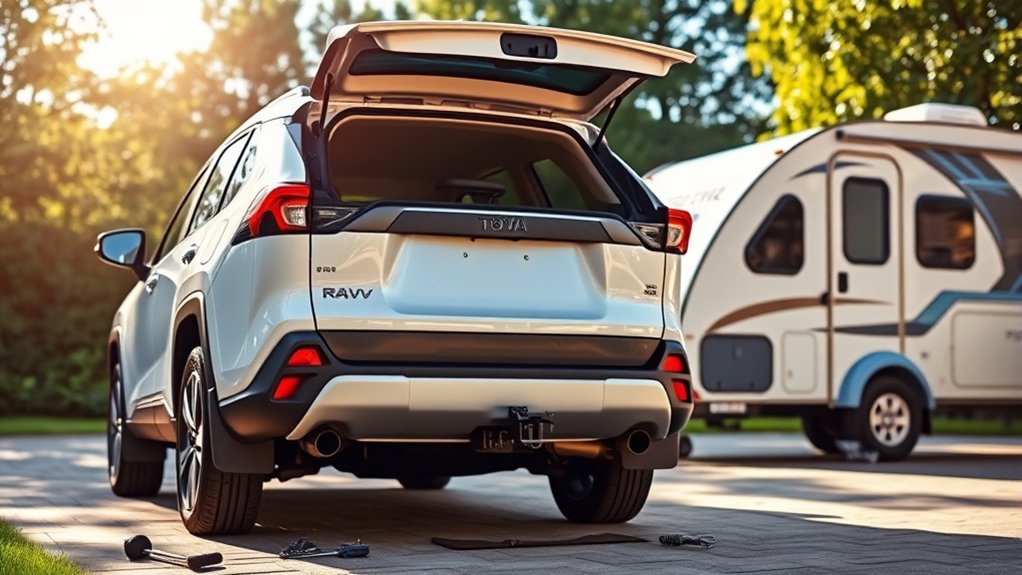
Use this process before your first trip and repeat the inspection whenever you reconnect or significantly change the camper’s load.
- Confirm the exact RAV4 configuration. Identify the grade, drivetrain, powertrain, and installed towing equipment. Review the towing section in the Toyota owner’s manual for your vehicle.
- Check every applicable rating. Verify the vehicle tow rating, payload, axle limits, tire limits, hitch rating, ball-mount rating, ball rating, camper GVWR, and tongue-weight limits.
- Load the camper correctly. Secure heavy items low and near the appropriate area around the trailer axle, following the camper manufacturer’s loading instructions.
- Measure the loaded weights. Weigh the travel-ready camper and, when possible, the complete combination and individual axles at a suitable vehicle scale.
- Inspect the connection. Confirm that the coupler is fully seated and locked, the pin or latch is secured, safety chains are attached, and the breakaway cable is connected correctly.
- Test the electrical system. Check running lights, brake lights, turn signals, trailer brakes, and the brake controller when fitted.
- Inspect tires and wheels. Set cold tire pressures according to the applicable labels and manuals. Check tire condition, tread, sidewalls, wheel fasteners, and the spare tire.
- Complete a low-speed test. Practice starting, turning, braking, and reversing in a safe open area before entering traffic.
Recheck the coupler, chains, cargo, tires, and wheel fasteners after the first portion of the trip and at regular stops. Heat, vibration, and settling cargo can change the setup.
Why the RAV4 Can Work for a Lightweight Camping Setup
The 2026 RAV4 offers a practical combination of passenger space, available AWD, electrified powertrains, and towing capability on selected grades. Hybrid models produce 226 net combined horsepower with FWD or 236 with AWD. Plug-in hybrid models produce 324 net combined horsepower.
Those power figures may help with acceleration and climbing, but horsepower does not replace the published towing, payload, axle, hitch, or braking limits. Expect slower acceleration, longer stopping distances, wider turns, and increased energy or fuel use while towing.
A compact pop-up camper can present less frontal area than a tall travel trailer, but aerodynamic drag still rises with speed. Wind, hills, temperature, cargo, tire pressure, and driving style can noticeably affect consumption and performance.
The RAV4 is therefore best matched with a camper that leaves room within every relevant limit rather than one that reaches the maximum rating before passengers and supplies are considered.
Related Guides
Frequently Asked Questions
What engine options are available in the 2026 Toyota RAV4?
The U.S. 2026 RAV4 lineup is fully electrified. Hybrid models use a 2.5-liter four-cylinder-based system and produce 226 net combined horsepower with FWD or 236 with AWD. Plug-in hybrid models also use a 2.5-liter four-cylinder-based system and produce 324 net combined horsepower.
Does the RAV4 require a special hitch for towing?
It requires a receiver, ball mount, hitch ball, wiring, and related equipment that are compatible with the exact vehicle and camper. The Woodland includes a standard 2-inch receiver and wiring harness. Confirm equipment requirements for every other grade and use the lowest rating among all towing components.
What fuel economy should I expect while towing?
No single MPG figure applies to every towing trip. Consumption varies with camper weight and shape, speed, wind, temperature, hills, tire pressure, drivetrain, traffic, and driving style. Expect lower efficiency than the vehicle’s standard manufacturer estimate and track your actual trip results.
Can I tow a pop-up camper with a front-wheel-drive RAV4?
Possibly, but you must use the towing limit for that exact FWD grade and configuration. Do not apply an AWD model’s 3,500-pound rating to a FWD RAV4. Check the owner’s manual, vehicle labels, and installed equipment before selecting a camper.
Does a 3,500-pound tow rating mean I can buy a camper with a 3,500-pound dry weight?
No. A camper with a 3,500-pound dry weight will weigh more after adding batteries, propane, water, equipment, and personal cargo. It may also create too much tongue weight or exceed the RAV4’s payload, axle, hitch, or combined-weight limits.
How can I find my camper’s real loaded weight?
Load the camper with the battery, propane, water, food, bedding, equipment, and cargo you normally carry, then weigh it at a suitable public vehicle scale. Measure tongue weight with suitable equipment and compare every result with the applicable vehicle, hitch, axle, tire, and camper limits.
What maintenance is needed when towing with a RAV4?
Follow Toyota’s maintenance schedule and any severe-use guidance that applies. Pay close attention to tires, brakes, fluids, cooling performance, wheel fasteners, suspension, hitch hardware, electrical connections, and the camper’s bearings, brakes, tires, and breakaway system.
Conclusion
A 2026 Toyota RAV4 can tow a suitable pop-up camper when the vehicle has the correct rating and equipment. Toyota lists up to 3,500 pounds for selected AWD grades, while LE AWD is rated at 1,750 pounds.
Choose your camper using its actual loaded weight, tongue weight, and GVWR. Then confirm that passengers, cargo, accessories, and hitch load remain within the RAV4’s payload, axle, tire, hitch, and combined-weight limits. A verified setup with room below every limit is safer than one built around the maximum advertised number.
Sources
- Toyota USA Newsroom: The Next Adventure Begins, 2026 RAV4 Arrives This Winter — U.S. grade, drivetrain, towing, powertrain, hitch, and safety-feature specifications.
- Toyota Owners: Manuals and Warranties — access to vehicle-specific owner’s manuals, specifications, operating guidance, and maintenance information.
- Toyota Global Newsroom: All-New RAV4 World Premiere — sixth-generation platform, electrified lineup, technology, and maximum towing-capability announcement.
