A Toyota RAV4 can tow a towable horsebox only when the fully loaded trailer and loaded vehicle remain within every applicable rating for that exact RAV4. For the 2026 U.S. RAV4, Toyota lists a 1,750 lb towing capacity for all front-wheel-drive models and the LE AWD, while selected AWD grades are rated up to 3,500 lb. Toyota Australia lists 800 kg braked for current 2WD versions and 1,500 kg for AWD versions, showing why a single generic RAV4 towing figure is unsafe.
Before towing a live animal, confirm every limit in your vehicle handbook and on the vehicle, towbar, and trailer plates. Use the actual loaded horsebox weight and remember that the lowest applicable rating controls the setup.
Quick Answer
Yes, sometimes. A Toyota RAV4 can tow a horsebox only when the exact vehicle is approved for the fully loaded trailer weight and the complete setup also stays within payload, axle, gross-combination, towbar, and coupling limits. Current RAV4 ratings differ substantially by configuration and market, so add the horse, tack, feed, water, and equipment and verify the figures for your exact vehicle before travelling.
Key Takeaways
- RAV4 towing limits vary by year, trim, engine or hybrid system, drivetrain, country, and factory equipment.
- A braked horsebox does not increase the vehicle manufacturer’s stated towing limit.
- Use the horsebox’s actual loaded weight, not only its empty or advertised weight.
- Passengers, luggage, hitch load, and equipment also consume the RAV4’s payload and axle capacity.
- When the combination is close to any limit, a more capable tow vehicle is the safer choice.
Last updated: September 11, 2026. This update rechecked current Toyota RAV4 towing figures, Great Britain towing requirements, and current horsebox manufacturer specifications.
Scope and methodology: In this article, “horsebox” means a towable horse trailer, not a self-propelled 3.5-tonne or larger horsebox. This guide compares manufacturer ratings, government towing rules, and published horsebox specifications. It does not claim first-hand road testing with a live horse.
Can a Toyota RAV4 Tow a Horsebox?

Possibly, but only after you identify the exact rating for your vehicle and the actual loaded weight of the horsebox. Toyota has sold many RAV4 configurations across different markets, and their approved trailer limits are not interchangeable.
For example, Toyota states that the 2026 U.S. RAV4’s front-wheel-drive models and LE AWD are rated to tow 1,750 lb, while selected AWD grades are rated up to 3,500 lb. Toyota Australia lists 800 kg braked for 2WD versions of the all-new RAV4 and 1,500 kg for AWD versions. These are maximum manufacturer figures for those specific markets and configurations, not universal RAV4 ratings.
Five Checks That Decide Whether Your RAV4 Can Tow the Horsebox
| Check | What must be true | If it fails |
|---|---|---|
| Loaded trailer weight | The horsebox as actually loaded must remain within the exact RAV4’s approved trailer limit. | Do not tow it with that RAV4. |
| Vehicle + trailer | The complete loaded combination must stay within the stated gross combination or train-weight limit. | Reduce the load or use a more capable vehicle. |
| Payload and axles | Passengers, luggage, accessories, and coupling load must not overload payload or either axle. | The setup is not acceptable even if trailer weight is below the tow rating. |
| Towbar and coupling | The towbar, towball or receiver, coupling, and vertical-load ratings must all be sufficient. | Use correctly approved equipment or do not tow. |
| Legal and safety requirements | Brakes, licence entitlement, tyres, lights, mirrors, breakaway equipment, and local towing rules must all be satisfied. | Correct the issue before travelling. |
The answer is therefore “yes” only when every relevant check passes. Being below a single advertised towing-capacity number is not enough.
Use the Toyota owner’s-manual finder or the official manual supplied with your RAV4. If your vehicle was sold outside the United States, use the Toyota website or handbook for that market because ratings can differ even when the model name looks the same.
Warning: Do not assume every RAV4 can tow 3,500 lb, 1,500 kg, or 1,800 kg. Those figures can apply to specific versions or markets and may require specific drivetrains or towing equipment. Your handbook, certification plate, equipment ratings, and local law control.
How Do You Find Your RAV4’s Exact Towing Limit?
Check all of the following before comparing your RAV4 with a horsebox:
- Maximum braked trailer weight: The heaviest loaded trailer the vehicle may tow when the trailer has an approved braking system.
- Maximum unbraked trailer weight: Usually much lower and rarely suitable for a loaded horse trailer.
- Gross combination or train weight: The maximum permitted weight of the loaded vehicle and loaded trailer together.
- Vehicle payload: The available capacity for people, luggage, accessories, and the downward load from the trailer coupling.
- Front and rear axle limits: A combination can exceed an axle limit even when its overall weights appear acceptable.
- Towbar or hitch rating: The coupling must be approved for the vehicle and rated for both trailer weight and vertical load.
- Trailer rating: The horsebox’s maximum authorised mass, gross vehicle weight rating, axle ratings, and coupling limit must also be respected.
The safe limit is always the lowest relevant figure. A 3,500 lb hitch does not make a 1,750 lb-rated vehicle capable of towing 3,500 lb. Likewise, trailer brakes do not raise the vehicle’s published limit.
For a broader model-year overview, see how many pounds a Toyota RAV4 can tow. Use this page for the additional horsebox-specific weight, live-load, stability, and welfare checks.
Current 2026 RAV4 Examples Show Why Market Matters
| Market / configuration | Published maximum | Important context |
|---|---|---|
| 2026 U.S. RAV4 — FWD models and LE AWD | 1,750 lb | Toyota lists these below the maximum available on selected AWD grades. |
| 2026 U.S. RAV4 — selected AWD grades | Up to 3,500 lb | Applies only to the AWD grades Toyota identifies for the higher rating. |
| 2026 Australian RAV4 — 2WD | 800 kg braked | Do not substitute an AWD or overseas-market rating. |
| 2026 Australian RAV4 — AWD | 1,500 kg braked | Still subject to vehicle, payload, axle, equipment, and trailer limits. |
These examples demonstrate why the badge “RAV4” is not enough to determine horsebox suitability. Check the exact vehicle rather than selecting the largest RAV4 figure you find online.
How Do You Read the Vehicle Plate?
In Great Britain, the vehicle manufacturer’s plate normally lists the maximum vehicle weight, maximum vehicle-and-trailer weight, and front and rear axle limits. The difference between the first two figures can help identify the permitted combined trailer load, but you should still confirm the handbook’s towing conditions.
The Driver and Vehicle Standards Agency towing checklist explains these plate figures and states that passengers, other loads, and fuel count toward the vehicle’s maximum weight.
How Are Braked and Unbraked Ratings Different?
A horsebox should normally have its own functioning braking system. In Great Britain, an unbraked loaded trailer must not exceed 750 kg and should not weigh more than half the car’s weight. A braked trailer still has to remain within the vehicle-and-trailer limit shown on the manufacturer’s plate.
Rules vary by country, so check the laws where you will drive. Meeting a driving-licence entitlement does not override the RAV4’s lower mechanical rating.
How Do You Calculate the Fully Loaded Horsebox Weight?
The empty or unladen trailer weight is only the starting point. Your calculation should include:
- the empty horsebox;
- the horse or horses;
- saddles, bridles, rugs, boots, partitions, and storage equipment;
- feed, hay, bedding, and water;
- tools, spare wheels, ramps, and emergency supplies; and
- any other item carried in or attached to the trailer.
For a real manufacturer reference, Ifor Williams lists the single-horse HBX403 at 720 kg unladen and 1,600 kg gross weight. The road-going weight rises as the horse, tack, water, feed, accessories, and other equipment are added. That does not mean a RAV4 rated near those figures can automatically tow it; the vehicle’s exact limit and every other applicable rating still control.
Actual loaded weight and the trailer’s plated maximum authorised mass or gross rating are separate numbers. The trailer must not exceed its own plated limit, while the RAV4 must remain within its towing, combination, payload, and axle limits. Driving-licence rules can also use the trailer’s maximum authorised mass, so check both the real scale weight and the plated figures.
The most reliable method is to weigh the loaded combination at a certified public weighbridge or vehicle scale. Measure the tow vehicle, each axle where possible, and the trailer in the same condition you will use on the road.
How Do Payload and Coupling Load Affect the RAV4?
The horsebox applies a downward load at the towball or hitch. That load becomes part of the RAV4’s payload and can increase the rear-axle load. Passengers, luggage, aftermarket accessories, and equipment in the cargo area use the same capacity.
Follow the nose-weight or tongue-weight range specified by the vehicle, towbar, and trailer manufacturers. Do not use a universal percentage if it conflicts with any of those limits.
Pro Tip: Weigh the setup as it will actually travel, including people, fuel, tack, water, and the horse. A combination that looks acceptable from the trailer’s empty weight can exceed payload or rear-axle limits before it reaches the trailer-weight limit.
Why Is a Horsebox Harder to Tow Than Ordinary Cargo?
A horse is a live, high-centred load that can shift its weight while the vehicle accelerates, turns, brakes, or travels over uneven roads. A horsebox also has a large side area that can react strongly to crosswinds and passing trucks.
These factors can make a combination feel less stable than a low utility trailer of the same scale weight. Good loading, correct tyre pressures, working trailer brakes, suitable coupling load, and conservative driving matter even when the numbers are technically within their limits.
Allow the horse to travel with adequate space, ventilation, secure partitions, and safe footing. Follow applicable animal-welfare and transport rules as well as vehicle regulations. In Great Britain, review the government’s guidance for transporting horses in horseboxes and trailers.
What Equipment Do You Need for Safe Horsebox Towing?
A safe setup normally requires more than fitting a towbar. Confirm that every component is approved for the exact RAV4 and horsebox.
- Vehicle-specific towbar or receiver: Use an approved installation with the correct fasteners and mounting points.
- Correct towball and coupling: Match the size, height, weight rating, and type required by the trailer.
- Trailer brake system: Inspect and maintain the brakes according to the trailer manufacturer’s schedule.
- Breakaway cable or secondary coupling: Connect it exactly as the manufacturer instructs so it can work if the trailer detaches.
- Electrical connection: Check tail lamps, brake lamps, indicators, reflectors, and any required auxiliary circuits.
- Towing mirrors: Fit approved extension mirrors when the horsebox blocks the required rearward view.
- Suitable tyres: Use the specified sizes, load ratings, pressures, and tread condition on both vehicle and trailer.
- Load restraint and partitions: Secure equipment so it cannot move or injure the horse.
If you still need the vehicle-side hardware, see the separate guide to Toyota RAV4 tow-hitch fitment and towing setup.
Do not add a weight-distribution system, suspension modification, transmission cooler, or other towing accessory and assume it increases the official rating. Use such equipment only when Toyota and the component manufacturer approve it for your exact configuration.
What Should You Check Before Every Horsebox Trip?
Complete these checks before every journey:
- Confirm the loaded trailer, vehicle, combination, axle, towbar, and coupling loads remain within their ratings.
- Check that the horsebox is correctly seated and locked onto the towball or hitch.
- Attach the breakaway cable or safety connection correctly, with enough slack and no contact with the road.
- Test all lights, indicators, brakes, and electrical connections.
- Inspect tyres for damage, age, tread, pressure, and load suitability.
- Check wheel fasteners to the trailer manufacturer’s specified torque.
- Secure doors, ramps, windows, partitions, tack, water containers, and loose equipment.
- Set mirrors for a clear view along both sides and behind the trailer where required.
- Plan a route that avoids unsuitable gradients, narrow roads, low clearances, and poor surfaces.
- Carry emergency contact details and a safe plan for unloading or recovering the horse if the vehicle or trailer breaks down.
How Should You Drive a RAV4 With a Horsebox?
Accelerate, steer, and brake smoothly. Leave more space than usual because the combination is heavier and the horse needs time to balance. Reduce speed before bends, descents, junctions, and uneven surfaces rather than braking sharply during the manoeuvre.
Use a lower gear or an appropriate transmission mode on long descents when the owner’s manual recommends it. Avoid sustained operation that causes warning lights, overheating, unusual transmission behaviour, brake fade, or instability.
If the trailer begins to snake or swerve, ease off the accelerator and reduce speed gently while keeping the steering steady. Do not make abrupt steering inputs or brake harshly in a bend. Stop in a safe place and correct the speed, loading, tyre, or mechanical issue before continuing.
Note: In Great Britain, licence entitlement, trailer maximum authorised mass, speed limits, lane rules, and towing equipment requirements all apply in addition to the vehicle’s own limits. Review the current GOV.UK towing guidance before travelling.
What Does Towing a Horsebox With a RAV4 Feel Like?
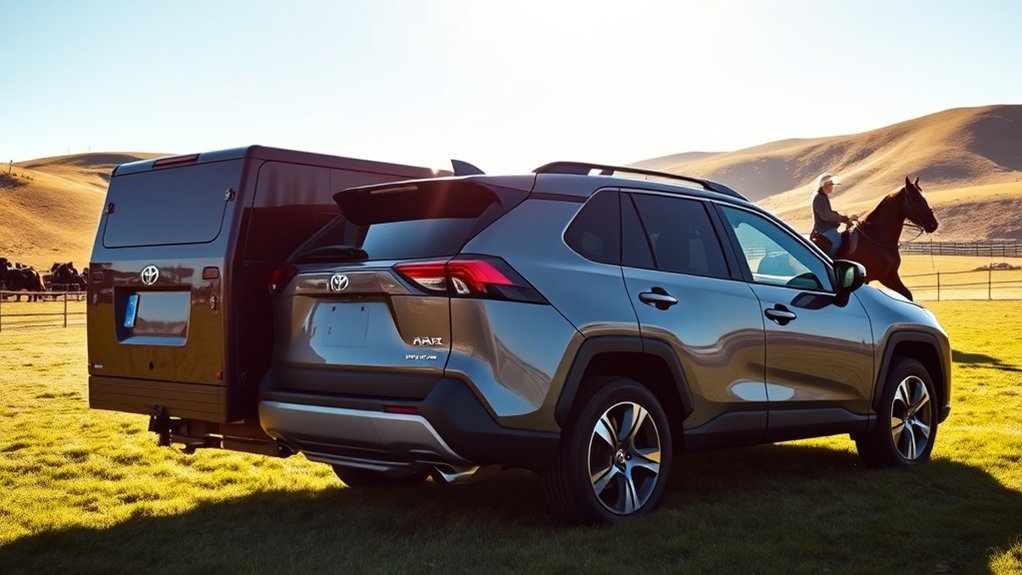
Even a legal combination can feel slow on hills, more affected by wind, and less settled during emergency manoeuvres than the unloaded RAV4. The engine or hybrid system may run at higher output, the transmission may change ratio more often, and fuel or energy use will increase.
A horse can also move during the journey, changing how the trailer feels through the coupling. That is why a short solo test with an empty trailer cannot fully predict how the loaded horsebox will behave.
Being below one published towing figure is not enough. The loaded combination must stay within every vehicle, axle, coupling, trailer, licence, and legal limit.
When Is a RAV4 Not the Right Tow Vehicle?
Choose a more capable tow vehicle when any of these conditions applies:
- The loaded horsebox exceeds, matches, or leaves little practical margin below the RAV4’s approved towing limit.
- The coupling load would overload the payload or rear axle after passengers and gear are added.
- The route includes frequent steep hills, strong crosswinds, rough access roads, or long motorway journeys.
- You regularly carry two horses or a large horse in a heavy trailer.
- The RAV4 lacks the required towing preparation, electrical compatibility, braking support, or approved towbar for the intended setup.
- You cannot confirm the relevant ratings from official documents and plates.
A heavier vehicle with higher manufacturer-approved towing, payload, axle, and combination ratings can provide more operating margin. The replacement vehicle still needs to be correctly matched to the same loaded horsebox.
What Are the Lighter Alternatives for RAV4 Owners?
If your current combination is too heavy, consider a genuinely lighter single-horse trailer, carrying less non-essential equipment, or using professional horse transport. Do not rely on a brand name or an advertised “lightweight” label. Compare the trailer’s verified empty weight, maximum authorised mass, axle rating, and actual loaded scale weight.
A smaller horse or pony can reduce the load, but it does not remove the need to check every rating. Never reduce essential water, safety equipment, partitions, or welfare provisions simply to meet a target weight.
Frequently Asked Questions
Can a 2026 Toyota RAV4 tow a horse trailer?
Potentially. In the United States, Toyota lists 1,750 lb for 2026 FWD RAV4 models and the LE AWD, while selected AWD grades are rated up to 3,500 lb. Other countries publish different figures. A horse trailer is suitable only when its actual loaded weight and every payload, axle, combination, hitch, and trailer limit also pass.
Can a RAV4 tow a single-horse trailer?
Some RAV4 configurations may be able to tow a genuinely lightweight single-horse trailer, but “single horse” does not prove compatibility. Check the trailer’s actual loaded scale weight against the exact RAV4 towing rating, then verify payload, axles, coupling load, towbar rating, trailer brakes, and combination weight.
Which Toyota RAV4 models are best for towing a horsebox?
The best candidate is the exact RAV4 configuration with the highest manufacturer-approved towing, payload, axle, and combination ratings in your market. Do not assume a Hybrid, Plug-in Hybrid, older V6, or all-wheel-drive badge automatically has the highest limit. Verify the handbook and vehicle plate.
Can I tow a horsebox without a towbar or trailer hitch?
No. You need a vehicle-specific, approved towbar or receiver, the correct towball or coupling, and the required electrical and safety connections. The installation must remain within the RAV4’s stated limits.
Does a braked horsebox increase the RAV4’s towing capacity?
No. Trailer brakes may allow you to use the vehicle’s higher braked-trailer rating where one is specified, but they do not increase that published rating. The loaded trailer must still remain within the vehicle, combination, axle, coupling, and trailer limits.
Can a stronger hitch or suspension upgrade raise the towing limit?
No aftermarket hitch, spring, air bag, brake controller, or cooler automatically changes Toyota’s certified towing rating. An accessory may help the vehicle operate within its existing limits, but only approved documentation can establish a different legal rating.
How does load distribution affect towing capacity?
Correct distribution improves stability and helps keep axle and coupling loads within their limits. It does not increase the stated towing capacity. Too little or too much coupling load can make the combination unstable or overload the rear axle, towbar, or trailer coupling.
Does the horse count toward the towing limit?
Yes. The horse, trailer, tack, feed, water, bedding, partitions, tools, and all other trailer contents count toward the loaded trailer weight. Items carried in the RAV4 also affect payload, axle, and combination weight.
How does towing affect RAV4 fuel economy or electric range?
Towing normally increases fuel or electricity use because the vehicle must move more mass and overcome greater aerodynamic drag. The exact reduction depends on speed, terrain, wind, temperature, trailer shape, and load, so plan refuelling or charging stops conservatively.
Conclusion
A Toyota RAV4 can tow a horsebox only when the exact vehicle, towing equipment, and fully loaded trailer are correctly matched. Current 2026 ratings demonstrate why you cannot rely on a single RAV4 capacity: configuration and market can materially change the published limit.
Confirm the handbook and plate figures, weigh the real combination, include coupling load in payload, and check all axle, hitch, trailer, licence, and legal requirements. For many full-size horse-and-trailer combinations, the available margin may be too small or the load may exceed one or more RAV4 ratings. In that case, use a more capable tow vehicle or professional horse transport rather than operating at or beyond a limit.
Sources
- Toyota USA Newsroom: 2026 RAV4 — current U.S. model and towing-capacity information.
- Toyota Owners: Manuals and Warranties — model-specific manuals and towing instructions.
- Toyota Australia: All-New RAV4 — current Australian 2WD and AWD braked towing figures.
- GOV.UK: Towing With a Car — licence entitlement, maximum authorised mass, vehicle weight, and current towing rules in Great Britain.
- Driver and Vehicle Standards Agency: Trailer Safety Checks — coupling, breakaway cable, tyres, lights, weight limits, and driving guidance.
- Ifor Williams Trailers: HBX Horsebox Specifications — manufacturer gross and unladen weights for the HBX403 and other HBX horse trailers.
- GOV.UK: Transporting Horses in Horseboxes and Trailers — official horse-transport and licence guidance.