
If you’re planning a flight with your little one, taking a stroller can make the airport much easier to manage. The key is knowing your airline’s stroller rules before you arrive, because carry-on size limits, gate-check options, and baggage procedures can vary. With the right preparation, you can keep your child comfortable, protect your stroller, and move through check-in, security, boarding, and arrival with fewer surprises.
Quick Answer
Yes, you can usually bring a stroller when flying with a child. Small collapsible strollers may be allowed as carry-on items if they meet the airline’s size rules, while larger strollers are usually checked for free at the ticket counter or gate.
Key Takeaways
- Most airlines allow families to bring a stroller, but the exact size, weight, and carry-on rules depend on the carrier.
- A compact, collapsible stroller is the easiest option for air travel because it is simpler to fold, carry, store, or gate-check.
- Gate checking lets you use the stroller through the airport, while ticket-counter checking may be better for bulky or heavy strollers.
- Before travel, remove loose accessories, add a luggage tag, fold the stroller properly, and consider using a protective travel bag.
- Always confirm your airline’s current stroller policy before your flight, especially for international routes or small aircraft.
At a Glance
| Best Stroller Type | Lightweight, collapsible, compact travel stroller |
| Common Carry-On Goal | A folded size close to standard carry-on limits, often around 22 x 14 x 9 inches, depending on the airline |
| Best Check Method | Gate check for airport convenience; ticket-counter check for bulky strollers |
| Main Preparation Steps | Check airline rules, remove accessories, fold the stroller, add a luggage tag, and use a travel bag when possible |
Understanding Airline Policies for Strollers
When planning air travel with a little one, understanding airline policies for strollers is essential. Most airlines allow parents and caregivers to bring a stroller, but the way the stroller is handled depends on its folded size, weight, design, and the aircraft cabin space available on your route.
Many airlines let you bring a stroller onboard if it meets their standard size limits and is collapsible. In many cases, families aim for a folded size close to typical carry-on dimensions, such as 22 x 14 x 9 inches. Some stroller guidance also refers to dimensions around 22 x 18 x 10 inches, so the safest move is to check your specific airline before packing.
If your stroller exceeds the airline’s carry-on limits, don’t worry. Many airlines allow you to check it for free at the ticket counter or gate. That can be especially helpful if you have a full-size stroller, a jogging stroller, or a travel system frame that is too large for the cabin.
For added convenience, airlines like Delta and Alaska Airlines are often known for family-friendly stroller handling, including gate-checking, so you can use your stroller until just before boarding. Still, stroller regulations vary widely, and aircraft size can affect what is allowed at the gate.
Some carriers may count small, foldable strollers as part of your carry-on allowance, while others treat them as separate child-related items. Before your trip, review the airline’s stroller page, baggage page, or family travel page so you know exactly what to expect.
Note: Airline rules can change, and international flights may follow different stroller size limits than domestic flights. Always check the current policy for every airline in your itinerary, including connecting carriers.
Types of Strollers Allowed on Flights

Understanding the types of strollers allowed on flights can make your travel experience smoother. The easiest stroller to fly with is usually a lightweight, compact, collapsible model that folds quickly and takes up minimal space.
Most airlines permit collapsible strollers as carry-on items only when they fit the airline’s posted carry-on dimensions. These strollers often showcase practical travel features, such as one-hand folding, shoulder straps, storage bags, and narrow frames that are easier to move through airport crowds.
A compact, collapsible stroller gives you the best chance of using it through the airport and avoiding baggage-claim delays after landing.
However, if your stroller exceeds the permitted dimensions or isn’t collapsible, you’ll likely need to gate-check it or check it at the ticket counter, following your airline’s specific stroller policy.
Each airline has different stroller weight limits and handling rules, so it’s essential to verify these before your trip. Some airlines, like Delta and Alaska, may offer free gate-checking, allowing you to use your stroller until you board.
Here are the most common stroller types families bring on flights:
- Umbrella strollers: Lightweight, simple, and easy to fold, but often less supportive for younger babies.
- Compact travel strollers: Designed for airports and city travel, with smaller folded dimensions and better portability.
- Full-size strollers: Comfortable and sturdy, but often too large for cabin storage and better suited for gate check or ticket-counter check.
- Jogging strollers: Useful at your destination, but bulkier and usually better checked in a protective bag.
- Travel system strollers: Helpful when paired with an infant car seat, but the frame and seat may need separate handling depending on the airline.
Preparing Your Stroller for Air Travel
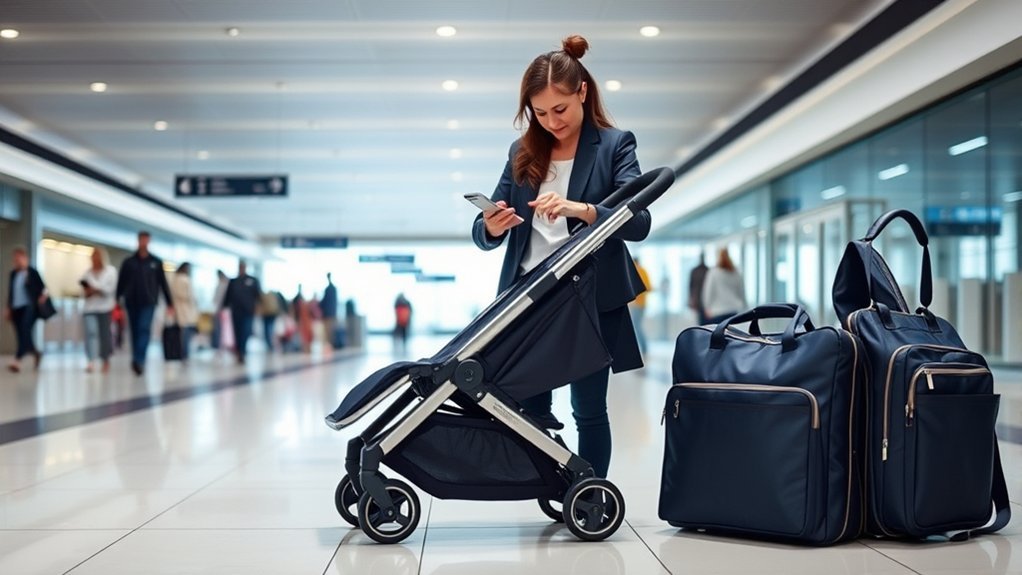
As you prepare for air travel with your stroller, confirm that it meets the airline’s size and weight restrictions. Carry-on stroller limits often follow standard carry-on measurements, such as around 22 x 14 x 9 inches, but some airlines use different stroller-specific limits. Check the exact policy before you leave for the airport.
Start by removing any loose items and stroller accessories. Toys, cup holders, snack trays, fans, hooks, rain covers, and organizers can fall off during screening or baggage handling. A sturdy travel bag can also protect the stroller from dirt, scratches, and loose straps during transit.
| Preparation Step | Details |
|---|---|
| Check Size & Weight | Verify it fits airline requirements |
| Remove Accessories | Clear out loose items and attachments |
| Use a Travel Bag | Protects your stroller during travel |
Don’t forget to attach a luggage tag with your contact information to avoid potential loss, and inform airport staff at check-in if you plan to gate-check the stroller. Familiarize yourself with the airline’s stroller policies for a smooth journey.
Before leaving home, practice folding and unfolding the stroller quickly. Airport staff may ask you to fold it at security, at the gate, or before handing it over. If your stroller has a lock, latch, or removable wheel, make sure every part is secure.
Pro Tip: Take a quick photo of your stroller before handing it to airline staff. If it is delayed or damaged, the photo can help you describe the model, color, condition, and any missing parts.
Getting Through Airport Security With a Stroller
Security screening is easier when your stroller is already organized. Remove your child, take out bags and loose items, and fold the stroller when asked. Smaller strollers may go through the X-ray machine, while larger strollers may need a separate inspection.
Keep baby essentials in a separate diaper bag or carry-on so you are not digging through the stroller basket at the checkpoint. If you are traveling with bottles, formula, breast milk, snacks, medications, or baby care items, keep them easy to access in case screening officers need to inspect them.
- Remove your child from the stroller before screening.
- Empty the stroller basket before reaching the conveyor belt.
- Fold the stroller before placing it on the belt, if it fits.
- Ask for help if the stroller is too large to lift safely.
- Recheck the stroller after screening to make sure no straps, wheels, or accessories are loose.
Warning: Never leave your child seated in the stroller while folding it, moving it onto a security belt, or handing it to airline staff. Remove your child first and lock the stroller only after it is clear.
Gate Checking vs. Checking at the Ticket Counter

How do you decide between gate checking your stroller and checking it at the ticket counter? The best choice depends on your child’s age, how far you need to walk, how much luggage you have, and how bulky your stroller is.
Gate checking offers the convenience of using your stroller until you board the plane, making it easier to navigate the airport with kids in tow. This is often the best choice for toddlers, long layovers, large terminals, or late-night flights when your child may need a place to rest.
Plus, once you land, you’ll typically get your stroller back near the aircraft door or jet bridge, saving you from the baggage claim hassle. In some airports, however, gate-checked items may be returned at baggage claim instead, so ask the gate agent what to expect.
On the other hand, checking at the ticket counter requires leaving your stroller with airline staff earlier. This may result in a longer wait post-flight as it goes through baggage handling, but it can be a smart choice for large strollers, jogging strollers, double strollers, or travel systems that are difficult to carry through the airport.
| Option | Best For | Main Trade-Off |
|---|---|---|
| Gate Check | Using the stroller through the airport until boarding | You may need to fold and hand it over quickly at the aircraft door |
| Ticket Counter Check | Large, heavy, or bulky strollers | You lose access to the stroller before security and may wait at baggage claim |
| Carry On | Very compact foldable travel strollers that meet airline size rules | Cabin space is limited and final approval may depend on staff and aircraft size |
Tips for Managing Your Stroller at the Airport
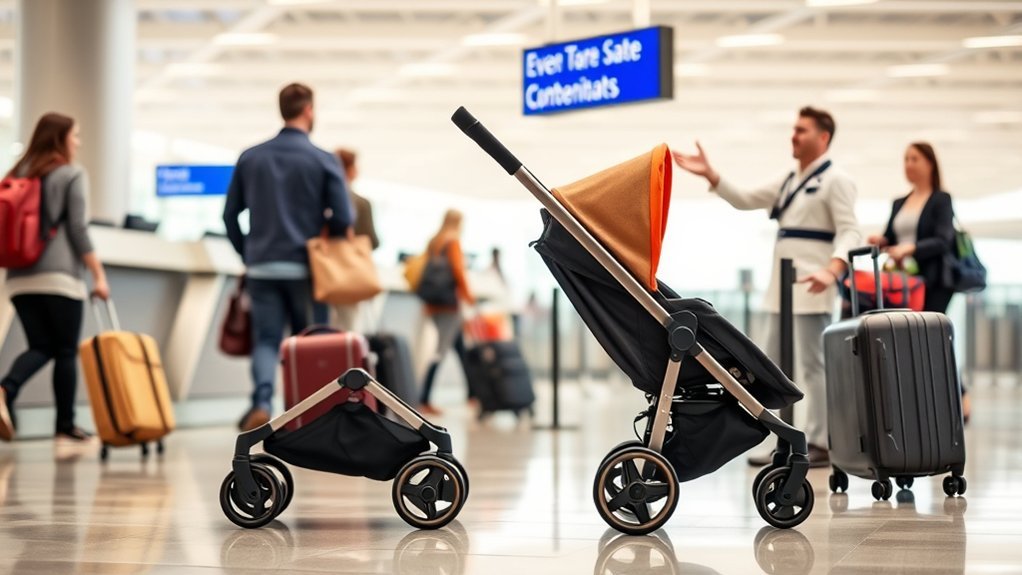
Managing your stroller at the airport can make a world of difference in your travel experience. Here are some essential travel tips to keep in mind:
| Tip | Description |
|---|---|
| Remove Loose Accessories | Take off any stroller accessories to prevent loss. |
| Use a Travel Bag | Protect your stroller during transit and keep it clean. |
| Check Airline Policies | Confirm size restrictions on your specific airline. |
| Arrive Early | Give yourself time to navigate security and get help. |
| Gate Check or Ticket Check | Decide which method suits your needs best. |
Arriving early matters because family travel usually takes extra time. You may need time to print a gate-check tag, fold the stroller at security, handle diaper changes, feed your child, or find the right boarding lane.
If you are traveling with another adult, divide tasks before reaching security. One person can handle the child while the other folds the stroller and manages bags. If you are flying solo, keep your carry-on load light and use a stroller that folds with one hand whenever possible.
- Place your gate-check tag where it is easy for airline staff to see.
- Keep the stroller basket empty before security and boarding.
- Use a stroller bag if your stroller has delicate fabric, exposed wheels, or removable parts.
- Carry a baby carrier as a backup in case your stroller is checked earlier than expected.
- Ask the gate agent where the stroller will be returned after landing.
Benefits of Traveling With a Stroller

Traveling with a stroller truly enhances your mobility at the airport, making it easier to navigate through crowds while keeping your child secure. It can also give your child a familiar place to sit, nap, snack, or take a break when the terminal gets busy.
It also provides a comfortable spot for your little one to rest, reducing any fussiness during long waits. This can be especially helpful during delays, layovers, early departures, and late arrivals.
Plus, using a familiar stroller can help ease anxiety, creating a smoother travel experience for both of you. Instead of carrying your child across long terminals, you can save your energy for boarding, baggage, and the rest of the trip.
Enhanced Mobility in Airports
While maneuvering the bustling corridors of an airport can be an intimidating task, having a stroller at your side makes the experience considerably smoother.
With a stroller, you can navigate the crowds with ease, keeping your child secure and close. Here are some benefits of using a stroller during your travels:
- Convenient resting spot for toddlers during long waits
- Lightweight and compact designs simplify airport navigation
- Gate-checking options mean no extra baggage fees
- Familiarity can ease children’s irritability in unfamiliar settings
- Reduces stress for both parents and little ones
With these stroller features, you can focus more on enjoying your journey, embracing the freedom that comes with enhanced mobility in busy airport environments.
Child Comfort and Safety
Having a stroller not only enhances your mobility in the airport but also greatly contributes to your child’s comfort and safety during travel.
With a familiar space to rest, your little one can relax during long waits or layovers, reducing stress for both of you. Strollers give you better control over your child’s safety as you navigate crowded terminals, allowing you to focus on managing your luggage.
Plus, using your own stroller helps keep your child in a familiar and cleaner space, minimizing contact with shared rental equipment. Lightweight and compact options can be easier to stow, carry, or gate-check, improving travel comfort from check-in to arrival.
Familiarity Reduces Irritability
When you bring along a familiar stroller, your child instantly feels more secure, which can greatly reduce anxiety and irritability during your journey. This personal touch creates a comforting space amid unfamiliar environments, making adjustments smoother.
- Familiar strollers help maintain your child’s routine, easing stress for both of you.
- They often include features designed for comfort, like cozy seating and storage for favorite toys.
- Children are less likely to resist changes when nestled in their known stroller.
- A personal stroller supports a clean, familiar space, easing concerns about shared equipment.
- Familiarity fosters a sense of adventure, allowing your child to explore new places with confidence.
Traveling with a stroller can truly transform your experience, especially when your child still needs naps, breaks, or help moving through long terminals.
Recommended Strollers for Air Travel

When you’re planning air travel with your little one, choosing the right stroller can make all the difference. A travel-friendly stroller should fold compactly, feel light enough to carry, roll smoothly through terminals, and stay sturdy enough for everyday use at your destination.
Lightweight options like the Mompush Lithe V2 and compact models such as the TernX Carry On not only aim to meet common airline carry-on guidelines but also support hassle-free maneuverability in crowded airports.
Before buying or packing any stroller, compare the folded dimensions with your specific airline’s current policy. Even if a stroller is marketed as travel-ready, final cabin approval can depend on the airline, aircraft, gate staff, and available overhead bin space.
Lightweight Travel Stroller Options
Traveling with little ones can be a breeze when you choose the right lightweight stroller. These strollers are designed for travel convenience, making airport navigation smoother.
Here are some top picks to take into account:
- TernX Carry On: Folds to 22 x 14 x 9 inches and weighs about 17 lbs.
- Mompush Lithe V2: Known for its lightweight design and easy folding mechanism.
- Compact Size: Most airlines accept collapsible strollers as carry-ons only when they meet that airline’s size rules, ensuring easier transport.
- Gate-checking: Check specific airline policies for free gate-check options.
- Travel Bag: Investing in a travel bag protects your stroller during transit.
With these stroller features, you’ll enjoy freedom and flexibility while exploring new places with your little ones.
Compact Stroller Specifications
Choosing the right compact stroller can greatly enhance your air travel experience, especially for parents on the go. Lightweight, foldable strollers like the TernX Carry On and Mompush Lithe V2 are designed for convenience and ease of maneuvering through busy airports. Here’s a quick comparison of some recommended models:
| Stroller Model | Folded Dimensions (inches) | Stroller Weight (lbs) |
|---|---|---|
| TernX Carry On | 22 x 14 x 9 | 17 |
| Mompush Lithe V2 | 21 x 12 x 8 | 15 |
| Babyzen Yoyo 2 | 20.5 x 17 x 7 | 13 |
| Chicco Bravo Quick-Fold | 23 x 18 x 10 | 16 |
Always verify your airline’s stroller size and weight guidelines to avoid surprises at the gate. Also confirm the manufacturer’s current folded dimensions, because model updates and accessories can change the final size.
Airline Carry-On Guidelines
How can you guarantee a smooth travel experience with your stroller? Understanding airline carry-on guidelines and stroller regulations is key.
Here are some tips to help you navigate airline restrictions:
- Choose a collapsible stroller, like the TernX Carry On, with dimensions close to common carry-on limits such as 22 x 14 x 9 inches.
- Verify specific airline policies beforehand to avoid surprises.
- Gate-check small strollers with airlines like Delta and Alaska for convenience when the airline allows it.
- Remove loose items from the stroller to streamline security checks.
- Use a protective travel bag to keep your stroller safe during transit.
With the right preparation, you can enhance your travel experience, ensuring your little one stays comfortable and you remain stress-free.
What to Do if Your Stroller Is Lost, Delayed, or Damaged
Even with careful preparation, strollers can sometimes be delayed, misplaced, or damaged during travel. If your stroller does not appear where airline staff told you to collect it, ask a gate agent or baggage service desk before leaving the airport.
If the stroller is damaged, report it immediately. Take photos, keep your baggage tags, and ask for a written damage report or claim reference number. Waiting until after you leave the airport can make the claim harder to prove.
- Check the stroller before leaving the gate area or baggage claim.
- Look for missing wheels, bent frames, torn fabric, broken brakes, or damaged folding locks.
- Keep the gate-check tag or baggage tag until the issue is resolved.
- File a report with the airline as soon as possible.
- Ask whether the airline offers a temporary replacement or reimbursement process.
Frequently Asked Questions
Can I use my stroller during layovers?
Yes, you can usually use your stroller during layovers if it was returned to you after the first flight or if you carried it onboard. Stroller security policies vary by airport, so keep the stroller easy to fold and ask airline staff where it will be returned during connections.
What should I do if my stroller is damaged?
If your stroller is damaged, report it to the airline before leaving the airport. Take photos, keep your baggage or gate-check tag, and ask for a claim number. Then check whether your stroller insurance, travel insurance, credit card benefits, or airline baggage policy offers coverage or repair options.
Are there size restrictions for collapsible strollers?
Yes, there are size restrictions for collapsible strollers. Many airlines require a stroller to meet carry-on-style dimensions if you want to bring it into the cabin. Larger collapsible strollers may still be allowed as gate-checked or ticket-counter-checked items.
Can I rent a stroller at the airport?
Some airports, family lounges, theme-destination airports, and nearby rental services may offer stroller rentals, but availability is not guaranteed. Rental fees can vary, and not every terminal provides this service. If you need a stroller immediately after landing, bringing your own is usually safer.
Do airlines provide any stroller accessories during travel?
Most airlines don’t provide stroller accessories during travel. Bring your own travel bag, rain cover, cup holder, organizer, or stroller fan if you need them. Remove loose accessories before checking the stroller so they do not fall off or get damaged.
Is it better to gate-check or carry on a stroller?
Gate checking is often better if you want to use the stroller through the airport. Carrying it onboard is only realistic when the stroller is very compact and allowed by your airline. For bulky models, ticket-counter checking may be easier.
Conclusion
To sum up, traveling with a stroller can be a breeze if you know the rules. Just like a knight wouldn’t head into battle without their armor, you shouldn’t set out on your journey without checking airline policies and preparing your stroller. Whether you gate check, check it at the ticket counter, or carry on a compact model, a little planning goes a long way.
Before you leave, confirm the airline’s stroller size limits, remove loose accessories, attach a luggage tag, and decide where you want to check the stroller. So pack your bags, grab that stroller, and make your adventure as smooth as a buttered biscuit. Safe travels!
