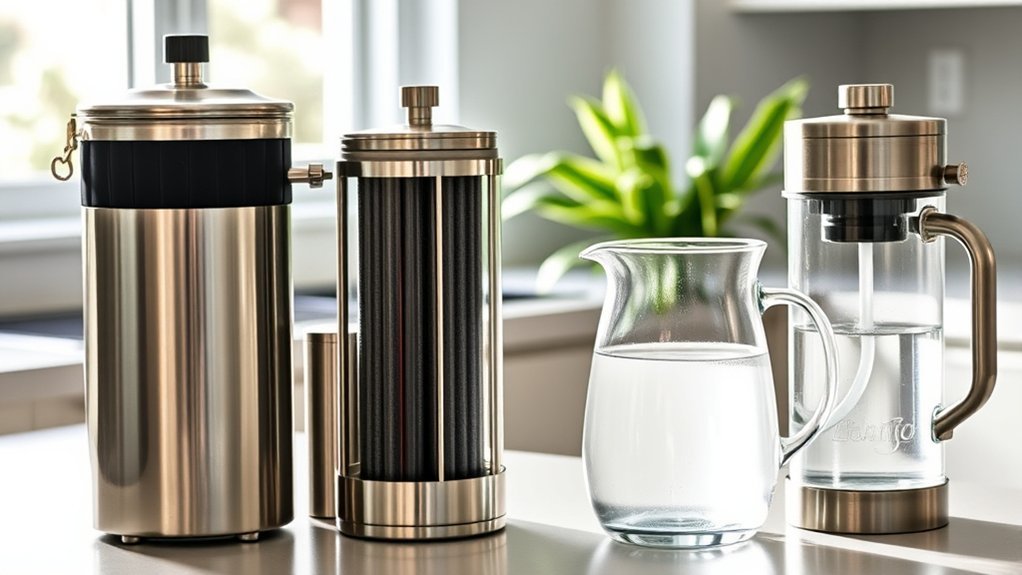
Choosing between Berkey vs Doulton water filters involves more than comparing two stainless steel containers. Both use gravity to filter drinking water without electricity, but their filter materials, certifications, replacement schedules, and availability differ. Understanding those differences helps you choose a system that addresses your water quality concerns rather than relying on broad purification claims.
Quick Answer
Doulton British Berkefeld uses ceramic gravity filters with independently certified reduction claims. Berkey uses proprietary composite elements with a higher advertised filtration capacity but no equivalent NSF performance certification for Black Berkey elements. Doulton recommends replacement every six months, while Berkey specifies 3,000 gallons per element. The right choice depends on water quality, verified performance, availability, and maintenance costs.
Last checked: September 26, 2026. Key specifications, certification claims, and regulatory developments were reviewed against manufacturer information, NSF listings, and public records.
Top Advantages of Doulton British Berkefeld Water Filters
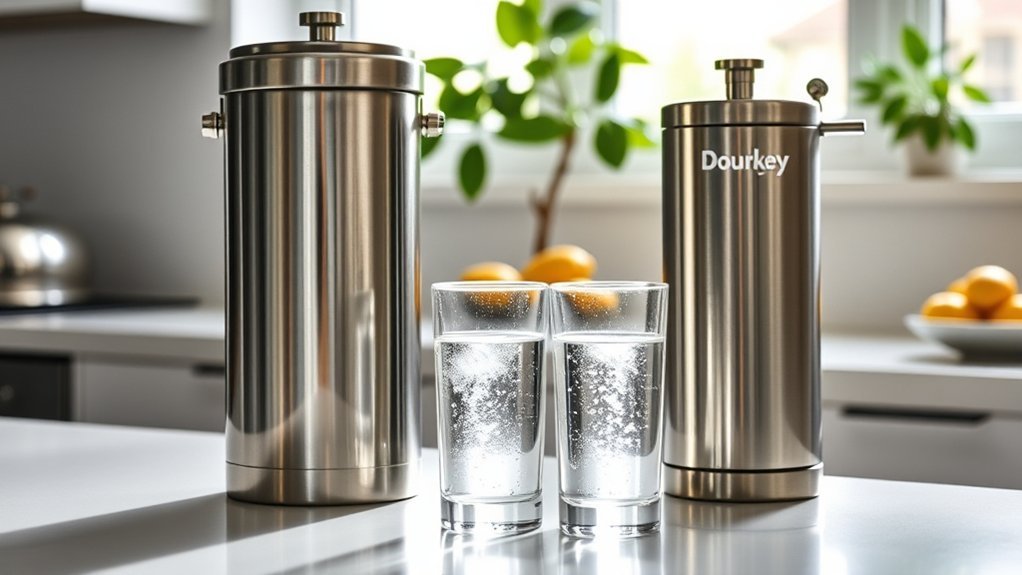
Doulton British Berkefeld water filters combine a porous ceramic shell with additional filtration media. The design targets particles, microorganisms, and selected chemical contaminants while operating entirely through gravity.
The main advantage is the availability of independent certification for specific filtration claims, rather than relying only on the manufacturer’s laboratory reports.
What Makes Ultra Sterasyl Filters Different?
Ultra Sterasyl candles contain a ceramic microfilter, activated carbon, and lead-reduction media. Each layer addresses a different part of the filtration process.
- Ceramic shell: Physically traps fine particles and helps reduce microorganisms.
- Activated carbon: Targets chlorine and certain organic substances that affect taste and odor.
- Additional filtration media: Supports the manufacturer’s stated heavy-metal reduction performance.
Doulton’s published gravity filter performance data reports more than 99% free-chlorine reduction for Ultra Sterasyl under its specified test conditions.
The manufacturer also publishes test results for bacteria, cysts, lead, and selected organic contaminants. However, a manufacturer’s test result should not automatically be treated as an NSF-certified claim.
Which NSF Certifications Does Doulton Have?
The British Berkefeld Ultra Sterasyl system appears in the official NSF listings under several standards.
- NSF/ANSI 42: Nominal particulate reduction, Class I.
- NSF/ANSI 53: Cyst reduction and turbidity reduction.
- NSF/ANSI 401: Microplastics reduction.
- NSF/ANSI/CAN 372: Compliance with lead-content requirements for applicable components.
These claims can be checked in the official NSF Ultra Sterasyl certification listing.
Certification applies to the listed models and contaminant claims. For example, certification under NSF/ANSI 53 does not mean every contaminant covered by that standard has been certified for removal by this particular filter.
Filter Life and Available Options
Doulton recommends replacing Ultra Sterasyl candles every six months. Cleaning the ceramic surface can restore flow when sediment builds up, but it does not reset the filter’s replacement schedule.
Some product descriptions cite a capacity of up to 800 gallons per candle. However, Doulton’s current gravity-filter specifications emphasize the six-month replacement period, and the NSF listing does not provide an equivalent rated gallon service cycle for the mechanical filtration claims.
British Berkefeld also offers Ultra Fluoride candles for households specifically interested in fluoride reduction.
These are different products. Standard Ultra Sterasyl candles are not the same as Ultra Fluoride candles, and Doulton advises against mixing the two types within one gravity system because doing so can affect performance.
Unique Benefits of Berkey Water Filters
Berkey water filters use a proprietary composite filtration medium inside reusable stainless steel gravity systems. Their design emphasizes substantial filtration capacity, convenient countertop use, and the ability to increase output by installing additional filter elements.
Berkey also publishes independent laboratory testing for its contaminant-reduction claims. However, independent testing and formal NSF product certification are different forms of evidence.
How Do Black Berkey Elements Work?
Black Berkey elements use a proprietary combination of filtration materials, including activated carbon and other media.
The manufacturer reports reductions in various contaminants, including selected heavy metals, organic chemicals, and substances that affect taste and odor.
Because the complete formulation is proprietary, buyers cannot directly compare every component with the materials used in Doulton’s ceramic candles.
Filtration Capacity and Flow Rate
Berkey systems can accommodate different numbers of filtration elements, depending on the model. Adding more elements increases the amount of water the system can process.
For example, the manufacturer’s system specifications list the Big Berkey with a 2.25-gallon storage capacity and a maximum advertised output of 7 gallons per hour when fully configured.
That maximum should not be mistaken for the guaranteed output of a standard two-element system.
Actual filtration speed depends on the number of elements, water level, initial conditioning, and filter condition.
How Long Do Black Berkey Elements Last?
Berkey recommends replacing each Black Berkey element after approximately 3,000 gallons. A pair therefore has a combined advertised capacity of 6,000 gallons.
This is a capacity-based recommendation rather than a universal annual replacement requirement.
For households using relatively little water, the advertised capacity may represent a longer period. Heavy use or poor incoming water quality can shorten the practical replacement interval.
The manufacturer advises earlier replacement when water conditions require it.
Comparing Water Filter Technologies: Doulton vs. Berkey
The main difference between Doulton and Berkey is how their filtration systems are constructed and how their performance claims are verified. Doulton combines ceramic filtration with additional media, while Berkey uses proprietary composite elements.
Both systems operate without electricity or permanent plumbing.
| Feature | Doulton British Berkefeld | Berkey |
|---|---|---|
| Primary filtration technology | Ceramic microfilter with carbon and additional media | Proprietary composite filtration elements |
| Gravity operation | Yes | Yes |
| NSF performance certification | Certified for specific claims under NSF/ANSI 42, 53, and 401 | Black Berkey elements do not hold equivalent NSF performance certification |
| Filter replacement | Every six months | 3,000 gallons per element; sooner if necessary |
| Filtration rate | Typical published rate of approximately 1 liter per hour per candle | Depends on model and number of elements |
| Fluoride option | Separate Ultra Fluoride candle | Separate PF-2 post-filter option |
| Maintenance | Condition and clean ceramic candles as directed | Prime and clean composite elements as directed |
| Original advertised price range | Approximately £114–£240, depending on configuration | Generally higher in the original comparison; current pricing varies |
Does NSF Certification Mean a Filter Removes Everything?
No. A certification verifies specified performance claims for a particular product or configuration.
A filter certified for cyst reduction does not automatically have certified performance against lead, fluoride, viruses, or every other contaminant.
Likewise, a product without NSF certification is not automatically ineffective. The distinction is that its performance has not been established through that specific certification process.
When assessing either system, match the contaminant you need reduced with the relevant test report or certification listing.
Which Filter Is Faster?
Berkey’s composite filtration design generally allows faster filtration than Doulton’s ceramic candles under comparable conditions. However, system size and the number of installed elements matter.
Doulton publishes a typical flow rate of approximately 1 liter per hour per Ultra Sterasyl candle.
Ceramic flow can be slow when the candles are new or insufficiently conditioned. Sediment buildup can also reduce output over time.
For either brand, compare the actual configuration rather than relying on a manufacturer’s maximum system capacity.
What About Fluoride, Lead, and PFAS?
Different contaminants require different evidence.
- Fluoride: Doulton offers Ultra Fluoride candles, while Berkey offers separate PF-2 elements. Standard Ultra Sterasyl candles are not intended as a fluoride-reduction solution.
- Lead: Doulton publishes lead-reduction test data, but the Ultra Sterasyl NSF/ANSI 53 listing does not establish a certified lead-reduction claim for that gravity configuration.
- PFAS: Doulton publishes reduction data for combined PFOA and PFOS. These manufacturer-reported results should not be confused with an independently certified PFAS reduction claim.
- Bacteria and cysts: Doulton publishes microbial test results and has specific NSF cyst-reduction certification. That does not establish universal protection from every pathogen.
The filter’s actual test conditions, capacity, and certified claims matter more than a broad statement that it removes hundreds of contaminants.
Warning: Do not assume either gravity system makes every untreated water source safe. During a boil-water advisory, follow local health guidance even if you use a household filter. Water containing suspected toxic chemicals may require a different source rather than additional filtration.
Cost Analysis: How to Choose the Right Water Filter for Your Needs
The true cost of a gravity water filter includes the stainless steel housing, replacement elements, and any additional fluoride filters or accessories.
Initial purchase price alone can be misleading because the two brands use different replacement schedules.
What Does a British Berkefeld System Cost?
The original comparison placed British Berkefeld systems between approximately £114 and £240, depending on model and configuration.
For a more specific reference, Doulton’s listed price for a 6-liter British Berkefeld system with two Ultra Sterasyl candles was £161.95 at the time of review.
Larger systems and additional filter elements increase the initial expense.
The amount of replacement media also matters. A household using four candles must budget for four replacements at each scheduled change, rather than two.
How Do Replacement Costs Compare?
Doulton lists Ultra Sterasyl replacement candles from £23.95 each and Ultra Fluoride candles from £43.95 each in its replacement-filter information.
Actual prices depend on the selected pack, product variant, retailer, and any applicable discounts.
Berkey’s published replacement guidance specifies 3,000 gallons per Black Berkey element, or 6,000 gallons per pair.
Its official replacement recommendation also states that incoming water quality can require earlier replacement.
Unlike a simple 12-month estimate, a capacity-based calculation requires you to consider your household’s water use.
How Should You Calculate Long-Term Value?
Use the same ownership period for both systems and include the cost of every replacement element required during that period.
For example, a household spending $360 annually on bottled water could compare that expense with the purchase and maintenance costs of a gravity system.
That bottled-water figure is an illustration, not a verified national household average. Actual savings depend on consumption, local prices, and replacement costs.
Also account for the availability of genuine replacement filters. An inexpensive housing offers limited value if its compatible elements are difficult to obtain.
Comparing Maintenance and Taste
Both Doulton and Berkey require regular cleaning, correct initial preparation, and timely filter replacement. Neither is a maintenance-free system.
For everyday drinking water, both can improve taste by reducing substances such as chlorine, although the precise performance depends on the installed filter.
Maintaining Doulton Ceramic Filters
Doulton’s ceramic candles require conditioning before regular use. As the ceramic becomes fully wetted, water can pass through more consistently.
If filtration slows noticeably, sediment may have accumulated on the ceramic surface.
Follow the manufacturer’s cleaning instructions to remove surface buildup without damaging the candle.
Replace the elements on the recommended six-month schedule. Cleaning can restore flow, but it cannot restore exhausted chemical-removal media.
Maintaining Black Berkey Elements
Black Berkey elements require priming to remove trapped air from the filtration medium.
Improper priming can cause unusually slow filtration even when the elements are new.
During routine maintenance, follow the manufacturer’s instructions for cleaning the element surface and checking that the system is assembled correctly.
Do not assume that improved flow after cleaning means the filter has regained its original contaminant-reduction capacity.
Which System Produces Better-Tasting Water?
Both systems can improve the taste and smell of chlorinated water.
Doulton users often describe a fresher taste after chlorine reduction, while Berkey users also report improvements in everyday drinking water.
However, taste is subjective. It cannot establish whether a filter has successfully reduced harmful contaminants.
The CDC’s guidance on choosing home water filters explains why water testing and contaminant-specific performance matter more than appearance, taste, or smell.
Which Option Creates Less Waste?
Doulton uses ceramic candles with a defined replacement schedule, while Berkey advertises a substantially higher capacity for each Black Berkey element.
A longer service life may reduce how often replacement cartridges are discarded, but overall environmental impact also depends on materials, packaging, shipping, and actual usage.
Neither filter’s environmental performance can be established from replacement frequency alone.
Berkey’s EPA Regulatory Status and Legal Developments
Berkey’s regulatory dispute is a separate issue from the comparison of filtration performance. It concerns how certain Black Berkey products are classified and regulated under US pesticide law.
The dispute should not be described simply as proof that the filters are ineffective or unsafe.
Why Did the EPA Issue a Stop-Sale Order?
The EPA issued enforcement orders involving Black Berkey filters after examining products containing silver and associated microorganism-reduction claims.
The agency determined that the products were subject to requirements under the Federal Insecticide, Fungicide, and Rodenticide Act, commonly called FIFRA.
An EPA enforcement record documents the May 8, 2023 stop-sale order involving Berkey International LLC.
Berkey disputed the agency’s interpretation and argued that its products qualified for regulatory exemptions.
What Happened in the September 2026 Court Ruling?
On September 18, 2026, the US Court of Appeals for the First Circuit affirmed a district court decision denying Berkey International preliminary injunctive relief.
The appellate court concluded that Berkey had not established the required likelihood of success for that preliminary request.
The decision addressed the EPA’s authority and the available administrative record. It did not resolve every underlying dispute through a final trial judgment.
The full reasoning appears in Berkey International, LLC v. Environmental Protection Agency, No. 24-1917.
The practical issue for consumers is replacement-element availability. An existing stainless steel housing may remain usable with compatible elements, but buyers should distinguish genuine Black Berkey products from alternative replacements.
Can British Berkefeld Filters Fit a Berkey Housing?
Yes. Doulton identifies several Berkey gravity systems as compatible with British Berkefeld replacement candles.
However, compatibility depends on the exact housing, filter type, and installation requirements.
This provides an alternative for owners who want to retain a stainless steel gravity housing while changing their filtration elements.
Do not assume that installing a different brand’s filters preserves the original system’s performance claims. The installed configuration must be assessed on its own merits.
Frequently Asked Questions
Which Is Better, Berkey or British Berkefeld?
The better match depends on your water quality, maintenance preferences, and the evidence you require. British Berkefeld provides NSF certification for specific contaminant-reduction claims and uses replaceable ceramic candles. Berkey offers high advertised element capacity and configurable gravity systems. Compare the exact filtration claims and replacement costs before choosing.
Why Were Berkey Filters Discontinued?
Certain Black Berkey products faced US stop-sale orders connected to EPA regulation of products containing silver and making microorganism-related claims. This affected manufacturing and distribution of the elements. It does not mean every Berkey housing or accessory was permanently discontinued, and the regulatory dispute should not be confused with a finding that every product is unsafe.
How Long Do British Berkefeld Water Filters Last?
British Berkefeld recommends replacing Ultra Sterasyl and Ultra Fluoride candles every six months under normal household use. Incoming water quality and maintenance can affect flow and practical performance. Cleaning the ceramic surface may improve filtration speed, but it does not extend the manufacturer’s recommended replacement interval.
What Is the Current Status of the Berkey Water Filter Lawsuit in 2026?
On September 18, 2026, the First Circuit affirmed the denial of preliminary injunctive relief in Berkey International’s challenge to the EPA. The decision addressed the preliminary injunction rather than delivering a final judgment on every underlying claim. The regulatory dispute therefore requires careful distinction between court rulings, enforcement orders, and the status of individual products.
Are Doulton and Berkey the Same Company?
No. British Berkefeld is part of the Doulton water-filter business, while Berkey is a separate brand associated with New Millennium Concepts. Their gravity systems share some design similarities, and certain replacement elements are compatible, but the brands use different filtration technologies and performance documentation.
Does Doulton Remove Fluoride?
Doulton offers dedicated Ultra Fluoride candles designed for fluoride reduction. Standard Ultra Sterasyl candles are not the equivalent product. Check the exact filter model and its documented performance rather than assuming every British Berkefeld system provides fluoride reduction.
Can I Use Doulton Filters in My Berkey System?
Yes, selected British Berkefeld gravity-filter candles are compatible with several Berkey stainless steel systems. Confirm the exact housing and filter model before purchasing. Compatibility alone does not establish the contaminant-reduction performance of every possible combination.
Conclusion
Both Doulton British Berkefeld and Berkey provide gravity-fed filtration without plumbing or electricity, but their strengths and limitations differ.
Doulton offers ceramic filtration with specific NSF-certified performance claims and a six-month replacement schedule. Berkey offers proprietary composite elements with substantial advertised capacity, although certification and replacement availability require closer attention.
Before purchasing, identify the contaminants in your water, compare the documented reduction claims, and calculate the cost of maintaining your chosen configuration.
If you already own a Berkey housing, checking compatible British Berkefeld candles may also help you continue using the existing system without replacing the entire stainless steel container.
Sources
- Doulton Water Filters — Technical Test Data: Gravity-filter specifications, contaminant-reduction results, flow rates, and replacement guidance.
- NSF International — Ultra Sterasyl Certification Listings: Verified product-specific certification standards and reduction claims.
- Doulton — British Berkefeld Gravity System: System configurations, product pricing, and replacement information.
- Berkey Water Systems — System Specifications: Housing capacity, available configurations, and advertised maximum filtration output.
- Berkey Water Systems — Filter Lifespan: Manufacturer replacement-capacity recommendations.
- Doulton — Replacement Filter Identification: Replacement pricing, filter identification, and compatibility information.
- CDC — About Choosing Home Water Filters: Water testing, filtration limitations, certification, and maintenance guidance.
- US Environmental Protection Agency — Berkey Enforcement Record: May 2023 stop-sale order.
- US Court of Appeals for the First Circuit — Berkey International v. EPA: September 18, 2026 appellate decision concerning preliminary injunctive relief.
